Cold brew is coffee extracted with cold or room-temperature water, while iced coffee usually means coffee brewed hot and then chilled. Japanese iced coffee, also called flash brew, is brewed hot directly onto ice: choose it when you want a freshly made cold drink without an overnight wait.
In short
- Brewing temperature defines cold brew, not whether the finished drink contains ice.
- Japanese iced coffee counts ice as part of the recipe’s water, rather than adding it to a full-strength hot brew.
- Cold brew can taste less bitter and sour, but “less acidic” needs qualification: pH, titratable acidity and perceived sourness are different measurements.
- Cold brew is not automatically stronger or higher in caffeine. Dose, extraction, dilution and serving size matter.
- For the flash-brew method below, use 22 g coffee, 200 g hot water and 130 g ice, a total coffee-to-water ratio of 1:15 by weight.
What is the difference between cold brew and iced coffee?
The simplest distinction is what happens before the coffee becomes cold.
Cold brew uses unheated water to extract coffee. In the common immersion method, grounds remain submerged before being filtered out. The result may be ready to drink or a concentrate that needs dilution. Our cold brew guide covers that method in detail.
Conventional iced coffee starts as hot-brewed coffee, which is cooled and served over ice. Here, that means coffee cooled separately before serving, rather than brewed directly onto the ice.
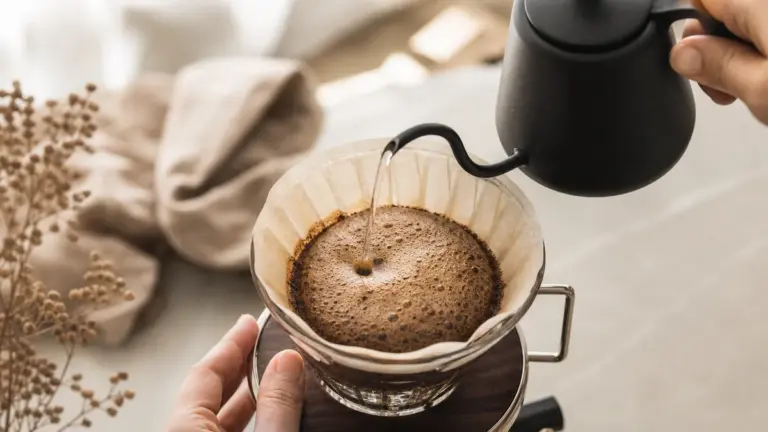
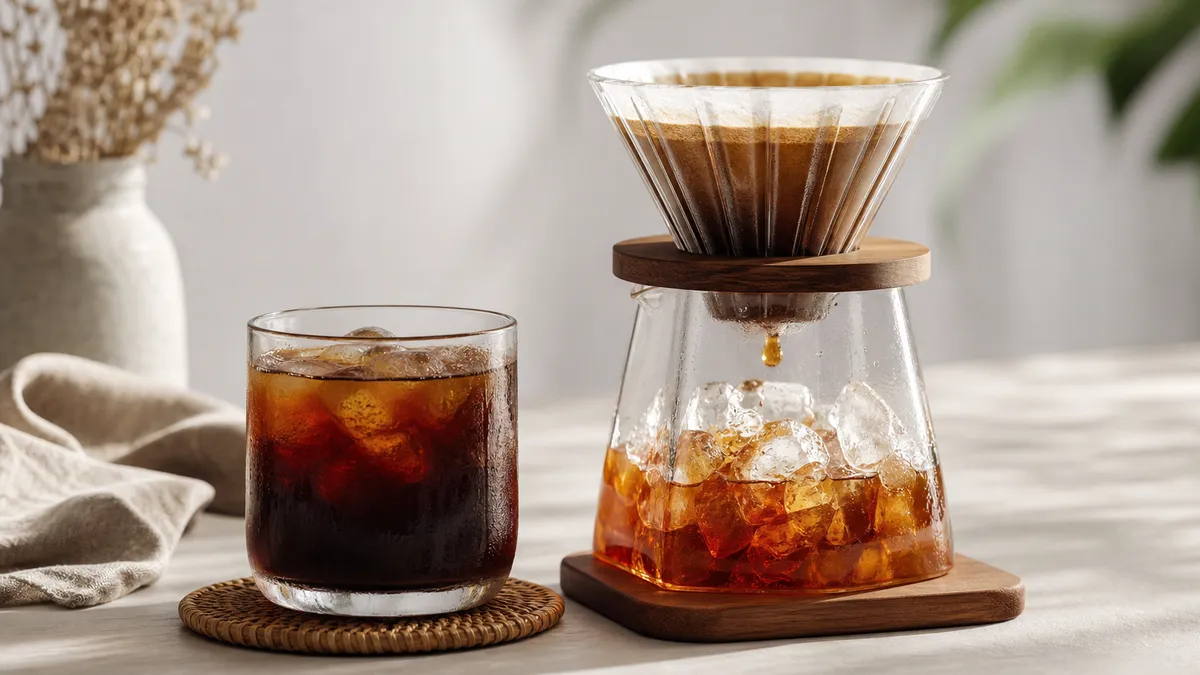
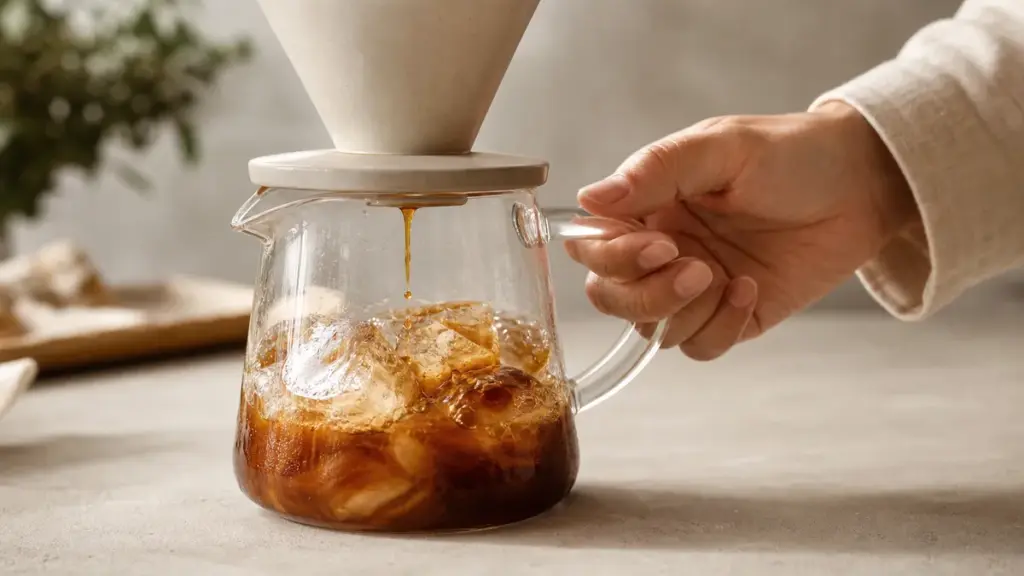
Japanese iced coffee is a particular hot-brewed iced method. A concentrated pour-over drips onto a measured quantity of ice, cooling and diluting it together.
The terminology is not perfectly tidy. “Iced coffee” describes a serving style as well as a family of methods, so ask how a drink was brewed if the distinction matters to you. Cold brew poured over ice remains cold brew.
For the wider distinction between immersion and water flowing through a coffee bed, see brewing methods.
Cold Brew vs. Japanese Iced Coffee
The comparison below uses five practical criteria: extraction method, waiting time, flavour direction, dilution control and suitability. Flavour descriptions are tendencies, not guarantees, and the suggested uses are editorial judgements based on those differences.
| Criterion | Cold brew | Conventional iced coffee | Japanese iced coffee |
|---|---|---|---|
| Extraction | Unheated-water steeping, then filtering | Hot brewing, followed by separate cooling | Hot brewing directly onto measured ice |
| Time | Recipe-dependent, usually planned ahead; OXO specifies 20 to 24 hours refrigerated for its compact brewer | Brewing time plus cooling | Ready after brewing; the recipe below targets about 2 minutes |
| Flavour direction | Can taste less bitter and sour than comparable hot-extracted coffee | Depends on the original brew and subsequent dilution | A useful choice for a lively, freshly brewed filter-style drink |
| Dilution control | Measure any water or milk added to concentrate | Account for serving ice rather than adding it without adjustment | Include the brewing ice in the total water allowance |
| Best suited to | Preparing a batch ahead | Using an existing hot-coffee routine with a planned cooling stage | Making a cold coffee to drink now |
Japanese iced coffee’s main practical advantage is immediacy. You finish brewing with a cold drink, rather than needing a separate cooling stage.
Cold brew’s advantage is a different workflow: prepare it ahead, filter it and serve portions later. Its disadvantage is the wait, along with the need to distinguish concentrate from drinking-strength coffee.
Neither method deserves an automatic flavour crown. If you enjoy a coffee’s brisk fruit character when brewed hot, flash brew is a sensible first experiment. If you prefer a less sour-tasting result, cold brew is worth comparing with the same beans.
How extraction changes flavour
Extraction means dissolving substances from ground coffee into water. Water temperature changes how quickly this happens and can change the balance of substances extracted. A longer cold steep is not simply a hot brew conducted in slow motion.
A controlled sensory study by Batali and colleagues, published in Foods in 2022, helps separate brewing effects from serving effects. Researchers compared coffees brewed at different temperatures, then standardised their strength and served them all cold.
The hot-extracted samples tasted more bitter, sour and rubbery; the cold-extracted samples were more floral across the origins and roast levels tested. This is evidence of a brewing-temperature effect, rather than merely a comparison between a hot drink and a cold one. It was an immersion experiment, however, not a direct test of Japanese pour-over.
That finding also challenges the idea that cold brew necessarily loses all delicate character. Descriptions such as “chocolatey cold brew” and “fruity flash brew” can be useful shopping shorthand, but they are not chemical rules.
Roast matters too. Laboratory work by Rao, Fuller and Grim in 2020 found that roast level affected the chemical differences between hot and cold brews. Do not expect changing the method to erase the character of the beans.
For a useful home comparison, use the same coffee and water, serve both drinks equally cold, and adjust them to a similar perceived strength. This is not laboratory testing, but it avoids the least helpful comparison: a strong concentrate against a heavily diluted iced coffee.
Japanese flash-brew recipe
This is an editorial adaptation of Union Coffee’s iced-filter quantities and Blue Bottle’s staged pouring method. It is a starting recipe, not a claim of first-hand testing or an SCA standard.
Ingredients and equipment
- 22 g coffee
- 200 g brewing water, approximately 200 ml when measured before heating
- 130 g ice, made from drinking water
- Paper-filter pour-over dripper and matching filter
- Heatproof server, kettle, scales, timer and grinder
Use a grind slightly finer than your usual hot pour-over setting. Start with water at 94°C.
The total water allowance is 330 g, including the ice. Dividing 330 g by 22 g gives 1:15 coffee to water by weight. Only 200 g passes through the grounds; the remaining 130 g cools and dilutes the extracted coffee.
Method
- Rinse the filter over the sink. Fit it into the dripper and rinse with hot water, keeping the rinse water out of the server.
- Weigh the ice. Put 130 g into the server, then position the dripper above it.
- Add the coffee. Grind 22 g, tip it into the filter and gently level the bed. Reset the scales to zero.
- Wet the grounds. Start the timer and pour 50 g water, wetting the coffee evenly. Aim to finish this pour in about 10 seconds.
- Make the second pour. At 40 seconds, pour until the scales show 120 g total brewing water.
- Complete the water allowance. At 1 minute 10 seconds, pour until the scales show 200 g total brewing water.
- Let it drain. Use 1 minute 45 seconds to 2 minutes 15 seconds as an initial guide, not a pass-or-fail test.
- Mix and serve. Remove the dripper and gently swirl the server to combine the coffee and melting ice. Taste before adding any further ice.
Do not pour 330 g hot water through the coffee and then add the specified ice. That would be a different, more diluted recipe. Equally, the finished drink will weigh less than the total ingredient input because wet grounds retain water.
Adjusting the result
Treat the following as troubleshooting starting points. Keep the quantities fixed while changing one brewing variable at a time.
| Symptom | Likely cause | First adjustment |
|---|---|---|
| Thin and sharply sour | Insufficient extraction through the reduced hot-water allowance | Try a slightly finer grind |
| Slow draining and a dry, harsh finish | Grind too fine for the brewer and pouring pattern | Try a slightly coarser grind |
| Pleasant initially, then watery | Additional serving ice melting into the drink | Taste before adding more ice |
| Inconsistent strength between servings | Coffee and meltwater insufficiently mixed | Swirl the server before dividing |
Do not chase a particular finishing time at the expense of flavour. Record the dose, water, ice and grind so that a successful adjustment is repeatable.
Is cold brew really less acidic?
Sometimes, depending on what “acidic” means. Three different ideas are often folded into that single word.
pH: one measure of chemical acidity
pH describes hydrogen-ion activity in a solution. A lower pH means a more acidic solution, but it does not measure every aspect of the drink’s acid content.
Rao and Fuller’s 2018 laboratory study in Scientific Reports compared hot and cold brews made from the same light-roasted coffees. Their pH measurements were comparable, ranging from 4.85 to 5.13 across the samples. That is a finding for those coffees and brewing conditions, not a universal range for coffee.
Titratable acidity: a different measurement
Titratable acidity measures how much alkali is required to bring a sample to a specified endpoint. It captures acid-neutralising behaviour that a pH reading alone does not.
The 2018 study found higher titratable acidity and higher measured antioxidant activity in the hot brews. The antioxidant result was a laboratory assay, not evidence that one drink produces better health outcomes.
The 2020 roast-level study found lower acidity in its cold brews. These results are not a licence to choose whichever headline sounds most appealing: different coffees, roasts and experimental methods can produce different results.
Perceived sourness: what you taste
Sourness is a sensory perception, not a pH reading. The controlled 2022 sensory study found less sourness and bitterness in cold-extracted coffee even when serving temperature and strength were matched.
It is therefore too simple to explain cold brew’s “smoothness” solely through a large pH difference, reduced volatile extraction or cold serving temperature. Temperature affects perception, but the brewing process matters too. The sensory research did not identify one universal chemical cause.
Nor do these studies establish that cold brew prevents reflux or is reliably gentler on the stomach. If coffee causes persistent symptoms, discuss them with a GP or pharmacist rather than treating a brewing method as medical advice.
Keeping cold coffee clean and chilled
Use clean brewers, filters, servers and storage containers, and make ice from drinking water. For a simple home routine, choose a refrigerated cold-brew recipe rather than assuming an extended countertop steep is interchangeable with it.
The Food Standards Agency recommends a fridge temperature of 0 to 5°C, checked with a thermometer. Its general guidance also advises cooling cooked food and refrigerating it within 1 to 2 hours. These are general food-handling principles, not a validated cold-brew shelf-life study.
Keep stored coffee covered and chilled, follow a reputable recipe’s storage instructions, and follow the use-by and storage directions for any milk added. Do not transfer the shelf life of a commercially packaged drink to a homemade batch.
For cold brew vs. iced coffee, make the final choice around your routine and the flavour you actually prefer, not an unsupported acidity promise.
FAQ
Does cold brew contain more caffeine than iced coffee?
Not necessarily: the method name alone cannot tell you the caffeine in a serving. Laboratory research shows that brewing conditions can change caffeine extraction, while dilution and portion size change what you drink. Compare a finished serving with another finished serving, not undiluted concentrate with a ready-to-drink iced coffee.
Can I use an AeroPress instead of a pour-over dripper?
Yes, an AeroPress can make hot-extracted coffee that is then chilled over ice. The same dilution principle applies, but the pour-over timings above are not an AeroPress recipe. Use a method written for that brewer and a suitably stable vessel; our AeroPress guide explains its operation.
Do I need special beans for cold brew or Japanese iced coffee?
No, a separate category of bean is not required. Begin with coffee you already enjoy, then compare methods before changing the beans too. Roast and brewing temperature interact, so neither “dark roast for cold brew” nor “light roast for flash brew” should be treated as an absolute requirement.
Where to go next
Read cold brew, our Cold Brew guide, for the steeping method, or brewing methods, the Brewing Methods hub, to compare the wider options. AeroPress is the useful next read if you want a compact brewer for experimenting with hot-extracted iced coffee.
Sources
- Union Coffee. Iced Filter Coffee, 2023. Recipe quantities, ice allowance and grind adjustment. Retrieved page.
- Blue Bottle Coffee. Hot Over Ice Brew Guide, undated, retrieved November 2026. Pouring sequence, temperature range and timing. Retrieved page.
- OXO. OXO Compact Cold Brew Coffee Maker Instructions, undated, retrieved November 2026. Manufacturer’s refrigerated brewing instructions and concentrate dilution. Retrieved page.
- Rao, N. Z. and Fuller, M., Thomas Jefferson University. Acidity and Antioxidant Activity of Cold Brew Coffee, Scientific Reports, 2018. Retrieved paper.
- Rao, N. Z., Fuller, M. and Grim, M. D., Thomas Jefferson University. Physiochemical Characteristics of Hot and Cold Brew Coffee Chemistry: The Effects of Roast Level and Brewing Temperature on Compound Extraction, Foods, 2020. Retrieved abstract.
- Batali, M. E. and colleagues, University of California, Davis. Sensory Analysis of Full Immersion Coffee: Cold Brew Is More Floral, and Less Bitter, Sour, and Rubbery Than Hot Brew, Foods, 2022. Retrieved abstract.
- Fuller, M. and Rao, N. Z., Thomas Jefferson University. The Effect of Time, Roasting Temperature, and Grind Size on Caffeine and Chlorogenic Acid Concentrations in Cold Brew Coffee, Scientific Reports, 2017. Retrieved paper.
- Food Standards Agency. How to chill, freeze and defrost food safely, 2017, live guidance retrieved November 2026. Retrieved guidance.
- Food Standards Agency. Why is cleaning important, 2017, live guidance retrieved November 2026. Retrieved guidance.
Researched using peer-reviewed chemical and sensory experiments, published brewing instructions and Food Standards Agency guidance; the flash-brew recipe is an attributed editorial adaptation, not a first-hand test.
Last checked: November 2026