
You can drink coffee during pregnancy, but the NHS advises no more than 200 mg of caffeine a day from all sources combined. The amount in a coffee varies, so count caffeine rather than cups, and speak to your midwife or GP if you are unsure about your intake.
In short
- NHS reference amounts include about 100 mg in instant coffee, 140 mg in filter coffee and 75 mg in tea, but these are estimates, not guaranteed amounts.
- Include chocolate, cola, energy drinks and any caffeine-containing supplements or medicines in your daily total.
- A single café coffee can exceed the pregnancy limit. Check information for the actual drink and serving size.
- Decaf contains much less caffeine, but it is not necessarily caffeine-free.
- For breastfeeding, this guide follows the NHS Breastfeeding and diet recommendation of no more than 200 mg daily. Another NHS page still states 300 mg, a discrepancy explained below.
How much coffee during pregnancy fits NHS guidance?
The NHS limit is about caffeine, not coffee alone. Tea, chocolate and other sources all contribute, so “two coffees a day” is not a reliable rule without knowing what those coffees contain.
Using NHS reference figures, two mugs of instant coffee would reach 200 mg before any tea, chocolate or cola. One mug of filter coffee and one mug of tea would total approximately 215 mg, already above the limit.
Treat 200 mg as a ceiling, not a target. Leaving some room below it is a practical way to accommodate uncertainty in drink strength and portion size.
The Royal College of Obstetricians and Gynaecologists, or RCOG, takes a more cautious tone: it recommends as little caffeine as possible, less than 200 mg daily, and ideally avoiding caffeine or switching to decaf. Tommy’s also recommends reducing caffeine below 200 mg or choosing decaffeinated drinks.
These recommendations share the same practical direction: limit caffeine and do not assume every cup contains the same amount. For broader context beyond pregnancy, see coffee and health.
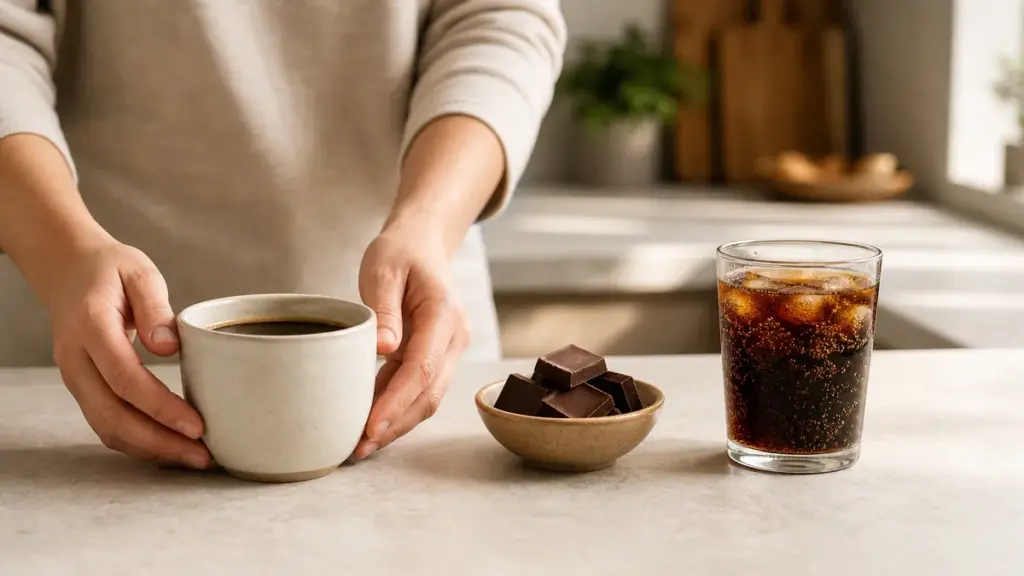
Caffeine in common drinks and foods
The following are NHS reference estimates, checked in November 2026. They are useful starting points, but a manufacturer’s or café’s information for the particular serving is more useful when available.
| Food or drink | Reference serving | Approximate caffeine |
|---|---|---|
| Instant coffee | One mug | 100 mg |
| Filter coffee | One mug | 140 mg |
| Tea, including black or green tea | One cup or mug | 75 mg |
| Cola | One 354 ml can | 40 mg |
| Energy drink | One 250 ml can | 80 mg |
| Plain dark chocolate | 50 g | Less than 25 mg |
| Plain milk chocolate | 50 g | Less than 10 mg |
The current NHS pregnancy page gives the instant coffee, tea, energy drink and chocolate figures above. The filter coffee estimate also appears in NHS patient guidance; the 354 ml cola serving is specified on the NHS Best Start in Life page.
These pages do not all use identical reference servings or estimates. In particular, the pregnancy page does not define the volume of a “cup” of instant coffee, and the breastfeeding pages give different example amounts. Do not treat the table as a laboratory analysis of your own mug.
Green tea still counts. The NHS pregnancy page includes it alongside black tea in its 75 mg estimate, although individual teas and brewing methods vary.
Why café coffee needs a separate check
Do not automatically assign the 100 mg instant coffee figure or 140 mg filter figure to a café drink. Coffee-shop servings can contain more, and a single serving can exceed 200 mg.
A laboratory study published in Food & Function in 2012 measured 20 commercial espresso servings. Four contained more than 200 mg, with the highest containing 322 mg. This was a small historical snapshot, not a current guide to particular chains, but it demonstrates why “one espresso” is not a dependable caffeine measurement.
Ask for the caffeine content of the exact drink, size and recipe. If that information is unavailable, choosing decaf avoids relying on a guessed espresso figure. A small cup is not, by itself, proof of a small caffeine dose.
A practical way to track your daily intake
A short record can make the guidance easier to apply without turning every drink into a research project.
- List everything containing caffeine. Include coffee, tea, cola, energy drinks, chocolate and relevant supplements or medicines.
- Record the actual serving. Note the product, drink size and whether you had more than one portion.
- Use product-specific information where available. Otherwise, use NHS estimates while recognising their limits.
- Add the caffeine amounts in milligrams. Keep the total at or below the pregnancy limit, with some room for uncertainty.
- Choose your replacements in advance. Decaf coffee, decaf tea and water can make the change simpler.
For example, assume one instant coffee contains the NHS reference amount of 100 mg and one tea contains 75 mg:
100 mg + 75 mg = approximately 175 mg caffeine.
That leaves only 25 mg before reaching 200 mg, without allowing for any other sources or variation in the drinks themselves. The calculation is illustrative, not a guarantee about two particular mugs.
Check medicines with a pharmacist rather than stopping prescribed treatment yourself. Some cold and flu remedies contain caffeine, and supplements may include caffeine-containing ingredients such as guarana.
Is decaf coffee suitable during pregnancy?
Decaf is a useful way to keep coffee in your routine while substantially reducing caffeine. Both RCOG and Tommy’s suggest decaffeinated drinks as an alternative during pregnancy.
However, decaffeinated does not mean caffeine-free. The US Food and Drug Administration confirms that decaf coffee and tea retain some caffeine, so use the producer’s information if you drink several servings or need to monitor intake closely.
There is no need to assign every decaf a single universal caffeine figure. The relevant amount depends on the product and serving, just as it does with regular coffee.
If you normally drink a lot of caffeine, reducing it gradually can make withdrawal less unpleasant. Start replacing regular servings with decaf while bringing your total within pregnancy guidance. Ask your midwife or GP for help if cutting down is difficult.
Herbal tea is not automatically an unrestricted substitute. The NHS advises limiting herbal tea during pregnancy to no more than four cups daily and avoiding teas containing liquorice root. Water is an option that requires no caffeine calculation.
What the evidence does, and does not, establish
Caffeine crosses the placenta, and pregnancy slows its clearance from the mother’s body. Those mechanisms help explain why pregnancy guidance differs from general adult guidance, but they do not establish a precise dose at which harm begins.
Much of the evidence on pregnancy outcomes is observational: researchers compare caffeine intake with outcomes rather than randomly assigning people to high caffeine exposure. These studies can identify associations, but cannot fully separate caffeine from every other influence.
| Claim | Type of evidence | Strength and limitation | Source |
|---|---|---|---|
| Keep pregnancy intake to no more than 200 mg daily | Public-health guidance and expert risk assessment | Clear practical recommendation, not proof of zero risk below a threshold | NHS; EFSA |
| Higher intake is associated with pregnancy loss and smaller babies | Systematic review and meta-analysis of observational studies | Associations identified, but bias and confounding remain possible | Greenwood and colleagues, 2014 |
| Trials establish whether avoiding caffeine improves pregnancy outcomes | Cochrane review of controlled trials | Evidence was insufficient; assessed evidence for birthweight and preterm birth was low quality | Jahanfar and Jaafar, 2015 |
| One commercial coffee can exceed 200 mg | Laboratory measurement of espresso servings | Direct measurements, but a small historical sample cannot describe every current drink | Crozier and colleagues, 2012 |
Why uncertainty does not make the limit meaningless
An observational association is not proof that caffeine caused an individual pregnancy complication. Smoking, other behaviours, inaccurate intake estimates and differences between study populations can affect findings.
The Greenwood review found associations between higher caffeine intake and several adverse outcomes, while also identifying substantial variation between studies and possible publication bias. It did not identify a clear threshold below which associations disappeared, but concluded that evidence was insufficient to justify lowering the existing maximum recommendation.
The Cochrane review reached a different kind of conclusion: controlled-trial evidence was too limited to confirm or refute the benefits of caffeine avoidance. That does not demonstrate that unlimited caffeine is safe.
EFSA’s assessment concluded that habitual intake up to 200 mg daily during pregnancy did not raise safety concerns for the fetus. NHS advice provides the practical ceiling, while RCOG encourages reducing further where possible. Neither position warrants promising that a particular intake guarantees a particular outcome.
Breastfeeding: which NHS advice should you follow?
The NHS Breastfeeding and diet page currently recommends no more than 200 mg of caffeine a day. This guide follows that recommendation.
There is a genuine inconsistency: the NHS Best Start in Life page, Food and drinks to avoid when breastfeeding, still advises no more than 300 mg daily. Both were checked in November 2026. Their existence should be acknowledged rather than presenting the NHS website as fully consistent.
The main breastfeeding diet page explains that caffeine passes into breast milk and may make a baby restless or keep them awake. It advises reducing caffeine particularly when the baby is younger than six months, while recognising that babies respond differently.
For a straightforward approach, keep total intake at or below 200 mg and discuss concerns with your health visitor, midwife or GP. If you suspect caffeine is affecting your baby, ask for advice rather than assuming that every unsettled period has the same cause.
When to speak to your midwife or GP
Ask for help if you cannot estimate your usual intake, regularly exceed the limit, take caffeine-containing products or feel worried about what you drank before knowing you were pregnant. A record of your drinks and product labels can make that conversation more useful.
If you have already gone over the guidance, try not to panic. Tommy’s specifically reassures readers not to worry too much about previous excess intake and emphasises that pregnancy loss is very rarely caused by something a parent did or did not do.
Focus on what you can change now, and seek individual advice rather than trying to calculate your baby’s risk from a cup of coffee. Population guidance cannot diagnose an individual pregnancy or explain a loss.
FAQ
Does drinking coffee before I knew I was pregnant mean I harmed my baby?
No, exceeding the guidance does not establish that your baby has been harmed. Work out your usual intake, reduce it in line with NHS advice and tell your midwife or GP if you are concerned. Tommy’s advises against excessive worry about past intake and reminds parents that pregnancy loss is very rarely caused by something they did or did not do.
Can I have a higher-caffeine day if I drink none the next day?
Do not use caffeine-free days to offset a higher-caffeine day. NHS guidance specifies a daily maximum, not a weekly allowance. Count each day’s coffee, tea, chocolate and other sources together. If a planned drink has an uncertain caffeine content, choosing decaf is more useful than trying to compensate afterwards.
Is the usual 400 mg adult guideline relevant while I am pregnant?
No, the general adult benchmark does not replace pregnancy guidance. EFSA’s assessment of up to 400 mg daily explicitly excludes pregnant women from that general adult recommendation. During pregnancy, follow the NHS maximum of 200 mg daily from all sources, or any more restrictive advice given by your maternity team for your circumstances.
Where to go next
Read Coffee and Health for the wider evidence, then How Much Coffee Is Too Much? for general intake guidance outside pregnancy. Coffee and Sleep explains sleep-related concerns, while Coffee and Anxiety covers sensitivity and anxious feelings; neither replaces the specific guidance on coffee during pregnancy.
Sources
-
NHS. Foods to avoid in pregnancy. Live guidance, checked November 2026.
https://www.nhs.uk/pregnancy/keeping-well/foods-to-avoid/
Primary source for the pregnancy maximum, current food and drink estimates, and herbal tea advice. -
University Hospitals Sussex NHS Foundation Trust. Healthy eating with Type 2 diabetes in pregnancy. Live patient guidance, checked November 2026.
https://www.uhsussex.nhs.uk/resources/healthy-eating-with-type-2-diabetes/
Used specifically for NHS reference caffeine amounts and variation between servings, not diabetes treatment advice. -
NHS. Breastfeeding and diet. Live guidance, checked November 2026.
https://www.nhs.uk/baby/breastfeeding-and-bottle-feeding/breastfeeding-and-lifestyle/diet/
Recommends no more than 200 mg daily while breastfeeding. -
NHS Best Start in Life. Food and drinks to avoid when breastfeeding. Live guidance, checked November 2026.
https://www.nhs.uk/best-start-in-life/baby/feeding-your-baby/breastfeeding/healthy-diet-when-breastfeeding/food-and-drinks-to-avoid-when-breastfeeding/
Retrieved to verify the conflicting 300 mg recommendation and specified cola serving. -
Royal College of Obstetricians and Gynaecologists. Healthy eating and vitamin supplements in pregnancy. Live patient information, checked November 2026.
https://www.rcog.org.uk/for-the-public/browse-our-patient-information/healthy-eating-and-vitamin-supplements-in-pregnancy/
Advises minimising caffeine, staying below 200 mg daily and ideally choosing decaf or avoiding caffeine. -
European Food Safety Authority. Caffeine. Summary of the 2015 Scientific Opinion on the safety of caffeine, checked November 2026.
https://www.efsa.europa.eu/en/topics/topic/caffeine
Used for pregnancy risk assessment and the distinction from general adult guidance. -
Greenwood DC and colleagues. Caffeine intake during pregnancy and adverse birth outcomes: a systematic review and dose-response meta-analysis. European Journal of Epidemiology, 2014.
https://pubmed.ncbi.nlm.nih.gov/25179792/
Used for observational associations, uncertainty, heterogeneity and possible publication bias. -
Jahanfar S, Jaafar SH. Effects of restricted caffeine intake by mother on fetal, neonatal and pregnancy outcomes. Cochrane Database of Systematic Reviews, 2015, Issue 6, CD006965, revision pub4.
https://www.cochrane.org/evidence/CD006965_effects-restricted-caffeine-intake-mother-fetal-neonatal-and-pregnancy-outcomes
Used for controlled-trial evidence, its limitations and slower caffeine clearance during pregnancy. -
Crozier TWM and colleagues. Espresso coffees, caffeine and chlorogenic acid intake: potential health implications. Food & Function, 2012, volume 3, pages 30 to 33.
https://eprints.gla.ac.uk/58252/
Original laboratory research demonstrating substantial caffeine variation in commercial espresso servings. -
US Food and Drug Administration. Spilling the Beans: How Much Caffeine is Too Much? Live consumer guidance, checked November 2026.
https://www.fda.gov/consumers/consumer-updates/spilling-beans-how-much-caffeine-too-much
Used for residual caffeine in decaf and gradual reduction to limit unpleasant withdrawal. -
Tommy’s. Mums-to-be need more guidance on the risk of caffeine during pregnancy. Live information, checked November 2026.
https://www.tommys.org/pregnancy-information/news-and-blogs/mums-be-need-more-guidance-risk-caffeine-during-pregnancy
Used for reducing intake, decaf alternatives and reassurance about previous consumption. -
National Institutes of Health, Office of Dietary Supplements. Dietary Supplements and Life Stages: Pregnancy, Health Professional Fact Sheet. Live reference, checked November 2026.
https://ods.od.nih.gov/factsheets/Pregnancy-HealthProfessional/
Used for placental transfer and pregnancy-related changes in caffeine clearance.
This article was researched using live NHS and specialist guidance, an expert risk assessment, peer-reviewed research and systematic reviews, with conflicting breastfeeding recommendations recorded explicitly.
Last checked: November 2026