An office coffee machine does not have to be plumbed in: a tank-fed model uses water that someone adds by hand, while a plumbed-in model replenishes its supply automatically from the mains. Choose between them by the likely refill burden and the practicality of installation, remembering that mains water and wastewater drainage are separate decisions.
In short
- Calculate water demand from the drinks menu, rinsing and cleaning, not just the number of staff.
- A mains connection removes manual water refilling, but not necessarily drip-tray emptying.
- Backflow protection must suit the particular machine, installation and UK jurisdiction.
- Both arrangements need water treatment matched to the local supply and the manufacturer’s requirements.
- Ask for an itemised written quotation covering the inlet, wastewater arrangements, filtration, commissioning and ongoing maintenance.
How the two water supplies work
A tank-fed coffee machine draws water from a reservoir filled by hand. The tank needs accessible filling or removal space, and someone must take responsibility for replenishing it. For example, JURA’s X10 instructions require fresh, cold water and daily water changes.
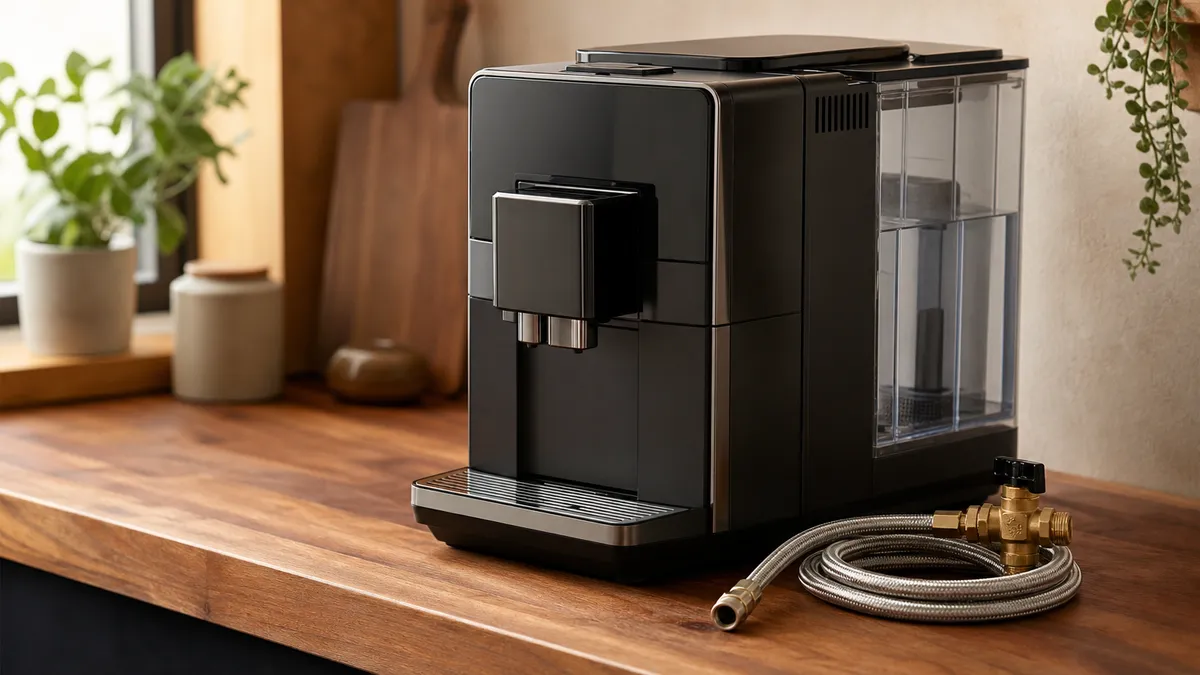
A plumbed-in coffee machine, also called mains-fed, connects to a drinking-water supply through the specified fittings and hose. It replenishes its water automatically, subject to the manufacturer’s inlet requirements. Franke’s A600 technical leaflet, for example, specifies both mains-water requirements and an optional internal tank on selected configurations.
Some machine families offer both arrangements, but do not assume that every version can switch between them. Confirm the exact configuration before ordering.
Water supply is only one part of choosing office coffee machines. It does not settle questions about the brewing system, milk arrangements or the machine’s ability to serve a busy break.
Plumbed-in vs tank-fed coffee machines compared
The criteria here are refill work, installation requirements, wastewater handling, water treatment and suitability. The recommendations are practical judgements, not manufacturer capacity ratings.
| Decision criterion | Tank-fed | Plumbed-in |
|---|---|---|
| Water replenishment | Someone fills the reservoir | Automatic replenishment from the supply |
| Installation | No fixed water inlet needed for a manually filled tank | Suitable inlet, isolation and assessed backflow protection needed |
| Wastewater | Usually collected in a tray; check the model | May use a tray, waste container or fixed drain |
| Positioning | Choose a position with convenient filling access | Position depends on acceptable supply and waste routes |
| Water treatment | Compatible tank cartridge or approved treated water | Appropriately specified inline treatment |
| Main operational drawback | Refill interruptions and staff handling | More installation planning and fixed connections |
| Who it suits | Workplaces where refilling is manageable or alterations are impractical | Permanent tea points where refill interruptions would be troublesome |
The useful question is not “Which is more professional?” It is “Which arrangement can this workplace operate consistently?”
A tank can be sensible in a permanent office with modest demand. Equally, automatic water replenishment may be worthwhile in a smaller workplace where nobody is reliably available to refill it.
Capacity and the real refilling burden
Tank capacity is a volume, not a daily drinks rating. Water also goes into automatic rinses and cleaning, so dividing tank litres by the finished cup size gives an incomplete answer.
Franke’s published A600 leaflet claims a 4-litre internal tank on selected configurations. That illustrates why the specification needs checking carefully: the tank option is not offered across every listed milk-system configuration. It is a manufacturer’s specification, not an independently measured usable capacity.
Start with attendance and drinks
Use the number of people actually present, then add visitors and meeting demand. This illustrative matrix assumes two machine-made drinks per person per working day, with no visitors:
| People present | Assumed daily drinks | What to investigate |
|---|---|---|
| 10 | 20 | Whether a tank and agreed refill routine are convenient |
| 25 | 50 | Water use for the actual drinks menu and cleaning |
| 50 | 100 | Refill frequency during concentrated breaks |
| 100 | 200 | Mains installation feasibility and peak serving capacity |
These are planning examples, not thresholds at which plumbing becomes compulsory. For selecting the machine itself, use daily cup capacity.
A worked water-demand example
Assume a hypothetical workplace has:
- 40 people present, each making two drinks daily;
- average machine water consumption of 150 ml per drink;
- another 2 litres daily for rinsing and cleaning;
- 3 litres of usable water between refills.
Drink production uses 40 × 2 × 150 ml = 12 litres. Adding the assumed cleaning allowance gives 14 litres daily.
At 3 litres per fill, that requires five tank loads, including the starting fill, and therefore four further refills. These are deliberately stated assumptions, not measured consumption for a particular machine.
Replace them with supplier data for your menu, then verify consumption during commissioning. Ask how much water remains when the refill warning appears, rather than treating nominal tank capacity as fully usable.
Plumbing in water does not necessarily mean plumbing out waste
Specify these three things separately:
- Fresh-water inlet: how drinking water reaches the machine.
- Wastewater collection: where rinsing water and drip-tray contents accumulate.
- Wastewater discharge: whether someone empties that collection vessel or water flows to a drain.
A mains-fed machine can still require manual wastewater handling. Ask explicitly what must be emptied, how the full-container warning works and whether drink preparation stops when it activates.
Gravity drainage
A fixed drain takes wastewater away through a suitable hose and connection. Its route matters: a hose that rises, sags or becomes trapped is not equivalent to a correctly installed gravity drain.
JURA’s installation sheet for its GIGA X8c/X3c specifies a falling residual-water hose, an open, unpressurised connection to the wastewater pipe and a trap in the building’s waste pipe. Those are model-specific instructions, not dimensions or arrangements to copy indiscriminately.
Pumped waste kits
Where a suitable gravity route is unavailable, a compatible wastewater pump may be an option. WaterCare, for example, publishes a pump system intended for espresso and coffee-making equipment positioned away from drainage points.
A pump moves wastewater to a disposal connection; it does not remove the need for one. Ask the installer to confirm compatibility, discharge routing, access for maintenance and what happens if the pump stops.
For any arrangement, request a drawing showing the inlet, filter, isolation valve, wastewater vessel or drain, and service access.
Water Fittings Regulations and backflow protection
Backflow means water travelling in the wrong direction towards the drinking-water supply, potentially carrying contamination with it. Protection must be assessed for the actual installation, not chosen solely because the appliance makes coffee.
The relevant frameworks are:
- England and Wales: Water Supply (Water Fittings) Regulations 1999.
- Scotland: Water Supply (Water Fittings) (Scotland) Byelaws 2014.
- Northern Ireland: Water Supply (Water Fittings) Regulations (Northern Ireland) 2009.
In England and Wales, Schedule 2, paragraph 15 requires protection appropriate to the highest applicable downstream fluid category. The Scottish byelaws and Northern Irish regulations contain corresponding requirements.
Why Category 3 and Category 4 advice can differ
Water Regs UK’s vending-machine guidance says drinks and food vending machines are typically Fluid Category 3, representing a slight health hazard, and normally use a suitable double check valve.
That is not a universal specification for every coffee machine. JURA’s GIGA X8c/X3c installation sheet instead specifies Fluid Category 4 preparations and a system separator of at least Type BA. United Utilities identifies a Type BA reduced pressure zone valve as an example of Category 4 protection.
The sources differ in scope: one describes typical vending installations; the other gives instructions for particular machines. An ordinary double check valve is not sufficient Category 4 protection. A suitably specified air-gap arrangement, physically separating the supply outlet from downstream water, is another protection approach, but its type and suitability require assessment.
What WRAS approval does, and does not, establish
WRAS-approved double check valves can help demonstrate product suitability, but approval is not a blanket certificate for the finished installation. WRAS says approval is not mandatory, other approval schemes exist, and installation conditions must be followed.
Have a competent installer confirm the risk category, existing internal protection and any additional device required with the local water undertaker. They should also establish whether notification or consent is needed before work begins.
Filtration matters with either arrangement
Neither a tank nor a mains hose makes unsuitable water suitable. Start with your local water supplier’s hardness information, then have the installer test the incoming water against the machine’s specification.
Hardness is commonly reported in mg/L as calcium carbonate, a shared reference scale for expressing mineral hardness. Manufacturer documents may instead use German or other hardness degrees, so ask the installer to reconcile the units rather than comparing unlike figures.
Treatment also needs to match the problem. BWT’s published documentation distinguishes activated-carbon treatment for chlorine and unwanted tastes from ion-exchange and decarbonisation treatments addressing mineral composition. “Filtered” does not automatically mean “protected against scale”.
For context, SCA Standard 102-2024, Table 2, gives cupping-water guidance of calcium hardness from 50 to 175 ppm as calcium carbonate, alkalinity at or near 40 to 70 ppm, pH from 6 to 8, and no chlorine. These are coffee-assessment specifications, not a universal office-machine warranty requirement.
Follow the machine manufacturer’s limits. Ask the supplier to record the treatment selected, cartridge setting, replacement schedule and responsibility for monitoring it.
Installation scope and ongoing running requirements
For a plumbed-in installation, request an itemised written quotation separating the machine from:
- the drinking-water connection, isolation valve and backflow protection;
- filtration, any pressure control and commissioning tests;
- worktop openings, pipe routes and making good;
- gravity drainage or a compatible pumped-waste arrangement;
- electrical preparation, training and subsequent maintenance.
For tank-fed equipment, include refill labour and access in the comparison. For both options, account for cleaning, filter replacement, servicing, beans, milk, energy and wastewater handling.
To calculate your own cost per cup, choose one assessment period and add the relevant quoted equipment and installation allocation, service and consumables, utilities and staff handling. Divide by expected drinks over that same period, stating attendance, working days, bean dose, milk use and the VAT basis of each item. Do not compare quotations until their inclusions and assumptions match.
Milk-system cleaning remains a separate workload. The comparison of fresh milk and powdered milk helps assess that part of the daily routine.
Before accepting either installation, have the supplier demonstrate refilling or isolation, wastewater emptying, cleaning access and the relevant warning messages.
FAQ
Can a tank-fed machine be converted to mains water later?
Only if the manufacturer supports that conversion for the exact model and configuration. A machine family offering both tank and mains versions does not establish that they are interchangeable. Ask for written confirmation of the required kit, installation instructions, backflow assessment and any effect on the warranty before choosing equipment on that assumption.
Will mains water make the coffee taste better?
Not simply because it arrives through a pipe. Compare the treated water reaching the brewing system, using the manufacturer’s requirements and appropriate coffee-water guidance. Tank-fed and mains-fed arrangements both need suitable water and maintained treatment. Changing the supply route is not, by itself, a demonstrated flavour improvement.
Does plumbing in the machine remove its daily cleaning?
No, automatic water replenishment does not remove cleaning duties. Follow the selected machine’s instructions for its coffee system, milk system, drip tray and waste containers. For example, JURA’s X10 manual specifies daily maintenance of the drip tray and grounds container, as well as daily changes of tank water.
Where to go next
Read Office Coffee Machines to place the plumbed-in vs tank-fed decision within the wider equipment choice, then Office Coffee Machines by Daily Cup Capacity to assess demand. For concentrated breaks and larger operations, Office Coffee Machines for High-Volume Use is the next read for planning beyond water replenishment.
Sources
- Franke, A600 product leaflet and technical data, undated retrieved edition. Manufacturer-claimed tank options, water requirements and drain specification. PDF.
- JURA, X10 Instructions for Use, undated retrieved edition. Tank filling, water changes, rinsing, maintenance and warning messages. PDF.
- UK legislation, The Water Supply (Water Fittings) Regulations 1999, SI 1999/1148, particularly Schedule 2, paragraph 15. PDF.
- Water Regs UK, Requirements Scotland, reproducing the Water Supply (Water Fittings) (Scotland) Byelaws 2014. Byelaws and guidance.
- Northern Ireland legislation, hosted by Northern Ireland Water, The Water Supply (Water Fittings) Regulations (Northern Ireland) 2009, SR 2009/255. PDF.
- Water Regs UK, What level of backflow risk is a vending machine?, February 2024, version 1.4. PDF.
- JURA, Important information about installing GIGA automatic coffee machines with a permanent water connection, GIGA X8c/X3c, undated retrieved edition. PDF.
- United Utilities, What is backflow and back pressure?, undated current webpage. Fluid categories and example protection devices. Guidance.
- WRAS, Product Approvals and Installation Requirement Notes, undated current webpages. Approval status, alternatives and installation limitations. Product approvals; installation requirements.
- WaterCare, Catalogue 2024, EspressoPump section. Manufacturer-described pumped-waste application. PDF.
- BWT water+more, Water for coffee and more, November 2023 edition. Treatment stages and distinctions between activated carbon, ion exchange and decarbonisation. PDF.
- Thames Water, Hard water, undated current webpage. Local variation, mineral hardness and reporting units. Guidance.
- Specialty Coffee Association, Coffee Value Assessment: Sample Preparation and Tasting Mechanics, SCA Standard 102-2024, section 7.4 and Table 2. PDF.
Research used retrieved legislation, water-industry guidance and manufacturers’ documentation; recommendations are editorial judgements, and the water-demand examples are explicitly hypothetical rather than test results.
Last checked: November 2026