The best types of coffee machine for offices depend on what people drink, how many arrive together and who will look after the equipment. Start with commercial bean-to-cup for varied self-service drinks, batch filter for shared black coffee, capsules for individual servings, and traditional espresso only where trained operators are available.
In short
- Count people actually on site, coffee drinkers and visitors, rather than using payroll headcount alone.
- Specify daily drinks and the busiest short serving period separately. A daily capacity recommendation does not guarantee short queues.
- Choose the milk arrangement before finalising the machine: fresh milk brings refrigeration and milk-system cleaning into the decision.
- Measure the complete working area, including refilling, waste removal, milk storage and servicing access.
- Request itemised written quotations covering equipment, ingredients, installation, maintenance and contract obligations.
Start with your office profile
Before comparing machines, record attendance, drinks and queues across a representative working week. Include the busiest shared-office day, meeting-room demand and visitors. Ask people what they actually choose: black coffee, espresso, cappuccino, other milk drinks or decaffeinated coffee.
Our recommendation is to shortlist against five criteria, in this order: peak demand, drink preferences, maintenance ownership, installation suitability and whole-life commitment. Appearance comes afterwards.
For the wider procurement process, use the parent guide to office coffee machines. Here, the task is narrower: matching the workplace to the right machine type.
Turn headcount into a demand estimate
Use:
People present × proportion drinking coffee × drinks per coffee drinker, then add visitor drinks.
The following figures are illustrative planning assumptions, not consumption averages or manufacturer capacity bands. Each row assumes everyone listed is present, half drink coffee and each coffee drinker has two drinks daily, excluding visitors.
| People present | Coffee drinkers assumed | Daily drinks calculated | Starting shortlist |
|---|---|---|---|
| 10 | 5 | 10 | Professional capsule, small filter or compact commercial bean-to-cup |
| 25 | 12.5 planning equivalent | 25 | Commercial bean-to-cup or filter, according to drinks |
| 50 | 25 | 50 | Bean-to-cup with suitable capacity, or batch filter |
| 100 | 50 | 100 | Higher-capacity bean-to-cup, batch brewing or distributed machines |
| 200 | 100 | 200 | Multiple serving points or a managed coffee area |
The fractional planning equivalent is simply an arithmetic assumption. Replace it with your observed number of coffee drinkers.
Match the best types of coffee machine to your drinks
These are editorial matches based on how each system prepares and serves coffee, not a ranking of tested machines. Compare the actual drinks, cleaning tasks and installation requirements of the models shortlisted.
| Office profile | Best starting type | Why it fits | Main limitation |
|---|---|---|---|
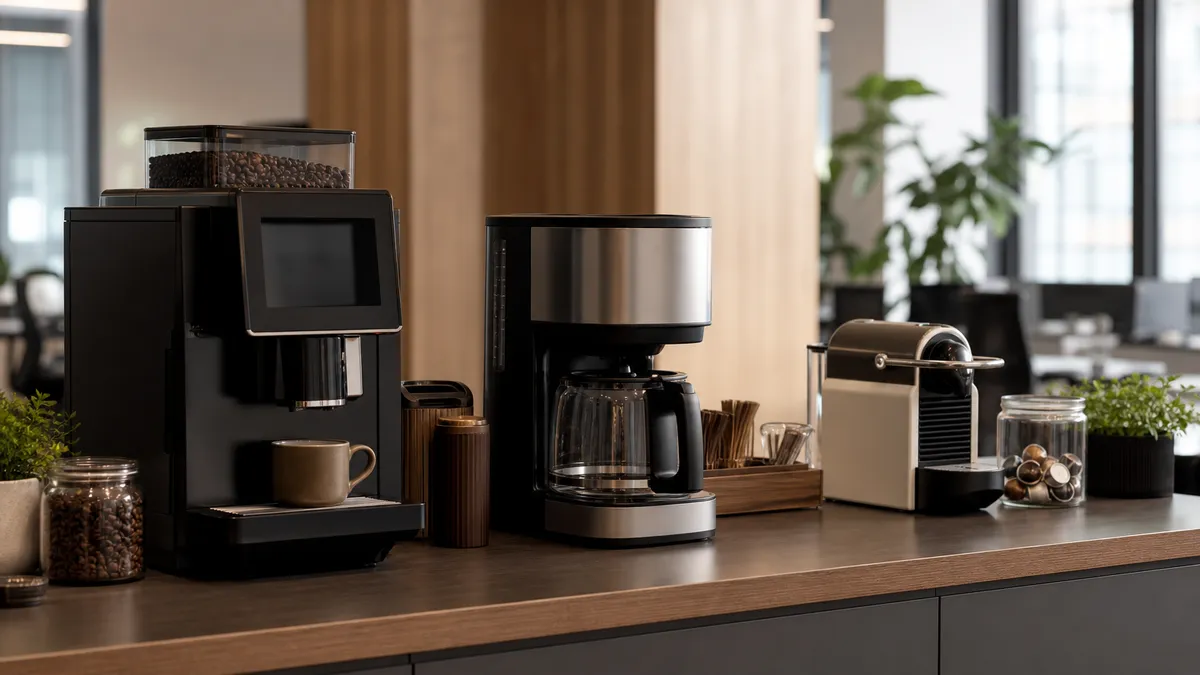
| Mixed tastes, self-service, regular milk drinks | Commercial bean-to-cup | Grinds beans and automates preparation; suitable models offer milk drinks | Requires ingredient replenishment, waste handling and scheduled cleaning |
| Mostly black coffee, meetings or shared breaks | Batch filter brewer | Prepares a batch for several people to serve | Does not make espresso or automatically textured milk |
| Individual drinks, intermittent use, preference for portioned coffee | Professional capsule | Pre-portioned coffee and straightforward drink selection | Capsule compatibility, supply arrangements and used-capsule handling need checking |
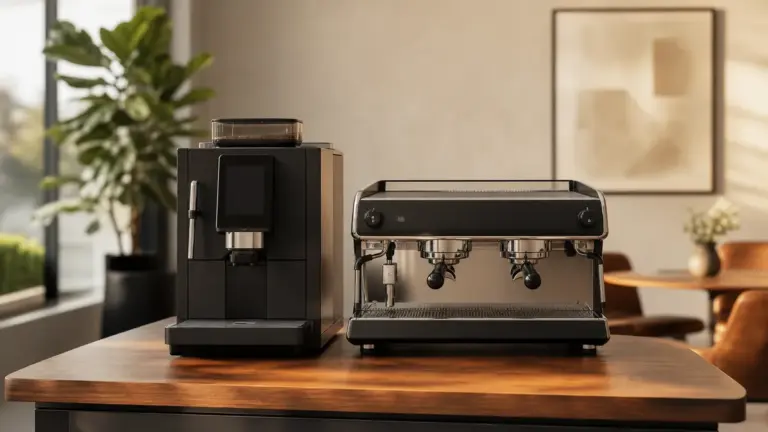
| Staffed hospitality area with trained operators | Traditional espresso | Gives the operator direct control over preparation and milk texturing | Needs operator skill, workflow space and cleaning |
| Self-service hot drinks where dry ingredients are preferred | Instant-ingredient drinks machine | Mixes soluble ingredients without espresso preparation | Taste the exact ingredients and recipes before choosing |
Bean-to-cup: the mixed-menu starting point
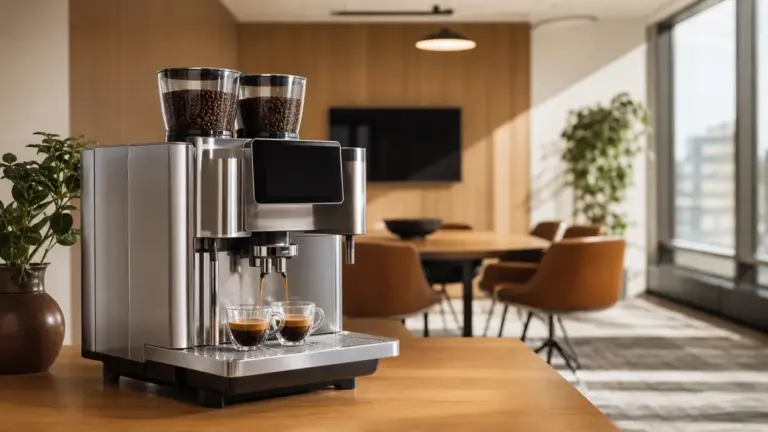
A commercial bean-to-cup machine is our first shortlist choice where colleagues want different drinks without learning espresso preparation. Black-coffee-only configurations also deserve consideration when milk drinks are uncommon.
Do not buy on menu length alone. Ask for the drinks people will order, in their usual mug sizes, including any extra-shot recipe. The guide to office bean-to-cup machines covers this class in more detail.
Filter: the shared black-coffee choice
Batch filter deserves priority when several people want black coffee together. Brewing before a meeting separates preparation from serving, rather than making every person wait for an individual brewing cycle.
Check output in litres and translate it into your mugs. Bravilor Bonamat’s Quick Filter brochure defines a cup as 125 ml: its claimed 18-litre hourly output for the Mondo therefore represents 144 brochure cups, but only 72 servings of 250 ml, before allowing for waste.
Capsules, traditional espresso and instant ingredients
Professional capsules suit workplaces that value individual portions and a defined coffee selection. Confirm the capsule format rather than assuming different systems are interchangeable. Our bean-to-cup versus pod comparison examines that decision.
Traditional espresso belongs on the shortlist when somebody is responsible for making the drinks, not simply because colleagues enjoy good coffee. Read the traditional espresso comparison before committing to an operator-led setup.
Instant-ingredient machines are a separate category, not bean-to-cup under another name. Taste the proposed coffee and milk ingredients rather than judging them by the drink names displayed.
Size for the queue, not just the day
Ask suppliers to distinguish recommended daily output, measured hourly throughput and performance with your drink mix.
For example, JURA publishes a recommended maximum daily output of 50 drinks for the W8, alongside claimed hourly figures of 74 coffees or 50 cappuccinos under DIN 18873-2. These are different measures, not permission to run at the hourly figure throughout the working day.
As an illustrative demand calculation, 20 drinks requested within 10 minutes require an average serving rate of two drinks per minute. That is a demand requirement, not a promise that a particular machine can meet it.
Request a demonstration reproducing your busiest period, mug sizes and milk-drink proportion. Include selection time, cup changes and any replenishment interruptions. For meetings, compare a prepared filter batch; for dispersed teams, compare separate serving points.
Decide the milk and maintenance arrangement together
For fresh-milk drinks, include refrigerated storage, replenishment and the manufacturer’s cleaning procedure in the operational plan. An automatic rinse is not a substitute for every cleaning task: JURA’s W8 instructions distinguish milk-system rinsing from cleaning and require milk-system cleaning daily when milk has been prepared.
Powdered-milk systems avoid storing fresh milk for that recipe, but do not assume they eliminate cleaning. Ask to see ingredient handling and mixer cleaning on the proposed model.
Where colleagues need plant-based drinks, confirm compatible ingredients and how shared components are managed. A separate carton alone does not establish an allergen-free preparation process. Food Standards Agency guidance identifies shared equipment and ineffective cleaning as cross-contact risks.
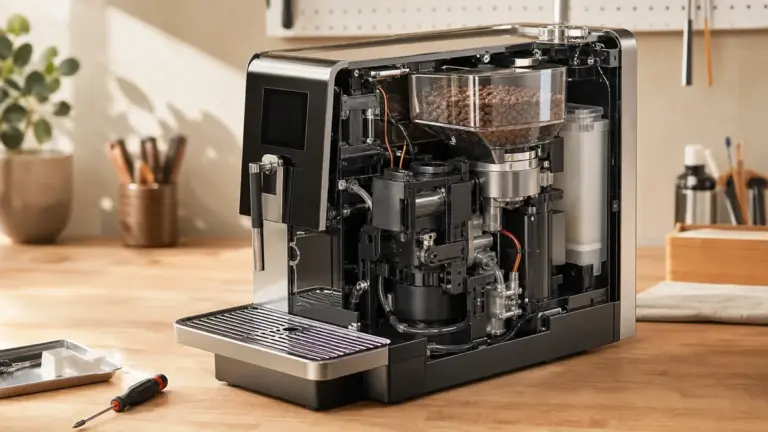
Assign a named owner and deputy for refilling, emptying waste, cleaning and contacting service support. The explanation of how bean-to-cup machines work helps identify the components behind those tasks.
Check space, plumbing and workplace obligations
Measure more than the closed machine. Allow access for the water tank, bean hopper, capsule bin or grounds container, plus milk refrigeration, cups and cleaning equipment. Confirm electrical requirements and the manufacturer’s ventilation instructions.
Tank-fed and mains-connected options exist within machine categories. Bravilor’s Mondo is manually filled, while its Matic uses a water connection. Choose against the actual installation, not an assumption that every commercial brewer needs plumbing.
Ask your water supplier for the premises’ hardness information, then have the installer specify suitable treatment. Hardness varies locally and contributes to scale formation. Reports commonly express it in milligrams per litre as calcium carbonate, written mg/L as CaCO₃; use the units required by the machine or filter instructions.
For a UK installation, check these responsibilities:
- Water fittings: in England and Wales, the Water Supply (Water Fittings) Regulations 1999 require appropriate backflow prevention. Obtain jurisdiction-specific confirmation elsewhere.
- Pressure systems: machines incorporating steam boilers can fall within Great Britain’s Pressure Systems Safety Regulations 2000. Steam is a relevant fluid at any pressure; check applicability and examination arrangements with the supplier and HSE guidance.
- Workplace welfare: HSE guidance requires access to drinking water and rest facilities. Coffee provision must not replace those essentials.
- Waste: in England, workplace recycling requirements took effect on 31 March 2025, with micro-firms having until 31 March 2027. The exemption concerns fewer than 10 full-time-equivalent employees across the business, not simply at one office. Agree grounds and capsule disposal with your collector.
Build a budget model without relying on headline figures
Compare ownership, lease, rental and managed-service proposals over the same period and with the same expected drink volume. Obtain itemised written quotations.
Include equipment and accessories, installation, ingredients, water treatment, cleaning materials, energy, staff time, servicing, repairs, waste collections and end-of-contract obligations. Ask about minimum ingredient orders, exclusions, replacement equipment and termination terms.
A worked usage basis for your own calculation
Assume 60 drinks daily across 220 operating days, using 9 g of beans per drink. Assume 30 daily drinks each contain 120 ml of milk. These are planning inputs, not recommended recipes.
- Annual drinks: 60 × 220 = 13,200.
- Annual beans: 60 × 9 g × 220 ÷ 1,000 = 118.8 kg.
- Annual milk: 30 × 120 ml × 220 ÷ 1,000 = 792 litres.
Add measured wastage separately. Apply your quoted ingredient terms, add the annualised equipment and operating items, then divide the total by 13,200 to calculate your workplace’s cost per served drink.
State whether your comparison includes VAT and how recoverable VAT is treated. HMRC generally zero-rates coffee and milk sold as food products, while hot drinks supplied in catering are generally standard-rated. Do not apply one VAT assumption to every line.
Red flags before you commit
- Capacity expressed only as “staff served”. It conceals attendance, coffee participation, mug size and peaks.
- A demonstration of espresso when staff mostly order large milk drinks. It does not reproduce the intended workload.
- “Automatic cleaning” with no task list. Staff may still need to supply cleaner, handle components and empty containers.
- A site survey that checks only width. Refilling, ventilation, refrigeration and service access can determine suitability.
- Unclear consumable or service obligations. Ask for written compatibility, minimum-order, response and exclusion terms.
The best types of coffee machine for offices are those that pass the real serving test and have an agreed care routine, not those with the longest menu.
FAQ
Can we use a domestic coffee machine in an office?
Only shortlist one if the manufacturer confirms that the intended workplace use is permitted and supported. Do not infer suitability from its appearance or water-tank size. Give the supplier your expected daily drinks, busiest serving period and milk requirements, then obtain written confirmation of use conditions, warranty coverage and maintenance arrangements.
Would two smaller machines be better than one larger machine?
They may be, particularly where teams use different floors or drink at the same time. Treat this as a layout option to evaluate rather than an automatic improvement. Compare the combined peak-serving performance, installation needs and duplicated cleaning tasks, and decide what service would remain available if either machine were unavailable.
How should we handle decaffeinated coffee?
Ask the supplier to demonstrate the exact decaffeinated workflow before ordering. Confirm whether the proposed machine uses a separate ingredient supply or requires manual intervention, and whether ordinary users can complete the process correctly. Include decaffeinated drinks in the peak-demand demonstration if colleagues regularly request them, rather than treating them as an occasional exception.
Where to go next
Read Office Coffee Machines for the wider procurement framework and Office Bean-to-Cup Coffee Machines if automated freshly ground coffee fits your workplace. Bean-to-Cup vs Pod Machines for Offices helps settle the portioned-coffee decision, while Bean-to-Cup vs Traditional Espresso Machines for Offices examines whether an operator-led setup suits your team.
Sources
Manufacturer specifications below are published claims, not independently tested performance results. Undated sources are identified as such rather than assigned an inferred publication year.
-
JURA, W8: UK product specifications, undated live page, checked November 2026.
https://uk.jura.com/en/professional/machines/w8-dark-inox-inta-15663 -
JURA, W8 (EA/SA/INTA): Instructions for Use, original instructions, undated retrieved edition.
https://uk.jura.com/-/media/global/pdf/manuals-global/professional/W8/W8-EA/download_manual_w8.pdf -
Bravilor Bonamat, Quick Filter: Mondo-series, Matic-series, TH-series, brochure revision 904.010.004C, undated.
-
Nespresso, Momento Coffee and Momento Coffee & Coffee: User Manual, models NP100 and NP200, undated retrieved edition.
https://www.nespresso.com/shared_res/manuals/momento/PDF/M100_200/Momento-100-200_UM_EN_IEC_A4_print.pdf -
Bravilor Bonamat, Bolero, undated manufacturer product information.
https://www.bravilor.com/bolero/ -
La Marzocco, Linea and FB70 Manual, version 6.0, undated retrieved edition.
https://lamarzoccousa.com/wp-content/uploads/2012/08/Linea-Classic-Manual-6.0.pdf -
Food Standards Agency, Precautionary allergen labelling, sections on shared equipment, cleaning and cross-contamination, published 2023.
https://www.gov.uk/government/publications/precautionary-allergen-labelling/precautionary-allergen-labelling -
Drinking Water Inspectorate, Water Hardness / Hard Water, undated guidance; Thames Water, Water quality, undated postcode-report service.
https://www.dwi.gov.uk/consumers/learn-more-about-your-water/water-hardness-hard-water/
https://www.thameswater.co.uk/help/water-and-waste-help/water-quality -
UK legislation, The Water Supply (Water Fittings) Regulations 1999, SI 1999/1148, Schedule 2, paragraph 15, original enacted text.
https://www.legislation.gov.uk/uksi/1999/1148/pdfs/uksi_19991148_en.pdf -
Health and Safety Executive, Pressure Systems Safety Regulations 2000 (PSSR), undated live guidance; Workplace facilities: What you must provide, live guidance.
https://www.hse.gov.uk/pressure-systems/pssr.htm
https://www.hse.gov.uk/simple-health-safety/workplace-facilities/welfare.htm -
Department for Environment, Food & Rural Affairs, Simpler recycling: workplace recycling in England, updated 3 October 2025.
https://www.gov.uk/guidance/simpler-recycling-workplace-recycling-in-england -
HM Revenue & Customs, Food products (VAT Notice 701/14) and Catering, takeaway food (VAT Notice 709/1), both updated 8 June 2026.
https://www.gov.uk/guidance/food-products-and-vat-notice-70114
https://www.gov.uk/guidance/catering-takeaway-food-and-vat-notice-7091
Research combined manufacturer specifications and operating manuals with official UK tax, workplace, water, allergen and waste guidance; office matches are editorial judgements and calculations use explicitly stated illustrative assumptions.
Last checked: November 2026