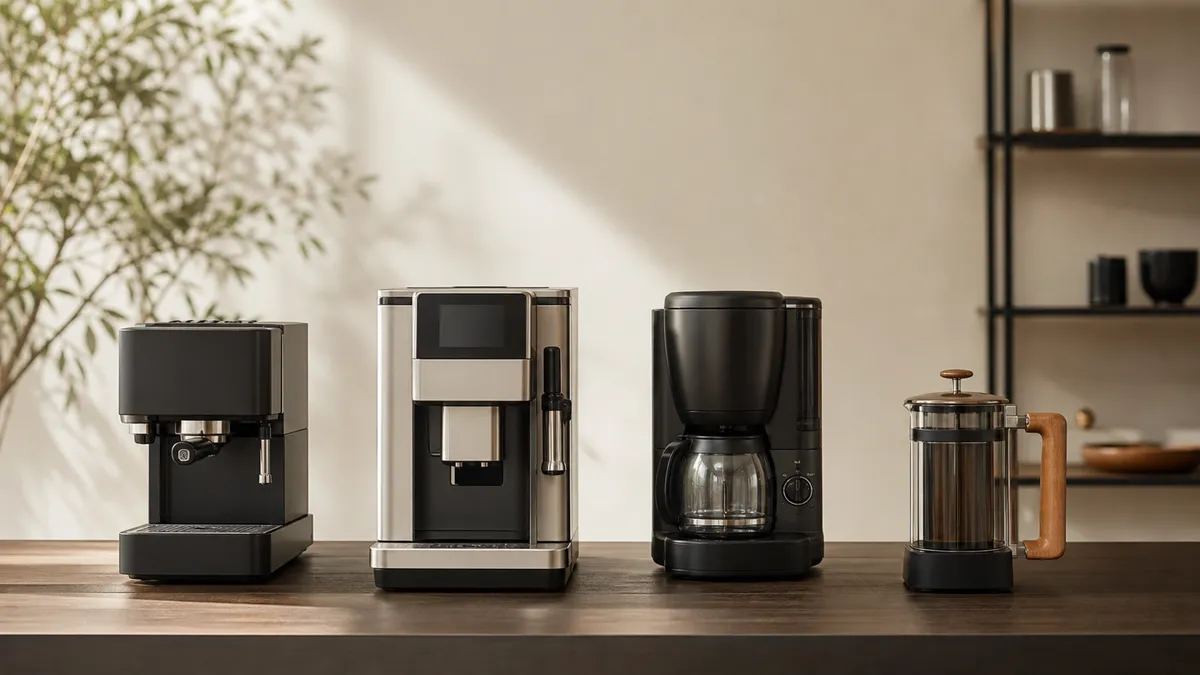
The main office coffee machine types differ in how they prepare coffee, handle milk and cope with queues. This office coffee machine comparison guide puts five categories side by side, so you can shortlist by drinks, peak demand and cleaning responsibility before comparing individual models.
In short
- Compare daily demand and the busiest break separately. A daily capacity claim does not establish how quickly a machine serves a queue.
- Separate espresso-based bean-to-cup machines from automatic freshbrew systems, which prepare filter-style coffee.
- Specify the milk system, not just “cappuccino”: fresh milk, powdered ingredients and milk packs involve different routines.
- Compare complete installations, including water treatment, drainage, milk storage and access for cleaning.
- Ask every shortlisted supplier to demonstrate your drink sizes and provide an itemised written quotation.
Define the comparison criteria first
Use the same criteria for every candidate. Otherwise, a machine demonstrated making small black coffees can appear to outperform one preparing large milk drinks without answering your workplace’s actual needs.
Taste means the drink style and control available, not a universal quality ranking. Compare black coffee and milk drinks separately, using ingredients your staff would actually choose.
Speed means the complete user cycle: selecting a drink, loading a pack or preparing coffee where necessary, dispensing and leaving the machine ready for the next person. Capacity means both sustainable daily use and output during your busiest period.
Milk covers the ingredient, storage, preparation and cleaning arrangement. An automatic milk circuit is different from a steam wand, an ingredient canister or milk frothed directly in the cup.
Plumbing covers incoming water, any drainage connection, water treatment and the space required for installation. Cleaning covers hands-on work as well as automatic programmes.
Cost means the whole operating arrangement: equipment, installation, ingredients, servicing, water treatment, energy, cleaning labour and waste handling. The table identifies these drivers rather than assigning unsupported “cheap” or “expensive” labels.
For the wider purchasing process, start with office coffee machines. Here, the task is narrower: compare categories against one consistent set of questions.
Office coffee machine comparison table
These are category-level descriptions, not guarantees about every model. Suitability statements are editorial judgements based on the workflow described; published specifications and the proposed configuration must still be checked.
| Type and who it suits | Taste and milk | Speed and capacity | Plumbing and cleaning | Main cost drivers |
|---|---|---|---|---|
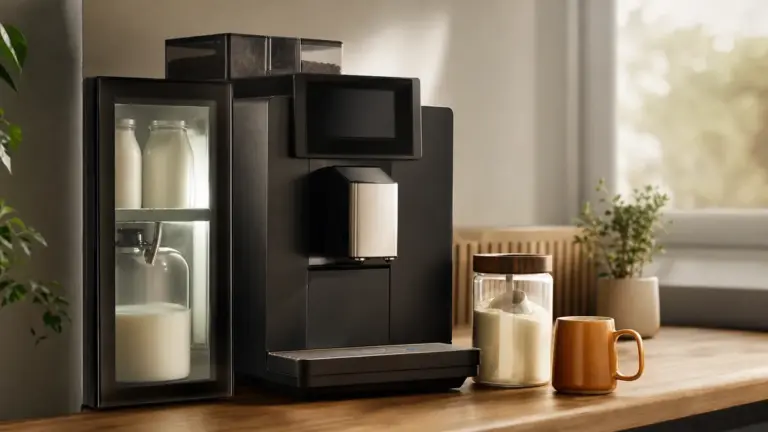
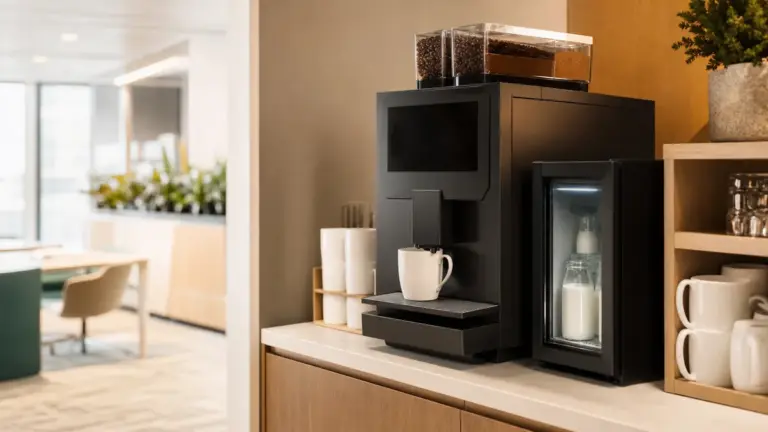
| Bean-to-cup: shared self-service tea points wanting freshly ground coffee and an espresso-based menu | Grinds beans automatically. Milk may use a chilled fresh-milk system or powdered ingredients, depending on configuration. Adjustment is bounded by the machine’s settings. | Prepares drinks on demand. Milk preparation, parallel dispensing and refill interruptions need checking. Daily suitability varies by model. | Tank-fed and mains-fed configurations exist. Allow for grounds, trays, brewing-system care and any milk-system cleaning. | Beans, milk, cleaning products, water treatment, servicing and staff time maintaining the machine. |
| Traditional espresso: staffed hospitality areas with trained operators | Separate grinding and a removable filter handle give the operator direct preparation control. A steam wand heats and textures milk. | Multiple brewing groups can work independently, but preparation and milk handling remain part of the service cycle. Assess the operator and machine together. | Commercial installations commonly need water and drainage provision. Brewing groups, filter handles and steam wands require cleaning. | Grinder, installation, operator time, training, milk handling, cleaning and maintenance. |
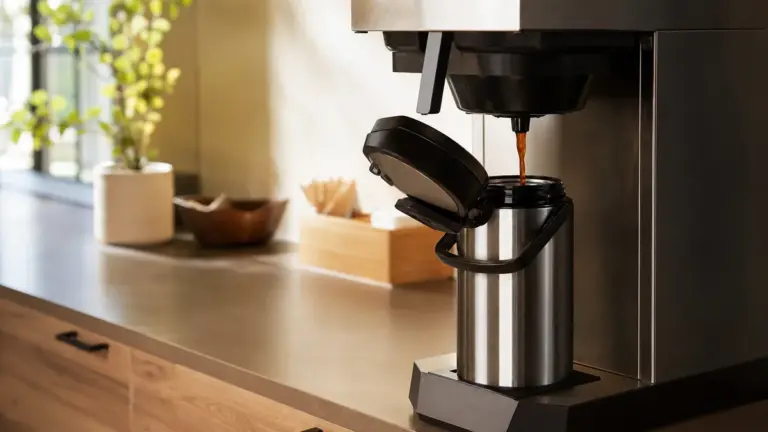
| Filter/bulk brewer: meetings and workplaces mainly drinking black coffee | Brews ground coffee into a jug or serving container. Milk is normally added separately; it does not produce espresso or steam milk. | Brews batches rather than an individual drink for each user. Ready coffee can serve a group, but replenishing an empty container takes another brew cycle. | Manual-fill filter machines and mains-connected bulk brewers are available. Clean brewing parts and serving containers. | Ground coffee, filters where required, serving equipment, cleaning and unused brewed coffee. |
| Commercial capsule/freshpack: workplaces prioritising portioned ingredients and straightforward drink selection | Uses compatible pre-portioned packs. Capsule and freshpack systems are not interchangeable, and milk arrangements differ between systems. | Individual drinks are prepared on demand. Include pack loading, any second pack and used-pack emptying in the assessment. | Tank and mains options depend on the model. Trays, pack bins, outlets and any milk equipment still need care. | Compatible packs, any milk ingredients, water treatment, servicing and used-pack collection. |
| Instant/freshbrew vending: self-service workplaces wanting automatic ingredient dispensing | Instant dissolves soluble coffee; freshbrew extracts ground coffee, sometimes ground from beans inside the machine. Powdered milk or topping may be part of the menu. | Instant avoids a ground-coffee extraction stage. Freshbrew adds brewing and grounds handling. Neither category name establishes a universal output. | Check the exact water connection. Mixing systems, canisters and outlets require cleaning; freshbrew also produces spent grounds. | Soluble ingredients or coffee, toppings, cleaning labour, water treatment, service and waste handling. |
Where the category boundaries matter
Bean-to-cup describes an ingredient route, not always a brewing method. Some automatic freshbrew machines also grind whole beans. For this comparison, the bean-to-cup row means an espresso-based automatic machine, while freshbrew vending means an automatic filter-style system. Bravilor explicitly describes freshbrew as filter coffee prepared individually for each cup.
Read office bean-to-cup machines for the category detail, and bean-to-cup versus traditional espresso when deciding between self-service and an operator-led service.
Capsule and freshpack belong together here because both use portioned packs, not because they brew identically. Milk also needs checking: the FLAVIA Creation 600 guide describes both milk-froth packs and liquid milk frothed in the cup. Do not assume every portioned system has an internal fresh-milk circuit.
Use office capsule machines for system-specific questions and bean-to-cup versus pods for that narrower choice.
Batch brewing answers a different question from individual dispensing: can coffee be ready when a group arrives? The trade-off is planning batch size and replenishment rather than offering every person a separate espresso-based recipe. See filter machines and bulk brewers for the detailed workflow.
Match headcount to daily cups and peak demand
Headcount is a starting point, not a machine specification. Use people actually attending, coffee participation, drinks per coffee drinker and visitor demand.
The following matrix is illustrative arithmetic, not a consumption survey or recommended capacity band. It assumes everyone attending drinks two machine-prepared coffees daily, with no visitors.
| People attending | Assumed coffees per person | Calculated daily coffees | What still needs measuring |
|---|---|---|---|
| 10 | 2 | 20 | Whether demand arrives together |
| 25 | 2 | 50 | Meeting and visitor drinks |
| 50 | 2 | 100 | Drink mix during busy breaks |
| 100 | 2 | 200 | Distribution between tea points |
The calculation is:
Daily coffees = attendees × coffee-drinking proportion × coffees per coffee drinker + visitor coffees.
Then count the busiest service window separately. As an illustrative planning example, 20 drinks needed within 10 minutes require an average completed output of two drinks per minute across the available equipment. That does not establish whether a particular machine can deliver them.
Manufacturer ratings need context. Franke’s current UK page claims an average daily capacity of up to 200 cups for the new A600, checked in November 2026. This is a manufacturer claim for that model, not a guarantee of peak milk-drink throughput or a capacity limit for bean-to-cup machines generally.
Ask suppliers what drink sizes, recipes and operating conditions underpin their figures.
How to shortlist without comparing unlike machines
Use a staged process rather than scoring every available machine.
- Write the required menu. Separate essential drinks from occasional requests. State finished drink volumes in millilitres and identify fresh milk, plant-based alternatives and decaffeinated coffee requirements.
- Choose the service arrangement. Decide whether users serve themselves or a trained person prepares drinks. Remove options that depend on staffing you will not provide.
- Confirm the installation. Check the complete footprint, door-opening space, hopper access, milk storage, electrical supply, water and drainage.
- Run a representative demonstration. Use your mugs and intended drink sizes. Time a mixed sequence, including pack changes, refilling and emptying where relevant.
- Demonstrate the cleaning. Ask the person who will maintain the machine to carry out the routine, rather than watching only an automatic rinse.
- Get written commitments. Request the exact configuration, permitted use, maintenance schedule, service coverage and what happens during a breakdown.
Keep a candidate only if it passes your essential requirements. A weighted score should not rescue a machine that cannot fit the tea point or cannot be maintained by the available staff.
Compare the complete operating arrangement
Request itemised written quotations covering the same equipment and service period. Include the machine, grinder where needed, milk equipment, installation, water treatment, consumables, planned servicing, breakdown support and end-of-contract obligations.
For your own operating calculation:
- Record each recipe’s coffee dose in grams and milk volume in millilitres.
- Estimate ingredient use from the expected drink mix.
- Add cleaning products, filters, energy, waste collection and staff time.
- Include unused batch coffee, discarded milk and other measured waste.
- Spread equipment and installation expenditure across the chosen comparison period.
- Divide the resulting total by expected drinks actually served.
State whether your calculation includes VAT and how recoverable VAT is treated. Do not combine quotations on different VAT bases.
HMRC generally zero-rates coffee and milk sold as food products, while hot drinks supplied in the course of catering are standard-rated. These are different supplies, so ingredient treatment should not be mistaken for the treatment of a catering service.
Check water, pressure systems and waste before committing
Water: obtain your local supplier’s hardness information and have the proposed treatment checked against the machine manufacturer’s requirements. Hardness varies with the water source; a single UK-wide assumption is not adequate. A taste-oriented brewing-water specification is not a substitute for installation requirements.
For mains-connected equipment in England and Wales, the Water Supply (Water Fittings) Regulations 1999 include backflow-prevention requirements. Have the installer confirm the appropriate protection and the applicable local requirements elsewhere in the UK.
Pressure systems: steam-boiler machines can fall within the Pressure Systems Safety Regulations 2000 in Great Britain. Steam is a relevant fluid at any pressure. Ask the supplier to establish applicability and any written scheme of examination and examination requirements before use, following HSE guidance.
Waste: in England, workplace food-waste separation requirements include coffee grounds. They have applied since 31 March 2025, with micro-firms below 10 full-time-equivalent employees given until 31 March 2027. The employee count is across the business, not just one office.
DEFRA says compostable or biodegradable packaging must not enter the ordinary food-waste collection. Confirm a suitable collection route for used packs rather than treating a “compostable” description as disposal instructions.
FAQ
Does a capsule machine remove the need for milk-system cleaning?
No, the milk arrangement determines the cleaning work. A capsule machine with an internal fresh-milk system still needs that system maintained. For example, the Nespresso Momento Coffee & Milk manual specifies milk-system cleaning every 24 hours. Pack-based milk and in-cup frothing arrangements have different instructions, which must be checked for the exact system.
Is instant vending the same as freshbrew vending?
No, instant uses soluble coffee, while freshbrew extracts ground coffee. Freshbrew can use pre-ground coffee or beans ground inside the machine, which explains why supplier terminology sometimes overlaps with bean-to-cup. Ask what ingredient enters the machine and how it is brewed, rather than relying on the category name alone.
Can an office use more than one machine type?
Yes, a mixed arrangement is worth assessing when different areas have different requirements. You might propose batch coffee for meeting service and an individual-drink machine for the shared tea point. Treat this as an option to test against your measured demand, then include both cleaning routines, installation needs and service arrangements in the comparison.
Where to go next
Read Office Coffee Machines by Daily Cup Capacity to turn measured demand into a specification, then Office Coffee Machines for High-Volume Use for concentrated demand and multiple tea points. How Office Bean-to-Cup Machines Work explains the automatic brewing process, while Best Types of Coffee Machine for Offices applies the category choices to workplace needs after this office coffee machine comparison.
Sources
Manufacturer descriptions below establish machine features and prescribed routines, not independently tested taste, reliability or performance. Undated pages are identified as such rather than assigned an invented publication year.
-
Franke, The Franke A600 coffee machine, undated current UK product page, retrieved November 2026.
https://www.franke.com/gb/en/coffee-systems/products/fully-automatic-coffee-machines/a600-coffee-machine.html -
Bravilor Bonamat, Filter coffee machines, undated current range page, retrieved November 2026.
https://www.bravilor.com/en/filter-coffee-machines/ -
Bravilor Bonamat, FreshBrew machines, undated current explanatory page, retrieved November 2026.
https://www.bravilor.com/en/products/filter-coffee-machines-en/freshbrew-machines-en/ -
Bravilor Bonamat, Bolero 11 and Bolero 21 Operating Manual, version 2.1a, document dated 23 May 2025.
-
Lavazza Professional, FLAVIA Creation 600 User Guide, UK version 3, hosted in the manufacturer’s September 2021 document directory.
https://www.lavazzapro.co.uk/wp-content/uploads/2021/09/70-41-3487-CREATION-600-USER-GUIDE-UK.v3.pdf -
Nespresso Professional, Momento User Manual, April 2023 file edition.
https://www.nespresso.com/ecom/medias/sys_master/public/27119847407646/Momento-User-Manual-2023-04.pdf -
La Marzocco, Linea Classic S Manual, version 1.0, undated retrieved edition.
https://lamarzoccousa.com/documents/linea-classic-s-manual/ -
Health and Safety Executive, Risk control for small pressure vessels: café boilers, bench-top autoclaves, and model steam engines, RR1177 (2022), first published 2023.
https://www.hse.gov.uk/research/assets/docs/rr1177.pdf -
HM Revenue & Customs, Food products (VAT Notice 701/14), updated 8 June 2026.
https://www.gov.uk/guidance/food-products-and-vat-notice-70114 -
HM Revenue & Customs, Catering, takeaway food (VAT Notice 709/1), updated 8 June 2026.
https://www.gov.uk/guidance/catering-takeaway-food-and-vat-notice-7091 -
UK legislation, The Water Supply (Water Fittings) Regulations 1999, SI 1999/1148, particularly Schedule 2, paragraph 15.
https://www.legislation.gov.uk/uksi/1999/1148/pdfs/uksi_19991148_en.pdf -
Health and Safety Executive, Pressure Systems Safety Regulations 2000 (PSSR), undated current guidance, retrieved November 2026.
https://www.hse.gov.uk/pressure-systems/pssr.htm -
Department for Environment, Food & Rural Affairs, Simpler recycling: workplace recycling in England, updated 3 October 2025.
https://www.gov.uk/guidance/simpler-recycling-workplace-recycling-in-england -
Thames Water, Hard water, undated current guidance, retrieved November 2026.
https://www.thameswater.co.uk/help/water-and-waste-help/water-quality/hard-water
This comparison was researched from manufacturer documentation, official UK guidance and legislation; suitability judgements are editorial, and the machines were not tested first-hand.
Last checked: November 2026