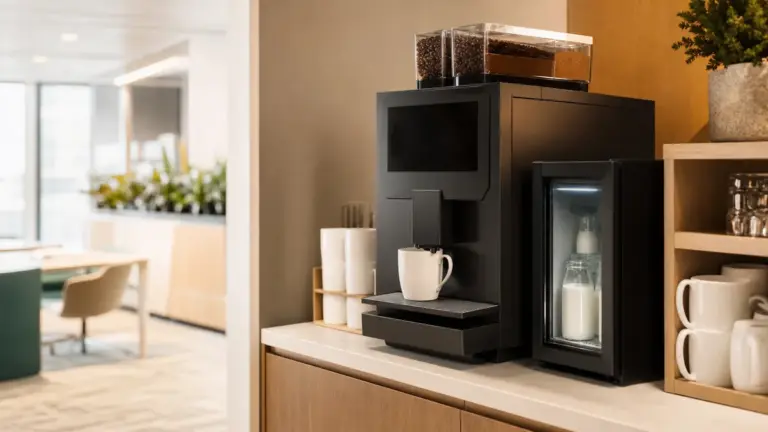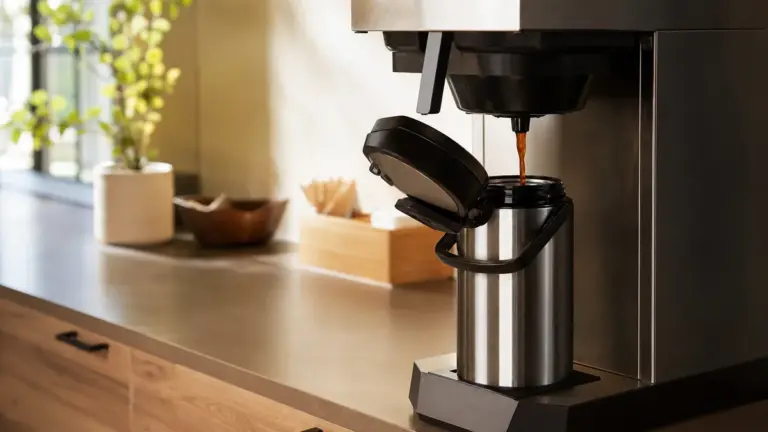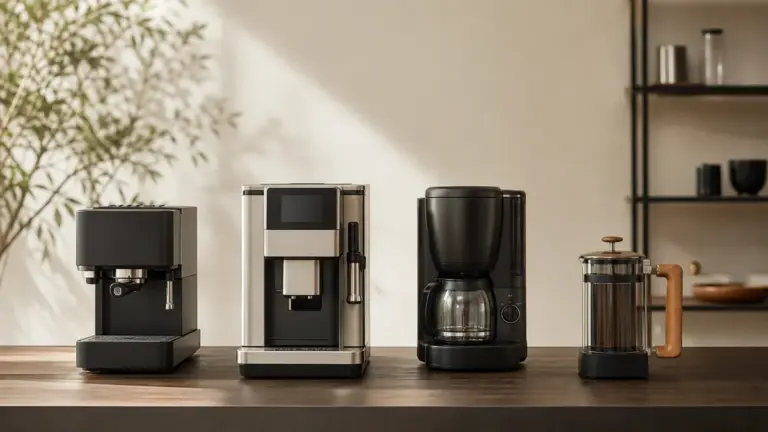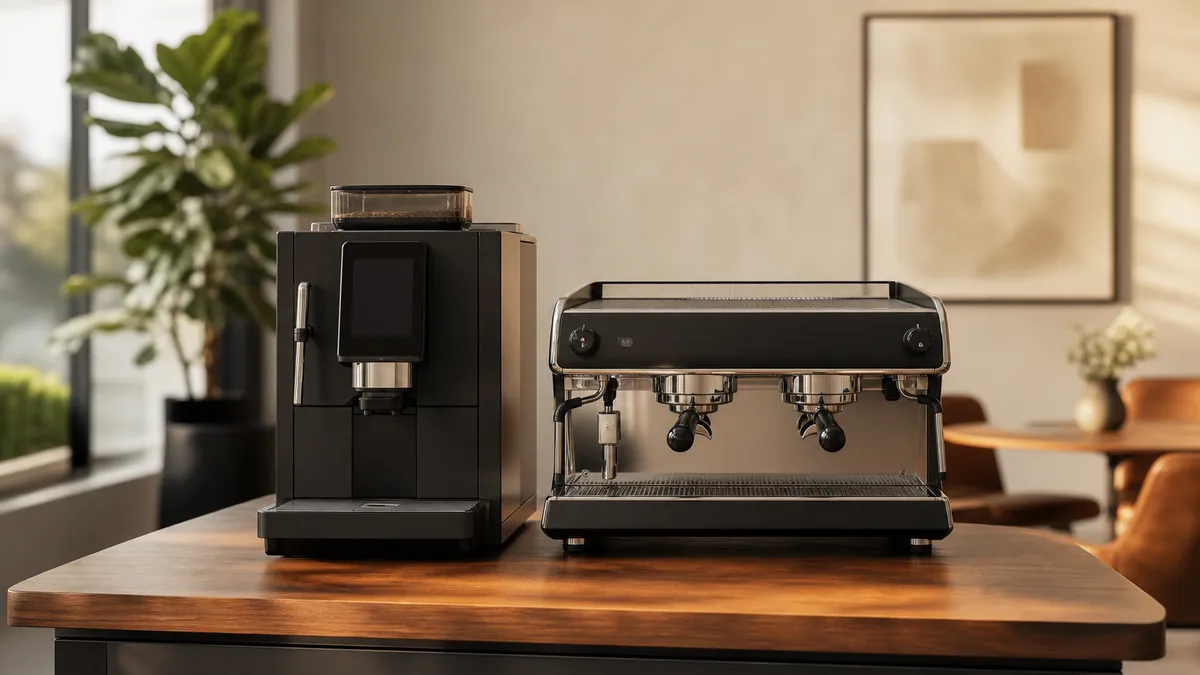
For most self-service workplaces, a bean-to-cup machine is the more practical choice; a traditional espresso machine suits an office that can provide trained operators and dependable cover. The useful distinction is push-button consistency versus greater manual control and operator skill, not ordinary coffee versus automatically superior coffee.
In short
- Choose around who will make the drinks, including during holidays and absences.
- Compare performance using your busiest break and actual drink mix, not an espresso-only output claim.
- Automatic milk preparation still needs replenishment, refrigeration where specified and scheduled cleaning.
- Neither machine category determines its electrical supply or pressure-system obligations. Check the exact configuration.
- Compare the complete operation: equipment, installation, ingredients, staff time, cleaning, maintenance and any statutory examinations.
Bean-to-cup vs traditional espresso: the practical differences
A bean-to-cup machine combines grinding and brewing inside the machine, with programmed recipes controlling preparation. A traditional machine uses a removable coffee holder, called a portafilter, which an operator fills with ground coffee and locks into the brewing head.
Here, “traditional” means a commercial portafilter machine, not necessarily a fully manual one. Many traditional machines stop the water delivery automatically, but the operator still prepares the coffee and handles milk.
The comparison below uses workplace criteria: operator availability, control, consistency, peak service, cleaning and installation. These are category-level differences, not ratings of particular models.
| Criterion | Bean-to-cup | Traditional espresso |
|---|---|---|
| Who operates it | Staff or visitors select a drink after basic instruction | Trained staff prepare each drink |
| Routine skills | Selecting recipes, replenishing supplies and responding to prompts | Grinder adjustment, dosing, tamping, extraction checks and milk steaming |
| Drink control | Adjustment within the machine’s available settings | More direct intervention in coffee preparation and milk texture |
| Consistency | Programmed preparation reduces differences between users | Depends more heavily on a shared recipe and operator technique |
| Peak service | Assess complete drink cycles and replenishment interruptions | Assess operator workflow, grinder capacity and steaming capacity |
| Cleaning | Programmes plus the manual tasks specified by the maker | Between-drink attention plus scheduled cleaning of brewing and milk equipment |
| Best fit | Shared tea points and distributed self-service | Staffed hospitality points and workplaces with reliable trained cover |
For the wider selection process, start with office coffee machines. The internal brewing sequence is explained separately in how bean-to-cup machines work.
Who operates it, and what training is needed?
Bean-to-cup is our default recommendation for an unstaffed office tea point. Users should not need to adjust a grinder or steam milk simply to get a drink. However, nominate a machine owner and a deputy to handle replenishment, cleaning and fault reporting.
A traditional setup needs a more substantial training plan. The Specialty Coffee Association’s barista curriculum covers grinder calibration, dosing, distribution, tamping, sensory assessment, milk preparation and equipment cleaning. These are working skills, not merely instructions for pressing the correct button.
Ask who will open the station, check the coffee and close it down. A machine operated confidently by one enthusiast is not yet a resilient workplace service.
Include safe operation in either handover. Hot water, steam and cleaning chemicals require instruction appropriate to the equipment.
Drink quality: consistency is not the same as control
Neither format guarantees the better-tasting drink. Assess the coffee you intend to serve, prepared by the people who will actually operate the equipment.
With bean-to-cup, ask the supplier to set up the recipes before judging the result. Evaluate espresso and black coffee as well as milk drinks: a large latte should not be the only test.
Traditional preparation gives the operator direct access to the coffee bed and milk-steaming process. That flexibility is useful when someone can recognise a problem and adjust the preparation. It is less useful when different users make uncontrolled changes.
Our judgement is that a workplace should choose traditional espresso for its usable control, not its appearance or presumed prestige. Conduct a side-by-side tasting using the intended beans, drink sizes and milk options.
Speed at peak times: test the queue, not just the machine
A daily capacity figure does not tell you how long colleagues will wait after a meeting. For example, Franke currently claims up to 200 cups daily for its new A600, but that is not a promise to deliver those drinks within a particular break.
For bean-to-cup, request a demonstration of consecutive drinks from your actual menu. Include milk changes, refilling, emptying grounds and any rinsing interruptions.
For traditional espresso, include grinding, preparing the portafilter, brewing, steaming, pouring and clearing down. Time the intended operator, not only the supplier’s demonstrator.
The matrix below is illustrative planning arithmetic, not a capacity recommendation. It assumes two drinks per person present daily, excludes visitors and does not assume that everyone drinks coffee.
| People present | Assumed drinks daily | What still needs measuring |
|---|---|---|
| 20 | 40 | Concentration around arrivals and breaks |
| 50 | 100 | Consecutive milk drinks and replenishment |
| 100 | 200 | Simultaneous demand across departments |
| 200 | 400 | Whether several service points are needed |
Record arrivals during the busiest 15 minutes. Ask each shortlisted supplier to demonstrate that workload, with the drink sizes and milk choices held constant.
Milk handling and cleaning workload
Bean-to-cup: automated preparation, assigned responsibility
Fresh-milk systems need the cooling arrangement specified by the manufacturer. Check who refills containers, manages opened milk and cleans the refrigerator and milk-contact parts.
A rinse is not necessarily a complete clean. JURA’s WE8 instructions, for example, distinguish milk-system rinsing from daily cleaning after milk use, and also require daily dismantling and rinsing of the frother. Other machines have different procedures, so obtain the exact manual.
Request a cleaning demonstration that includes preparation, chemical handling, component removal and reassembly. Record hands-on time separately from the programme’s elapsed time.
Traditional espresso: attention throughout service
Traditional milk preparation adds tasks between drinks. La Marzocco’s Linea Classic S manual requires steam-nozzle cleaning immediately after use, using a damp cloth and a short burst of steam.
Closing duties also include filters, portafilters, trays and the prescribed group-cleaning procedure. A group is the brewing head into which the portafilter locks. Automatic backflushing, where fitted, does not remove every manual task.
For either format, assess allergen cross-contact through shared milk equipment and utensils. Separate jugs alone do not establish that every shared contact surface is controlled. Agree a documented procedure rather than assuming an ordinary rinse makes a drink suitable for someone with an allergy.
Both formats also produce coffee grounds. In England, workplace food-waste separation requirements have applied since 31 March 2025, with micro-firms having until 31 March 2027. The exemption uses fewer than 10 full-time-equivalent employees across the business, not simply at one office; other UK nations have separate arrangements.
Space, power, plumbing and pressure systems
Measure the whole working station
Request an installation drawing covering the machine, grinder where separate, milk storage, water treatment, waste handling and servicing access. Include clearance for opening lids and removing containers, plus access to a suitable cleaning area.
Do not compare machine widths alone. Ask whether the worktop can support the installed equipment and whether deliveries and servicing can reach it.
Neither category guarantees a 13 A supply
“Bean-to-cup uses a socket; traditional needs three-phase” is not a reliable rule.
Franke’s published A600 technical leaflet lists configurations with single-phase supplies, including a 13 A option, and three-phase configurations. Availability and requirements depend on the version. Treat these as manufacturer-published specifications, not a substitute for a survey.
Obtain the exact UK electrical schedule and have a suitably qualified electrician confirm circuit capacity and isolation arrangements. Include milk refrigeration and other accessories in that assessment.
Check water connections and treatment
Confirm whether each proposal uses a tank or mains connection, and whether it needs a drain. Obtain a written water-treatment specification based on the site’s water and the machine maker’s requirements.
Plumbed installations in England and Wales fall under the Water Supply (Water Fittings) Regulations 1999, including backflow protection requirements. Scotland has its own byelaws and Northern Ireland its own regulations. Ask the installer to confirm the applicable requirements and any water-company notification.
Boiler examinations are configuration-specific
In Great Britain, the Pressure Systems Safety Regulations 2000 can apply to workplace coffee equipment containing steam. HSE identifies steam at any pressure as a relevant fluid.
For qualifying equipment, HSE requires a written scheme of examination and examination before use. The scheme specifies subsequent examination frequency. There is no universal annual interval to copy into every coffee-machine contract, and statutory examination is separate from routine servicing.
Nor should a thermoblock, which heats water as it passes through a heated block, be treated as an automatic exemption. Ask the supplier and competent person to confirm the exact machine’s position against HSE guidance. Northern Ireland has separate legislation.
Compare the complete cost of each setup
There is no useful category-wide winner without knowing the staffing and specification. Ask for itemised written quotations covering:
- Machine, installation, accessories and water treatment.
- Separate grinder and barista tools where needed.
- Beans, milk, cleaning materials and replacement filters.
- Energy, water and waste collection.
- Training, replenishment and cleaning time.
- Planned servicing, breakdown cover and replacement arrangements.
- Any required pressure-system scheme, preparation and examinations.
Use the same comparison period and expected number of drinks for both proposals. Allocate equipment and installation across that period, add recurring expenditure and paid staff time, then divide by expected drinks served.
Record attendance, operating days, coffee dose, milk-drink share, milk quantity and wastage assumptions. Keep VAT treatment consistent: HMRC generally zero-rates coffee and milk sold as food, while catering supplies and hot takeaway drinks follow different rules. Ask suppliers to identify VAT treatment line by line.
Hybrid options and who each approach suits
A hybrid arrangement can separate everyday self-service from staffed hospitality: bean-to-cup for general use, traditional espresso for a reception or hosted meeting service. Treat it as two operations, each needing cleaning ownership, servicing and absence cover.
A traditional machine with programmed drink volumes is another middle ground. La Marzocco’s published instructions show programmable coffee delivery and automatic cleaning functions, but these do not automate portafilter preparation or every cleaning task.
Our decision rule is:
- Choose bean-to-cup when convenient self-service and repeatable preparation matter most.
- Choose traditional espresso when trained cover is dependable and direct control will genuinely be used.
- Choose a hybrid when those requirements belong to distinct service points.
If neither suits the workplace, compare the best machine types for offices. For meeting-led black-coffee demand, investigate filter machines and bulk brewers before committing to individual espresso preparation.
FAQ
Can we use a domestic espresso machine in a small office?
Only consider it if the manufacturer confirms that the intended workplace use is permitted and supported. Low headcount does not establish suitability: demand can still arrive in a concentrated burst. Obtain written confirmation covering intended use, warranty, installation, cleaning and service support rather than relying on the machine’s size.
Should we compare the machines using the same beans?
Use the intended workplace coffee for the main comparison, with each machine properly adjusted for it. That tests the service you are considering rather than a supplier’s showcase recipe. If a supplier recommends different beans, request an additional tasting and a clear explanation, keeping drink size and milk choice consistent.
Can an automatic tamper remove the need for barista training?
No. It can automate one preparation task, but the operator still needs to understand the remaining workflow. Grinder calibration, checking extraction, milk preparation, hygiene and safe equipment use remain separate skills. Ask the supplier to demonstrate exactly which tasks are automated and which require judgement.
Where to go next
Read Office Coffee Machines to build the wider workplace specification, then How Office Bean-to-Cup Machines Work to understand what automation handles. Best Types of Coffee Machine for Offices broadens the shortlist, while Office Filter Coffee Machines and Bulk Brewers helps assess an alternative for meeting service.
Sources
-
Specialty Coffee Association, Coffee Skills Program Course Catalog, undated retrieved edition, Barista Skills sections.
https://education.sca.coffee/s/SCA-CSP-Course-Catalog.pdf -
JURA, WE8 Instructions for Use, undated retrieved edition, preparation and maintenance sections. The document is used for operating and cleaning instructions, not UK electrical specifications.
https://us.jura.com/-/media/global/pdf/manuals-na/Professional/WE8/download_manual_jura_we8_ul.pdf -
Franke Coffee Systems, The Franke A600 coffee machine, current UK product page, retrieved November 2026. Capacity is a manufacturer claim.
https://www.franke.com/gb/en/coffee-systems/products/fully-automatic-coffee-machines/a600-coffee-machine.html -
Franke Coffee Systems, A600 Product Leaflet, undated retrieved edition, technical data. Configuration-specific manufacturer specifications, not a claim about every current A600.
https://www.franke.com/content/dam/franke/language-masters/en/coffee-systems/documents/factsheets/en/EN_A600_Franke_CS_Product_Leaflet.pdf -
La Marzocco, Linea Classic S Operating Manual, MAN.29.1, version 1.0, January 2022.
https://lamarzoccousa.com/documents/linea-classic-s-manual/ -
La Marzocco, Linea Classic S Quick Start Guide, undated retrieved edition.
https://lamarzoccousa.com/documents/linea-classic-qsg/ -
Health and Safety Executive, Pressure Systems Safety Regulations 2000 (PSSR) and Introduction to pressure equipment, current guidance retrieved November 2026.
https://www.hse.gov.uk/pressure-systems/pssr.htm
https://www.hse.gov.uk/pressure-systems/about.htm -
UK legislation, The Water Supply (Water Fittings) Regulations 1999, SI 1999/1148, original instrument; Water Regs UK, Backflow Protection, current guidance retrieved November 2026.
https://www.legislation.gov.uk/uksi/1999/1148/pdfs/uksi_19991148_en.pdf
https://www.waterregsuk.co.uk/topics/backflow-protection/ -
Food Standards Agency, Precautionary allergen labelling, 2023, particularly shared equipment and cleaning guidance.
https://www.gov.uk/government/publications/precautionary-allergen-labelling/precautionary-allergen-labelling -
Department for Environment, Food & Rural Affairs, Simpler recycling: workplace recycling in England, current guidance retrieved November 2026.
https://www.gov.uk/guidance/simpler-recycling-workplace-recycling-in-england -
HM Revenue & Customs, Food products (VAT Notice 701/14) and Catering, takeaway food (VAT Notice 709/1), both updated June 2026.
https://www.gov.uk/guidance/food-products-and-vat-notice-70114
https://www.gov.uk/guidance/catering-takeaway-food-and-vat-notice-7091
This comparison was researched using manufacturer operating documents, SCA training material and official UK guidance; recommendations are editorial judgements, not findings from first-hand machine testing.
Last checked: November 2026