Choose office coffee machines by daily cup capacity using the number of people actually on site, their coffee consumption and the busiest drinking period, not total employee headcount alone. Calculate daily demand first, then check whether the machine can deliver your chosen drinks quickly enough without repeated refilling or emptying.
In short
- Use 1, 2 and 3 coffees per person attending as low, middle and high planning scenarios, not measured UK averages.
- Add visitors, meetings and training days separately, and size for a credible busy day.
- Record the busiest 15 minutes as well as the busiest hour.
- Compare drink-specific hourly output, not an espresso figure against a milk-heavy menu.
- Check beans, water, milk, grounds drawer and drip tray together: the first limit reached determines the next interruption.
Turn attendance into daily coffee demand
Start with this calculation:
Daily coffees = people attending × proportion drinking coffee × coffees per coffee drinker + visitor and meeting coffees.
Alternatively, use coffees per person attending, including non-drinkers in the average. Do not mix these two approaches or apply the non-drinker adjustment twice.
For example, assume 60 people attend, 75% drink coffee, each coffee drinker has 2 coffees, and visitors need 10 coffees:
60 × 0.75 × 2 + 10 = 100 coffees that day.
These are illustrative assumptions, not consumption statistics. Replace them with your attendance records, a short staff survey and, where available, existing machine counters.
Headcount and daily cups matrix
The matrix assumes that consumption averages 1, 2 or 3 coffees across everyone attending. It excludes visitors and meetings, which must be added separately.
| People actually on site | 1 coffee per person | 2 coffees per person | 3 coffees per person |
|---|---|---|---|
| 10 | 10 | 20 | 30 |
| 25 | 25 | 50 | 75 |
| 50 | 50 | 100 | 150 |
| 100 | 100 | 200 | 300 |
| 150 | 150 | 300 | 450 |
Count demand at each tea point, not just across the building. A machine on another floor should not be treated as spare capacity unless staff can realistically use it.
Our suggested approach is to examine several representative working weeks, including the busiest attendance day and any regular events. A quiet Friday average is a poor specification for a crowded Tuesday.
Match daily cup capacity to the office
Use the following as editorial shortlisting bands, not industry-standard machine classes:
- Up to 50 coffees daily: consider compact professional machines where demand is spread out and someone can handle replenishment.
- 51 to 100 daily: seek an appropriate professional daily recommendation, then examine water supply and milk-drink throughput closely.
- 101 to 200 daily: compare higher-capacity machines with splitting demand between two tea points.
- More than 200 daily: assess a high-volume installation or several machines, with an explicit replenishment and cleaning plan.
Select a daily recommendation that covers your credible busy day, with an agreed allowance for growth or uncertainty. There is no universal spare-capacity percentage that can replace a proper demand assessment.
These bands do not dictate machine type. For the wider choice, start with office coffee machines; for larger installations, see high-volume use.
Separate manufacturer ratings from real use
A recommended daily output and an hourly output answer different questions. The first helps position the machine for its intended workload; the second describes production under stated conditions.
The examples below show why neither figure should be used alone. Manufacturer-claimed specifications checked in November 2026; confirm the exact model, configuration and current UK specification before ordering. These are capacity examples, not a performance ranking.
| Published model | Recommended maximum daily output | Claimed cappuccinos per hour | Beans, tank and grounds container |
|---|---|---|---|
| JURA W8, INTB 15786 | 50 | 50 | 500 g; 3 litres; approximately 25 servings |
| JURA X10, EA 15546 | 100 | 72 | 500 g, optionally 1 kg; 5 litres; approximately 40 servings |
| WMF 1100 S | 80 | 105 | Standard bean hopper 550 g each; approximately 4.5 litres or fixed water supply; confirm grounds capacity for the supplied version |
The hourly figures are published against DIN 18873-2, a standard used for the stated output measurements. They are not a promise that an office queue will move at that speed.
WMF’s linked brochure says performance was determined with a fixed water connection and depends on cup size. Its UK specification page provides separate drink-specific hourly figures, so request the applicable test conditions rather than interpreting a headline figure in isolation.
Specify the drinks, sizes, strength settings, milk system and electrical configuration in writing. A demonstration should reproduce those choices, not substitute smaller drinks to produce a more impressive result.
Check peak-hour demand and consecutive drinks
An office needing 100 coffees across the day may still struggle if a large group arrives together. Daily demand measures workload; peak demand measures whether people can get back to their desks promptly.
Suppose 30 coffees are needed in 15 minutes:
30 ÷ 15 × 60 = 120 coffees per hour equivalent.
That does not mean demand continues at that rate all day. It means the machine must complete that particular batch within the available window.
Include milk preparation and user time
The JURA W8’s published output is 83 espressos per hour, compared with 50 cappuccinos. The latter equates arithmetically to an average interval of 72 seconds per cappuccino under the stated output conditions, not a guaranteed individual preparation time.
Milk heating and foaming add work to the recipe, although the extent to which stages overlap depends on the machine. Do not assume that every milk drink has the same preparation time, or that two visible outlets mean two milk drinks can always be prepared simultaneously.
For milk-system choices, read fresh milk versus powdered milk.
Ask for a consecutive-drink test
Set a demonstration workload using your actual menu and mugs. For an illustrative 20-drink test, request 12 milk drinks and 8 black coffees, made consecutively.
Time from the first selection until the final drink is ready. Record:
- Cup placement, selection and collection time.
- Any pauses between drinks.
- Water, bean and milk replenishment.
- Grounds-drawer and drip-tray emptying.
- Automatic rinses and other interruptions.
Do not extrapolate a short test into a guaranteed all-day output. Use it to establish whether the proposed configuration handles your particular rush.
Calculate the interruptions, not just the drinks
Bean hopper capacity
Divide usable bean capacity by the programmed dose.
For an illustrative 500 g hopper and 10 g per coffee:
500 ÷ 10 = 50 coffees in theory.
At 14 g, the same calculation gives approximately 35 complete coffees. These examples assume one grinding and brewing cycle per drink, with no losses; recipes using additional cycles need separate accounting.
Ask which hopper supplies each drink. Two hoppers containing different coffees do not necessarily provide one interchangeable reserve.
Water tank capacity
A tank’s stated volume is not the same as water available for finished drinks.
For an illustrative 3 litre tank and 150 ml of machine-supplied water per drink:
3,000 ÷ 150 = 20 drinks before allowing for rinsing, retained water or any unusable reserve.
This is an upper-bound calculation, not an operational promise. Use the coffee and hot-water components of each recipe, not the final drink volume including milk.
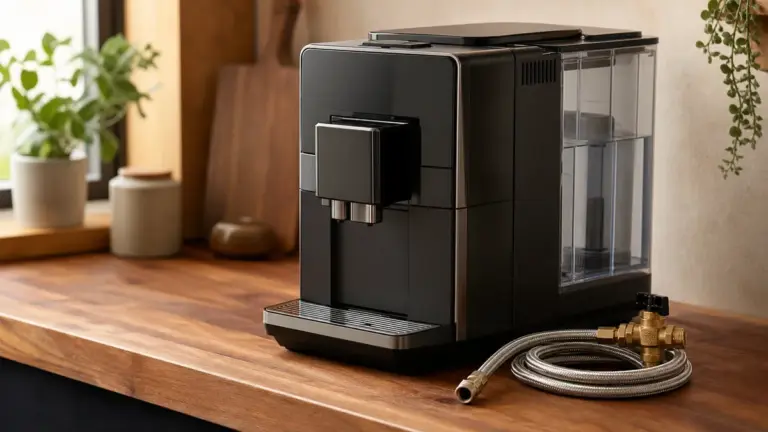
If repeated filling would disrupt the office, compare plumbed-in and tank-fed machines. Confirm drainage separately: supplying fresh water does not, by itself, remove wastewater.
Grounds drawer and drip tray
The grounds drawer collects spent coffee cakes, often called pucks. Published examples above hold approximately 25 or 40 servings, but these figures do not establish a universal “typical” range for office machines.
Count brewing cycles, not just finished drinks. A recipe using an extra brewing cycle can consume drawer capacity faster than a simple one-cycle recipe.
Ask for the drip tray’s usable volume and its emptying procedure. Franke’s published technical sheet for an A600 configuration, for example, specifies a 3 litre drip tray, illustrating that wastewater capacity is a separate specification from the fresh-water tank.
A larger tray is useful only if the arrangement suits the installation. Check whether it drains automatically, where rinses discharge and whether staff have safe access for emptying.
Milk and replenishment ownership
For an illustrative peak of 20 milk drinks, each using 120 ml of liquid milk, the required milk is:
20 × 120 = 2,400 ml, or 2.4 litres, before allowing for system losses or cleaning.
Use liquid milk consumption, not the volume of expanded foam. Agree who checks supplies before the rush and who responds when a refill or emptying prompt appears.
Build a workplace-specific operating comparison
Compare offers using the same attendance, drink mix and operating period. Ask for itemised written quotations, rather than an unexplained package total.
Include the machine and any finance agreement, installation, water connection and drainage, filtration, milk cooling, servicing, cleaning products, beans, milk, electricity and staff handling time. Ask each supplier to state what is included, excluded and subject to VAT.
To calculate your own cost per cup, add the relevant expenditure over a defined period and divide by the coffees actually served during that period. Keep the VAT basis consistent and separate coffee from other drinks if their consumption is included in the same contract.
Before choosing, have the supplier confirm:
- The proposed daily workload and busiest drinking window.
- Drink sizes, doses and expected milk-drink proportion.
- Consecutive-drink performance on the supplied configuration.
- Expected refill and emptying intervals.
- Installation requirements, cleaning responsibility and service arrangements.
Use the machine comparison guide to organise those responses. The strongest capacity specification describes both how many coffees are needed and how the office will keep them flowing.
FAQ
Should we count tea and hot chocolate in the coffee total?
Record them separately, then include their demands on any shared equipment. A hot-water drink may use tank water and dispensing time without using coffee beans or producing a puck. Give the supplier separate daily and peak totals for coffee, hot water, milk-only drinks and chocolate, and ask how the proposed configuration handles the combined workload.
Does a double-strength drink count as two cups?
Not necessarily: the relevant question is how the machine makes it. A stronger recipe might increase the dose within one brewing cycle or use an additional cycle. Record finished drinks for user demand, but ask the supplier to translate your recipes into bean consumption, brewing cycles and grounds-container usage.
Is buying two smaller machines better than one larger machine?
Two machines are worth comparing when queues or the location of tea points are the main problem. They provide separate places to make drinks, but also create separate cleaning and replenishment tasks. Assess each machine against its own peak demand, and check what remaining capacity would be available if one were out of service.
Where to go next
Read Office Coffee Machines for the wider buying framework, then Plumbed-In vs Tank-Fed Coffee Machines to decide how replenishment should work. Office Coffee Machines for High-Volume Use covers larger workloads, while Office Coffee Machine Comparison Guide helps turn your office coffee machine daily cup capacity requirement into a consistent supplier brief.
Sources
-
JURA, “W8, Dark Inox, INTB 15786”, current product specifications, undated, retrieved November 2026. Daily recommendation, drink-specific hourly output, hopper, tank and grounds-container figures.
https://uk.jura.com/en/professional/machines/w8-dark-inox-intb-15786
Manufacturer claims include 50 daily preparations, 83 espressos or 50 cappuccinos per hour, a 500 g hopper, 3 litre tank and approximately 25 grounds servings. -
JURA, “X10, Dark Inox, EA 15546”, current product specifications, undated, retrieved November 2026. Daily and hourly output and replenishment capacities.
https://www.jura.com/en/professional/machines/x10-dark-inox-ea-15546
Manufacturer claims include 100 daily preparations, 72 cappuccinos per hour, a 5 litre tank, 500 g hopper with optional 1 kg capacity and approximately 40 grounds servings. -
WMF, “WMF 1100 S: Specifications & downloads”, UK product page, undated, retrieved November 2026. Recommended daily output, DIN-referenced drink output, hoppers and water supply.
https://www.wmf-coffeemachines.com/en_uk/products/fully-automatic-coffee-machines/wmf-1100-s/specs/
The page states a recommended 80 cups daily, 105 cappuccinos per hour, standard 550 g bean hoppers and approximately 4.5 litre tank or fixed water supply. -
WMF, “WMF 1100 S” brochure, item 63.8055.0391, undated, retrieved November 2026. Published qualification of performance conditions.
https://assets.wmf-coffeemachines.com/f/267357/x/68fa86ddec/wmf-coffee-machines-1100s-brochure-en.pdf
Its performance note specifies a fixed water connection and dependence on cup size. -
Franke Coffee Systems, “A600: Technical Data”, configuration-specific product leaflet, undated, retrieved November 2026. Example of separately specified wastewater capacity.
https://www.franke.com/content/dam/franke/language-masters/en/coffee-systems/documents/factsheets/en/EN_A600_Franke_CS_Product_Leaflet.pdf.coredownload.pdf
The leaflet specifies a 3 litre drip tray for the described internal-tank arrangement, with configuration restrictions. -
WMF, “User Manual: WMF 1100 S”, North America English, series 1120, revision 06.2018, pages 37 and 38. Operational evidence for interruptions during grounds removal and tray emptying, not UK installation guidance.
https://assets.wmf-coffeemachines.com/f/267357/x/0261841b51/wmf-1100s-operating-instructions-en-us.pdf
The manual describes dispensing being blocked while the grounds container is removed, and emptying prompts for a monitored drip tray without drainage.
This article was researched from retrieved manufacturer specifications and operating documents; planning bands, example workloads and calculations are explicitly editorial illustrations, not first-hand testing or measured consumption averages.
Last checked: November 2026