Office coffee machine water filtration should be chosen from a test of the incoming water and the machine manufacturer’s requirements, not simply from whether the postcode is described as hard-water. The right treatment controls scale and unwanted tastes while keeping water chemistry suitable for brewing and the machine’s internal components.
In short
- Measure total hardness and alkalinity separately: they describe different properties.
- A carbon filter can reduce chlorine taste without providing meaningful scale protection.
- Match cartridge capacity to measured water quality, bypass setting and total water use, including rinsing.
- Replace cartridges at their capacity limit or the manufacturer’s time limit, whichever comes first.
- Filtration does not automatically remove the need for descaling, servicing or daily cleaning.
Why water matters
Water treatment has two jobs: helping coffee taste right and protecting the equipment that heats it. A filter that improves drinking-water flavour is not necessarily a suitable scale-control system.
Calcium and magnesium contribute to hardness. When water is heated, its chemistry can encourage mineral deposits inside the machine. Treatment therefore needs to address the actual water composition, rather than merely remove visible particles.
Alkalinity matters for flavour because it neutralises acids. Excessive buffering can make a coffee’s bright acidity less distinct; removing too much buffering can move the taste in the opposite direction. This is why changing the water can change the cup even when the beans and machine settings remain unchanged.
Treat filtration as part of the wider installation and maintenance plan, with a named person responsible for checks and replacements.
Check the local supply, then test at the machine
Start with the water supplier’s published hardness and water-quality information for the office postcode. Thames Water, for example, provides a postcode-based water-quality lookup. Use your own supplier’s results, not another office’s reading or a national map.
Then ask the installer to test the cold feed at the intended connection. Establish whether it already passes through a building softener or other treatment system.
Record:
- Total hardness and alkalinity.
- The units used for each result.
- Chlorine or chloramine treatment, confirmed with the water supplier where necessary.
- Any additional parameters specified by the machine maker, such as chloride, pH or conductivity.
Chloride is not the same thing as chlorine disinfectant. A cartridge selected for chlorine taste reduction should not be assumed to solve a chloride problem.
Hardness, alkalinity and the units on the report
Total or general hardness, often labelled GH, describes dissolved calcium and magnesium together.
Alkalinity describes the water’s capacity to neutralise acid, usually dominated by bicarbonate in drinking water. It is not the same measurement as pH.
Carbonate hardness, often labelled KH, is the portion of hardness associated with carbonate and bicarbonate. Strictly, it is limited by whichever is lower: total hardness or alkalinity, when both are expressed on the same calcium-carbonate basis. Filter literature sometimes uses “temporary hardness” or “KH” as shorthand for alkalinity, so follow the specified test method.
Water reports commonly express hardness as milligrams per litre as calcium carbonate, written mg/L as CaCO₃. German degrees, °dH, and Clark degrees are alternative scales, not interchangeable numbers. Check the report’s conversion information before entering a result into a machine or filter calculator.
How SCA water guidance applies
The Specialty Coffee Association’s SCA-102-2024 standard gives these water specifications for cupping, the controlled tasting method used to assess coffee:
- Calcium hardness: 50 to 175 mg/L as CaCO₃.
- Alkalinity: approximately 40 to 70 mg/L as CaCO₃.
- pH: 6 to 8.
- No chlorine.
These are cupping specifications, not a universal boiler-water specification. Calcium hardness also excludes magnesium, so it should not be substituted directly for total hardness.
For an office machine, follow the manufacturer’s operating limits first, then seek good flavour within them. As a manufacturer-published example, Franke’s A600 product leaflet specifies total hardness of 70 to 140 mg/L and carbonate hardness of 50 to 105 mg/L. Those figures illustrate why a generic coffee-water target cannot replace the requirements for the actual model.
Choose the treatment for the problem
Choose by treatment function, compatibility, capacity and required flow, rather than cartridge size alone. The following comparison describes treatment categories, not recommendations for particular brands.
| Treatment | Main function | Where it may suit | Main limitation |
|---|---|---|---|
| Particle filtration | Captures suspended material | A feed needing sediment protection | Does not remove dissolved hardness |
| Activated carbon | Reduces specified taste and odour substances, including chlorine | Water already suitable for the machine’s mineral requirements | Carbon alone does not soften water |
| Ion-exchange decarbonisation | Reduces carbonate hardness and adjusts mineral balance | Hard water needing controlled scale reduction | Capacity and settings depend on incoming chemistry |
| Sodium-cycle softening | Exchanges calcium and magnesium for sodium | Only where the machine maker approves it | Does not remove alkalinity in the same way as decarbonisation |
| Reverse osmosis, or RO | Uses a membrane to reduce dissolved salts | Water requiring broader mineral correction | Needs an appropriately designed post-treatment system |
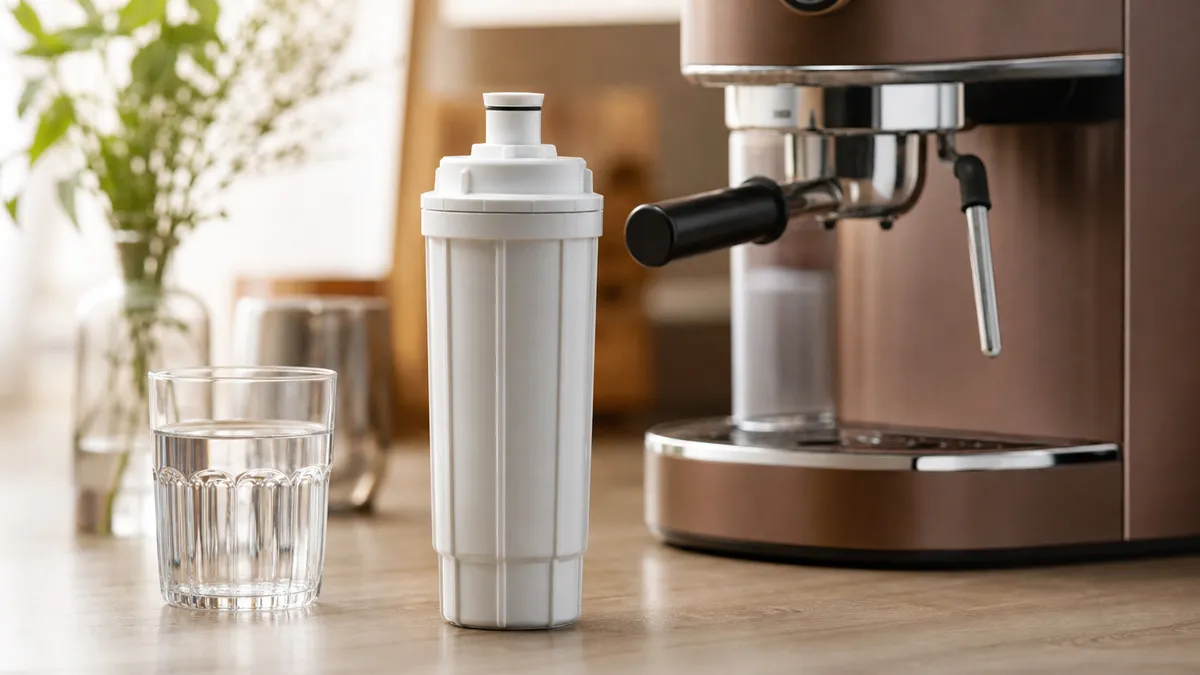
Many commercial cartridges combine several functions. Read the full specification rather than assuming “filtered” means softened, dechlorinated and suitable for every machine.
For chloramine-treated supplies, require an explicit chloramine-reduction specification at the intended flow. Pentair explains that chloramine reacts more slowly with activated carbon than free chlorine, requiring longer contact. A general chlorine-reduction claim is not enough.
What the bypass setting does
Commercial decarbonising systems such as BRITA PURITY C Quell ST and BWT bestmax use ion exchange with an adjustable bypass. Part of the water avoids the hardness-reduction stage and blends with the treated stream, retaining some of the incoming mineral content.
BRITA offers PURITY C heads with 0 to 70% bypass settings. BWT’s bestmax documentation instead identifies head positions 0 to 3. These are different adjustment systems, not equivalent scales.
The installer should select the setting from the cartridge’s application table and confirm the resulting water meets the machine specification. Do not increase bypass simply to extend cartridge life. Nor should every bypass be understood as completely unfiltered water: BWT states that its bestmax system also filters the bypass stream.
Size the cartridge and set a changing schedule
Published capacity is conditional. It depends on the cartridge, incoming water chemistry, application and bypass setting.
For example, BRITA’s April 2023 capacity table lists 4,000 litres for a PURITY C300 Quell ST at 10 °dH carbonate hardness and 40% bypass, under its coffee, espresso and vending category. That is a manufacturer-published capacity under stated conditions, not a guarantee for every office.
For an illustrative planning calculation, assume:
- The applicable cartridge capacity is 4,000 litres.
- Total water passing through it averages 20 litres per working day.
- That total includes drinks, machine rinses and other water drawn through the cartridge.
- Feed chemistry and bypass remain unchanged.
Then 4,000 litres ÷ 20 litres per working day = 200 working days. The calendar replacement limit may arrive first.
Use measured throughput where possible. Headcount and drink counts alone do not capture all water use, and a change in attendance can invalidate the original estimate.
BRITA’s PURITY C manual requires replacement at the stated capacity or no later than 12 months after commissioning, whichever comes first. BWT’s bestmax data sheet recommends regular replacement after six months, with replacement no later than 12 months, or when capacity is reached. Apply the instructions for the fitted product rather than adopting either interval universally.
Commissioning and replacement checklist
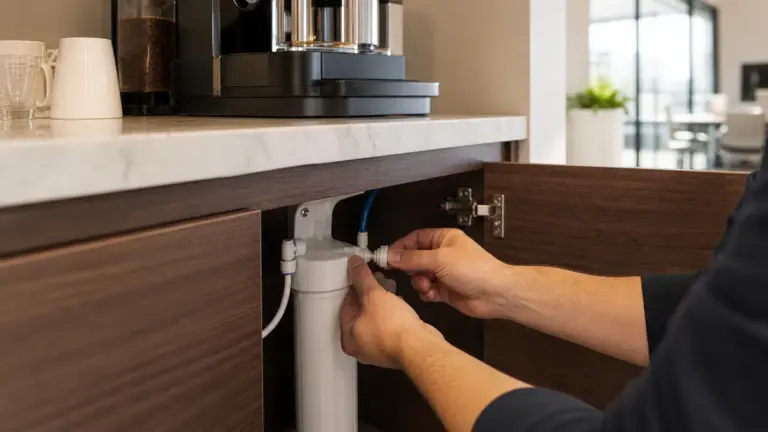
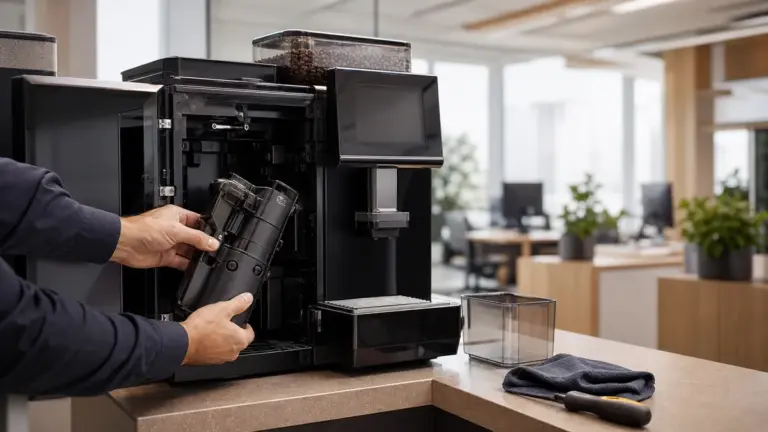
Have installation and cartridge replacement carried out by personnel authorised or trained for the system.
- Confirm the machine requirements. Obtain the model-specific water limits and permitted treatment arrangements.
- Test the incoming cold feed. Record hardness, alkalinity and any additional required parameters.
- Select the cartridge and head. Check application, flow, pressure, capacity and access for replacement.
- Set the bypass. Use the measured result and the correct manufacturer table.
- Flush and check for leaks. Follow the cartridge-specific commissioning instructions, not a universal flushing volume or time.
- Verify and record. Check treated cold water against the machine requirements, then log installation date, settings, readings, capacity and replacement deadline.
Agree the connection arrangements through the installation guide and plumbing requirements. Leave the filter accessible rather than buried behind cupboards.
After office closures, follow the filter maker’s stagnation and flushing instructions. A machine’s normal rinse should not automatically be treated as a substitute.
What filtration changes about taste and descaling
Correct treatment reduces the scale-forming load entering the machine. It does not establish that existing deposits have disappeared or that the manufacturer’s descaling programme can be abandoned.
Follow the model’s instructions and service advice, including how its hardness setting should be configured with the chosen filtration. Use the separate descaling and servicing guide for the maintenance procedure.
For flavour checks, keep beans and drink settings unchanged while comparing water treatment. This gives a more useful comparison than changing several variables together.
| Symptom | Possible water-related cause | Next check or action |
|---|---|---|
| Chlorine-like taste persists | Unsuitable media, exhausted cartridge or inadequate contact | Confirm disinfectant type and cartridge specification |
| Scale continues appearing | Exhausted capacity, excessive bypass or incorrect sizing | Retest feed and treated water; review throughput |
| Flow falls after replacement | Installation restriction or incomplete commissioning | Have the installer check connections and flushing |
| Coffee loses its bright acidity | Alkalinity may be providing excessive buffering | Measure alkalinity before changing treatment |
These are diagnostic leads, not proof of the cause. Filtration also does not replace daily cleaning and hygiene.
Avoid removing too much
The aim is suitable water, not the lowest possible mineral reading.
Low-buffer, highly demineralised water can be aggressive towards machine materials. La Marzocco warns that very pure water can cause corrosion and may also fail to operate some water-detection sensors.
However, sodium-softened water and unbuffered RO water are not chemically identical. Sodium-cycle softening exchanges hardness minerals; it does not necessarily remove alkalinity. Avoid treating “soft water causes corrosion” as a complete diagnosis.
Where RO is justified, have the supplier specify blending or remineralisation to meet the machine’s requirements. Ask for both hardness and alkalinity results: neither one alone establishes that the treated water is suitable.
Assess filtration costs without guessing
Request itemised written quotations covering the filter head, cartridges, installation, testing, monitoring, replacement visits and disposal arrangements. For RO, also ask about prefilters, membranes, post-treatment, servicing, electricity, feed-water consumption and reject water.
Compare proposals over the same operating period and water demand. Calculate cartridge replacements from both expected throughput and the calendar limit, then add the other stated items. Ask whether installation and replacement labour are included, and require the quotation to state its VAT basis.
Office coffee machine water filtration is easier to manage when the quotation includes a commissioning record, a replacement trigger and a clearly assigned maintenance responsibility.
FAQ
Is bottled water a suitable alternative for a tank-fed office machine?
Bottled water is suitable only if its composition meets the machine manufacturer’s requirements. A sealed bottle does not establish the right hardness, alkalinity or chloride content. Check the published analysis and obtain the supplier’s approval where necessary, rather than assuming mineral water or very low-mineral water is automatically the better choice.
Should we automatically use the office building’s softened water?
No, first check the machine maker’s instructions and identify the building’s treatment system. Franke’s A600 leaflet, for example, calls for untreated drinking-quality water at the installation side where possible, rather than water from a household decalcification system. The coffee machine may require a dedicated feed with its own specified treatment.
Can a filter make water safe during a boil-water notice?
Do not assume a coffee-machine filter makes affected water safe. BRITA’s instructions require users to follow official boil-water advice and include actions for the filter system afterwards. Follow the water supplier’s notice and obtain restart instructions from the machine and filter suppliers before returning the equipment to normal use.
Where to go next
Read Office Coffee Machine Installation Guide and Plumbing and Electrical Requirements before agreeing the connection and filter position. Use Office Coffee Machine Descaling and Servicing to plan scale-related maintenance, alongside Office Coffee Machine Daily Cleaning and Hygiene for the cleaning tasks that water treatment cannot replace.
Sources
- Specialty Coffee Association, SCA-102-2024: Coffee Value Assessment, Sample Preparation and Tasting Mechanics, 2024, Table 2 and section 7.4. Standard PDF.
- Specialty Coffee Association, Water and Coffee Acidity: How to Adapt Your Water for Different Extraction Methods, 25 Magazine, issue 9, publication year not displayed on the retrieved page. Technical article.
- Thames Water, Water quality, undated live guidance. Supplier guidance and postcode lookup.
- Albion Water, Your water quality, undated live guidance, hardness-unit tables. Supplier guidance.
- Franke Coffee Systems, A600: The all-round performer, undated retrieved product leaflet, water-connection requirements. Manufacturer PDF.
- BRITA, PURITY C Quell ST, undated live product specification. Manufacturer specification.
- BRITA, Table of bypasses and capacities: PURITY C Quell ST, April 2023. Capacity-table PDF.
- BRITA, PURITY C Water Filter System: Manual, revision July 2023. Instruction-manual PDF.
- BWT water+more, BWT bestmax: Filter system for water optimization, December 2023 data sheet. Manufacturer PDF.
- Pentair, Foodservice FAQs, undated live technical guidance, sections on carbon filtration, chloramines and softening. Manufacturer guidance.
- La Marzocco, La Marzocco Water Specifications, undated live UK technical guidance. Manufacturer guidance.
Research combined current supplier guidance, SCA technical material and manufacturer documents; capacity figures are published specifications, not independent performance tests.
Last checked: November 2026