An office coffee machine needs an electrical supply matched to its exact model and, if it is mains-fed, a drinking-water connection with suitable isolation and backflow protection. Some machines also need a permanent drain: confirm all three services against the manufacturer’s installation sheet before preparing the tea point.
In short
- A standard UK BS 1363 socket is rated at 13 A, roughly 3 kW, but the machine’s specified connection takes precedence.
- Higher-output machines may need an industrial socket or a hardwired connection, sometimes with a three-phase supply.
- Water pressure, flow and connector size are model-specific. Do not treat 1.5 to 6 bar or a washing-machine-style valve as universal requirements.
- Backflow protection must suit the appliance and its contamination risk, including any relevant cleaning arrangements.
- Use competent installers, keep isolation points accessible and agree who handles water-supplier notification before work begins.
Start with the exact machine specification
Request the installation sheet for the precise UK machine configuration, not just a brochure for the model family. Record its electrical rating, connection method, water requirements, drainage arrangement and any separately powered accessories.
The distinction matters because machines sharing a name can have different service requirements. Franke’s published A600 leaflet, for example, lists both single-phase and three-phase configurations with different electrical ratings.
Establish whether the machine uses a refillable tank or a permanent water connection, and whether waste collects in a removable tray or drains away. Do not assume that a mains-fed machine necessarily has an external drain.
For the wider sequence, including positioning and handover, see the installation guide. This article concentrates on the services beneath and behind the machine.
Electrical requirements: sockets, circuits and isolation
When a standard socket is suitable
A standard UK BS 1363 socket provides a 13 A connection, approximately 3 kW. That is a useful first screening figure, not permission to connect any appliance below that wattage: follow the manufacturer’s specified voltage, current, plug and protective arrangements.
For a machine supplied for connection through a UK plug, plan a suitable nearby socket rather than relying on a trailing extension or multiway adaptor. Include the milk fridge, cup warmer and other accessories in the electrical survey.
An empty socket does not establish that the circuit has enough spare capacity. Ask the electrician to assess the existing installation and the other equipment it supplies, especially heating appliances used at the same time.
Higher-output machines
Some configurations need a 16 A or 32 A industrial connection, often described as a blue CEE or “Commando-style” connection for a suitable single-phase supply. Others require hardwiring through an appropriate isolator. These are possible connection arrangements, not interchangeable upgrades.
Three-phase equipment needs the specified three-phase supply. A larger single-phase socket cannot substitute for it.
Have a competent electrician confirm:
- Whether the existing circuit is suitable or a dedicated circuit is needed.
- Cable sizing, earthing and protective devices.
- Appropriate residual current device protection, usually abbreviated to RCD.
- The required socket or hardwired connection.
- A safe, accessible means of electrical isolation.
Do not select a circuit breaker, replace a plug or use an adaptor simply to make an incompatible machine fit the available outlet.
Inspection is risk-based
In Great Britain, electrical equipment at work must be maintained to prevent danger. HSE explicitly says that annual portable appliance testing, commonly called PAT testing, is not universally required by law.
Set inspection and testing intervals according to the equipment, environment, use and likelihood of damage. Staff should report damaged cables, discolouration, overheating or repeated tripping rather than treating a dated test sticker as proof that everything remains safe.
Water pressure, flow and connections
Use a drinking-water supply that meets the machine manufacturer’s requirements. Pressure is only part of the specification: the machine also needs adequate flow while it is filling.
Static pressure is measured with no water flowing. Flow pressure, sometimes called dynamic pressure, is measured while water is being drawn. A satisfactory static reading does not establish that the supply will perform adequately in use.
These published manufacturer requirements show why a generic specification is unsafe:
| Machine documentation | Claimed water requirement | Connection detail |
|---|---|---|
| WMF 1300 S planning information | At least 2 bar flow pressure at 2 litres per minute; maximum 6 bar | 3/8-inch hose connector with mains tap |
| Franke A600 product leaflet | 0.8 to 8 bar; flow greater than 0.1 litres per second | G 3/8 union nut |
| JURA GIGA X8c instructions, generation 2 | Maximum inlet pressure 8 bar | G 3/4 connection |
These are manufacturers’ published requirements, checked in November 2026, not independently measured performance or a specification for every current variant. Obtain the installation sheet supplied for the machine being installed.
The suggested 1.5 to 6 bar range is therefore not a universal office-coffee rule. Nor should a contractor automatically terminate the supply with a 15 mm compression fitting or 3/4-inch BSP washing-machine-style valve: pipe size and appliance thread are different specifications, and the final connection must match the approved installation arrangement.
Ask the installer to measure pressure and flow at the proposed connection point and assess any restrictions introduced by the selected treatment equipment. If pressure regulation or other alterations are necessary, have them designed rather than improvised.
For treatment selection, summarise the machine’s water specification and follow the water filtration guide.
Water fittings regulations and backflow protection
Which rules apply?
The relevant water fittings framework differs across the UK:
- England and Wales: Water Supply (Water Fittings) Regulations 1999.
- Scotland: Water Supply (Water Fittings) (Scotland) Byelaws 2014.
- Northern Ireland: Water Supply (Water Fittings) Regulations (Northern Ireland) 2009.
These requirements protect drinking-water supplies against contamination and other problems arising from unsuitable fittings or installations. A manufacturer’s connection diagram does not remove the need to comply with the local framework.
Assess the appliance, not just the supply hose
Backflow is water moving upstream towards the supply. Protection must address both possible contamination and the way reverse flow could occur.
Fluid categories classify contamination risks from category 1, wholesome drinking water, to category 5, a serious health hazard. The appropriate protection depends on the actual appliance and installation, not simply its description as a coffee machine.
Ask the installer to document:
- The highest relevant downstream fluid category.
- The machine’s built-in protection and evidence supporting it.
- Any additional external protection required.
- How the arrangement addresses cleaning chemicals or other potential contaminants.
A check valve is not a universal answer. Water Regs UK’s specifications rate an EA single check valve for category 2 protection; an appropriate double check valve can protect against category 3 risks. Higher risks require suitable alternatives.
Do not assume that every coffee machine is category 3, or that adding a double check valve always makes the connection compliant. Where the documentation is unclear, obtain the local water supplier’s decision before connection.
WRAS approval and notification
Specify fittings with traceable evidence that they meet the applicable requirements. WRAS approval is one route to demonstrating product suitability, but the legal requirement is compliance, not possession of that particular brand of approval.
Check the actual product approval and its installation conditions where WRAS-approved fittings are proposed. Product certification alone does not establish that the completed installation complies.
Also establish whether advance notification and consent are required. Water Regs UK warns that work permitted without notification at mains-supplied non-domestic premises is limited. Do not assume that employing an approved contractor exempts every part of the proposed work.
Isolation valves, drains and access
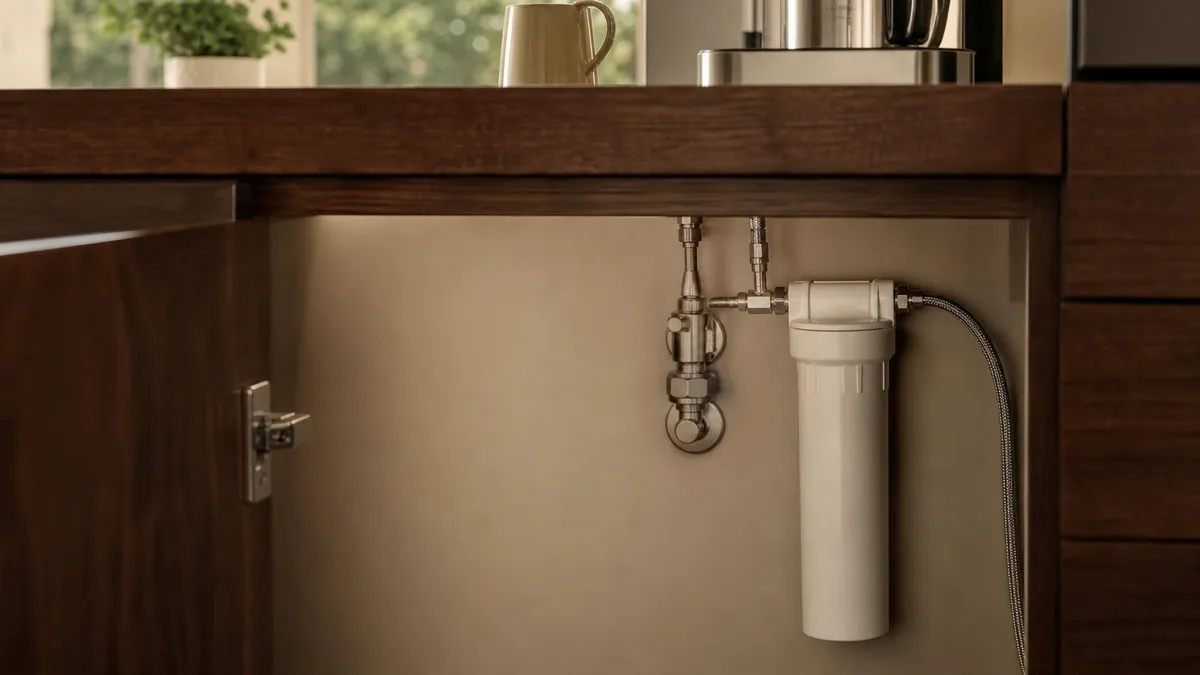
Provide an accessible water isolation valve so the machine supply can be shut off without dismantling the tea point. Leave enough access to inspect connections and service the filter in accordance with its instructions.
WMF’s 1300 S planning information specifically calls for an easily accessible water tap below the counter. Treat accessibility as a design requirement, not something to solve after cupboards are filled.
Where drainage is required, follow the specified hose size, fall and connection arrangement. For example, WMF specifies a minimum DN 19 drain tube, a downward slope of 2 cm per metre and a funnel siphon for the documented installation. Those figures belong to that machine’s instructions, not every office appliance.
Have the plumber confirm the trap and any required free-discharge or air-break arrangement. Avoid routing that defeats the manufacturer’s required fall, and leave the connection accessible for inspection.
At commissioning, ask the engineer to demonstrate drainage during the relevant operating and cleaning cycles. A permanently drained tray still needs the cleaning described in the daily cleaning and hygiene guide.
Who may do the work?
Use a competent electrician for new circuits, fixed wiring, industrial outlets and hardwired connections. Competence must cover the particular work: being able to connect a machine does not necessarily establish competence to alter the building’s electrical installation.
Use a competent plumber or appropriately qualified appliance installer for the water connection and drainage. WaterSafe-listed businesses offer a practical route to finding approved plumbing contractors, although approved-scheme membership is not universally mandatory.
Agree responsibilities in writing. WMF’s planning information, for example, separates the owner’s preparatory building-services work from the service engineer’s connection to prepared points.
Ask for itemised written quotations covering electrical preparation, plumbing, backflow protection, drainage, commissioning and documentation. Confirm who obtains any consent and who signs off each part.
Pre-installation and handover checklist
Use this checklist alongside your wider installation and maintenance plan.
- Identify the machine: exact model, UK configuration, rating plate and installation document.
- Survey electricity: supply phase, circuit capacity, accessories, protection, outlet and isolation.
- Survey water: drinking-water source, measured pressure and flow, connector and treatment requirements.
- Confirm compliance: applicable national rules, backflow assessment and notification responsibilities.
- Check access: reachable water valve, electrical isolation and filter servicing space.
- Confirm drainage: whether needed, hose specification, fall, trap and discharge arrangement.
- Commission: check for leaks, filling problems and drainage faults under the manufacturer’s procedure.
- Handover: retain test results, applicable certificates, consent records, instructions and installer details.
Do not accept “standard connection” as the complete specification. Plumbing and electrical requirements are ready for sign-off when the machine supplier and building-services installers agree on the same documented arrangement.
FAQ
Can a coffee delivery engineer carry out all the installation work?
Not necessarily: their role may cover connection and commissioning rather than alterations to building services. Ask the supplier to define the engineer’s scope before delivery. New electrical work, plumbing alterations and drainage preparation may require separate contractors. Confirm competence for each task and name the person responsible for coordinating the finished installation.
Can I reuse the connections from the previous machine?
Only after they have been assessed against the replacement machine’s requirements. Check the electrical supply, water pressure and flow, connector, backflow protection and drain arrangement rather than assuming that an existing connection is suitable. Retain the assessment with the replacement machine’s documents, especially where its configuration or cleaning system differs.
What should staff do if water leaks near the electrical supply?
Keep people away and do not touch wet plugs, sockets or equipment. Isolate electricity and water only where this can be done safely, without entering the affected area or contacting wet equipment. Follow the workplace emergency procedure and call the responsible facilities person or competent contractor. Do not restart the machine until it has been assessed.
Where to go next
Read Office Coffee Machine Installation Guide for the complete installation sequence, and Office Coffee Machine Water Filtration for treatment selection. Office Coffee Machine Daily Cleaning and Hygiene covers the routines that remain necessary after plumbing is complete; Office Coffee Installation and Maintenance brings the wider maintenance programme together.
Sources
-
Electrical Safety First, Plugs and fuses, undated guidance, checked November 2026.
https://www.electricalsafetyfirst.org.uk/safety-advice/home-and-people/house-maintenance/plugs-and-fuses/ -
HSE, Frequently asked questions: Electrical safety and PAT: answers to popular questions, undated guidance, checked November 2026.
https://www.hse.gov.uk/electricity/faq.htm
https://www.hse.gov.uk/electricity/faq-portable-appliance-testing.htm -
MENNEKES, Industrial plugs and sockets catalogue, 2024 edition.
https://www.mennekes.de/industry/services/planung-beschaffung/kataloge-broschueren/ -
WMF, WMF 1300 S planning information, undated retrieved edition.
https://assets.wmf-coffeemachines.com/f/267357/x/3e21d3f983/wmf_1300s_planning_information_en.pdf -
Franke Coffee Systems, A600 product leaflet: Technical Data, undated retrieved edition.
https://www.franke.com/content/dam/franke/language-masters/en/coffee-systems/documents/factsheets/en/EN_A600_Franke_CS_Product_Leaflet.pdf -
JURA, GIGA X8c Instructions for Use, generation 2, undated retrieved edition.
https://cee.jura.com/-/media/global/pdf/manuals-global/professional/GIGA-X8c-G2/download_manual_jura_giga_x8c_gen2.pdf -
UK legislation, Water Supply (Water Fittings) Regulations 1999, SI 1999/1148, original instrument.
https://www.legislation.gov.uk/uksi/1999/1148/pdfs/uksi_19991148_en.pdf -
Scottish Water, Water Byelaws, undated current guidance.
https://www.scottishwater.co.uk/business-and-developers/byelaws-and-trade-effluent/water-byelaws -
UK legislation, Water Supply (Water Fittings) Regulations (Northern Ireland) 2009, SR 2009/255, revised contents.
https://www.legislation.gov.uk/nisr/2009/255/contents -
Water Regs UK, What is a fluid category?; All FAQs, including backflow device specifications; Can fittings certified or approved as being Reg (4)(1)(a) compliant be installed?; and What is notification and why do I have to notify?, undated guidance.
https://www.waterregsuk.co.uk/topics/all-faqs/what-is-a-fluid-category/
https://www.waterregsuk.co.uk/topics/all-faqs/
https://www.waterregsuk.co.uk/topics/all-faqs/can-fittings-certified-or-approved-as-being-reg-4-1-a-compliant-be-installed/
https://www.waterregsuk.co.uk/topics/all-faqs/what-is-notification-and-why-do-i-have-to-notify/ -
WRAS, Product Approval Process, undated current guidance.
https://www.wrasapprovals.co.uk/approvals/process/ -
WaterSafe, WaterSafe Register FAQs, undated current guidance.
https://www.watersafe.org.uk/about/information_for_customers/watersafe_faqs/
Research combined retrieved manufacturer installation documents with legislation and official electrical-safety and water-industry guidance; no first-hand installation testing was undertaken.
Last checked: November 2026