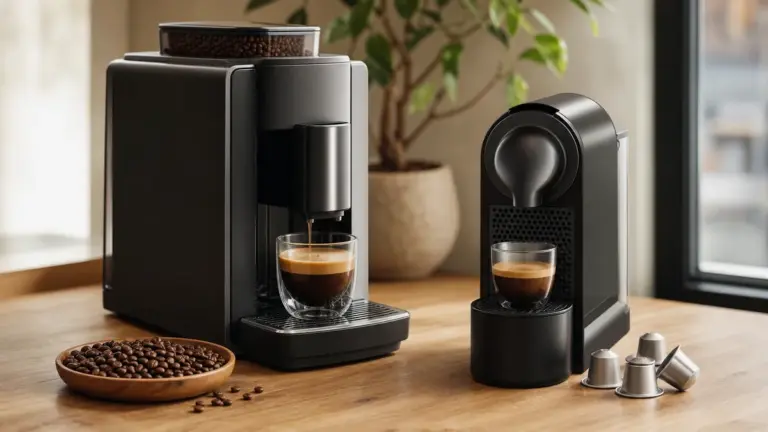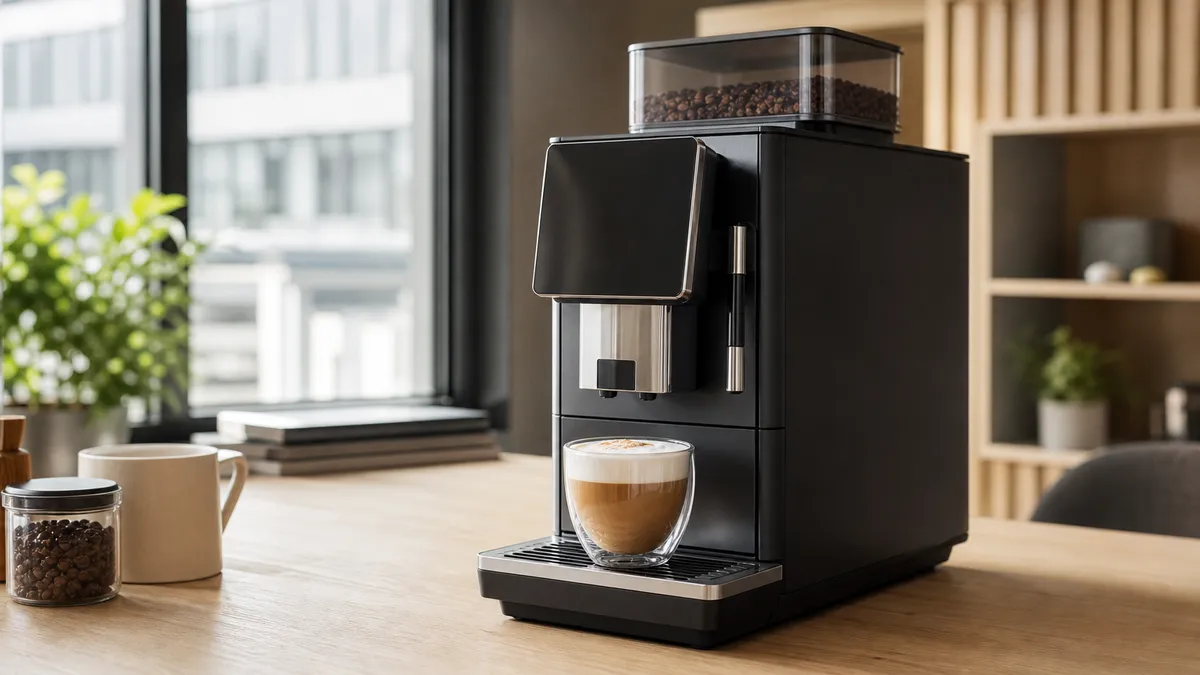
Office bean-to-cup coffee machines grind whole beans and brew coffee automatically when someone selects a drink. They are worth considering when staff want freshly prepared coffee without operating a separate grinder or espresso machine, provided someone takes responsibility for cleaning, replenishment and servicing.
In short
- Choose around actual daily drinks and the busiest break, not employee headcount alone.
- Manufacturer recommendations span compact machines intended for around 30 drinks daily to commercial models intended for several hundred.
- Fresh milk adds automatic cappuccinos and lattes, but also refrigeration, milk handling and cleaning duties.
- Tank-fed machines need refilling; mains-fed machines still need a plan for wastewater and used grounds.
- Request a demonstration using your intended drinks, plus itemised written quotations covering installation, consumables and service.
What an office bean-to-cup coffee machine does
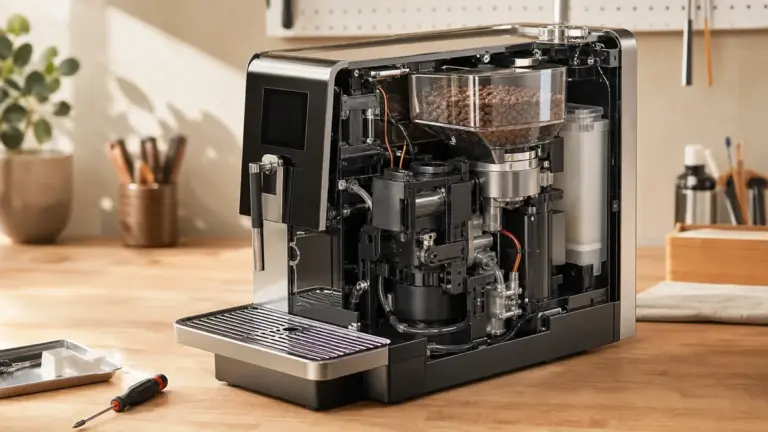
A bean-to-cup machine combines bean storage, grinding and brewing in one appliance. In a typical automatic cycle, it grinds a measured portion, compresses the grounds inside a brewing chamber, passes hot water through them and discharges the used coffee into a container.
The user normally chooses a programmed recipe rather than handling loose grounds. A milk-equipped version also prepares milk or foam, although the exact sequence and degree of automation depend on its configuration.
That explains its workplace appeal: people can serve themselves without learning to dose coffee or operate a traditional espresso machine. It does not establish that bean-to-cup dominates the UK office market, and this guide makes no market-share claim.
For the wider choice of equipment, start with our office coffee machines guide. The internal components and brewing sequence are covered separately in how office bean-to-cup machines work.
Drink menus: check the recipe, not just the name
Depending on the machine and installed modules, menus can include espresso, longer black coffees, cappuccino, latte-style drinks, hot milk and hot water. Chocolate generally requires a suitable powder system rather than simply another touchscreen button.
Treat a long menu as a list to investigate, not proof of better coffee. Ask the demonstrator to show what changes between recipes: coffee quantity, brewing water, added hot water, milk quantity and foam preparation.
Choose your actual mugs before approving recipes. A drink that tastes balanced in a small demonstration cup may not suit the larger mug staff bring to work. Ask for the finished serving volume in millilitres and taste the proposed recipes yourself.
Keep the initial menu manageable. A clear choice of black coffee, espresso and the milk drinks people actually request is more useful than numerous unfamiliar names.
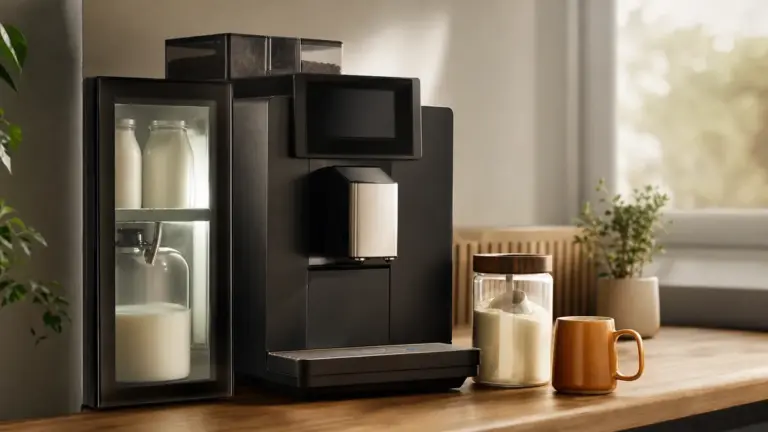
Fresh milk modules
An automatic fresh milk system draws milk through tubing from a container or refrigerated module, then heats and textures it for the selected drink. Some commercial configurations can produce different foam textures or cold milk foam.
Check whether the quoted configuration includes the cooler, milk container and every necessary connection. “Milk drinks available” does not tell you what equipment is included.
Ask the supplier to demonstrate replenishment and the complete cleaning procedure. If dairy and plant-based drinks are required, request written details of their milk routes, shared components and cleaning arrangements, rather than assuming that separate menu buttons mean separate equipment.
Powdered milk or topping systems are another configuration to assess. Taste the finished drink and inspect the replenishment and cleaning routine before choosing either approach.
Capacity: daily cups and peak throughput are different
Manufacturer capacity figures are recommendations, not independent performance tests. As examples checked in November 2026, JURA recommends its WE8 for around 30 speciality coffees daily, while WMF recommends up to 180 daily cups for the 1500 S+. WMF also publishes commercial models with daily recommendations reaching 350 cups.
These examples illustrate the breadth of the category, not a shortlist or a universal sizing rule.
Daily output describes workload; peak throughput describes how quickly people get served. WMF publishes hourly output figures under DIN 18873-2 separately from its daily recommendation. Its published performance qualifications include cup size, settings, configuration, power and water connection.
A headcount and daily cups planning matrix
The following figures are illustrative arithmetic, not consumption research or machine recommendations. They assume everyone shown is present and that each coffee drinker has two drinks during the working day.
| People present | Assumed coffee drinkers | Assumed drinks each | Calculated daily drinks | What to establish next |
|---|---|---|---|---|
| 15 | 10 | 2 | 20 | Visitors and busiest break |
| 40 | 30 | 2 | 60 | Milk-drink share and refilling |
| 80 | 60 | 2 | 120 | Peak queue and service cover |
| 150 | 110 | 2 | 220 | Whether demand needs splitting |
Replace these assumptions with attendance records, drink counts and visitor demand. For hybrid offices, use busy attendance days as well as weekly averages.
Then count demand during the busiest short period. An illustrative requirement for 20 drinks in 15 minutes equals an average dispensing rate of 80 drinks an hour during that period. It does not mean a machine with that headline hourly figure will necessarily meet the queue.
Request a timed demonstration using your intended mug sizes and mixture of drinks. Include the ordinary handling between servings, not just uninterrupted espresso production.
Tank-fed or plumbed-in: plan the whole installation
Tank-fed machines use a refillable reservoir. They suit sites where a mains connection is unavailable, but someone must monitor and replenish the water.
Published examples include the WE8’s 3 litre tank and a tank option of approximately 4.5 litres for the WMF 1500 S+. Do not divide reservoir capacity by drink volume and treat the result as guaranteed servings: rinsing and cleaning also use water.
A mains-fed configuration removes manual reservoir filling, but water supply and wastewater disposal are separate decisions. Some machines offer a drain connection; others retain wastewater in a drip tray that staff must empty. Confirm the exact arrangement in writing.
Before ordering, check:
- Machine, cooler and filter dimensions, including access for filling and servicing.
- The worktop’s suitability and the manufacturer’s installation clearances.
- Electrical supply requirements for the complete configuration.
- Water connection, isolation and any drainage work.
- Where grounds, cleaning materials and replacement consumables will go.
In England and Wales, the Water Supply (Water Fittings) Regulations 1999 require appropriate backflow prevention. Ask the installer to confirm compliance with the rules applicable to your location.
Ask the supplier to assess local water and specify the appropriate treatment. Use your water supplier’s published information alongside the machine’s requirements, rather than assuming one hardness figure represents the UK. Thames Water, for example, provides a postcode-based water-quality lookup.
Cleaning: automatic does not mean unattended
Cleaning ownership is part of the buying decision, not an arrangement to make after delivery. Name a responsible person and a deputy, and obtain the instructions for the exact machine and milk configuration.
JURA’s WE8 instructions, for example, require daily milk-system cleaning and daily dismantling and rinsing of the frother when milk has been prepared. A rinse and a cleaning programme are different procedures.
Use this handover checklist:
- At opening: complete the prescribed checks, replenish supplies and confirm readiness.
- During use: respond to water, grounds, drip-tray and cleaning prompts.
- At closing: complete the required milk cleaning, removable-part cleaning and surface cleaning.
- At scheduled intervals: carry out filter changes, descaling where required and professional servicing according to the instructions.
There is no responsible universal cleaning recipe specifying one detergent dose, water temperature or programme duration for every office machine. Follow the manufacturer’s procedure and chemical instructions.
| Symptom | Likely cause to check | Practical response |
|---|---|---|
| Milk foam deteriorates | Dirty frother or milk route | Complete the specified cleaning and inspection |
| Coffee dispenses unusually slowly | Grind setting or blockage | Follow the manual’s troubleshooting procedure |
| Service stops repeatedly | Water, grounds or drip-tray attention needed | Check prompts and adjust replenishment arrangements |
| Leaks or persistent faults appear | A fault requiring assessment | Stop use where necessary and contact service support |
For steam-boiler equipment in Great Britain, ask the supplier to establish whether the Pressure Systems Safety Regulations 2000 apply and what examination arrangements are needed. HSE guidance includes steam at any pressure among relevant fluids; do not judge applicability from the machine’s appearance.
Plan grounds disposal too. In England, Simpler Recycling requirements took effect on 31 March 2025, with micro-firms given until 31 March 2027. Coffee grounds count as food waste, and the micro-firm test concerns fewer than 10 full-time-equivalent employees across the business, not simply at one office.
What drives cost per cup?
A useful workplace calculation includes more than beans. Ask suppliers to itemise:
- Machine provision, installation, commissioning and training.
- Coffee dose and bean consumption for each recipe.
- Milk, chocolate and other ingredients.
- Filters, cleaning products and replacement parts.
- Servicing, call-outs and any exclusions.
- Electricity, water, staff cleaning time and discarded ingredients.
For your own calculation, choose a consistent period, total the relevant expenditure and divide it by drinks actually served. Separate recurring consumption from equipment and installation, and record how the latter are allocated over that period.
Use the programmed coffee dose, not an assumed café dose. An illustrative 10 g recipe gives 100 theoretical portions from 1 kg of beans before wastage; recipes using another dose will change that yield. These are calculation inputs, not recommended brewing settings.
Keep VAT treatment consistent. HMRC generally zero-rates coffee and milk sold as food ingredients, while hot drinks supplied in catering are standard-rated. Those are different transactions. Obtain itemised written quotations showing the VAT treatment of each supplied item, and have your finance team assess the relevant basis for comparison.
Is bean-to-cup the right choice for your office?
Assess it against five criteria: desired drinks, daily demand, peak queues, cleaning ownership and installation suitability.
The advantages are automatic preparation from beans, self-service and programmable recipes. Suitable configurations bring black and milk drinks together in one system, without requiring each user to handle the brewing process.
The compromises are the replenishment and maintenance duties, the need to manage fresh milk where fitted, and dependence on the machine’s available recipes and components. Staff should try the proposed drinks before anyone commits to a specification.
Consider something else when:
- Meeting service is mainly black coffee: compare a filter or bulk brewer, especially when drinks must be ready together.
- Use is occasional: compare capsule equipment and assess its replenishment and waste arrangements.
- A trained operator wants manual control: compare a traditional espresso setup.
- Nobody can own the daily milk routine: reconsider the fresh milk configuration.
These are selection judgements, not claims that one category always performs better. Our guide to the best machine types for offices develops those comparisons.
Office bean-to-cup coffee machines are worth considering when the complete arrangement fits: the drinks are wanted, the peak demand is demonstrated and the upkeep has an owner.
FAQ
Can an office bean-to-cup machine make decaf?
Yes, some configurations support decaf through a separate grinder or a ground-coffee bypass. Check how users select it and whether each serving needs manual preparation. JURA’s WE8, for example, has a ground-coffee option. Ask the supplier to demonstrate the full routine rather than assuming that every machine with multiple drink buttons supports separate beans.
Should a larger office use one machine or several?
There is no universal answer: compare the busiest demand at each location and the consequences of one machine being unavailable. Several serving points may suit separated teams, while a central point may be easier to supervise. Request a site-specific proposal that accounts for queues, replenishment, cleaning responsibility and service arrangements rather than headcount alone.
Can staff change the coffee strength?
Many machines allow adjustments, but the controls and permissions vary. JURA publishes programmable strength and drink settings for the WE8, while commercial machines may provide administrator controls over recipes. Ask which changes ordinary users can make, which settings can be protected and how the supplier will establish the initial drinks.
Where to go next
Read Office Coffee Machines: The Complete UK Guide for the wider selection process, then Best Types of Coffee Machine for Offices to compare alternative formats. For the components behind the drink buttons, continue with How Office Bean-to-Cup Machines Work.
Sources
Manufacturer figures below are published claims, not independently tested results. Undated documents are identified as such rather than assigned an assumed publication year.
-
JURA, WE8: product information and technical data, undated, retrieved November 2026.
https://www.jura.com/en/professional/machines/we8dark-inox-ea-15420 -
JURA, WE8 Instructions for Use, document reference J74108/WE8/en/201812.
https://www.jura.com/-/media/global/pdf/manuals-global/professional/WE-8-2019/download_manual_jura_we8_v19.pdf -
WMF, WMF 1500 S+: Specifications & downloads, undated, retrieved November 2026.
https://www.wmf-coffeemachines.com/en_uk/products/fully-automatic-coffee-machines/wmf-1500-s-plus/specs/ -
WMF, Fully automatic coffee machines, undated, retrieved November 2026.
https://markets.wmf-coffeemachines.com/en_com/products/fully-automatic-coffee-machines/ -
WMF, User Manual WMF 1500 S+, retrieved edition, undated.
https://assets.wmf-coffeemachines.com/f/267357/x/078c561443/wmf-1500splus-operating-instructions-en.pdf -
UK legislation, The Water Supply (Water Fittings) Regulations 1999, SI 1999/1148, Schedule 2, paragraph 15.
https://www.legislation.gov.uk/uksi/1999/1148/pdfs/uksi_19991148_en.pdf -
Thames Water, Water quality, undated, retrieved November 2026.
https://www.thameswater.co.uk/help/water-and-waste-help/water-quality -
HSE, Pressure Systems Safety Regulations 2000 (PSSR), current guidance retrieved November 2026.
https://www.hse.gov.uk/pressure-systems/pssr.htm -
DEFRA, Simpler recycling: workplace recycling in England, current guidance retrieved November 2026.
https://www.gov.uk/guidance/simpler-recycling-workplace-recycling-in-england -
HMRC, Food products (VAT Notice 701/14), current guidance retrieved November 2026.
https://www.gov.uk/guidance/food-products-and-vat-notice-70114 -
HMRC, Catering, takeaway food (VAT Notice 709/1), updated 8 June 2026.
https://www.gov.uk/guidance/catering-takeaway-food-and-vat-notice-7091
This guide was researched using retrieved manufacturer specifications and operating instructions, official UK guidance and legislation, and a water supplier’s published information; no first-hand machine testing is claimed.
Last checked: November 2026