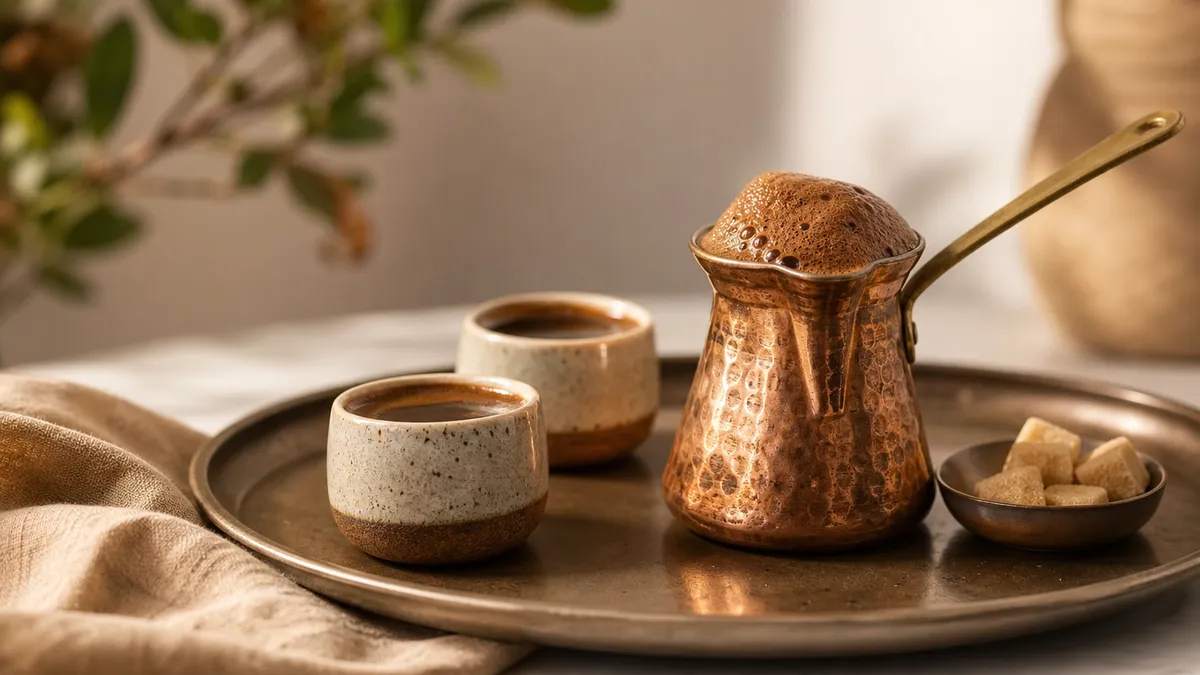
Turkish coffee brewing means heating very finely ground coffee with water, and optional sugar, in a small long-handled pot called a cezve, then serving it without filtering. Start with 7 g coffee and 70 g water per person, lift the pot as the foam rises, and let the grounds settle in the cup before drinking.
In short
- Use a powder-fine Turkish grind, finer than a typical espresso grind.
- Measure water by weight for consistency: 70 g is approximately 70 ml.
- Add any sugar before heating, and ask guests how sweet they want their coffee.
- Watch the rising foam rather than waiting for vigorous boiling.
- Leave the poured coffee undisturbed for 2 to 3 minutes, then sip without stirring up the sediment.
What makes Turkish coffee different?
The defining combination is very fine coffee, direct heating in a cezve and service with the grounds still present. There is no paper filter and no final separation of the liquid from the coffee particles: settling happens in the drinking cup.
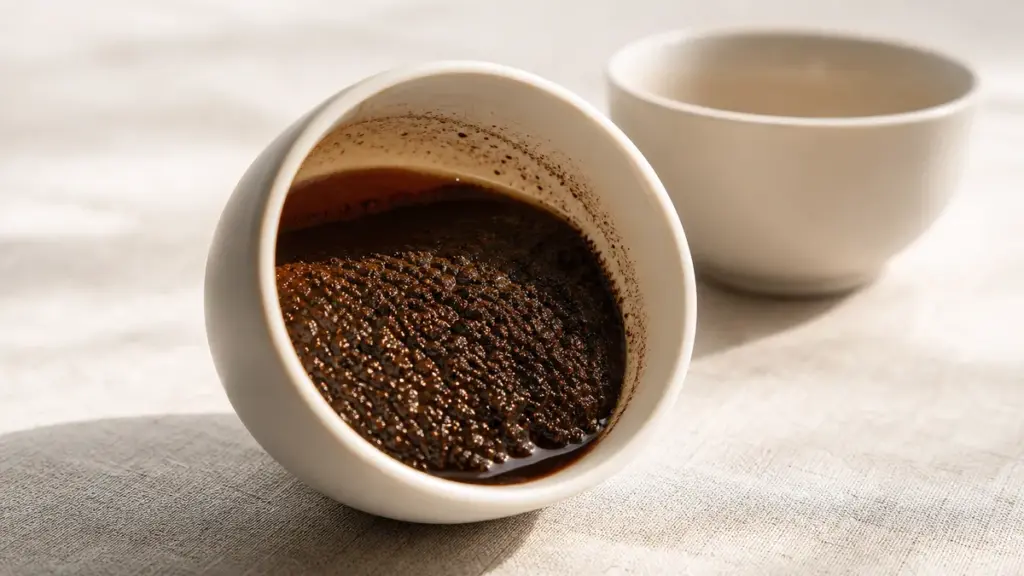
That changes the drinking experience. Expect a small serving with a substantial texture, surface foam and sediment at the bottom, rather than the clarity of a filtered brew.
Turkish coffee is a preparation method, not a requirement to use beans grown in Türkiye. Choose coffee you enjoy, but have it ground specifically for this method. Our brewing methods guide puts it alongside other ways of preparing coffee without repeating their individual recipes.
Choose the right pot and grind
A cezve is a small pot with a pouring lip and a long handle. Choose one intended for your heat source and serving quantity, following its manufacturer’s instructions, and leave room above the mixture for the foam to rise.
For your first attempts, make a single serving. This makes it easier to connect a measured dose, a particular heat setting and the moment you remove the pot. Once that routine is repeatable, scale up within the vessel’s working capacity.
Grind finer than espresso
Ask for a Turkish grind, not simply “fine coffee”. The traditional texture is powder-like, without the obvious granules you would expect in coffee ground for a cafetière.
A grinder’s espresso setting does not automatically mean it can produce the grind you need. Check its stated capabilities, or ask a roaster to grind the coffee for you. Ready-ground Turkish coffee is also a practical starting point.
There is some variation within the method. Specialty Turkish Coffee’s contemporary guide recommends a grind much finer than espresso but slightly coarser than the traditional powder. Start with a recognised Turkish grind before experimenting, rather than trying to compensate for unsuitable grounds through longer heating.
Water, coffee and sugar levels
Use 7 g coffee to 70 g water, a 1:10 coffee-to-water ratio by weight, as a starting recipe. This is the ratio used in Specialty Turkish Coffee’s guide, not a compulsory traditional standard.
Measure the water before brewing. The amount you pour into the cup will not be an identical measure of clear coffee, because the serving includes grounds and heating can change the liquid quantity.
For a second serving, the same ratio gives 14 g coffee and 140 g water, approximately 140 ml. Keep sugar separate from the ratio calculation.
Decide sweetness before heating
The usual sweetness terms are sade for unsweetened, az şekerli for lightly sweetened, orta for medium sweetness and şekerli for sweetened coffee. These are preferences, not universally fixed gram specifications.
For a repeatable home recipe, the following are suggested weighed starting points, rather than official definitions:
| Preference | Suggested sugar per 70 g water | How to use it |
|---|---|---|
| Unsweetened | 0 g | Start here to judge the coffee itself |
| Lightly sweetened | 2 g | Try a little sweetness without making it the main feature |
| Medium sweetness | 4 g | Adjust after tasting |
| Sweet | 8 g | Treat this as a deliberate sweetened drink |
Ask before making coffee for guests. If they want different sweetness levels, brew separate batches rather than adding sugar to their finished cups, where stirring would disturb the settled grounds.
Keep water simple
Start with fresh drinking water that tastes pleasant on its own. If you suspect the water is obscuring the coffee, compare the same recipe using a different drinking-water source before changing several brewing variables.
The SCAE water guidance distinguishes hardness, associated mainly with calcium and magnesium, from alkalinity, the water’s capacity to neutralise acids. They are not interchangeable. For this small-pot method, there is no need to turn the first brew into a water-treatment project.
Turkish coffee brewing: step by step
For one small serving, prepare:
- 7 g Turkish-ground coffee
- 70 g drinking water, approximately 70 ml
- Optional sugar, chosen before brewing
- A suitable cezve, small cup, spoon, scales and timer
- An optional thermometer
The method below uses a traditional cool-water start with a single foam rise. Allow roughly 2 to 3 minutes of heating as an initial working window, followed by settling time; the visible endpoint matters more than the clock.
-
Measure the ingredients. Put the water, coffee and any sugar into the cezve. Make sure there is space above the mixture rather than filling the vessel close to its rim.
-
Mix before heating. Stir until the coffee is thoroughly wetted and there are no obvious dry clumps. This is the moment to incorporate the sugar, not after pouring.
-
Apply controlled heat. Place the cezve securely over a suitable heat source. Start gently enough that you can watch the surface develop without an immediate rush towards the rim.
-
Leave the mixture largely undisturbed. After the initial mixing, avoid repeated stirring while the foam develops. Keep watching the pot throughout heating.
-
Lift as the foam rises. Remove the cezve when the surface foam swells upwards, before vigorous rolling boiling. If using a thermometer, 93°C is a published experimental reference point from a Turkish-coffee study, not a proven universal optimum or a reason to ignore overflowing foam.
-
Pour gently. Transfer the coffee into the cup without splashing or vigorous agitation. For multiple servings, you can first distribute a little surface foam between the cups, then share out the remaining coffee.
-
Let it settle. Leave the cup undisturbed for 2 to 3 minutes, then check that it is comfortable to sip. Drink slowly and stop before the thick sediment at the bottom.
Record the dose, water quantity, heating time and result. On the next brew, change just one thing so that the adjustment teaches you something useful.
Heating and foam: what to watch
The useful visual cue is the surface changing from a relatively quiet mixture into an expanding foam cap. Be ready to lift the pot as that cap climbs, rather than waiting for a particular timer reading.
Published instructions genuinely differ. Kurukahveci Mehmet Efendi’s traditional guide distributes foam into the cups and then brings the remaining coffee to another boil. Specialty Turkish Coffee’s contemporary guide removes the pot before boiling and does not prescribe repeated rises.
Neither supports the idea that every Turkish coffee must undergo the same number of boils. The single-rise method here is a straightforward starting routine, not a claim that other household traditions are wrong.
Treat foam and flavour as separate observations. Note whether you retained the foam, but also whether you enjoyed the coffee underneath it. Do not keep reheating an otherwise satisfactory brew simply to chase a taller cap.
If you want another compact stovetop routine to explore afterwards, see our moka pot brewing guide.
Serving, settling and the drinking ritual
Serve the coffee in small cups, with a glass of water alongside. UNESCO’s account places that service within a wider tradition of hospitality, conversation and friendship, rather than treating it as just a brewing technique.
Leave the cup alone during settling. Stirring, swirling and tipping it repeatedly are unhelpful when you are trying to keep the sediment at the bottom.
Take small sips and leave the final thick residue. The grounds are part of the preparation and presentation, but they are not the intended last mouthful.
UNESCO inscribed Turkish coffee culture and tradition in 2013 on its Representative List of the Intangible Cultural Heritage of Humanity. Its account includes engagement ceremonies, holidays and the practice of reading fortunes from the remaining grounds. These are cultural practices, not additional steps required to make the recipe work.
Troubleshooting Turkish coffee
Use these as practical checks, not certain diagnoses. Keep the coffee and water quantities unchanged while testing a suggested fix.
| Symptom | Likely cause to check | Fix |
|---|---|---|
| Foam races over the rim | Too much heat or insufficient headroom | Lift immediately; use gentler heat or a smaller batch next time |
| Surface breaks into vigorous bubbling | Heating continued past the chosen endpoint | Remove earlier, as the foam rises |
| Dry clumps remain | Incomplete initial mixing | Wet and mix the grounds thoroughly before heating |
| Coffee feels gritty throughout | Cup disturbed or insufficient settling | Wait undisturbed, sip gently and leave the sediment |
| Cups have uneven foam | Foam was poured mainly into the first cup | Distribute a little foam first, then share the remaining coffee |
After brewing, let the pot cool and clean it according to its care instructions. Wash cups and utensils with warm, soapy water, and keep the preparation surface clean.
A closer look at extraction and texture
Extraction means dissolving soluble material from ground coffee into water. It is different from carrying undissolved particles into the cup, although Turkish coffee does both.
Moroney and colleagues’ experimentally informed extraction model describes a rapid release from particle surfaces followed by slower movement of soluble material from inside the particles. That helps explain why grind and contact time matter, but the work does not establish a single ideal Turkish-coffee recipe.
Likewise, the study using a 93°C endpoint was an analytical experiment examining aroma-related compounds under specified conditions. It was not a consumer tasting trial proving that temperature best for every coffee.
For home adjustments, keep two questions separate: is the flavour pleasant, and is the sediment being managed well? First establish a repeatable heating endpoint, then adjust the ratio if you want a different concentration. Change the grind only when you can identify and reproduce the setting.
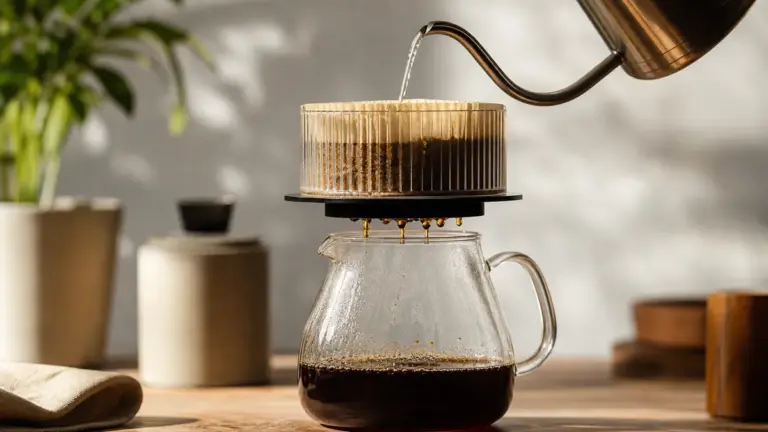
If you would prefer to explore a method that separates the grounds during preparation, our Vietnamese phin brewing guide is a useful contrasting read.
FAQ
Can I use ordinary espresso-ground coffee?
Coffee ground specifically for Turkish brewing is the better starting point. Specialty Turkish Coffee’s guide calls for a grind much finer than espresso, while acknowledging variation within Turkish preparation itself. If your grinder cannot reach that range, use suitable ready-ground coffee or ask a roaster, rather than assuming extra heating will produce the same result.
Do I need to boil Turkish coffee three times?
No, three boils are not a universal requirement. Published guides differ: some traditional instructions include another rise after distributing foam, while a contemporary specialty guide recommends removing the pot before boiling. Begin with the single-rise routine here, then explore another documented method as a separate recipe rather than mixing instructions together.
Can I make several servings in the same pot?
Yes, provided the cezve is intended for the quantity and has sufficient headroom. Keep the coffee-to-water ratio consistent, but observe the heating endpoint afresh rather than assuming the same time will apply. Agree the sweetness beforehand, and distribute foam between the cups before sharing the remaining coffee.
Where to go next
Read Brewing Methods through our method overview to choose your next approach, or explore Siphon Brewing in the siphon guide for a different hands-on routine. Cold Brew vs. Iced Coffee, covered in our cold coffee comparison, is the next read if you want to understand preparation choices for a chilled drink.
Sources
-
Specialty Turkish Coffee, “STC Preparation”, undated live brewing guide by Turgay Yıldızlı. Ratio, grind, heating approach, pouring and settling guidance.
https://www.specialtyturkishcoffee.com/how-to-make/stc-preparation/ -
Kurukahveci Mehmet Efendi, “With Cezve”, undated live brewing guide. Traditional preparation, foam distribution, reheating and water service.
https://www.mehmetefendi.com/eng/brew-guide/turkish-coffee/with-cezve -
Beko, “BKK 2300 Turkish Coffee Machine User Manual”, document revision code 5119-06. Sweetness categories and guidance that ingredient quantities may be adjusted to preference.
https://download.beko.com/Download.UsageManualsBeko/AE/en_US_Manual_7489730260_en_US20191210-100749-497.PDF -
UNESCO, “Turkish coffee culture and tradition”, 2013 inscription record. Preparation, service, hospitality and associated rituals.
https://ich.unesco.org/en/RL/turkish-coffee-culture-and-tradition-00645 -
Speciality Coffee Association of Europe, “The SCAE Water Chart: Measure, Aim, Treat”, undated retrieved edition, by Marco Wellinger, Samo Smrke and Chahan Yeretzian. Water chemistry and treatment distinctions.
-
Şen, Can, Asil and Demirel, “Effect of pH and Brewing Methods on Volatile Nitrogenous Compounds in Turkish Coffee”, Journal of Raw Materials to Processed Foods, 2023. Experimental preparation using a 93°C endpoint.
https://journalrpfoods.com/index.php/pub/article/view/63 -
Moroney and colleagues, “Coffee extraction kinetics in a well mixed system”, Journal of Mathematics in Industry, 2016, DOI 10.1186/s13362-016-0024-6. Experimentally informed modelling of surface dissolution and slower internal diffusion.
https://link.springer.com/article/10.1186/s13362-016-0024-6 -
Food Standards Agency, “Why is cleaning important”, 2017, current retrieved text. Cleaning of preparation areas, utensils and dishes.
https://www.gov.uk/government/publications/why-is-cleaning-important/why-is-cleaning-important
This article was researched using published brewing instructions, UNESCO’s cultural record, coffee-water guidance, primary extraction research and Food Standards Agency cleaning advice; suggested sugar weights and troubleshooting steps are editorial starting points, not a formal brewing standard.
Last checked: November 2026