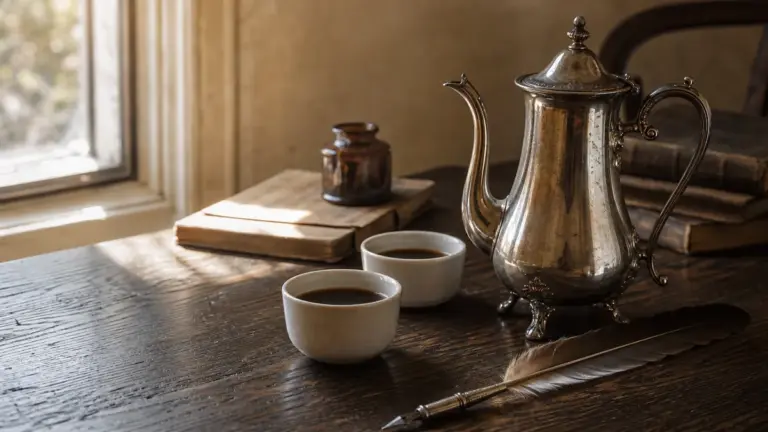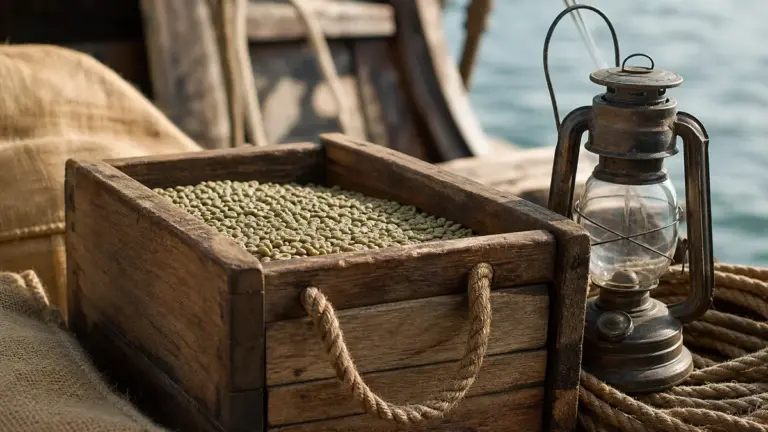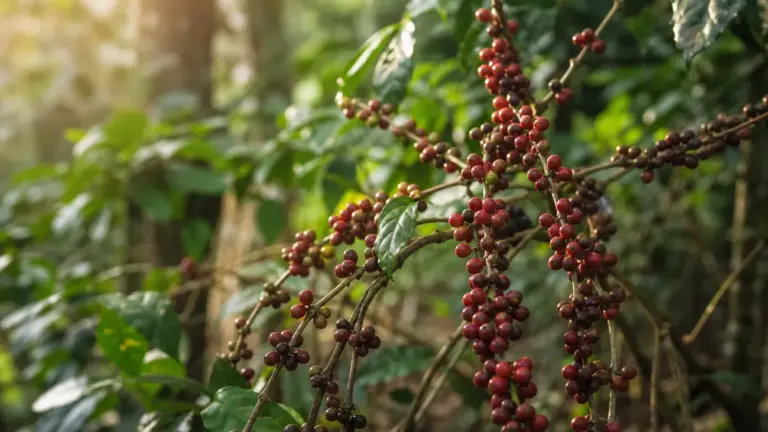
The first, second, third and fourth waves of coffee describe changing priorities: mass-market convenience, the coffee-shop experience, origin-focused craft and, more controversially, what comes next. They are overlapping ways of understanding the industry, not official historical periods, and the fourth wave has no agreed definition.
In short
- First wave: coffee becomes an everyday packaged product, with convenience and consistency central.
- Second wave: specialist roasters and espresso-based coffee shops make coffee an experience as well as a drink.
- Third wave: attention shifts towards distinctive beans, their producers and skilled preparation.
- Fourth wave: competing definitions emphasise science, convenient access to speciality coffee or greater producer equity.
- Trish Rothgeb coined “third wave”, not a complete four-wave framework; the model should not be mistaken for a universal history.
Where the coffee-wave terminology came from
Coffee professional Trish Rothgeb, née Skeie, is credited with coining “third wave” in “Norway and Coffee”, written for The Flamekeeper, the Roasters Guild newsletter. Her account explored coffee through three overlapping movements, using Norwegian baristas to illustrate an emerging emphasis on craft and questioning established rules.
There is a dating wrinkle worth preserving rather than smoothing away. Rothgeb’s company, Wrecking Ball Coffee Roasters, dates the essay November 2002, while Tim Wendelboe’s archive files its copy under 2003. The safest attribution is therefore to Rothgeb’s early-2000s essay, commonly dated 2002, rather than presenting November 2002 as an independently confirmed newsletter publication date.
Her contribution was naming and explaining the third wave in relation to the first two. She did not establish a universally accepted four-wave system.
The model is most useful as an introduction to changing commercial and cultural priorities. For the wider story beyond these recent movements, start with our coffee history guide.
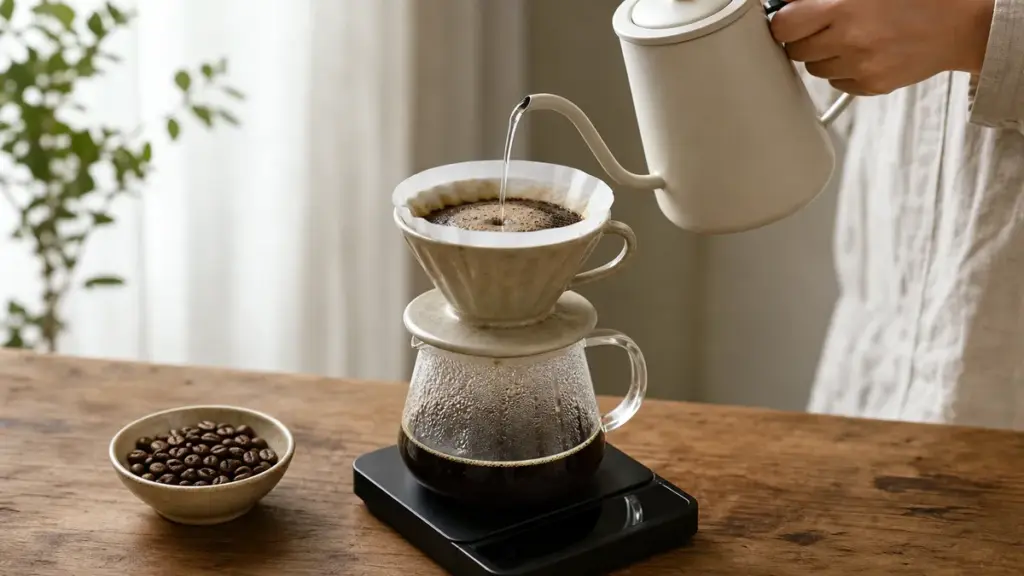
First wave: coffee becomes an everyday commodity
The first wave describes coffee’s expansion into a widely available household product. Its defining question was less “Which farm grew this?” and more “Can people buy and prepare it conveniently?”
Packaged ground coffee, recognisable brands, vacuum packaging and instant coffee fit this account. The emphasis was on distributing a consistent product widely, rather than explaining differences between individual harvests or producers.
Nescafé’s launch in 1938 is a useful milestone, although it was not the invention of instant coffee. Nestlé’s own history describes the product as a powdered coffee extract prepared by adding hot water.
It is easy to dismiss this wave as nothing but disappointing coffee. That misses its contribution: making coffee accessible, familiar and straightforward to prepare. Convenience was a genuine achievement, even where flavour distinction received less attention.
Nor does “first wave” mean every instant coffee tastes alike. It describes an industrial and consumer pattern, not a reliable tasting verdict on everything sold in a jar. Our history of instant coffee follows that particular technology in more detail.
Second wave: coffee becomes an experience
The second wave brought greater attention to roasting, origins and the pleasure of visiting a coffee shop. In the familiar American account, specialist roasters such as Peet’s and the subsequent expansion of Starbucks helped reshape expectations.
Espresso-based drinks became central to the experience: customers encountered menus built around drinks such as cappuccinos and lattes, alongside choices about roast and origin. Coffee shops also offered somewhere to meet, pause or spend time between home and work.
The important distinction is not simply “chains rather than supermarkets”. Rothgeb’s account described the second wave’s artisan beginnings, including small roasting businesses and destination shops. The later success of large chains was part of that development, not its entire meaning.
Its contribution was to encourage people to seek out coffee, rather than treat it solely as something already in the kitchen. Its limitation, in the wave narrative, was the possibility that a recognisable shop experience and standardised menu could overshadow the individual character of the beans.
Third wave: the coffee itself moves to the centre
Third-wave coffee places greater emphasis on what makes one coffee different from another. Origin, producer, processing, roasting and preparation become part of the explanation, rather than background information.
Typical signs include named farms or cooperatives, roast dates, specific flavour descriptions and a choice of brewing methods. “Single-origin” means coffee presented as coming from one identified origin, although that origin may be a country, region, farm or more narrowly defined lot.
Lighter roasting and manual brewing are commonly associated with the movement, but neither is a membership requirement. A carefully prepared espresso blend can express the same concern for quality and traceability as a hand-poured filter coffee.
The deeper change is one of attention. Instead of accepting a fixed house style as the whole story, the roaster and barista try to explain the coffee’s particular qualities and prepare it accordingly.
This is also why third wave and speciality coffee are not exact synonyms. A wave describes a movement; speciality describes how coffee or a coffee experience is distinguished and valued. The Specialty Coffee Association’s current definition considers distinctive attributes, including sensory qualities and information such as origin, producer and processing.
Fourth wave: three competing interpretations
There is no agreed answer to “What is fourth-wave coffee?” Different organisations and commentators use the label for developments that sometimes overlap and sometimes pull in different directions.
Science and precision
One interpretation emphasises measurement, water chemistry, brewing equipment and a deeper understanding of coffee’s properties. The International Coffee Organization’s market-development toolkit records this as one proposed definition.
The objection is straightforward: improving scientific understanding could be a continuation of third-wave curiosity, rather than evidence of a new cultural movement. More detailed measurement does not, by itself, establish a new historical period.
Speciality coffee with less effort
Another interpretation concerns making quality coffee available to more people through convenient formats and repeatable systems.
The International Trade Centre’s The Coffee Guide, fourth edition, proposes “scaling up specialty coffee” as the fourth wave. It includes speciality businesses offering capsules, instant coffee and ready-to-drink products, alongside greater acceptance of automation.
Under this definition, the change is not that everyone becomes an expert brewer. It is that more people can access distinctive coffee without needing specialist equipment or a lengthy preparation ritual. Pods alone, however, do not prove that a business belongs to a new wave.
Producer equity and wider participation
A third interpretation asks who benefits. It focuses on stronger producer partnerships, reinvestment in farming communities and participation by people historically marginalised within the industry.
Here, equity means fairer opportunities and a fairer distribution of benefits, not simply displaying a farmer’s photograph. The California Migration Museum also presents possible fourth-wave developments in terms of ownership, workers’ rights and speciality consumption in producing countries.
These are substantive ambitions. Calling them a fourth wave does not demonstrate that they have been achieved.
How the waves played out in the UK
The familiar British shorthand is post-war instant coffee, 1990s coffee-shop chains, then the independent speciality expansion of the later 2000s. It is a useful outline, provided it is not mistaken for a clean sequence.
Historian Jonathan Morris describes Britain’s post-war growth in home coffee consumption as driven largely by instant brands. His account also examines the transformation of drinking coffee outside the home during the 1990s, when espresso-based coffee shops expanded.
But British espresso culture did not begin with that expansion. Costa dates its roasting business to 1971 and its first coffee shop to 1981, illustrating the earlier foundations beneath the chain-growth story.
Australia and New Zealand also mattered to the later independent scene. Flat White opened in Soho in 2005, while Square Mile Coffee Roasters was founded in 2008. Kaffeine’s founder recalls the period from 2005 to 2009 as one of developing cafés, shared enthusiasm and a growing coffee community.
These are London milestones, not proof that every British town followed the same timetable. They show why the UK’s version needs its own explanation rather than dates borrowed wholesale from an American chart.
A short timeline
| Date | Verified milestone | What it illustrates |
|---|---|---|
| 1938 | Nescafé launches | Mass-market convenience |
| 1971 and 1981 | Costa begins roasting, then opens its first shop | British foundations before the 1990s expansion |
| 1998 | Starbucks enters the UK through its acquisition of Seattle Coffee Company | Expansion of the branded coffee-shop model |
| November 2002 / 2003 | Rothgeb’s company dates “Norway and Coffee” to November 2002; Wendelboe archives it under 2003 | The terminology’s early-2000s origins |
| 2005 and 2008 | Flat White opens; Square Mile is founded | Milestones in London’s independent speciality scene |
| 2021 | ITC’s fourth-edition Coffee Guide proposes a fourth wave | One influential definition, not universal agreement |
What the wave model gets wrong
The model is memorable because it simplifies. Its weaknesses begin when that simplification becomes a claim about everyone’s coffee history.
It centres particular consuming markets. Nepal’s national coffee export strategy explicitly notes that the three-wave concept reflects the North American situation. Other places need not pass through the same stages in the same order.
It can turn chronology into a quality ranking. Coffee trader Thompson Owen criticises the assumption that each successive wave represents progress. A later business model is not automatically a better drink or a fairer relationship.
It can hide producers behind consumer discoveries. A café beginning to name farms does not mean those farms have only just acquired expertise or identity. To understand the relationships that the wave story leaves out, read coffee’s plantation and colonial history.
Its boundaries are porous. The ITC itself stresses that waves coexist and do not necessarily represent improvements in quality or social and environmental outcomes.
Use the framework to ask what changed and for whom. Do not use it to decide whose coffee culture counts as advanced.
Where are we now?
As of November 2026, it is more accurate to describe overlapping priorities than declare that the world has entered one numbered wave. Convenience, coffee-shop experience, traceable craft, scientific measurement and producer participation are not mutually exclusive.
The SCA’s Coffee Value Assessment offers a concrete example of current development: it separates descriptive sensory assessment, liking and information about a coffee, rather than treating value as one undifferentiated judgement.
For readers, the useful questions are therefore specific. What information accompanies the coffee? How is quality assessed? What does the sourcing relationship actually involve?
The first, second, third and fourth waves of coffee provide a vocabulary for discussing change. The evidence behind a particular cup or business tells you more than its chosen number.
FAQ
Does third-wave coffee have to be drunk black?
No, drinking coffee black is not a requirement of third-wave coffee. The movement concerns attention to the beans, their origins and their preparation, rather than a rule against milk. Espresso-based drinks can belong within that approach, and latte art is commonly associated with it. Your preferred drink is not an entrance examination.
Can one business belong to more than one wave?
Yes, the wave model allows overlapping approaches within one business. A roaster might describe individual producers while also offering convenient formats, or combine a standardised café experience with detailed coffee information. The ITC explicitly describes waves as coexisting. Classifying every company under one number usually makes the model less useful.
Is “fourth wave” a certification?
No, “fourth wave” is not an agreed certification or quality standard. The ICO records competing definitions, while the ITC proposes its own interpretation based on scaling speciality coffee. When a business uses the phrase, ask what it means in practical terms rather than assuming that the label verifies quality, sourcing practices or producer benefits.
Where to go next
Read History of Coffee for the wider chronology, then The History of Instant Coffee for the technology behind the first-wave shorthand. Coffee, Colonialism and Plantation History supplies essential context for judging what the wave model says, and leaves unsaid, about producers.
Sources
-
Wrecking Ball Coffee Roasters, “About Trish”, undated, retrieved November 2026. Author’s professional biography and reading list, which dates “Norway and Coffee” November 2002.
https://www.wreckingballcoffee.com/pages/about-us -
Tim Wendelboe, “Press”, undated, retrieved November 2026. Lists “Norway and Coffee” under 2003.
https://timwendelboe.no/pages/press -
Trish R. Skeie, “Norway and Coffee”, The Flamekeeper, early 2000s, transcript reproduced on Coffee Forums in 2017. Used for the essay’s three-wave argument, not as independent verification of its publication date.
https://www.coffeeforums.com/threads/third-wave-coffee.17198/ -
International Trade Centre, The Coffee Guide, fourth edition, 2021, chapter 1, particularly “Coffee waves” and “Fourth wave: Scaling up specialty coffee”.
https://www.intracen.org/sites/default/files/uploadedFiles/intracenorg/Content/Publications/ITC_Coffee_4th_Report_20210930_web_pages.pdf -
International Coffee Organization, Market Development Toolkit, coffee-wave discussion, undated, retrieved November 2026.
https://ico.org/market-development-toolkit/page/index/4 -
Nestlé, “The timeline of Nestlé’s company history”, undated, retrieved November 2026, 1938 entry.
https://www.nestle.com/about/history/nestle-company-history -
Jonathan Morris, “Why espresso? Explaining changes in European coffee preferences from a production of culture perspective”, European Review of History, 2013.
https://uhra.herts.ac.uk/id/eprint/3121/2/907295.pdf -
Costa Coffee, “Our history”, undated, retrieved November 2026. Used for the company’s founding and first-shop dates, not its promotional claims.
https://www.costa.co.uk/behind-the-beans/our-story/history -
House of Commons Public Accounts Committee, “Written evidence from Starbucks”, 2012.
https://publications.parliament.uk/pa/cm201213/cmselect/cmpubacc/716/716we03.htm -
Kaffeine, “Rave culture and specialty coffee, a comparison”, undated, retrieved November 2026. Participant recollection of Flat White and London’s developing speciality community.
https://kaffeine.co.uk/rave-culture-and-specialty-coffee-a-comparison/ -
Square Mile Coffee Roasters, “About us”, undated, retrieved November 2026.
https://shop.squaremilecoffee.com/pages/about-us -
Specialty Coffee Association, “What is specialty coffee?” and “Coffee Value Assessment”, undated current pages, retrieved November 2026.
https://sca.coffee/what-is-specialty-coffee
https://sca.coffee/value-assessment -
Nepal, National Sector Export Strategy: Coffee 2017 to 2021, 2017, coffee-wave discussion.
https://tepc.gov.np/tepc_pub/NepalNationalExportStrategyCoffee.pdf -
Thompson Owen, Sweet Maria’s Coffee Library, “Fifth Wave of Coffee”, 2019. Used as an explicitly attributed industry critique.
https://library.sweetmarias.com/the-fifth-wave-of-coffee/ -
California Migration Museum, “Coffee Waves”, undated, retrieved November 2026. Used for its discussion of competing fourth-wave social interpretations.
https://www.calmigration.org/learn-chapter/coffee-waves
Research combined industry documents, a peer-reviewed historical study, company records and attributed participant accounts, preserving the uncertainty over the essay’s publication dating and the fourth wave’s definition.
Last checked: November 2026