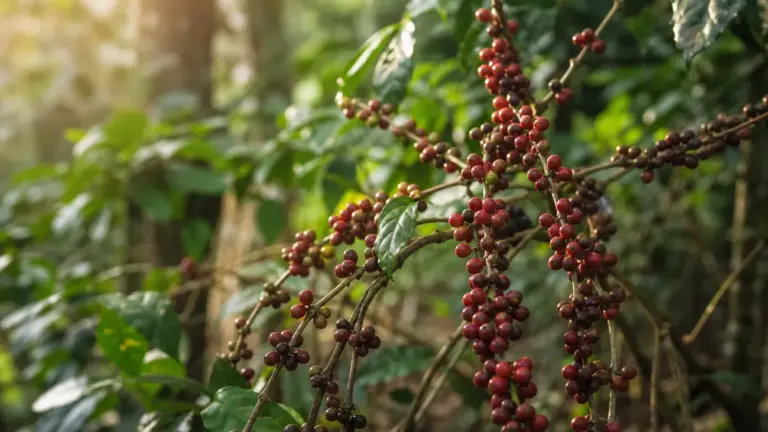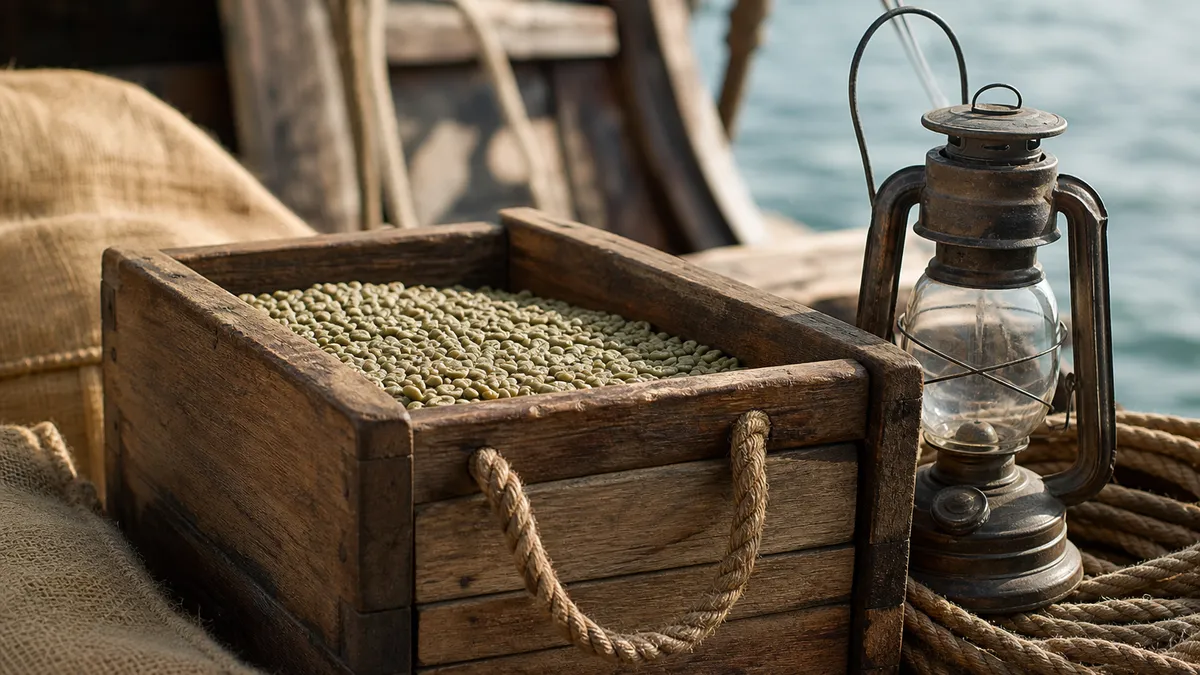
Coffee’s role in early trade was to connect an expanding market for a daily drink with merchants, ports and, eventually, colonial agriculture. From Yemen‘s Red Sea trade to Dutch-controlled production in Java and distribution through Amsterdam, coffee became both a valuable cargo and a reason to seek control over the land and labour that produced it.
In short
- Mocha was a major coffee port, but not Yemen’s only export outlet or the centre of every coffee transaction.
- Arab, Ottoman and Indian merchants sustained substantial trading networks before European companies expanded their involvement.
- Moving living plants mattered differently from shipping beans: it made new sources of production possible.
- Dutch transfers to Java in the late 1690s helped turn coffee from a regional export into a colonial crop.
- Commercial expansion brought unequal rewards, including compulsory cultivation in Java and enslaved labour on Caribbean plantations.
Before Amsterdam: coffee and the Red Sea
Coffee entered European commerce through trading systems that already existed. In fifteenth-century Yemen, Sufi communities used the drink during religious observances; its subsequent spread created demand well beyond the places where the crop grew. European merchants joined this commerce rather than inventing it.
The Red Sea was not simply a passage between Yemen and Europe. It connected coffee-producing districts with Arabian and Egyptian markets, while southern ports also participated in Indian Ocean exchange. Coffee’s commercial geography therefore makes more sense as several connected networks than as one uninterrupted voyage from Mocha to Amsterdam.
In the late seventeenth and early eighteenth centuries, Bayt al-Faqih was a crucial inland wholesale market. Coffee moved from there through Mocha, al-Hudayda and al-Luhayya. Much of the northbound trade used the latter two ports, then passed through Jidda towards Suez and Cairo.
This matters because the familiar European account can make other buyers disappear. Coffee had customers, brokers and established routes before it became a regular European cargo. For the wider chronology, start with our history of coffee; the development of its largest early consuming market belongs in coffee in the Ottoman Empire.
What Mocha actually contributed
Mocha, also written Mokha or al-Mukha, gave the trade a recognisable maritime gateway. Its position suited ships travelling between the Red Sea and Arabian Sea, and European company records made it especially prominent in later histories.
Yet Mocha was not a town devoted solely to coffee. Research based on Dutch eyewitness records identifies a broader market in textiles, spices, minerals, porcelain and aromatics. Coffee belonged to this mixed commerce, not to an isolated trading system with its own ships, merchants and institutions.
Nor should the port be confused with the growing districts or wholesale market. A merchant buying coffee in Mocha might be purchasing beans already assembled and transported by others. The port’s fame compresses several separate activities into one name: growing, inland exchange, shipment and overseas sale.
That distinction also changes how we read historical evidence. A European ship’s account tells us what its officers bought and observed, not everything passing through Yemen. Mocha’s visibility in company archives is evidence of European involvement, not proof that Europeans dominated the whole trade.
Trading companies entered an existing market
The Dutch East India Company, usually abbreviated to VOC, became one of coffee’s most consequential commercial participants. Leiden University Libraries dates its representatives’ first visit to Mocha to 1616, while noting that permission to establish a trading presence came later.
The English East India Company also purchased Yemeni coffee. Its surviving Mocha correspondence includes exchanges with Bombay, agents at Bayt al-Faqih and officers aboard company ships. These records reveal an operation spread across several places rather than a simple transaction at the quayside.
The British Library’s catalogue lists coffee accounts alongside documents concerning iron, steel, aloes and bullion. It also records trading permissions and gifts to officials. Such material shows the practical infrastructure behind a cargo: local authority, correspondence, purchasing agents, shipping arrangements and the means to settle transactions.
French participation would become particularly significant in transferring coffee cultivation to Bourbon Island, now La Réunion. Dutch, English and French interests should nevertheless remain distinct. Buying Yemeni beans, establishing another source of production and distributing plants between colonies were related activities, but they were not the same business.
Price and profit: why control of supply mattered
Coffee offered commercial opportunity because demand was spreading while production remained geographically restricted. Historians describe attempts to prevent foreigners exporting seeds and seedlings, alongside European efforts to establish cultivation elsewhere. A living plant could threaten an existing supply advantage in a way that a cargo of beans could not.
The attraction was not simply that coffee could be sold abroad. Merchants also sought an advantage in where, when and through whom they bought it. Nancy Um’s reconstruction of the Yemeni trade shows that even news of arriving ships could push purchasing prices upwards.
Revenue from a successful sale should not be confused with profit. The accounts, invoices, shipping records and official permissions preserved in company archives point to a business with many obligations between purchase and resale. No single impressive transaction establishes a typical return.
Colonial production changed the balance again. In Java, the VOC moved from encouraging and purchasing growers’ coffee towards compulsory production and delivery. Its commercial advantage increasingly rested on restricting producers’ choices, not merely on finding customers overseas.
Moving plants: documented transfers and smuggling stories
Stories about stolen coffee plants are memorable because they capture a real commercial issue: whoever could establish productive trees elsewhere could create a competing supply. However, the evidence for particular adventures is uneven.
Pieter van den Broecke’s visit to Mocha in 1616 is well supported. The additional story that he removed living plants to Amsterdam should not be treated as equally secure. The sources checked for this article establish the visit but do not provide a contemporary account sufficient to verify that plant-removal episode.
The firmer route into Dutch colonial cultivation runs through India. World Coffee Research records transfers from the Malabar coast to Batavia, now Jakarta, in 1696 and 1699. This is more precise than the often-repeated shorthand that Dutch growers simply took plants straight from Mocha to Java.
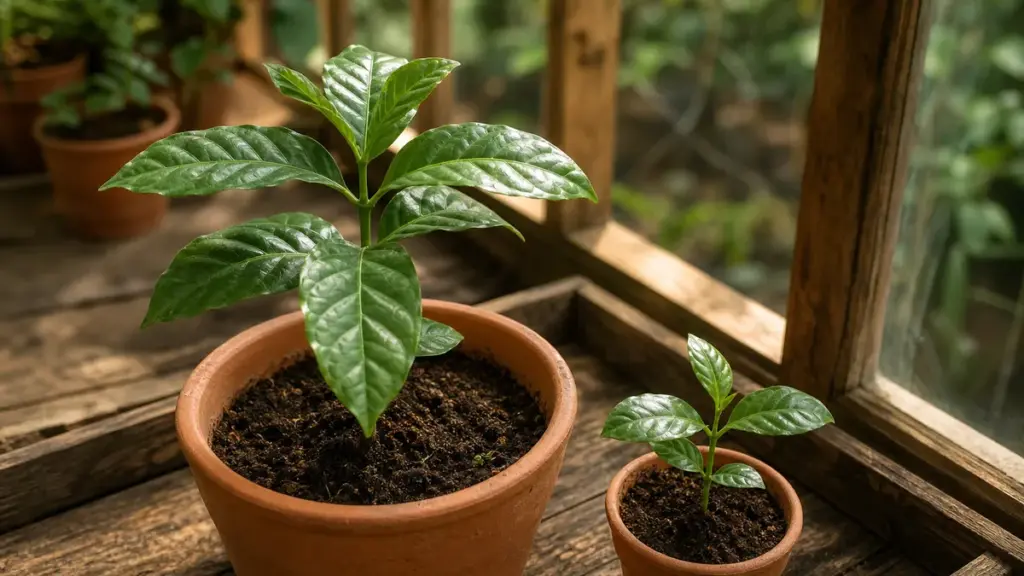
By 1706, coffee from Java had reached Amsterdam’s botanical garden, where it flowered and fruited. The garden was therefore more than a collection of curiosities: it could supply material for further propagation, meaning the production of new plants.
A diplomatic transfer followed. World Coffee Research dates Amsterdam’s gift of a coffee plant to Louis XIV to 1714. At the Jardin du roi, today’s Jardin des Plantes, Antoine de Jussieu helped cultivate coffee under glass. Trade, botanical expertise and state ambition were now working together.
The distinction between a documented transfer and an embellished adventure is explored further in legends and myths.
From botanical collections to colonial production
The French route to Bourbon Island was separate from the Java-to-Amsterdam route. Records summarised by World Coffee Research describe attempted introductions from Yemen in 1708, 1715 and 1718, with plants surviving from the later introductions. These became associated with the Bourbon coffee lineage.
In the Caribbean, Gabriel de Clieu is associated with taking a coffee plant from France to Martinique. The date needs qualification: World Coffee Research gives 1723, a USDA-hosted chronology gives 1720, and France’s natural history museum places the episode broadly in the 1720s. This article follows 1723 while acknowledging the disagreement rather than presenting an exact year as universally settled.
A surviving seedling was only the beginning. Establishing export agriculture required land, growers, processing and a system for gathering and shipping the harvest. Botanical success and commercial success were different stages.
The labour arrangements also differed. In Java’s Priangan highlands, the VOC imposed a coffee monopoly in 1723 and subsequently developed coerced production. Caribbean plantation expansion relied on enslaved people. These were distinct systems of exploitation, not interchangeable examples of ordinary paid farming.
There was a biological consequence too. Genetic research has found much less diversity in the widely dispersed Typica and Bourbon groups than in the Ethiopian material studied. Moving small selections of plants helped expand cultivation geographically while narrowing its genetic foundations. Our guide to coffee cultivation through the ages follows the agricultural story beyond these early transfers.
A short timeline of coffee’s role in early trade
| Date | Verified event or qualified milestone | Significance |
|---|---|---|
| 1616 | VOC representatives visited Mocha | Marks documented Dutch engagement, not a verified plant theft |
| 1696 and 1699 | Coffee was transferred from India’s Malabar coast to Java | Helped establish a competing production base |
| 1706 | Coffee from Java reached Amsterdam’s botanical garden | Enabled further propagation and exchange |
| 1714 | Amsterdam gave Louis XIV a coffee plant | Connected botanical cultivation with diplomacy |
| 1715 and 1718 | Successful introductions contributed to coffee on Bourbon Island | Established another colonial growing route |
| 1723, with differing chronologies | World Coffee Research dates the Paris-to-Martinique transfer to this year | Part of coffee’s Caribbean expansion |
| 1723 | The VOC imposed a coffee monopoly in Java’s Priangan region | Restricted growers’ ability to sell independently |
Read together, these milestones distinguish two movements: beans travelling to consumers and plants travelling to new growing areas. Coffee’s role in early trade changed most profoundly when merchants and colonial authorities sought to control both.
FAQ
Did Yemen’s coffee trade disappear once Java began producing?
No, Yemeni coffee continued to be traded after competing production developed elsewhere. The British East India Company continued buying directly from Mocha into the early nineteenth century. New growing regions weakened Yemen’s exclusive position, but did not abruptly remove its coffee from commerce or erase the networks serving its buyers.
Was all early traded coffee grown in Yemen?
No, Ethiopia also supplied coffee, although Yemen was central to the cultivation and redistribution described here. Historical accounts that present Yemen as the only source can confuse its commercial importance with absolute exclusivity. The history of a traded cargo also needs to distinguish where beans grew from the port through which they were shipped.
Can genetics prove the stories about individual plant smugglers?
No, genetic evidence can support relationships between coffee populations, but it cannot identify who carried a particular plant aboard a ship. The research discussed here supports a restricted genetic foundation for widely dispersed cultivated groups. Names, voyages and exact dates still require documentary evidence, assessed separately from the biological findings.
Where to go next
Read History of Coffee for the broader sequence, and Coffee in the Ottoman Empire for the demand that helped sustain early commerce. Coffee Cultivation through the Ages follows changing agricultural systems, while Historical Artefacts turns to the objects through which coffee’s past can be studied.
Sources
- University of Washington Press, Nancy Um, The Merchant Houses of Mocha: Trade and Architecture in an Indian Ocean Port, 2009, particularly “The Yemeni Coffee Network”. Retrieved book text.
- Cambridge University Press, C. G. Brouwer, “Storehouse of Stimulants: Opium in the Market of al-Mukhâ at the Turn of the Seventeenth Century: Statements by Dutch Eyewitnesses”, Itinerario, volume 32, issue 2, 2008. Article and accessible extract.
- Folger Shakespeare Library, Neha Vermani, “Spilling the beans: The Islamic history of coffee”, 2021. Institutional history article.
- Leiden University Libraries, “Mocha”, Yemen through a Dutch lens, undated digital exhibition. Exhibition record.
- British Library, Letters and Accounts from Mocha, IOR/G/17/2, undated catalogue description of historical records. Archive catalogue.
- Cambridge University Press, K. N. Chaudhuri, “Coffee”, chapter 16 of The Trading World of Asia and the English East India Company: 1660 to 1760, 1978. Chapter summary.
- World Coffee Research, Arabica Varieties, catalogue file retrieved in 2026, “Coffee’s movement around the globe”. Catalogue PDF.
- Naturalis Biodiversity Center, “Coffea arabica”, Useful Plants: An Introduction to Economic Botany, undated. Species history.
- Muséum national d’Histoire naturelle, “Le café, une histoire liée à celle du Jardin des Plantes”, 5 March 2026. Museum history.
- USDA Agricultural Research Service, Coffee and Cacao Crop Germplasm Committee, Coffee Crop Germplasm Vulnerability Statement, approved 18 November 2020, table 2. Statement PDF.
- Cambridge University Press, Tania Murray Li, “The Price of Un/Freedom: Indonesia’s Colonial and Contemporary Plantation Labor Regimes”, Comparative Studies in Society and History, 2017. Research article.
- Amsterdam University Press, Jan Breman, Mobilizing Labour for the Global Coffee Market: Profits from an Unfree Work Regime in Colonial Java, 2015. Open-access book record and description.
- University of California, Santa Cruz, Center for World History, “Coffee, 1400 to 1800”, undated teaching resource. Historical overview.
- F. Anthony and colleagues, “The origin of cultivated Coffea arabica L. varieties revealed by AFLP and SSR markers”, Theoretical and Applied Genetics, volume 104, 2002. Research paper PDF.
This article was researched using archival catalogue descriptions, documentary histories, museum and botanical resources, and genetic research, with conflicting transfer dates identified rather than silently reconciled.
Last checked: November 2026