European coffeehouses developed through trade and contact with the Ottoman world, becoming established in western and central European cities during the seventeenth century. They offered more than a drink: customers came to exchange news, meet trading partners and argue about politics, although claims about the very first opening often rest on uncertain evidence.
In short
- Coffee arriving in a city, being sold there and being served in a dedicated coffeehouse are different milestones.
- Oxford’s traditional date of 1650 and London’s date of 1652 need qualifications, not unquestioning repetition.
- Paris’s early coffee trade included Pascal’s establishment at the Saint-Germain fair in 1672, before the famous Procope of 1686.
- Vienna’s documented starting point is Johannes Diodato’s coffee-serving privilege in 1685, not the familiar Kolschitzky founding legend.
- Coffeehouse conversation was often predominantly male, but women also owned businesses, served customers and participated in wider intellectual life.
The First Coffeehouses
An Ottoman model, not a European invention
The coffeehouse was already an established institution in the Ottoman world before its spread through western Europe. Merchants and travellers encountered both the drink and the custom of gathering over it, then helped introduce them elsewhere.
“European” therefore needs care. Ottoman cities belonged to European history too, and Istanbul straddles Europe and Asia. The story here concerns the adoption and adaptation of coffeehouses in Venice, Oxford, London, Paris and Vienna, not the invention of sociable coffee drinking.
For the earlier setting, read Ottoman coffee culture. The wider history of coffee follows the drink beyond these city meeting places.
The essential distinction is between coffee consumption, public coffee selling and a recognisable coffeehouse. An imported parcel of beans does not prove that a public establishment existed. Nor does a later plaque necessarily establish an opening date.
Venice: an early centre with an uncertain first date
Venice appears prominently in coffeehouse histories, but its earliest dates are inconsistent. The University of California, Irvine Libraries’ exhibition chronology gives 1645; other historical accounts repeat 1647. The British Museum’s exhibition guide instead gives 1640, while historian Markman Ellis’s account places a Venetian coffeehouse in 1683.
These are competing chronologies, not interchangeable dates. They also illustrate the difficulty of deciding when coffee selling became a distinct establishment. The sources consulted do not establish one uncontested first Venetian opening, so neither 1645 nor 1647 should be presented as settled fact.
Caffè Florian offers a firmer landmark. Its own history records an opening on 29 December 1720, under the name Alla Venezia Trionfante, with the familiar name developing from its founder, Floriano Francesconi.
Florian belongs to the later development of Venetian coffeehouse culture. Its famous name should not be used to fill the gaps in the city’s earlier history.
Oxford: Jacob, the Angel and the problem with 1650
Oxford’s traditional claim centres on a man recorded as Jacob, described by the antiquarian Anthony à Wood as Jewish, who opened a coffeehouse at the Angel Inn. The date commonly attached to this account is 1650.
Ellis’s examination of Wood’s writings reveals a complication. Wood’s earlier diary distinguishes private coffee drinking in 1650 from public selling near the Angel in 1654 or 1655. A later version mentions Jacob’s coffeehouse without securely dating the entry; its placement in March 1650/51 was an editorial conjecture.
Oxford was an early centre of coffeehouse activity. What is less secure is the neat claim that a documented opening in 1650 conclusively establishes priority over London.
London: Pasqua Rosée and the merchant connection
London’s conventional starting point is 1652, when Pasqua Rosée is said to have begun selling coffee in St Michael’s Alley, Cornhill. The business was associated with Daniel Edwards, a merchant with experience of Ottoman trade.
Here, too, the familiar date needs qualification. Ellis’s archival study shows that the 1652 account relies on recollections recorded later. Parish and property records provide firmer evidence for the business’s subsequent development, rather than an uncomplicated contemporary record of its first day.
The setting matters as much as the date. Coffee selling developed among people already connected through commerce and overseas experience. A meeting place for those customers could become useful before coffee was an ordinary household drink.
The separate British coffeehouse history explores London and the wider domestic story in more detail.
Paris: Pascal before Procope
In 1672, an Armenian coffee seller known as Pascal established a coffee business at the Saint-Germain fair in Paris. Historian Jean Leclant’s study distinguishes this early venture from the later establishment that became Café Procope.
The famous Procope dates from 1686, when Francesco Procopio dei Coltelli established the business at the location associated with its enduring name. Calling it simply “Paris’s first café” obscures those earlier sellers.
Procope’s significance lies partly in its subsequent intellectual reputation. The Library of Congress identifies it with Enlightenment figures including Voltaire, Rousseau and Diderot. That later history should not be compressed into an imaginary opening-night gathering of famous thinkers.
Vienna: Diodato rather than the founding legend
For Vienna, the strongest starting point is 1685. The Wien Museum identifies the Armenian merchant Johannes Diodato, also called Deodat, as the first person granted the privilege of publicly serving coffee in the city.
The Austrian Academy of Sciences gives the privilege’s date as 17 January 1685. This is a documented authorisation, rather than a date inferred from a much later anecdote.
The rival story credits Georg Franz Kolschitzky with founding Vienna’s first coffeehouse after the 1683 Ottoman siege. The Academy traces the written promotion of that founding legend to Gottfried Uhlich’s account of 1783, a century later.
Kolschitzky’s role as a messenger during the siege and his supposed role as coffeehouse founder are separate claims. Evidence for the former does not establish the latter.
A short timeline, with the uncertainties visible
| Date | Place | Event and qualification |
|---|---|---|
| 1645 or 1647, disputed | Venice | Frequently repeated early opening dates; consulted sources give conflicting chronologies. |
| 1650, traditional | Oxford | Jacob at the Angel; Wood’s differing accounts make the dating uncertain. |
| 1652, conventional | London | Pasqua Rosée in St Michael’s Alley; the precise opening date rests on later recollections. |
| 1672 | Paris | Pascal’s coffee business at the Saint-Germain fair. |
| 1685 | Vienna | Diodato receives the privilege to serve coffee publicly. |
| 1686 | Paris | Date associated with the establishment of the famous Procope. |
| 1720 | Venice | Caffè Florian opens on 29 December. |
Coffeehouse Culture
News was part of the attraction
Coffeehouses made news a shared activity. Customers encountered newspapers, correspondence and other people’s reports, while news writers themselves gathered information in these rooms.
That created an exchange between spoken and printed information. A report could prompt conversation, attract a correction or circulate further through someone who had heard it discussed. The coffeehouse was both a place to consume news and a place where news acquired new audiences.
These habits also attracted official suspicion. Coffeehouse discussion could become political discussion, and political discussion could be treated as a threat. The association helps explain attempts to suppress or regulate British coffeehouses.
Trade depended on useful company
Edward Lloyd’s coffeehouse is a particularly clear example of a house developing around specialist information. It attracted ship captains, merchants and shipowners, and became associated with shipping intelligence and marine insurance.
Lloyd cultivated information about ships, cargoes and foreign events through correspondents in European ports. The useful product was therefore not merely the coffee: it was access to people and reports relevant to a customer’s business.
Coffeehouses also accommodated correspondence, auctions and professional meetings. They could function as working addresses without being offices in the modern sense. Their commercial usefulness came from concentrating people who had reasons to find one another.
What customers drank and saw
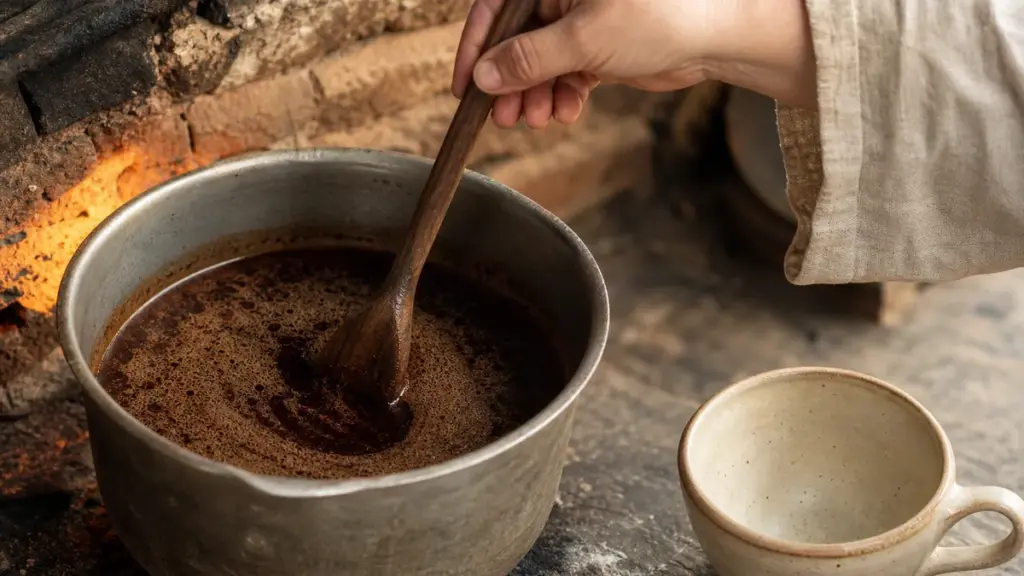
Early coffeehouses should not be pictured as modern espresso bars in antique rooms. Brian Cowan’s account of British establishments describes ground coffee boiled with water, with additional coffee kept warm in metal pots near the hearth.
Tea and chocolate could also appear on the menu. Coffee might be taken with milk or sugar, but there was no early modern espresso.
The room itself could be modest: tables, benches or chairs, a serving area and a hearth, rather than the elaborate interiors associated with later grand cafés. Prints and pictures joined written material as part of the surroundings.
For the later technological change, see espresso machine history.
Women: restricted participation, not complete absence
The familiar description of coffeehouses as men-only spaces contains part of the story, but not all of it. British coffeehouse conversation was predominantly masculine, and ideals of respectable participation favoured men.
Women nevertheless worked within these businesses as proprietors and employees. Ellis identifies Anne Blunt as the proprietor of Blunt’s Coffee-House in Cannon Street in 1672. Her example makes a blanket statement that women were absent impossible to sustain.
Ownership, employment and participation as a customer were different positions. A woman serving coffee was physically present without necessarily sharing the conversational freedom of male customers. Social restrictions and reputational expectations could matter even where there was no universal prohibition.
Women also participated in intellectual exchange elsewhere. In France, elite women hosted salons, invitation-based gatherings in private homes where ideas and literature were discussed. Coffeehouse history becomes misleading when one male-dominated setting is made to stand for the whole of public conversation.
Debate did not mean equality
Historians sometimes discuss coffeehouses as part of a public sphere, meaning the settings in which people exchanged views about matters beyond their households. That interpretation captures their importance, but it can become too tidy.
Cowan and Ellis emphasise the gap between idealised sociability and actual participation. Gender, status and the character of a particular establishment affected who could speak, work or feel welcome.
European coffeehouses mattered because they gave news, trade and argument a recurring meeting place. Their achievement was not universal equality, but a durable connection between a drink and the business of exchanging information.
FAQ
Can we name Europe’s first coffeehouse with certainty?
Not from the evidence reviewed here. The answer also depends on whether “Europe” includes Ottoman European cities and whether a seller, stall or dedicated establishment qualifies. Conflicting Venetian chronologies and the problems with Oxford’s traditional date make a single confident winner less useful than a carefully qualified account of several early centres.
Were coffeehouses the ancestors of modern cafés?
They were important predecessors, but the connection is not a simple, unchanged line. Early establishments combined drink service with activities such as correspondence, auctions and business meetings. Modern cafés share some of those social functions, but their equipment, service and expectations should not be projected backwards onto seventeenth-century rooms.
How should an “oldest coffeehouse” claim be judged?
Ask what the claim actually measures. An early opening, the survival of a name, occupation of the same site and uninterrupted trading are different propositions. A founding date alone cannot establish all four. Give greatest weight to dated records and clearly explained institutional histories, while checking whether a celebrated interior belongs to a later period.
Where to go next
Read History of Coffee for the wider chronology and Coffee in the Ottoman Empire for the culture that preceded these western and central European establishments. UK Coffee House follows the British story, while The History of Espresso Machines explains a later transformation in how European coffeehouses prepared their drinks.
Sources
-
British Museum, Life in a cup: coffee culture in the Islamic world, exhibition large-print guide, 2021.
https://www.britishmuseum.org/sites/default/files/2021-10/Life_in_a_cup_coffee_culture_in_the_Islamic_world_large_print_guide_1021.pdf -
University of California, Irvine Libraries, From Bean to Brew, exhibition item list, publication year not stated in the retrieved document.
https://exhibits.lib.uci.edu/sites/exhibits/files/docs/exhibit-item-list/From_Bean_to_Brew-exhibit-list.pdf -
University of Sheffield, White Rose eTheses, Claire P. Finn, The Material Culture of Drinking and the Construction of Social Identities in the Seventeenth-Century Dutch Republic, doctoral thesis, 2014, chapter 11. Repository record with downloads:
https://etheses.whiterose.ac.uk/id/eprint/7880/ -
Pickering & Chatto / Routledge, Markman Ellis, editor, Eighteenth-Century Coffee-House Culture, volume 1, Restoration Satire, 2006; Routledge edition, 2016, general introduction.
https://api.pageplace.de/preview/DT0400.9781351568722_A30395612/preview-9781351568722_A30395612.pdf -
The London Journal, Markman Ellis, “Pasqua Rosee’s Coffee-House, 1652 to 1666”, volume 29, issue 1, 2004, publisher’s abstract.
https://www.tandfonline.com/doi/abs/10.1179/ldn.2004.29.1.1 -
Annales / Persée, Jean Leclant, Le café et les cafés à Paris (1644-1693), volume 6, issue 1, 1951.
https://www.persee.fr/doc/ahess_0395-2649_1951_num_6_1_1900 -
Library of Congress, Café Culture in Paris: A Short History, research guide, publication year not stated.
https://guides.loc.gov/food-wine-cafe-culture-paris-france/history -
Wien Museum, The oldest Viennese cafés, online collection essay, publication year not stated.
https://sammlung.wienmuseum.at/en/album/93jcnqn7p7mgyik23-the-oldest-viennese-cafes/ -
Austrian Academy of Sciences, Johannes Feichtinger, Johann Heiss and Martina Bogensberger, Wien 4, Favoritenstraße/Kolschitzkygasse, Kolschitzky-Denkmal, publication year not stated.
https://www.oeaw.ac.at/tuerkengedaechtnis/denkmaeler/ort/favoritenstrasse-kolschitzkygasse-kolschitzky-denkmal -
Caffè Florian, Caffè Florian History, institutional history, publication year not stated.
https://caffeflorian.com/en/florian-venezia/history/ -
Lloyd’s, Edward Lloyd, institutional history, publication year not stated.
https://www.lloyds.com/about-lloyds/history/important-people-from-our-past/edward-lloyd -
Yale University Press, Brian Cowan, On the Origin of the Coffeehouse, 2016, excerpt from The Social Life of Coffee.
https://yalebooks.yale.edu/2016/09/29/on-the-origin-of-the-coffeehouse/ -
Cambridge University Press, Markman Ellis, “Coffee-women, The Spectator and the public sphere in the early eighteenth century”, in Women, Writing and the Public Sphere, 1700-1830, 2001.
https://assets.cambridge.org/97805217/71061/sample/9780521771061ws.pdf -
Digital Encyclopedia of British Sociability in the Long Eighteenth Century, Brian Cowan, Coffeehouses, publication year not stated.
https://www.digitens.org/en/notices/coffeehouses.html
Research compared museum and library histories with scholarly discussions of archival evidence, distinguishing documented events from traditional dates and later legends.
Last checked: November 2026