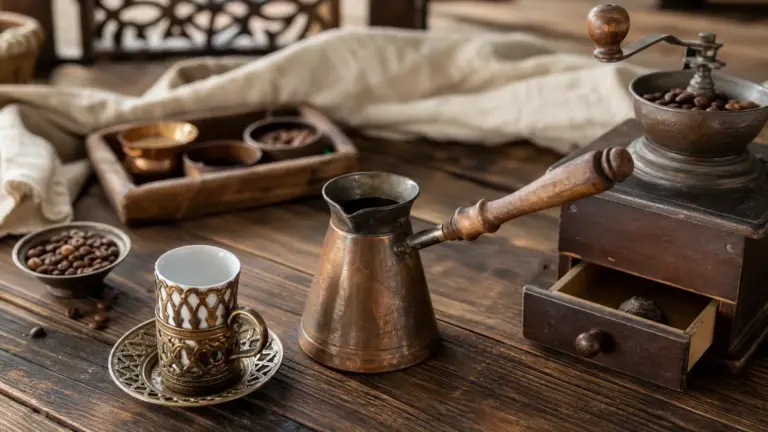
Coffee in the Ottoman Empire was both an everyday drink and a focus for hospitality, entertainment and political argument. Istanbul’s first coffeehouses are traditionally dated to 1554 to 1555, during Suleiman the Magnificent’s reign, but their significance lay in what followed: new places to meet, exchange news and debate matters beyond the household.
In short
- Peçevi’s account names Hakem of Aleppo and Şems of Damascus as early coffeehouse keepers in Istanbul’s Tahtakale district.
- Coffeehouses supported conversation, games, storytelling and working connections, but their customers were predominantly men.
- Restrictions targeted both coffee drinking and the gatherings around it, most famously under Murad IV in 1633.
- Palace coffee service had specialist staff, including the kahvecibaşı, or chief coffee maker.
- UNESCO inscribed Turkish coffee culture and tradition in 2013, recognising a living tradition rather than Ottoman society generally.
Coffee and Ottoman Society
When did coffee arrive in Istanbul?
The best-known account comes from the Ottoman chronicler İbrahim Peçevi. He records that Hakem, from Aleppo, and Şems, from Damascus, opened coffee establishments in Tahtakale in the Islamic year 962, corresponding to 1554 to 1555. This was during Suleiman the Magnificent’s reign.
There is a useful distinction between dating the first coffeehouses and identifying the first cup drunk in the city. Peçevi’s account supports the former much more securely than the latter. It should not be treated as a record of the precise moment when someone first carried coffee into Istanbul.
The dating is not entirely uniform. Historian Ahmet Yaşar’s account for the TDV İslâm Ansiklopedisi also reports Mustafa Âli’s date of 1553. The defensible summary is therefore that Istanbul’s earliest coffeehouses appeared around the middle of the sixteenth century, with 1554 to 1555 the traditional date associated with Peçevi’s named founders.
For the wider chronology beyond Istanbul, begin with the history of coffee.
What happened in a coffeehouse?
An Ottoman kahvehane, meaning coffeehouse, offered much more than refreshment. Men met to talk, exchange news, play games and listen to stories. The drink provided a reason to gather; the company gave people a reason to stay.
These establishments also had practical uses. In his study of Istanbul coffeehouses, historian Cengiz Kırlı describes places where customers arranged business, found workers or offered professional services. Newcomers could make contacts that helped them establish themselves in the city. Coffeehouses therefore connected leisure with the everyday business of earning a living.
Storytelling could turn an audience into a temporary community. Research on Ottoman urban centres around 1780 to 1830 shows how listening to stories overlapped with popular political discussion. Entertainment and public affairs were not necessarily separate activities: a performance could invite listeners to think about authority, justice or current events.
That does not mean every coffeehouse was a debating chamber or a centre of rebellion. A room could accommodate idle conversation, useful introductions and political criticism without having a single, fixed purpose. Its importance lay partly in this flexibility.
Who belonged, and who did not?
Descriptions of coffeehouses as places that brought society together need qualification. Their public sociability was predominantly male. Mixing among customers did not make them spaces of equal access for everyone.
Women nevertheless participated in coffee culture. Pera Museum’s account describes domestic gatherings, conversations and marriage-related customs centred on coffee. The household was not simply an absence from public life: it had its own networks of hospitality and exchange.
This distinction matters when interpreting the surviving evidence. A coffeehouse scene tells us something about men’s encounters in a particular setting, not everything about Ottoman coffee drinking. Cups, domestic accounts and descriptions of service reveal other parts of the story.
Why coffeehouses changed relationships
One interpretation of this history concerns the choices of ordinary consumers. In their research on early modern Ottoman coffeehouse culture, Eminegül Karababa and Güliz Ger argue that customers and sellers did not merely accept instructions from political and religious authorities. Their practices helped reshape what became socially acceptable.
That is a more useful explanation than saying coffee simply defeated prohibition. Acceptance developed through negotiation between drinkers, traders, religious institutions and government. The coffeehouse became established because people repeatedly found uses for it, while authorities adapted their responses.
Coffee’s commercial foundations belong to a separate story. Read coffee’s role in early trade for the movement of the commodity rather than the social life built around its consumption.
Bans and Debates
Opposition to coffee involved more than disapproval of its taste or stimulating effects. Authorities worried about gatherings, rumours and criticism of government. Religious debate also distinguished the permissibility of the beverage from the conduct associated with coffeehouses.
There was no single, unchanging religious position. Yaşar’s account identifies a favourable legal opinion from Bostanzâde Mehmed Efendi, while also describing continuing hostility towards coffeehouses. Approval of coffee did not automatically mean approval of everything that happened around it.
In 1633, Murad IV ordered Istanbul’s coffeehouses closed and prohibited coffee drinking. This is the clearest landmark in the history of Ottoman coffee restrictions, but it should not be expanded into a claim that coffee remained permanently forbidden across the empire.
Over time, surveillance and selective intervention became more significant than attempts at blanket suppression. The historical pattern is one of changing regulation, not an uninterrupted contest between coffee-loving subjects and uniformly hostile rulers.
Turkish Coffee
A preparation method, not a geographical origin
“Turkish coffee” describes a way of preparing and serving coffee, not beans grown in Türkiye. UNESCO’s explanation makes this distinction explicit: the identity rests on preparation, including the fine grinding of the roasted beans.
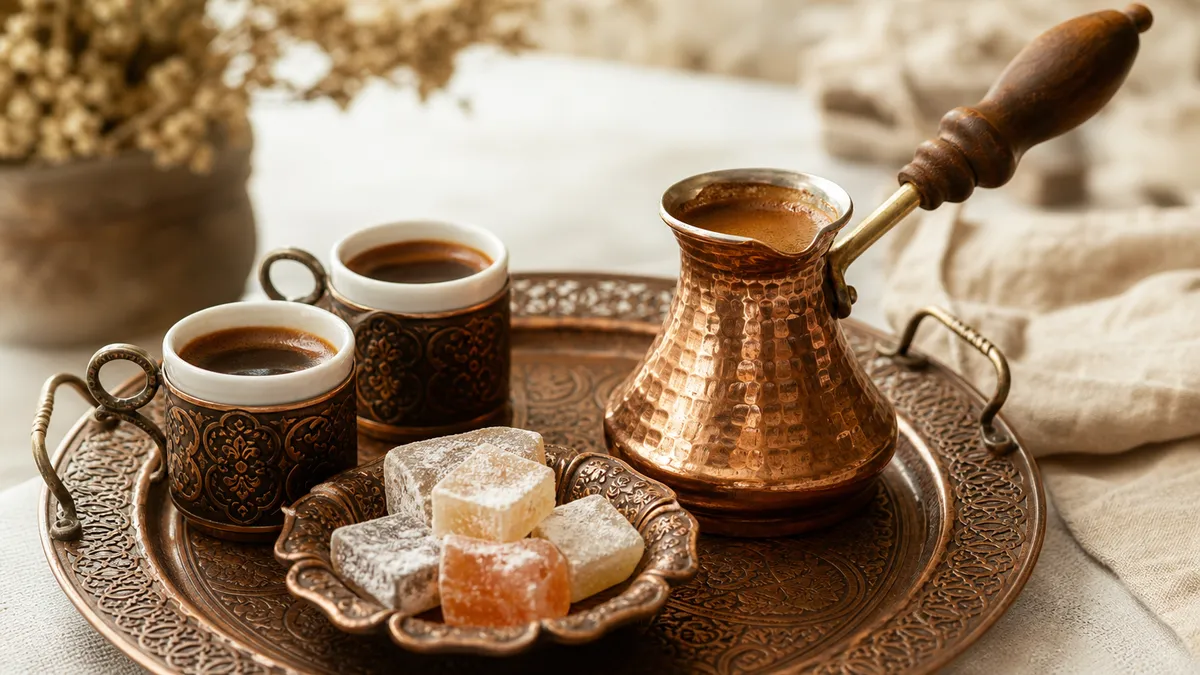
The familiar method uses a cezve, a small, long-handled brewing pot. Finely powdered coffee is combined with water and, where wanted, sugar, then heated slowly to develop foam. The drink is served with its grounds rather than passed through a filter.
To understand the sequence without treating it as a modern recipe:
- Roasted coffee is ground or pounded to a fine powder.
- Coffee and water are placed in the pot, with sugar according to preference.
- The mixture is heated gently, producing a foamy surface.
- Coffee is poured into small cups, with the grounds remaining in the drink.
These are the defining features of the surviving tradition, not proof that every Ottoman household followed an identical formula. A historical overview should not impose a modern dose, temperature or brewing time on several centuries of practice.
The ministry-published Turkish Coffee Culture records considerable variation in preferences and preparation. This is a reminder that continuity does not require uniformity: people could recognise a shared drink while disagreeing about how best to make it.
Coffee at the palace
Coffee also belonged to court service. The kahvecibaşı, usually translated as chief coffee maker, headed specialist coffee staff. The existence of this role shows how preparation became an organised responsibility rather than an incidental kitchen task.
Ayvazoğlu’s Turkish Coffee Culture includes a later example drawn from Ayşe Sultan’s recollections of her father, Abdülhamid II. His coffee maker, Halil Efendi, prepared coffee in a silver cezve and carried it on a small gold tray to the harem entrance for delivery.
Such accounts show the importance of attendants, equipment and controlled access. They should not, however, be projected backwards as a complete description of service under Suleiman. Palace practice had its own chronology, and later memoirs illuminate particular households and reigns.
What the cups reveal
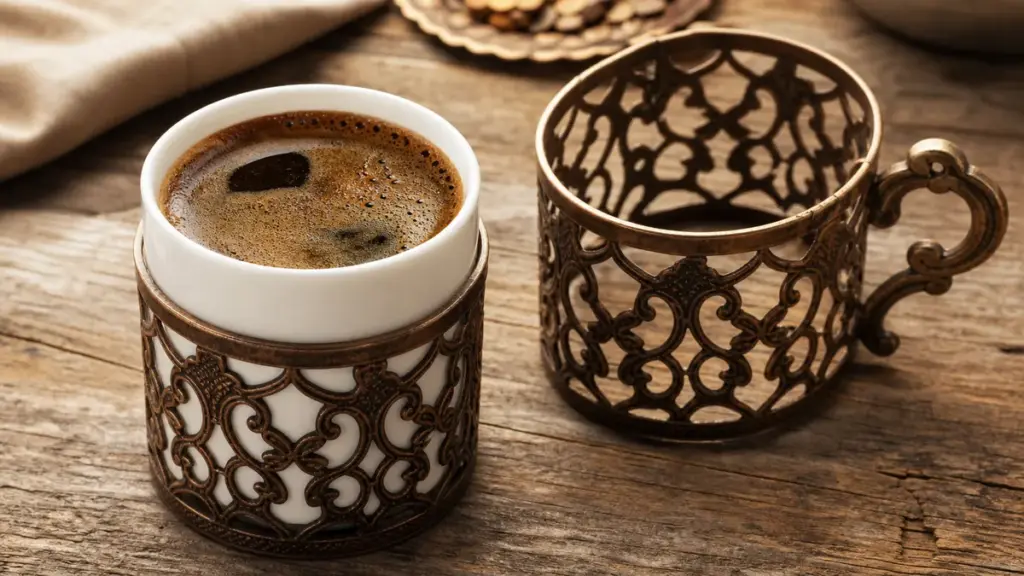
Surviving objects make this history tangible. Pera Museum’s collection links coffee consumption with the production of Kütahya ceramics, including small coffee cups. Brewing and serving generated work for craftspeople as well as coffee sellers.
A zarf is a holder for a cup, often one without a handle. The British Museum explains how metal holders protected fingers from hot porcelain and became objects of craftsmanship themselves. Its collection also demonstrates the international character of coffee equipment, including European wares made for Ottoman customers.
A decorated cup is therefore more than an attractive accessory. It can provide evidence about manufacturing, trade and the presentation of hospitality.
A Short Timeline
| Date | Verified landmark | Why it matters |
|---|---|---|
| 1554 to 1555 | Peçevi dates Hakem and Şems’s Tahtakale establishments to Islamic year 962. | The traditional reference point for Istanbul coffeehouse history. |
| 1633 | Murad IV orders Istanbul’s coffeehouses closed and prohibits coffee drinking. | A major episode in the regulation of coffee and assembly. |
| 2013 | UNESCO inscribes Turkish coffee culture and tradition, nomination file 00645. | Recognition of the surviving cultural practice. |
Cultural Legacy
UNESCO placed Turkish coffee culture and tradition on the Representative List of the Intangible Cultural Heritage of Humanity in 2013. The recognised element combines preparation skills with communal practices, including hospitality, conversation and ceremonial occasions.
This is recognition of a living tradition, not an endorsement of Ottoman society generally or a declaration that every present-day custom has remained unchanged since the empire. UNESCO describes knowledge passed through observation and participation, particularly within families.
The strongest connection between past and present is therefore not an untouched recipe. It is the continuing relationship between making coffee and making time for other people. Coffee in the Ottoman Empire helps explain how a small drink acquired that larger social role.
FAQ
Was Ottoman coffee the same as espresso?
No. The preparation described here heats finely ground coffee with water in a pot and serves it without filtration. Espresso is a different brewing method. Small serving vessels alone are not a reliable guide to how a drink was made, so an Ottoman coffee cup should not be interpreted as evidence of espresso-style preparation.
Were all Ottoman coffeehouses politically radical?
No. Coffeehouses supported many activities, including games, storytelling, business contacts and ordinary conversation. Political criticism was one possibility, not their universal purpose. Research on storytelling also shows that performances could communicate ideas about government, making the relationship between entertainment and politics more complicated than a simple opposition between rulers and customers.
Does UNESCO recognition apply to the coffee beans?
No. The inscription concerns Turkish coffee culture and tradition, including preparation and social practices, rather than a bean variety or growing region. Its nomination file is numbered 00645. The recognition should therefore be understood as cultural heritage, not certification of the origin, quality or authenticity of a packet of coffee.
Where to go next
Read History of Coffee to place Ottoman developments within the wider chronology, then Coffee’s Role in Early Trade for the commercial connections behind the drink. European Coffeehouses provides the next comparison in public sociability, while UK Coffee House focuses on the British story.
Sources
- Kadir Has University and Salt, Reşad Ekrem Koçu archive, “Hakem (Halebli)”, undated archival entry quoting Peçevi. Archival text.
- TDV İslâm Ansiklopedisi, Ahmet Yaşar, “Kahvehane”, 2019. Encyclopaedia article.
- Manchester University Press, hosted by Cambridge University Press, Cengiz Kırlı, “Coffeehouses: leisure and sociability in Ottoman Istanbul”, publisher’s chapter summary, online edition 2026. Chapter record and summary.
- Oxford University Press, Journal of Social History, “Imagining Communities: Story Listening and Popular Politics in Ottoman Urban Centers, ∼1780 to 1830”, 2026, volume 59, issue 4. Publisher’s indexed abstract and extracts consulted. Article record.
- Journal of Consumer Research, Eminegül Karababa and Güliz Ger, “Early Modern Ottoman Coffeehouse Culture and the Formation of the Consumer Subject”, published online 2010. Abstract consulted. Research abstract.
- Republic of Turkey Ministry of Culture and Tourism, Beşir Ayvazoğlu, Turkish Coffee Culture, translated by Melis Şeyhun, first edition, 2011. Book PDF.
- Republic of Turkey Ministry of Culture and Tourism, “Kahvenin Vatanı-Yetiştirilmesi ve Anadolu’ya Gelişi”, undated electronic publication. Ministry text.
- Suna and İnan Kıraç Foundation Pera Museum, Coffee Break: The Adventure of Coffee in Kütahya Tiles and Ceramics, third edition, 2019. Museum publication.
- British Museum, Life in a Cup: Coffee Culture in the Islamic World, large-print exhibition guide, 2021. Exhibition guide.
- UNESCO Intangible Cultural Heritage, “Turkish coffee culture and tradition”, nomination file 00645, inscription 2013. Official listing text retrieved through search. Inscription record.
- UNESCO, “Turkish coffee, not just a drink but a culture”, 2023. Official explanatory article.
This article was researched using an archival quotation of Peçevi, specialist historical scholarship, museum publications and official Turkish and UNESCO sources, distinguishing reported early dates from securely defined later recognition.
Last checked: November 2026