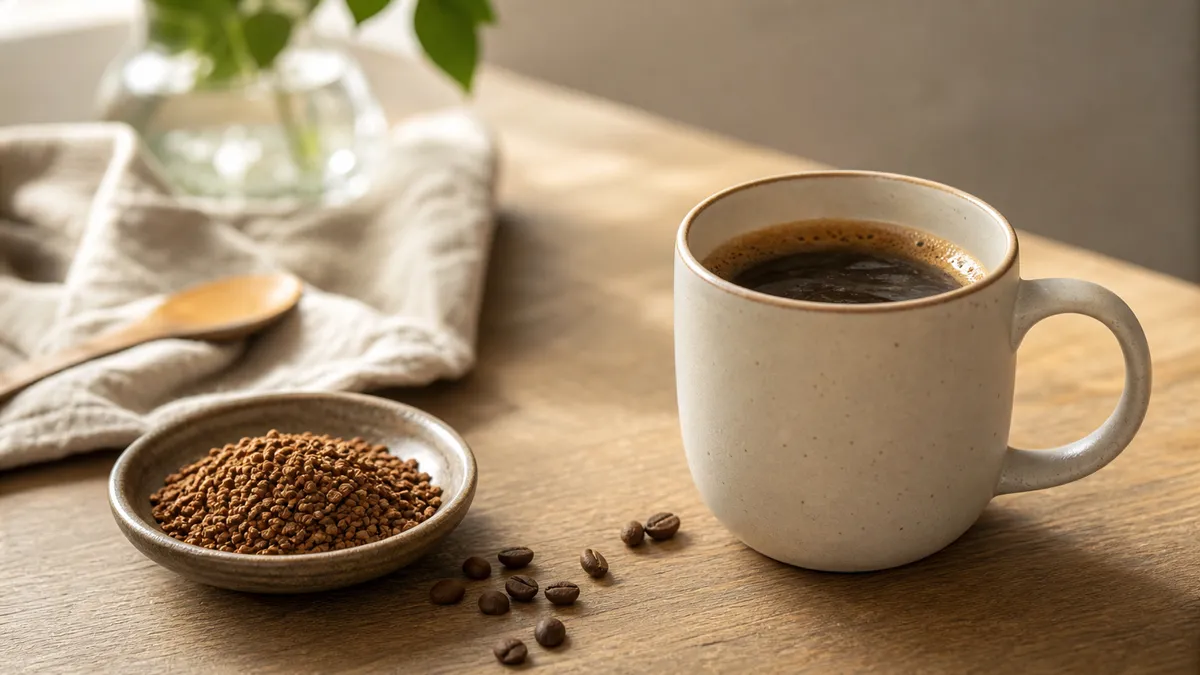
The history of instant coffee is a series of inventions, not one person’s breakthrough: early concentrates and soluble powders preceded Nescafé’s launch in 1938, while freeze-drying changed the category in the 1960s. Its central challenge has remained the same: removing water from brewed coffee without losing too much of its aroma.
In short
- Early coffee essences, sweetened preparations and dry soluble powders were different products, so claims to have invented the “first instant coffee” need qualification.
- French patent records document Alphonse Allais and François-Victor Pillard’s soluble sugar-coffee preparation in 1881.
- David Strang’s New Zealand powder and Satori Kato’s American work both preceded Nescafé.
- Nescafé launched in Switzerland on 1 April 1938; military demand subsequently helped expand instant coffee production.
- Freeze-drying improved the possibilities for aroma preservation, but the drying method alone does not establish cup quality.
What counts as instant coffee?
Modern instant coffee is dried coffee extract: coffee is brewed during manufacture, then water is removed so the remaining material can dissolve when water is added again. It is not simply roasted coffee ground into an exceptionally fine powder.
That distinction matters when reading its history. A liquid coffee essence, a sweetened coffee cake and a jar of soluble granules can all promise a drink without conventional brewing, but they are not identical inventions. “First instant coffee” might mean the earliest convenient concentrate, the earliest patented dry preparation or the first product manufactured on a substantial scale.
The wider history of coffee provides the background. Here, the story follows one particular change: moving the brewing work from the drinker’s kitchen into the factory.
Early experiments and competing invention claims
Coffee cakes and essences
An often-repeated starting date is 1853. A US Army historical article describes an American coffee preparation developed that year in cake form and later tested during the American Civil War. That account is a retrospective summary, however, not the original manufacturing record, so it should not be treated as proof that modern soluble coffee began in 1853.
Nor should that date be attached to Camp Coffee. Museum records date Paterson & Sons’ Glasgow coffee-and-chicory essence to 1876. Camp belongs to the history of convenient coffee concentrates, but its liquid syrup was different from the dry soluble powders that followed.
These early preparations addressed a familiar problem: how to make coffee without carrying out the usual grinding, brewing and separation of grounds. Their shared purpose helps explain why later histories sometimes group quite different products together.
Allais and Pillard: a documented French claim
The French writer Alphonse Allais appears in many accounts of instant coffee’s invention. France’s intellectual property office, INPI, supplies a more precise description: Allais and pharmacist François-Victor Pillard filed a patent for “Sucre-café-soluble” on 7 March 1881, numbered 141530.
The title identifies a soluble sugar-coffee preparation. This is firmer evidence than a general claim that Allais invented the contents of every modern instant coffee jar. It establishes an early patented preparation, not an uncontested claim to all subsequent soluble-coffee technology.
It also does not justify describing his invention as modern freeze-dried coffee. Solubility and freeze-drying are separate matters: one describes how a preparation behaves in water, the other how water is removed during manufacture.
David Strang: soluble powder in New Zealand
David Strang, a coffee and spice merchant in Invercargill, is another important claimant. New Zealand’s patent registrar’s report published in 1890 records Patent No. 3518, titled Strang’s Patent Soluble Dry Coffee-powder.
Contemporary advertising makes his contribution particularly useful to historians. A November 1889 advertisement already offered soluble coffee powder, while later advertisements promoted his patented “Dry Hot-Air” process. Those advertisements demonstrate that a commercial powder existed before Kato’s better-known American work.
The wording needs care. The 1889 advertisement also mentions a dry hot-air roaster, so it would be unsafe to reconstruct the entire powder-making method from the advertising phrase alone. The secure conclusion is that Strang marketed a soluble powder, supported by a documented patent record.
Satori Kato: demonstration and patent are different dates
Satori Kato introduced soluble coffee at the 1901 Pan-American Exposition, according to the Smithsonian’s Lemelson Center. His US patent, 735777, was granted on 11 August 1903, following an application in 1901.
Kato’s patent describes coffee concentrate and its preparation, including the handling of volatile oil and fatty material. It shows that inventors were concerned with more than making something dissolve: preserving a recognisable coffee character was already part of the problem.
These records explain the competing names. Allais and Pillard, Strang and Kato each have evidence behind their contributions, but they did not necessarily make the same product or solve the same manufacturing problem. Awarding one of them an unqualified title of sole inventor conceals more than it explains.
Commercial production and wartime demand
George Constant Louis Washington helped move instant coffee towards larger-scale commercial production. William H. Ukers’ contemporary trade history, All About Coffee, records that the George Washington Coffee Refining Company was organised in 1910, initially marketing its product as Red E coffee.
Washington’s significance is commercial rather than a convincing claim to have invented soluble coffee before everyone else. Earlier patents and advertisements rule out that simpler story.
The First World War created an obvious use for the product. The National WWI Museum and Memorial holds a pocket-sized tin of soluble coffee intended for a soldier or sailor. It is a modest object with a clear message: coffee that needed no separate handling of grounds could fit into military routines.
Instant coffee was useful, but it was not the only coffee supplied to troops. The same museum documents the shipment of green beans for roasting overseas. Wartime coffee history therefore includes both soluble preparations and conventional brewing, not a sudden universal switch to powder.
Nescafé in 1938: the breakthrough in scale
Nescafé launched in Switzerland on 1 April 1938. Nestlé identifies chemist Max Morgenthaler as central to its development, following a request to find a useful outlet for surplus Brazilian coffee.
According to the company’s history, researchers worked on retaining flavour in a soluble preparation, with carbohydrates playing a part in the early formulation. Production at Orbe used extraction and spray-drying. Nestlé dates the UK introduction to two months after the Swiss launch.
This was not the invention of instant coffee from nothing. It was a major development in making and distributing it. Nestlé’s own historical publicity sometimes uses “first” language, but the earlier patent and commercial records make “a major industrial breakthrough” the more accurate description.
The Second World War then increased demand. Nestlé records substantial supplies to US troops and additional American factories operating by 1943. Its account is a manufacturer’s history, but the broader military importance of instant coffee is also supported by the US National Park Service’s account of wartime coffee supply.
The Brazilian connection also places this technical story within coffee’s agricultural and trading history. For that wider context, see coffee and plantation history.
Spray-drying and freeze-drying: two different solutions
Both methods start with coffee extract, but they remove its water differently.
Spray-drying
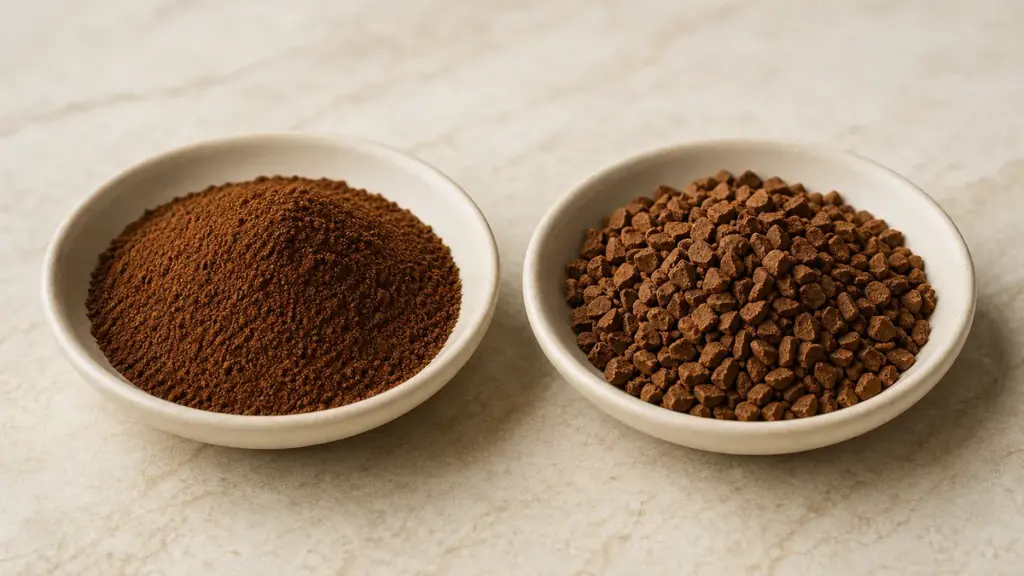
In spray-drying, liquid extract is dispersed into droplets and dried using hot air. The process produces soluble powder; further processing can join small particles into larger granules, a step called agglomeration.
That last point prevents a common misunderstanding: large granules are not automatically evidence of freeze-drying. Spray-dried powder can also become a granulated product.
Spray-drying made continuous industrial production practical, but aroma retention requires careful control. Some aroma compounds are volatile, meaning they readily pass into the surrounding air. Removing water can therefore remove desirable smells as well.
Freeze-drying
Freeze-drying first freezes the extract. Under reduced pressure, ice is removed by sublimation, meaning it changes directly from solid ice into water vapour rather than first melting into liquid.
A General Foods patent filed in 1963 describes this process and the production of porous coffee solids. The frozen material can be broken into granules before drying, helping produce the angular pieces associated with many freeze-dried coffees.
The commercial change belongs firmly to the 1960s. A US court judgment records that General Foods began test-marketing freeze-dried Maxim on 29 November 1963. Nestlé’s anniversary history dates freeze-dried Nescafé Gold Blend to 1965.
Those dates describe particular product milestones, not necessarily an identical launch date in every country. Test marketing, wider distribution and local brand introductions should not be collapsed into one event.
A short timeline of instant coffee
| Date | Verified milestone | Why it matters |
|---|---|---|
| 1876 | Camp Coffee’s coffee-and-chicory essence introduced | A convenient liquid precursor, not modern dry granules |
| 1881 | Allais and Pillard file their soluble sugar-coffee patent | Documents an early French preparation |
| 1889 to 1890 | Strang’s powder advertised; Patent No. 3518 recorded in the 1890 registrar’s report | Establishes a commercial New Zealand contribution |
| 1901 and 1903 | Kato’s exposition appearance, followed by his US patent grant | Separates public demonstration from patent date |
| 1910 | Washington’s company organised, initially marketing Red E coffee | Marks a significant commercial development |
| 1938 | Nescafé launches on 1 April | A major industrial and distribution milestone |
| 1963 and 1965 | Maxim test marketing and Nestlé’s stated Gold Blend milestone | Shows freeze-dried coffee entering commercial markets |
Why instant coffee became a British habit
Instant coffee offered British households a straightforward proposition: add water to a mug, stir and serve, without a separate brewer or used grounds to handle. Its fit with kettle-based drink preparation is a plausible explanation for its appeal, although that is an interpretation rather than proof of a single national cause.
Its reach is documented. A British Coffee Association fact page published in November 2021 stated that 80% of UK households bought instant coffee for home consumption.
That figure needs its proper boundaries. It describes household purchasing, not instant’s share of all cups drunk, and it should not be presented as a newly measured November 2026 statistic.
Britain’s instant habit also need not be treated as the opposite of coffeehouse culture. Preparing a quick drink at home and choosing a different coffee elsewhere serve different purposes. The waves of coffee offer another way to explore changing expectations without pretending that one format simply erased the previous one.
Quality today: beyond the drying method
Modern manufacturers can recover aroma during processing and return it to the product. Equipment supplier GEA describes aroma recovery, extraction, concentration and drying as connected stages, rather than treating the dryer as the sole source of quality.
Experimental evidence supports freeze-drying’s potential, with limits. A 2024 controlled processing study compared aroma compounds in spray-dried and freeze-dried robusta coffee at laboratory and industrial scales. Under its tested conditions, freeze-dried samples retained more total volatile aroma compounds.
That is not a blind tasting verdict on every supermarket jar. More retained volatile material does not, by itself, establish which finished drink a particular reader will prefer.
There are also producers making freeze-dried instant for specialty roasters. Swift Coffee, for example, describes brewing, freeze-drying and co-manufacturing for roasting partners. This verifies that such production exists, not that every product carrying a specialty description is equally good.
The useful lesson from the history of instant coffee is to separate format, process and flavour. A drying method explains part of the manufacture; the finished cup still deserves to be judged on what it actually smells and tastes like.
FAQ
Was the inventor George Washington the American president?
No, the coffee manufacturer was a different George Washington. The company discussed here was organised in 1910 and initially marketed Red E coffee. The shared name can make short histories confusing, but his place in this story concerns commercial soluble-coffee production, not the presidency.
Did early Nescafé have the same formulation as later pure instant coffee?
No, Nestlé’s account describes carbohydrates as part of the early development and identifies a 1952 product that did not require added carbohydrates. The brand name therefore should not be taken to mean an unchanged formulation throughout its history. Modern products also need to be distinguished by their own ingredient declarations.
Does an old advertisement prove that a coffee tasted good?
No, an advertisement proves what a seller offered or claimed, not that its flavour claims were independently demonstrated. Strang’s advertisements are valuable evidence that soluble powder was being marketed. Their praise for fragrance and quality must still be recognised as sales language rather than an impartial sensory assessment.
Where to go next
Read The History of Espresso Machines for a contrasting story of coffee technology that kept brewing at the point of service. UK Coffee House explores the social setting around British coffee drinking, while The First, Second, Third and Fourth Waves of Coffee examines changing ideas about convenience, provenance and quality.
Sources
-
US Army, Better living through Military innovation: Instant Coffee, 2019. Retrospective source for the qualified 1853 cake-form claim.
URL: https://www.army.mil/article/215940/better_living_through_military_innovation_instant_coffee -
Te Hikoi Museum, via DigitalNZ, Bottle, Glass, Essence of coffee and chicory, catalogue record, updated 2025.
URL: https://digitalnz.org/records/49882915 -
INPI, Saga culinaire, section “L’instantané d’Alphonse Allais”, undated; documents the 1881 patent.
URL: -
New Zealand Registrar of Patents, Designs, and Trade-Marks, First Annual Report, 1890, Patent No. 3518.
URL: https://paperspast.natlib.govt.nz/parliamentary/AJHR1890-I.2.3.2.1 -
Lake Wakatip Mail, advertisement for Strang’s soluble coffee powder, 29 November 1889, page 2; Press, advertisement, 28 October 1893, page 5. National Library of New Zealand, Papers Past.
URLs: https://paperspast.natlib.govt.nz/newspapers/LWM18891129.2.17.6.1
https://paperspast.natlib.govt.nz/newspapers/CHP18931028.2.17.2 -
Smithsonian Institution, Lemelson Center, Coffee in an Instant, 2017.
URL: https://invention.si.edu/invention-stories/coffee-instant -
Satori Kato, Coffee concentrate and process of making same, US Patent 735777, 1903; patent text reproduced by Google Patents.
URL: https://patents.google.com/patent/US735777A/en -
William H. Ukers, All About Coffee, 1922, section on soluble coffee; digitised by Project Gutenberg.
URL: https://www.gutenberg.org/files/28500/28500-h/28500-h.htm -
National WWI Museum and Memorial, Coffee and WWI, undated collections article.
URL: https://www.theworldwar.org/learn/about-wwi/coffee-and-wwi -
Nestlé UK & Ireland, Nescafé marks its 75th anniversary, 2013; Nescafé UK & Ireland, About Us: The Nescafé Story, undated. Manufacturer histories, used with attribution.
URLs: https://www.nestle.co.uk/en-gb/media/newsfeatures/nescafe-75-years
https://www.nescafe.com/gb/coffee-culture/knowledge/about-us -
US National Park Service, Coffee Rationing on the World War II Home Front, undated.
URL: https://www.nps.gov/articles/000/coffee-rationing-on-the-world-war-ii-home-front.htm -
GEA, Instant Coffee Process Technologies, undated technical brochure. Manufacturer source for processing descriptions, not independent performance verification.
URL: https://www.gea.com/assets/170654/ -
General Foods Corporation, Process for producing freeze dried coffee of improved color, US Patent 3244529, filed 1963, granted 1966.
URL: https://patents.google.com/patent/US3244529A/en -
US Court of Appeals, Second Circuit, Louis Ender, Inc. v. General Foods Corporation, 467 F.2d 327, 1972; judgment reproduced by Justia.
URL: https://law.justia.com/cases/federal/appellate-courts/F2/467/327/154127/ -
British Coffee Association, 80% of UK households…, 23 November 2021.
URL: https://britishcoffeeassociation.org/portfolio/80-of-uk-households/ -
Nathamol Chindapan and Chanakan Puangngoen, Comparative Evaluation of Volatile Aroma Compounds Content of Freeze-Dried and Spray-Dried Instant Coffees, Burapha Science Journal, volume 29, issue 2, 2024.
URL: https://li05.tci-thaijo.org/index.php/buuscij/article/view/423 -
Swift Coffee, Instant Coffee FAQ, undated, retrieved November 2026. Manufacturer account of its own process and roasting partnerships.
URL: https://www.swiftcoffee.com/pages/frequently-asked-questions
This article was researched using patent records, contemporary advertisements, museum collections, a court judgment, manufacturer histories and technical documentation, and peer-reviewed experimental research, with disputed priority claims kept distinct from verified milestones.
Last checked: November 2026