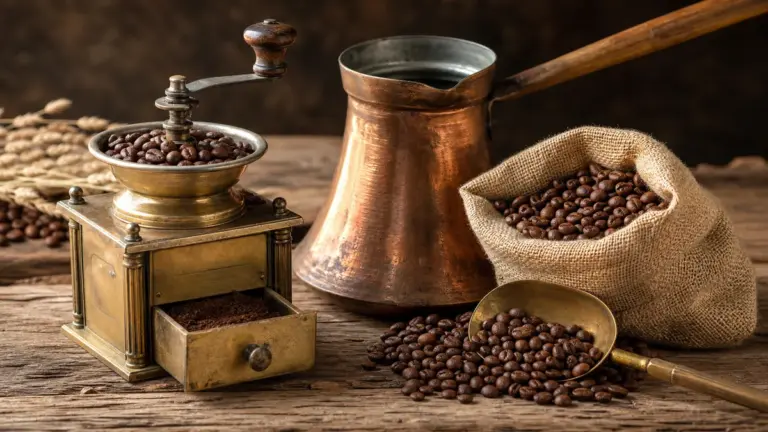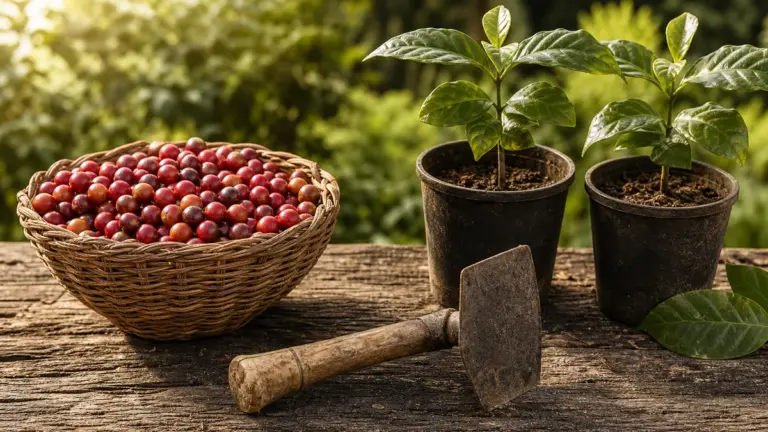
Coffee’s origin legends and myths include dancing goats, watchful Sufis, miraculous discoveries and a pope who supposedly baptised the drink. They are memorable stories, but a written record of a legend proves that someone told it, not that its events happened: the strongest historical ground concerns coffee’s use among religious communities in Yemen.
In short
- The animal-discovery story appears in Nairon’s printed treatise of 1671, with an unnamed herder in Yemen, not a named Ethiopian Kaldi.
- William H. Ukers included a named Kaldi in 1922, but this does not establish when the name was invented.
- Sufi involvement in coffee’s early spread has historical support; miraculous claims about individual discoverers require separate treatment.
- Pope Clement VIII’s supposed blessing is an anecdote, not a verified papal ruling.
- A story’s setting, its earliest surviving text and its later publication dates are different things.
Kaldi and the Dancing Goats
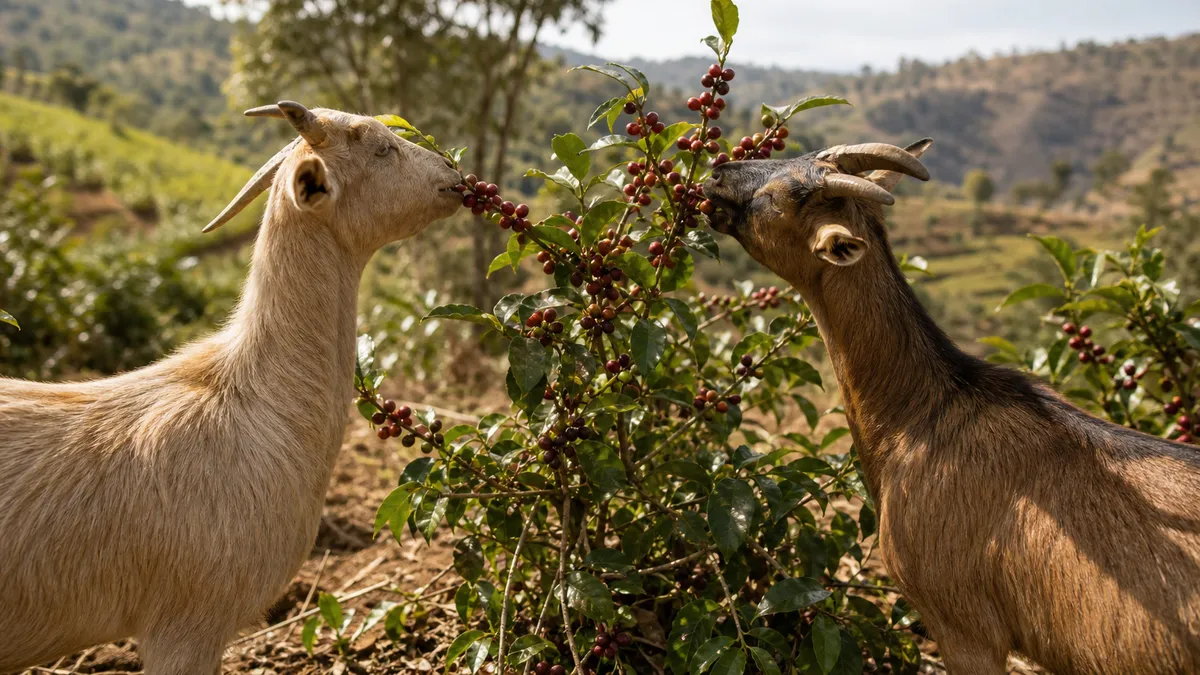
In the familiar telling, a herder named Kaldi notices his goats becoming unusually lively after eating coffee cherries. He tries the fruit, experiences its invigorating effect and brings the discovery to a religious community.
The verifiable printed ancestor is less familiar. Antoine Faustus Nairon’s De saluberrima potione cahue, seu cafe nuncupata discursus, published in Rome in 1671, describes an unnamed keeper of camels, or goats according to another version, complaining that his animals remain awake and leap about at night. The setting is Ayaman in Arabia Felix, meaning Yemen.
A religious superior investigates their grazing place, boils the fruit in water and finds that the drink helps him stay awake. Nairon presents this as a received tradition, not something he witnessed.
Ukers’s All About Coffee contains a named Kaldi in 1922. That establishes an appearance of the name by then, not that Ukers coined it.
The distinction matters. Calling the entire modern Ethiopian story “first recorded in 1671” quietly gives the early account details it does not contain. The animal-discovery motif is traceable; Kaldi’s identity and supposed discovery date remain unverified. For the separate question of where the plant and drink originated, read origin and discovery.

Sufi Monks and Coffee
“Sufi monks” is a familiar label in coffee histories, but Sufi practitioners, teachers or devotees is usually clearer. Sufism concerns Islamic spiritual practice, and the communities discussed in these accounts should not automatically be imagined as Christian-style monasteries.
Historical research connects coffee drinking with Sufi devotional gatherings, including dhikr, the remembrance of God through repeated prayers or invocations. Coffee’s valued role was practical: helping participants remain alert during religious observance.
That gives the religious stories a credible historical background. It does not validate every saintly encounter, miraculous cure or claim to have brewed the first cup.
There is also a source problem hiding inside the word “discovered”. Someone might recognise a plant, prepare its fruit, recommend a drink or introduce it to a new community. Those are different achievements. A story crediting a teacher with spreading coffee need not mean that nobody had consumed it before.
The useful question is therefore not simply “Which holy man discovered coffee?” It is “What practice does the source describe, and how close was its author to the events?”
The Sufi Monks of Yemen
Yemen provides the firmer historical setting behind these stories. In their peer-reviewed study, Hatim Mahamid and Chaim Nissim examine accounts connecting coffee with religious scholars and Sufis there, including Jamal al-Din al-Dhabhani. They also discuss a competing attribution involving Abu Bakr al-Aydarusi.
These are not interchangeable names for one securely documented inventor. They are different accounts of coffee’s adoption and promotion.
Even the dating of a central written source needs care. Ukers dates Abd al-Qadir al-Jaziri’s coffee treatise to 1587. Historian Pierre Ageron describes a text written in 1558, with the Paris manuscript he identifies copied in 1644. These sources do not provide a single uncomplicated “first recorded” date.
This article therefore follows the cautious formulation: al-Jaziri is a sixteenth-century witness to accounts of earlier coffee use, not an eyewitness to its original discovery. The precise relationship between the dates should not be settled by choosing whichever one makes the neatest timeline.
That leaves a defensible distinction: Sufi participation in coffee’s early history is supported by historical scholarship; assigning the invention to one individual is much less secure. The wider sequence belongs in the complete history.
The Angel Gabriel’s Brew
In this legend, the angel Gabriel provides coffee to restore the Prophet Muhammad’s strength. Ukers records a version in which Gabriel invents the drink to revive him.
Read as a story, the meaning is straightforward: coffee becomes a heavenly gift rather than an unfamiliar substance needing explanation. That is an interpretation of the narrative, not evidence for its origin.
The written trail is less straightforward. Ukers also reproduces Thomas Herbert’s account of a Gabriel tradition, citing the 1638 edition of Herbert’s travels. Wellcome Collection independently confirms that edition’s publication. However, the relevant original passage could not be inspected directly for this article.
Accordingly, 1638 is a bibliographic lead transmitted through Ukers, not a verified first attestation here. A directly checked printed retelling exists in Ukers’s 1922 book; the legend’s earliest written appearance remains unestablished by this research.
It should not be presented as a documented episode in Muhammad’s life, or as a belief shared by all Muslims. A traveller’s report of a tradition is evidence about a reported story, not a religious community speaking with one voice.
Omar’s Miraculous Discovery
Omar’s story makes discovery a matter of survival. In a modern commercial retelling, the exiled healer finds coffee berries, tries roasting and boiling them, and drinks the resulting liquid. Reports of its miraculous benefits eventually bring him back to Mocha.
It is an appealing sequence: hunger leads to experiment, experiment to relief, and relief to recognition. But a sequence that explains brewing neatly is not necessarily a record of how brewing developed.
Ukers associates versions of Omar’s legend with the Abd al-Qadir manuscript. That is the basis for the often-repeated connection with al-Jaziri and 1587. The relevant Arabic passage was not directly checked here, so that date cannot responsibly be declared the legend’s independently verified first appearance.
The safest conclusion is narrower: Omar’s discovery belongs to an established family of coffee legends, with older-source attributions requiring textual checking. The earliest verifiable written attestation was not established in this research.
Miraculous recovery also belongs to the storytelling, not medical evidence. Nor should every roasting, boiling and healing episode from different versions be combined into one supposedly original account.
Pope Clement VIII’s Baptism of Coffee
According to the anecdote, opponents ask Pope Clement VIII to condemn coffee. He tastes it, enjoys it and proposes baptising it instead.
The pope was real: the Holy See dates his pontificate from 1592 to 1605. The tasting and baptism are another matter.
Ukers explicitly introduces the episode as a legend. His 1922 publication is a verifiable written telling, but it does not establish when the anecdote first appeared. Nor does it supply a contemporary papal document confirming the incident.
Calling it an “early seventeenth-century anecdote” can therefore mislead. That describes approximately when the story is supposed to happen, not a securely established date when someone first wrote it down.
The tale can be read as a reassuring reversal: a threatening foreign drink becomes acceptable after an authority enjoys it. That is an interpretation, not a proven account of its creation.
Coffee’s European acceptance should not be reduced to this supposed permission slip. For the material evidence that can support a historical argument, explore historical artefacts.
The Protective Spirits of Coffee
“The protective spirits of coffee” is not one clearly identifiable legend with a single author, birthplace or recording date. A more defensible subject is coffee’s documented place in particular spiritual traditions.
Heran Sereke-Brhan’s Boston University paper describes beliefs in parts of Wallo, northern Ethiopia, that associate coffee with safeguarding the household. Drawing on Rita Pankhurst’s research, it also discusses coffee in zar spirit-related practices.
These examples must not be turned into a universal Ethiopian belief. Anthropologist Sarah Howard describes a more complicated picture: coffee can be a medium of spiritual contact, while some people avoid ceremonies partly because of associations with harmful spirits.
The evidence therefore supports specific reported beliefs and practices, not a claim that coffee has objectively protective supernatural powers. It also cautions against treating every coffee ceremony as a spirit ritual.
For dating, Sereke-Brhan’s paper appeared in 2010 and cites Pankhurst’s 1997 work. Those are identifiable scholarly records, not dates when the beliefs began. No single earliest attestation for a general “protective spirits” legend was established.
Respectful history can take such traditions seriously without either endorsing their supernatural claims or dismissing their cultural significance.
Coffee Legends and Myths: A Short Evidence Timeline
The dates below identify records and publications, not proven discovery events.
| Date | Verifiable record | What it establishes |
|---|---|---|
| Sixteenth century | Al-Jaziri’s coffee treatise, discussed by later scholars | An early written source, with dating differences noted above |
| 1671 | Nairon’s printed treatise | An unnamed animal keeper’s discovery story set in Yemen |
| 1922 | Ukers’s All About Coffee | Checked retellings including Kaldi, Omar, Gabriel and Clement VIII |
| 2010 | Sereke-Brhan’s Boston University paper | A scholarly discussion of coffee-related spiritual practices |
When assessing another origin story, separate three questions:
- When is it supposed to happen?
- What is the earliest text that can actually be inspected?
- Does that text report an event, repeat a tradition or argue for a belief?
A dated book can answer the second question without settling the first. Likewise, several websites repeating an identical claim do not provide several independent witnesses.
That is the most useful way to enjoy coffee legends and myths: preserve the stories, but keep their evidence labels attached.
FAQ
Does calling a story a legend mean it is worthless?
No. A legend can be valuable evidence about storytelling, identity and the significance people give a drink, even when its discovery scene cannot be verified. The distinction is between using it to understand a tradition and using it to establish that a particular person performed a particular act.
Can an oral tradition be older than its first surviving written record?
Yes, but its age cannot simply be assumed. A publication establishes that a version existed by that point; it does not reveal how long people had been telling it. Equally, a late surviving record does not by itself prove that its author invented the entire story.
How should these stories be introduced in educational material?
Introduce them explicitly as legends, then distinguish their narrative setting from their documented publication history. Phrases such as “in a familiar version” avoid implying that every detail belongs to an original text. Where the earliest written appearance has not been established, say so rather than supplying an attractive but unsupported date.
Where to go next
Start with History of Coffee for the wider subject, then read The Complete History of Coffee for the chronological account. Origin and Discovery separates botanical origins from human use, while Coffee’s Role in Early Trade follows the movement of coffee beyond its early communities.
Sources
-
Biblioteca Brasiliana Guita e José Mindlin, University of São Paulo: Antoine Faustus Nairon, De saluberrima potione cahue, seu cafe nuncupata discursus, 1671, particularly printed pages 15 to 18. Catalogue and digitised Latin text consulted.
https://digital.bbm.usp.br/handle/bbm/3903 -
Project Gutenberg: William H. Ukers, All About Coffee, 1922, chapters III, IV, VI and XXXII. Used as evidence of published retellings, not automatic confirmation of their historical claims.
https://www.gutenberg.org/files/28500/28500-h/28500-h.htm -
Dumbarton Oaks, Plant Humanities Lab: Arabica Coffee: Cultivating Connection and Climate Resilience, undated web essay, consulted November 2026. Used to cross-check the distinction between the familiar Kaldi story and Nairon’s version.
https://lab.plant-humanities.org/coffee -
Brill, Journal of Sufi Studies: Hatim Mahamid and Chaim Nissim, “Sufis and Coffee Consumption: Religio-Legal and Historical Aspects of a Controversy in the Late Mamluk and Early Ottoman Periods”, volume 7, 2018, pages 140 to 164. Author-uploaded copy consulted.
https://www.researchgate.net/publication/332950898_Sufis_and_Coffee_Consumption_Religio-Legal_and_Historical_Aspects_of_a_Controversy_in_the_Late_Mamluk_and_Early_Ottoman_Periods -
Pierre Ageron, author-hosted scholarly paper: “Les sciences arabes à Caen au XVIIe siècle”, publication year not established from the retrieved extract, page 110, note 50. Used for the contrasting dates assigned to al-Jaziri’s text and manuscript copy.
-
Wellcome Collection: Thomas Herbert, Some yeares travels into divers parts of Asia and Afrique, 1638 edition, collection catalogue. Bibliographic record consulted; relevant original passage not directly inspected.
https://wellcomecollection.org/works/dtj6fdj7 -
Omar Coffee: “The Legend of Omar”, undated company webpage, consulted November 2026. Used solely as an identifiable modern retelling.
https://www.omarcoffee.com/about/the-legend-of-omar/ -
The Holy See: “Clement VIII”, undated official pontificate record, consulted November 2026.
https://www.vatican.va/content/vatican/en/holy-father/clemente-viii.html -
Boston University, Frederick S. Pardee Center: Heran Sereke-Brhan, Coffee, Culture, and Intellectual Property: Lessons for Africa from the Ethiopian Fine Coffee Initiative, The Pardee Papers, number 11, July 2010, particularly page 15 and bibliography.
https://www.bu.edu/pardee/files/2010/09/Pardee-Paper-11-Ethiopian-Fine-Coffees.pdf -
Anthropology Matters: Sarah Howard, “Coffee and the State in Rural Ethiopia”, undated retrieved article, based on fieldwork conducted between 2011 and 2015.
https://www.anthropologymatters.com/index.php/anth_matters/article/download/510/634?inline=1
Research compared a digitised early text, later published retellings, peer-reviewed historical research, ethnographic work and institutional records, distinguishing direct inspection from second-hand attribution.
Last checked: November 2026