Clean a coffee machine by removing used coffee and milk residue, washing the removable parts approved for washing, and completing the cleaning programme specified in its manual. This coffee machine cleaning guide covers bean-to-cup, espresso, capsule and electric filter machines: the essential rule is to match the cleaning product and method to the part, rather than put one solution through everything.
In short
- Clean milk-contact parts after use and complete the prescribed end-of-day milk-system clean.
- Empty drip trays and waste containers daily as a practical baseline, or sooner when full.
- Treat weekly and monthly routines as reminders to check the manual, not universal cleaning intervals.
- Cleaning removes coffee and milk residue; descaling deals with mineral deposits and is a separate task.
- Never force out a brew unit, assume a part is dishwasher-safe, or backflush a machine without its manufacturer’s approval.
Start with the right kind of cleaning
A coffee machine has several cleaning jobs, not one. Coffee-contact parts collect grounds and oils; milk parts retain milk residue; drip trays collect waste liquid; and the water circuit can accumulate mineral deposits. These need different treatment.
A rinse is useful, but it is not automatically a substitute for a detergent cleaning cycle. Equally, a coffee-oil cleaning tablet is not a descaler. If the machine requests descaling, follow its separate procedure and our guide to descaling in hard water.
Find the manual using the complete model number before starting. Look for the cleaning schedule, dishwasher permissions, approved chemicals and instructions for removing parts. For the wider maintenance picture, begin with equipment care and repairs.
Complete powered cleaning programmes before switching off for manual washing. Let an automatic machine finish its normal shutdown before attempting to remove its brew unit. Unplug and allow hot parts to cool before handling them, following the model’s safety instructions.
Daily, weekly and monthly routines by machine type
The schedule below is a practical organiser, not a replacement for manufacturer instructions. “Daily” means each day the machine is used. Complete any earlier usage-based cleaning prompt rather than waiting for the next calendar reminder.
| Machine type | Daily or after use | Weekly | Monthly or when prompted |
|---|---|---|---|
| Bean-to-cup | Complete milk cleaning; empty and rinse tray and waste container; replenish drinking water | Clean accessible coffee residue; rinse a removable brew unit if the manual specifies weekly cleaning | Perform prescribed tablet cleaning; inspect maintenance requirements and filter reminders |
| Portafilter espresso | Rinse baskets and portafilter; clean the shower screen; wipe and purge the steam wand; wash tray | Inspect basket holes, group seal and removable wand parts; perform approved cleaning as directed | Soak compatible coffee-contact parts; complete the machine’s prescribed cleaning programme |
| Capsule or pod | Eject spent capsules as instructed; empty and rinse waste container and cup support; wipe outlet | Run the model’s recommended water-cleaning procedure; inspect accessible brewing-area residue | Check the manual for further cleaning, filter or descaling tasks; do not invent a monthly chemical cycle |
| Electric filter | Discard used filter and grounds; wash jug, lid and filter holder after use | Inspect the lid, outlet and permitted removable parts for retained residue | Check the brew-count cleaning interval; clean internally only with an approved method |
Intervals genuinely differ. Philips’ 800 series manual specifies weekly brew-group rinsing and monthly coffee-oil tablet cleaning. De’Longhi’s UK general care guide places removable brewing-unit cleaning under monthly maintenance. Neither schedule should be copied indiscriminately to another machine.
For filter machines, usage can be more meaningful than the calendar. Moccamaster’s European guidance specifies internal cleaning and descaling after every 100 brews, with more frequent attention where water conditions require it.
In a shared workplace, make the routine someone’s named responsibility. A simple opening and closing checklist is more useful than assuming the last person making coffee will remember every part.
How to clean a coffee machine, step by step
Gather the manual, clean cloths, a soft brush, a suitable washing bowl and the approved cleaning product. Keep the milk-cleaning cloth separate from the cloth used on the drip tray.
The sequence below applies across the main machine types. The measured examples are deliberately restricted to compatible parts: they are not universal recipes for a machine’s water tank.
-
Finish the machine’s prescribed rinse or milk-cleaning programme. Follow its display and manual, including the required container size. Keep hands away from hot outlets and steam.
-
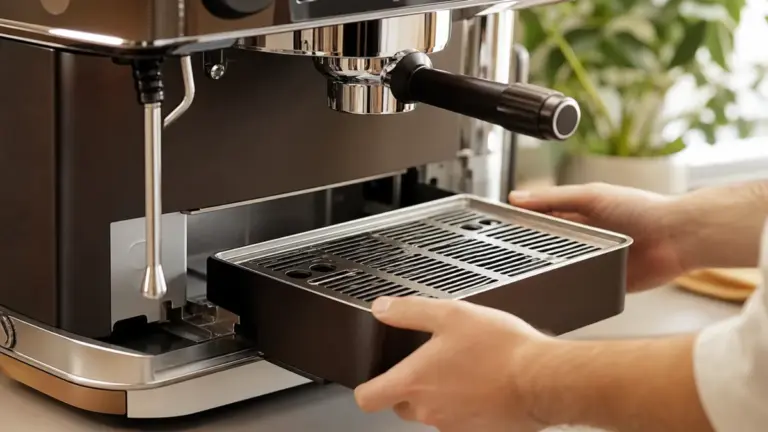
Shut down safely and remove waste. After shutdown and cooling, unplug where instructed. Remove used grounds, filters or capsules, then lift out the tray and waste container. Do not pull out a brew unit while an automatic machine is still positioning it.
-
Wash approved removable parts. Use warm water and mild washing-up liquid only where the manual permits it. Brush corners, lid channels and the underside of the drip-tray grid, then rinse thoroughly. Keep the electrical body out of the sink.
-
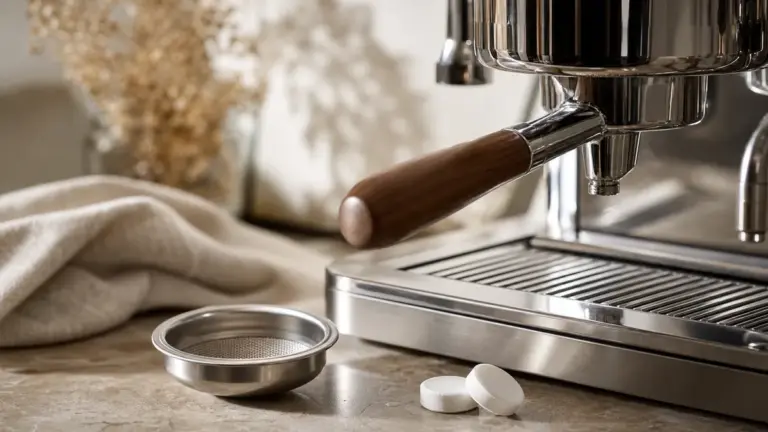
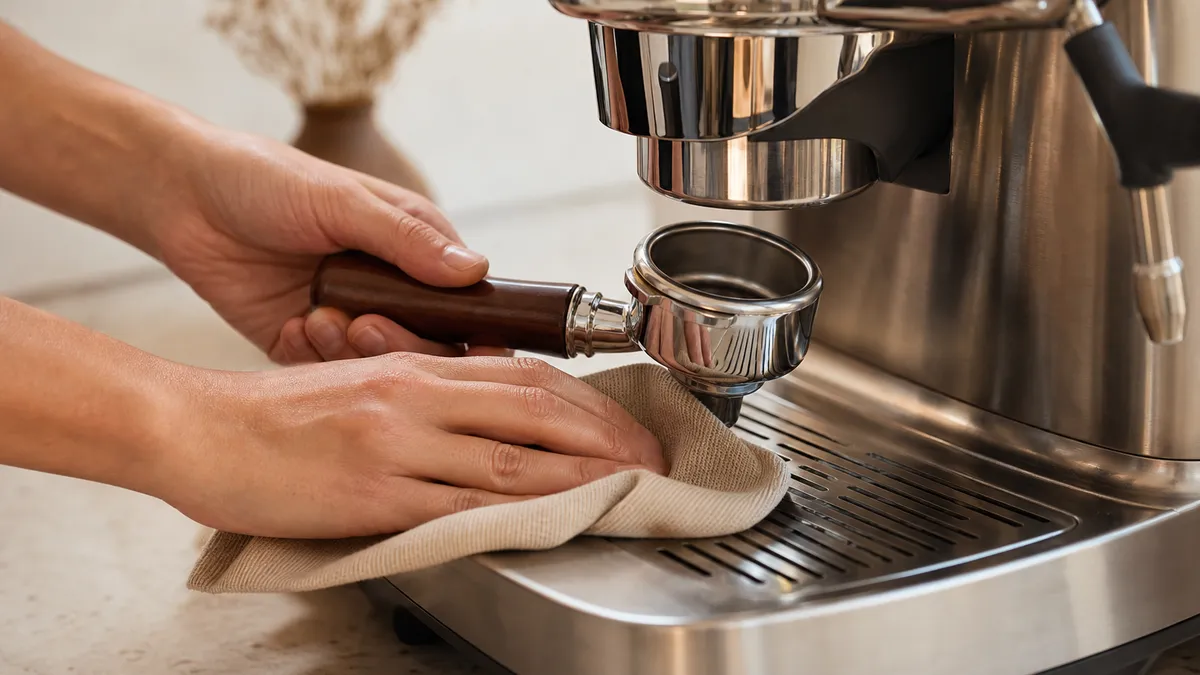
Clean the coffee-contact components using their specific method. Rinse a water-only brew unit without detergent. For compatible espresso baskets and metal portafilter heads, Urnex specifies a Cafiza soaking solution of 6 g per 1,000 ml of hot water, followed by 30 minutes soaking and a fresh-water rinse. Keep the handle above the solution. Use this only when both the component manufacturer and cleaner instructions permit it.
-
Dismantle permitted milk parts. Separate the intake tube, outlet, connector and removable lid pieces according to the manual. As a model-specific example, De’Longhi’s Magnifica Evo FEB296X/FEB298X EX:2 instructions specify hand-washing the listed carafe components in drinking water at at least 40 degrees Celsius with washing-up liquid for at least 30 minutes, followed by thorough rinsing. Do not apply that temperature or soaking time to unrelated frothers.
-
Dry, inspect and reassemble. Follow the drying instructions for each part. Philips specifies air-drying its brew group rather than drying it with a cloth, which could leave fibres. Check that tubes, lids, trays and seals are properly seated.
-
Complete the specified final rinse. Restore power only after reassembly. Run the manufacturer’s rinse sequence and discard cleaning water. If the instructions require a sacrificial coffee after cleaning, discard that too.
Do not increase chemical strength to compensate for a missed routine. Use the stated concentration, contact time and rinse procedure.
Milk parts and drip trays need particular attention
Milk systems
A clean-looking spout does not prove that the tube and internal channels are clean. Follow the whole milk path, including the intake tube, connectors, frother openings and removable lid components.
An automatic milk rinse and a detergent milk clean may be separate operations. JURA’s S8/S80 instructions require daily milk-system cleaning when milk has been prepared, using its specified cleaner and supplied container. De’Longhi also distinguishes the carafe’s after-use CLEAN function from dismantling and washing its components.
For a manual steam wand, wipe off milk promptly with a clean damp cloth and purge as instructed, pointing the outlet away from people. If performance remains weak, clean the removable tip using the supplied tool and method. Do not enlarge its holes with an improvised implement.
Drip trays and waste containers
Lift off the grid rather than washing only the visible surface. Clean the tray’s corners and the accessible recess beneath it, taking care not to push water into the machine.
Empty trays before their full indicator demands attention when practical. Some machines discharge rinse water internally, so a tray can fill even when little coffee has been spilt. Remove wet grounds regularly rather than leaving the waste container until the next deep clean.
Brew units, espresso groups and filter jugs
Removable and enclosed brew units
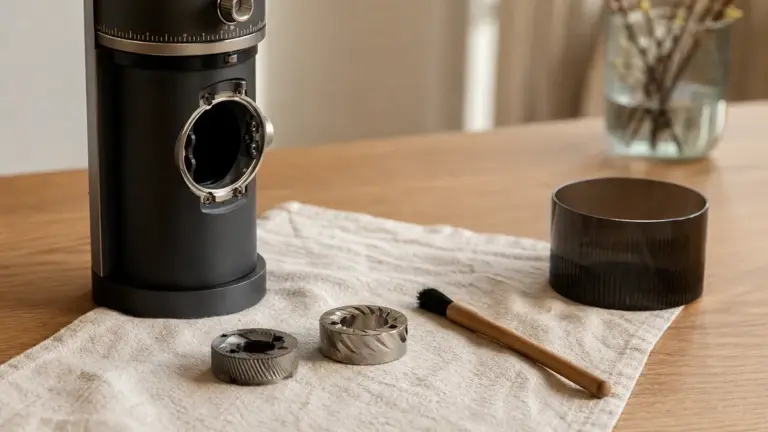
The brew unit, also called the brew group or infuser, is the assembly where an automatic machine compresses and brews the coffee.
For a removable unit, follow its release and reinsertion instructions exactly. De’Longhi specifies water-only cleaning for the infusers covered by its guidance, including an approximately five-minute soak. Detergent and dishwasher cleaning are prohibited for those units.
Where the manual provides no user-removal procedure, use the prescribed internal cleaning programme. Do not dismantle the housing to reach an enclosed unit. Add cleaning tablets only at the location and stage specified.
Some removable groups also need lubrication. This is a separate maintenance task: apply only the specified lubricant at the points and intervals in the model’s instructions.
Espresso groups
The shower screen distributes water above the coffee basket. Wipe accessible grounds from it and perform the manufacturer’s permitted rinse.
Backflushing sends cleaning water through an espresso machine’s designated return path using a blind basket or cleaning disc. It is not suitable for every espresso machine. Check compatibility before following the separate guide to espresso backflushing.
Filter jugs and baskets
Wash the jug, lid and filter holder after use rather than repeatedly rinsing away only loose grounds. Moccamaster recommends mild washing-up detergent and thorough rinsing for its carafe and brew basket.
Do not assume that a glass jug, thermal flask and plastic filter holder share the same dishwasher permission. Check each component.
Cleaning products and safe alternatives
Choose products by their stated task and your machine’s instructions, not merely by the words “coffee machine cleaner”.
- Coffee-oil cleaner: for approved coffee-contact parts or the designated cleaning programme.
- Milk-system cleaner: for the compatible milk circuit or removable milk components.
- Descaler: for mineral deposits in the water circuit, using the separate descaling procedure.
- Mild washing-up liquid: a safe alternative for certain removable parts when the manual explicitly permits it, not a general-purpose internal cleaner.
Plain water is the correct option for parts labelled water-only. It is not permission to skip a prescribed detergent programme elsewhere.
Vinegar is not a universal alternative. Moccamaster explicitly advises against it for descaling. Likewise, dishwasher detergent should not be treated as interchangeable with hand washing-up liquid or an internal machine cleaner. Follow the exact component and product instructions, without combining cleaning products or substituting a homemade mixture.
Symptoms, likely causes and fixes
These are cleaning checks, not definitive fault diagnoses.
| Symptom | Likely cleaning-related cause | First fix |
|---|---|---|
| Bitter coffee with visible oily residue | Retained coffee oils on coffee-contact parts | Clean the basket, jug or brew path using its approved method |
| Weak steam or poor frothing | Milk residue blocking the wand tip or frother channels | Perform the prescribed milk clean; dismantle permitted parts |
| Large bubbles or spluttering milk | Dirty or incorrectly assembled carafe lid or connector | Clean the channels and reassemble according to the manual |
| Coffee grounds in a capsule-machine drink | Residue in the brewing area | Eject the capsule and run the specified cleaning procedure |
| Drip tray repeatedly full | Collected rinse water or an overdue emptying routine | Empty, clean and refit; investigate persistent external leakage |
| Reduced flow after routine cleaning | Remaining blockage, scale or a separate fault | Check the manual’s troubleshooting and descaling instructions |
If the prescribed clean does not resolve the problem, stop repeating chemical cycles and seek manufacturer or service guidance.
FAQ
Can I put coffee-machine parts in the dishwasher?
Only when the manual approves that particular part. Permissions can differ within the same machine: a tray may be washable while its decorative front panel is not. Philips’ 800 series instructions identify such exceptions, while Sage prohibits dishwasher cleaning of the Bambino portafilter. Check the component list rather than judging by material alone.
Does the automatic rinse mean the machine is clean?
No, an automatic rinse does not replace every cleaning task. Manufacturers separately specify washing waste containers, cleaning milk systems and removing coffee oils. Let automatic rinses run, but also complete the manual’s detergent programmes and removable-part cleaning. A machine can finish rinsing while still needing its tray emptied and milk components washed.
What should I do before using a machine left idle?
Follow the model’s restart or prolonged-non-use instructions before making coffee. Clean the removable parts, replace the standing water with fresh drinking water and complete the specified rinse or cleaning programme. Nespresso provides a separate first-use or long-non-use procedure for the Vertuo Plus. Do not assume one quick rinse is the correct restart for every machine.
Where to go next
Use Coffee Equipment Care and Repairs to organise the rest of your maintenance routine, and How to Descale a Coffee Machine in UK Hard Water when mineral deposits need separate treatment. If your espresso machine supports it, Espresso Machine Backflushing explains that task in detail; keep this Coffee Machine Cleaning Guide as your everyday checklist.
Sources
Manufacturer instructions below apply to the models and components they describe. Undated sources are identified as such rather than assigned an inferred publication year.
-
De’Longhi, Coffee Machine Care Guide, undated, current web version. General cleaning tasks, milk care and monthly maintenance.
https://www.delonghi.com/en-gb/e/uk-customer-care/coffee-machine-guide -
De’Longhi, Brewing Unit: Cleaning, Maintenance and Troubleshooting, undated, current support page. Water-only infuser cleaning and approximately five-minute soaking.
https://www.delonghi.com/en-us/faqs/Brewing-Unit:-Cleaning,-Maintenance-and-Troubleshooting/a/570264 -
De’Longhi, Magnifica Evo FEB296X/FEB298X EX:2: Instructions for Use, undated, document EN-57132C8537. Milk-carafe washing temperatures, contact time and infuser restrictions.
https://dls.delonghigroup.com/files/pdfmanuals/EN-57132C8537.pdf -
Philips, Fully Automatic Espresso Machine, 800 Series: User Manual, undated, retrieved PDF edition. Weekly and monthly cleaning, drying, lubrication and dishwasher exceptions.
-
Sage, the Bambino: Instruction Book, undated, BES450 manual. Portafilter, shower screen, steam wand, tray and housing cleaning.
https://assets.sageappliances.com/BES450/SES450_EU_UG8_F21_LR.pdf -
Urnex, Cafiza Powder, undated, current product instructions. Compatible accessory soaking concentration, contact time and rinsing.
https://urnex.com/cafiza-powder -
JURA, S8/S80 Instructions for Use, undated, retrieved English edition. Daily milk-system cleaning and designated maintenance products.
https://www.jura.com/-/media/global/pdf/manuals-global/home/S8/download_manual_s8_s80.pdf?em_force=true&hash=807599C900F22C7F9E6EBCFDE9BD9E8D&la=en&sc_lang=en -
Moccamaster, Frequently Asked Questions, undated, current European web version. Brew-count maintenance interval, dishwasher restrictions and advice against vinegar.
https://www.moccamaster.eu/faq -
Moccamaster USA, Brewer Cleaning: Step-by-Step Guide to Cleaning Your Moccamaster Coffee Brewer, undated, current web version. After-use hand-washing of the carafe and brew basket.
https://us.moccamaster.com/blogs/blog/cleaning-your-moccamaster-brewer -
Nespresso, Vertuo Plus User Manual and Machine Assistance, undated, current support page. Cleaning-related troubleshooting and prolonged-non-use procedure.
https://www.nespresso.com/us/en/machine-assistance/vertuo-plus -
Nespresso, VertuoPlus and Aeroccino White: Machine Assistance, undated, current support page. Capsule-container, outlet, water-tank and programmed water cleaning.
https://www.nespresso.com/ae/en/machine-assistance/vertuoplus-bundle-aeroccino-white-machine-assistance-2
Research used retrieved manufacturer manuals, support pages and cleaning-product instructions, with model-specific procedures kept distinct from the suggested general routine.
Last checked: November 2026