Vietnamese phin brewing makes a small, concentrated coffee by letting hot water drip slowly through ground coffee in a metal filter. Start with 14 g of coffee and 120 g of water, allow a 45-second bloom, then aim for the main dripping to finish at around 5 minutes, adjusting the grind to suit your particular phin.
In short
- Use a small phin with a fine, sand-like grind, not powder.
- The top insert holds the grounds in place; it is not a plunger to push during brewing.
- Count bloom water within the total brewing water, not as an extra addition.
- Sweetened condensed milk is a traditional accompaniment, but phin coffee can also be enjoyed black.
- For an iced version, stir the coffee and condensed milk together before adding ice.
What a phin is and how its parts work
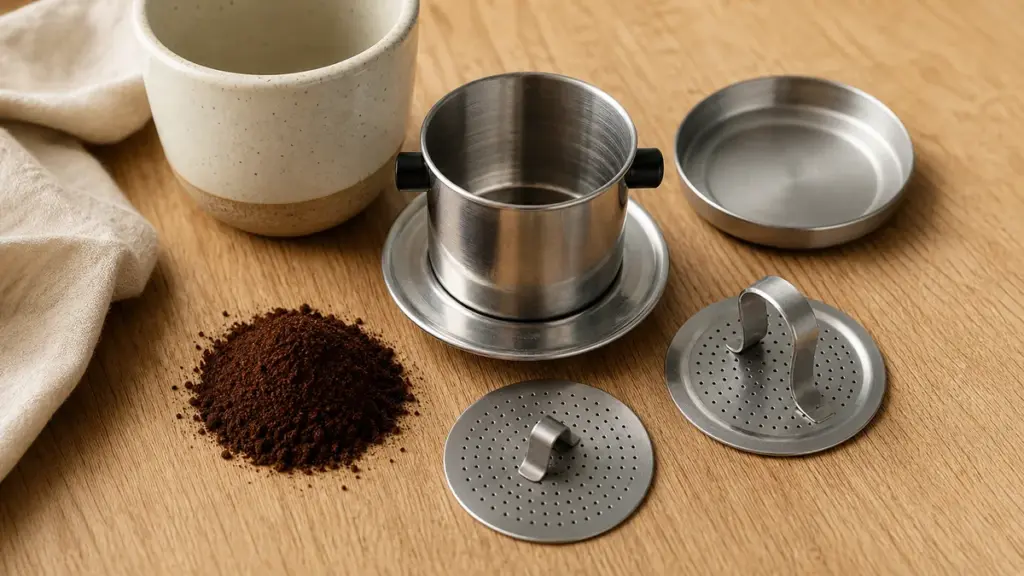
A phin is a Vietnamese metal coffee brewer that sits directly on a cup or glass. Water passes through the grounds and perforated metal under gravity, without a paper filter or a pump.
Most designs have four main parts:
- Filter plate: the wide base that rests on the cup.
- Brewing chamber: the cylinder holding the coffee and water, with a perforated bottom.
- Press or insert: a perforated disc resting on the grounds.
- Lid: the cover for brewing, which can also serve as a drip-catching stand afterwards.
There are two common insert designs. A gravity insert rests freely on the coffee; a screw-down insert attaches to a central thread and allows its tightness to be adjusted.
For your first attempts, let a gravity insert settle under its own weight. With a screw-down version, follow its maker’s instructions and avoid compressing the bed hard: the coffee needs room to become wet and expand.
The phin belongs among gravity-fed brewing methods, but its concentrated recipes deserve their own approach. Do not assume that a familiar filter-coffee recipe will suit it unchanged.
Choose your coffee, dose and grind
A Vietnamese robusta or robusta-arabica blend is a useful starting point, particularly if you want to add condensed milk. Vietnamese roasters also offer arabica for phin brewing, so robusta is not a requirement imposed by the equipment.
Choose a coffee whose description appeals to you rather than treating “Vietnamese” as a single flavour. For a milk drink, a roast described as chocolatey, nutty or dark-roasted is a sensible place to begin.
A starting recipe, not a universal standard
For a small, single-serving phin, use this editorial starting recipe:
| Variable | Starting point |
|---|---|
| Ground coffee | 14 g |
| Total brewing water | 120 g, approximately 120 ml measured before heating |
| Coffee-to-water ratio | Approximately 1:8.6 by weight |
| Water temperature | 94°C at pouring |
| Bloom and total time | 45-second bloom; finish around 5 minutes from first wetting |
This adapts published manufacturer guidance into a weighed, metric method. It is not an SCA phin standard, and it is deliberately less concentrated than some Vietnamese iced-coffee recipes.
The water figure is input water, not finished drink volume. Do not keep topping up until the cup contains 120 ml: that would be a different recipe.
Start with a fine, sand-like grind. Grinder labels are not consistent, so judge the setting by how the coffee flows through your brewer rather than by a number borrowed from someone else’s grinder.
If the brew rushes through, try a little finer. If it barely moves, try coarser before changing the dose, temperature and insert pressure as well.
Vietnamese phin brewing: step by step
You need a small phin, a stable heatproof cup or glass, scales, a kettle and a timer. Have a spoon ready if using condensed milk.
The following method makes one small coffee. The condensed milk is optional.
-
Check and warm the equipment.
Make sure the plate sits securely on your cup. Rinse the phin and cup with hot water, discard that water and dry the chamber before adding coffee. -
Add condensed milk if wanted.
Put 25 g of sweetened condensed milk in the cup. This is a starting amount drawn from a published Vietnamese iced-coffee recipe, not a compulsory proportion. -
Weigh and level the coffee.
Add 14 g of ground coffee to the chamber. Gently shake it level rather than leaving a mound on one side, then place the gravity insert on top without forceful tamping. -
Bloom for 45 seconds.
Start the timer and gently pour 30 g of water at 94°C, approximately 30 ml before heating, over the insert. Wait 45 seconds before adding the remaining water. -
Complete the water addition.
Slowly add another 90 g of water, approximately 90 ml before heating, bringing the total to 120 g. Pour gently over the insert and fit the lid; if the chamber cannot safely accommodate the water, pause rather than filling it to overflowing. -
Let it drip without pressing.
As a manufacturer’s diagnostic guide, look for the first drip by about 2 minutes and the last main drips around 5 minutes, measured from the first water addition. These are reference points, not a pass-or-fail test. -
Remove, stir and taste.
Carefully lift the hot phin onto a heatproof surface once the main dripping has finished. Stir thoroughly if using condensed milk, then taste before deciding what to change next time.
Record the coffee, grind setting, water amount and finish time. A short note such as “too intense, flow steady” is more useful than chasing an exact time without tasting.
Why the bloom matters
The bloom is the initial wetting stage, when hot water causes trapped carbon dioxide to escape from the grounds. You may see swelling or bubbles beneath and around the insert.
The pause gives the coffee time to wet before the chamber receives the remaining water. Do not press the insert down to suppress the swelling.
Manufacturer instructions differ here. Nguyen Coffee Supply’s main brewing guide places the gravity insert on the dry grounds, while its maintenance guide also suggests blooming before fitting the insert when gas causes problems.
Use the insert-first method above for consistency. If it repeatedly lifts or tilts during blooming, try blooming without it, then gently fit it before the main pour.
Condensed milk and the iced version
Sweetened condensed milk is a traditional partner for Vietnamese phin coffee. It brings sweetness and thickness, but it is an accompaniment rather than a requirement of the brewing method: black phin coffee is also an option.
Make cà phê sữa đá
For cà phê sữa đá, Vietnamese iced milk coffee, brew into the condensed milk using the method above. Remove the phin, stir until the milk is fully mixed through, then add ice.
Taste after stirring and cooling. If you want less sweetness next time, reduce the condensed milk rather than changing the coffee recipe at the same time.
For a more concentrated iced drink, PHIN Coffee publishes a stronger recipe using 20 to 25 g of coffee and roughly 80 to 100 g of water. Treat that as a separate recipe and check that the dose suits your chamber, rather than forcing extra grounds into a small phin.
Handle opened milk properly
Follow the condensed milk’s instructions for refrigeration and use after opening. Transfer unused milk from an opened tin into a clean, covered storage container rather than storing it in the tin.
Food Standards Agency guidance recommends a fridge temperature of 0 to 5°C. Return the milk promptly after preparing your drink; do not assume that an opened product can be stored like a sealed tin.
Troubleshooting the slow drip
Change one variable per brew wherever possible. Grind is usually the clearest first adjustment because both excessively fast and stalled flow can result from an unsuitable grind.
| Symptom | Likely cause | Fix |
|---|---|---|
| Water runs through rapidly | Grind too coarse or dose too small for the brewer | Keep the recipe fixed and grind slightly finer |
| Water remains above the grounds with almost no dripping | Grind too fine or bed compressed too firmly | Try coarser coffee and gentler insert placement |
| Gravity insert rises or tilts | Expanding coffee and escaping gas disturb it | Try blooming before fitting the insert |
| Coffee is more concentrated than you enjoy | Recipe strength does not suit your preference | Add hot water to the finished drink before changing the brewing recipe |
| Brew time changes unexpectedly | Grind, dose or preparation has changed | Reweigh the ingredients and repeat the same preparation |
| Flow remains poor with several grind settings | Filter holes may need cleaning | Cool, dismantle and clean the brewer before trying again |
For a stalled brew, do not push down on the insert or shake a chamber full of hot water. Let it cool before dismantling it.
A slightly faster or slower finish is not automatically a fault. Manufacturer guidance explicitly allows variation, and a cup you enjoy matters more than a stopwatch reading.
Understanding strength, extraction and water
Strength describes the concentration of dissolved coffee in the drink. Extraction describes how much soluble material has been removed from the grounds. They are related, but they are not interchangeable.
Adding hot water after brewing reduces concentration without sending more water through the coffee bed. This makes it a useful first experiment when a cup tastes pleasing but feels too intense.
Grinding finer is a different intervention: it changes the particles and the routes water can take through the bed. Peer-reviewed mathematical modelling, compared with experimental coffee-bed data, shows that flow patterns can produce uneven extraction. This is supporting mechanism research, not a controlled trial establishing the best phin recipe.
The practical lesson is modest: finer is not automatically better. Aim for repeatable flow and an enjoyable cup, not the slowest possible drip.
The SCA’s older published water guidance specifies clean, odour-free water without chlorine. That is a useful starting principle, but do not import its conventional filter-coffee strength targets into this concentrated method.
Keep your water source consistent while adjusting grind. If investigating local hardness, consult your water supplier’s report rather than assuming that all UK tap water is alike.
For a different way to manage contact time, explore steep-and-release brewers. To compare this method with another traditional preparation, read about Turkish coffee brewing.
Cleaning and keeping the method repeatable
Once the phin has cooled, remove the grounds and wash the separate parts. Inspect the perforations and rinse away trapped particles.
Use a soft sponge rather than steel wool or an abrasive scourer. Check your own brewer’s care instructions before putting it in a dishwasher, since a manufacturer’s dishwasher claim does not apply automatically to every phin.
Before the next brew, check that the insert sits properly and the plate remains stable on the cup. Consistent preparation makes a grind adjustment much easier to judge.
FAQ
Can I use pre-ground coffee?
Yes, provided its grind allows a steady drip through your phin. Coffee sold specifically for phin brewing is a useful starting point, although it still needs to suit your particular filter. If the brew repeatedly stalls or rushes through, changing to a more suitable grind is preferable to compensating with heavy insert pressure.
Should I refill the phin for a second drink?
You can pour more water through it, but that changes the recipe rather than repeating the original brew. Nguyen Coffee Supply suggests a second pour for a less concentrated result. For learning the method, make a fresh dose instead: it gives you a clearer comparison between grind settings and preparation changes.
Why do online recipes use such different ratios?
Phin recipes serve different preferences and brewer sizes, so there is no single ratio used by every manufacturer. Some make a relatively longer black coffee, while others produce a small concentrate for condensed milk and ice. Follow one complete recipe first, including its dose and total water, rather than combining isolated instructions from several guides.
Where to go next
Read Brewing Methods for the wider method map, then Clever Dripper and Hario Switch if you want to compare phin brewing with steep-and-release preparation. Turkish Coffee Brewing offers another traditional method to explore once your Vietnamese phin brewing is consistent.
Sources
-
Nguyen Coffee Supply, “How to Brew Vietnamese Coffee with a Phin Filter”, undated, live version retrieved November 2026. Brewing sequence, fine grind, bloom and timing guidance.
https://nguyencoffeesupply.com/blogs/vietnamese-coffee-brew-guide/traditional-vietnamese-drip-phin -
Nguyen Coffee Supply, “Dialing In Your Phin: How to Make the Best Vietnamese Phin Coffee”, 2020. Grind and flow troubleshooting.
https://nguyencoffeesupply.com/blogs/news/dialing-in-your-phin-how-to-make-the-best-vietnamese-phin-coffee -
Nguyen Coffee Supply, “How to Use & Clean a Vietnamese Phin Filter”, 2020. Alternative bloom sequence, timing tolerance and cleaning.
https://nguyencoffeesupply.com/blogs/news/using-and-maintaining-a-vietnamese-phin-filter -
Nguyen Coffee Supply, “The Phin Filter: Vietnam’s Coffee Maker”, 2021. Components, gravity and screw-down inserts, and metal filtration.
https://nguyencoffeesupply.com/blogs/news/what-is-the-vietnamese-phin-filter -
PHIN Coffee, “How to Brew: Vietnamese Iced Coffee”, undated, live version retrieved November 2026. Condensed milk, concentrated recipe and iced serving sequence.
https://www.phincoffee.com.au/pages/how-to-brew-vietnamese-iced-coffee -
Specialty Coffee Association, “Coffee Standards”, archived compilation hosted in 2019, sections 4.1 and 5.1; document revision not stated. Used as historical water and brewing guidance, not a phin-specific standard.
-
Moroney and colleagues, PLOS ONE, “Analysing Extraction Uniformity from Porous Coffee Beds Using Mathematical Modelling and Computational Fluid Dynamics Approaches”, 2019, 14(7), e0219906. Extraction definitions and flow mechanisms.
https://journals.plos.org/plosone/article?id=10.1371/journal.pone.0219906 -
Food Standards Agency, “How to Chill, Freeze and Defrost Food Safely”, 2017, live guidance retrieved November 2026. Fridge temperature, packaging instructions and opened tins. The publication states that it applies to England, Northern Ireland and Wales.
https://www.gov.uk/government/publications/how-to-chill-freeze-and-defrost-food-safely/how-to-chill-freeze-and-defrost-food-safely -
Nguyen Coffee Supply, “Coffee Facts: What Is the Bloom?”, 2020. Carbon dioxide release during initial wetting.
https://nguyencoffeesupply.com/blogs/news/coffee-facts-what-is-the-bloom
This piece was researched using published manufacturer instructions, archived SCA guidance, peer-reviewed extraction research and FSA food-storage advice; the starting recipe is an editorial adaptation, not a claim of first-hand testing.
Last checked: November 2026