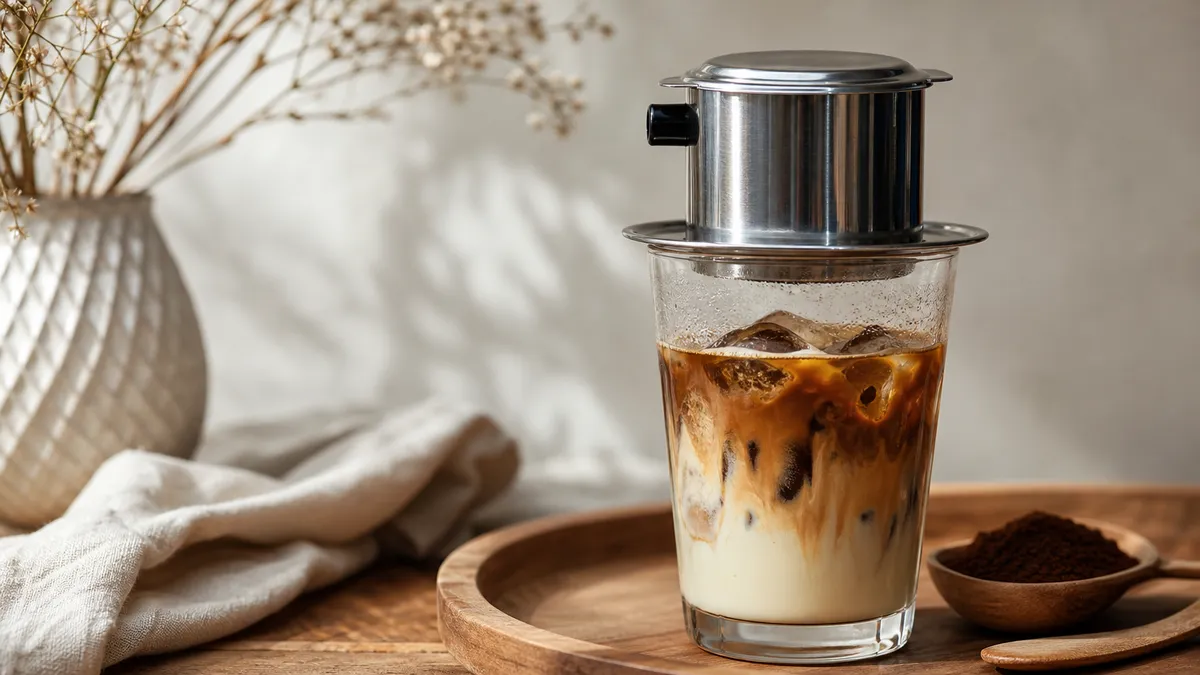
Vietnamese iced coffee, cà phê sữa đá, is strong coffee mixed with sweetened condensed milk and poured over ice. To make it at home, brew through a phin, a small Vietnamese metal drip filter, then stir the milk into the hot coffee before adding ice.
In short
- Start with 14 g coffee, 100 g water and 25 g sweetened condensed milk for one glass.
- Vietnamese robusta or a robusta blend is a good starting point; dark-roasted arabica is an alternative, not the same thing.
- Allow roughly 5 to 7 minutes for dripping, adjusting the grind rather than forcing the water through.
- Mix the coffee and condensed milk thoroughly before pouring over 100 g ice.
- Caffeine varies substantially. The illustrative estimate below is not a measured value or an upper limit.
What makes Vietnamese iced coffee different?
The combination is concentrated coffee, thick sweetened milk and enough ice to chill and dilute it. Aim for a drink that remains distinctly coffee-led after stirring, with sweetness supporting the roasted flavour rather than hiding it.
A phin has a perforated brewing chamber, a support plate, an insert that rests on or screws down over the grounds, and a lid. Hot water passes through the coffee by gravity. It does not brew under espresso-machine pressure.
This recipe belongs to our coffee recipes collection. If you enjoy concentrated coffee prepared in a metal filter, Indian filter coffee offers a useful comparison, although its preparation and serving style are different.
Robusta, dark roast or both?
Robusta describes the coffee species; dark roast describes how the beans were roasted. They are not interchangeable terms.
For a familiar starting point, choose Vietnamese robusta or a Vietnamese robusta-arabica blend intended for phin brewing. A medium-dark or dark roast suits the condensed milk well. Dark-roasted arabica also works, particularly if that is what you already have, but it produces a different drink.
Begin with coffee ground for a phin if available. Otherwise, start with a sand-like grind, then adjust according to how your particular filter drains. There is no universal grinder setting that suits every phin.
Vietnamese iced coffee recipe
This is a home recipe adapted from published phin methods, not a claim that every Vietnamese household or café uses the same proportions.
Serves: 1
Preparation: about 2 minutes
Brewing: approximately 5 to 7 minutes
Total time: about 8 to 10 minutes
Ingredients
- 14 g ground coffee, preferably Vietnamese robusta or a robusta-arabica blend
- 100 g drinking water, approximately 100 ml before heating
- 25 g sweetened condensed milk
- 100 g ice, made from drinking water
The brewing ratio is 1:7.1 coffee to water by weight, before the condensed milk and ice are added. The coffee dose to condensed milk ratio is 1:1.8 by weight. These are starting proportions, not a standard.
Equipment
- Small single-serving phin
- Heatproof brewing glass or cup that supports the phin securely
- Separate serving glass
- Kettle
- Scales
- Spoon
- Timer
- Thermometer or temperature-controlled kettle, if available
Method
-
Prepare the milk and ice. Weigh 25 g condensed milk into the heatproof brewing glass. Put 100 g ice in the separate serving glass.
-
Load the phin. Set the support plate and brewing chamber over the milk. Add 14 g ground coffee and gently shake the chamber to level it.
-
Position the insert. Rest a gravity insert on the grounds. With a screw-down design, follow its instructions and avoid tightening it hard against the coffee.
-
Wet the grounds. Heat the measured brewing water to 92 to 94 degrees Celsius. Pour about 25 g over the insert and wait 30 to 45 seconds. This initial wetting is often called the bloom.
-
Add the remaining water. Pour in the remaining 75 g gently and put the lid on. If your phin cannot hold it all at once, add the rest as space becomes available.
-
Let it drip. Use roughly 5 to 7 minutes from the first pour as an initial guide, not a pass-or-fail test. Do not press the insert down to hurry the brew.
-
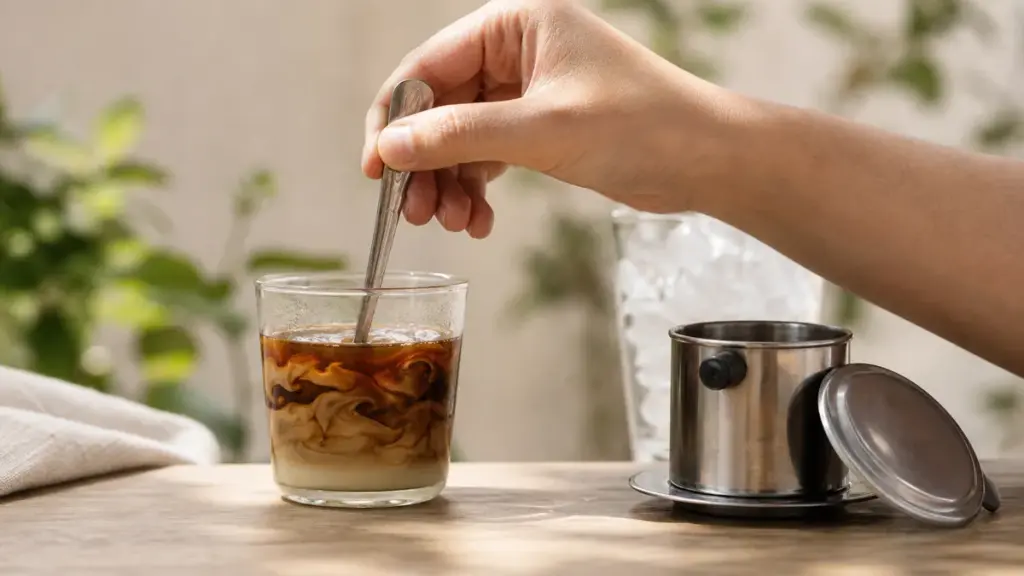
Mix while hot. Remove the phin carefully and stir the coffee into the condensed milk until no thick layer remains at the bottom.
-
Pour over ice. Transfer the mixture to the serving glass and stir. Taste after mixing, when some ice has melted, before deciding whether to change the next batch.
Approximate caffeine
Illustrative estimate: about 250 mg for an all-robusta serving, but this recipe has not been laboratory-tested.
The calculation assumes 14 g coffee × 24 mg caffeine per gram × 75% recovery into the drink = 252 mg. The assumed bean content falls within published laboratory findings for Vietnamese robusta; the recovery percentage is an illustrative modelling assumption, not a verified phin measurement. Actual caffeine may be substantially lower or higher, so do not use this estimate to manage a strict caffeine limit.
The NHS advises no more than 200 mg caffeine a day from all sources during pregnancy. Individual sensitivity varies; choose decaffeinated coffee if appropriate and speak to a GP, pharmacist or midwife about personal concerns.
Balance the condensed milk and ice
For your next glass, try 15 g condensed milk for a less sweet version or 35 g for a sweeter, milkier one, keeping the other ingredients unchanged. These are suggested adjustments, not fixed traditional ratios.
Always judge sweetness after stirring over ice. Condensed milk left at the bottom makes the first mouthful taste too harsh and the last mouthful excessively sweet.
Ice is part of the recipe rather than decoration. Some melting is intended, which is why the coffee starts concentrated. Keep the ice quantity consistent while adjusting the coffee or milk, otherwise several variables change together.
Troubleshooting the phin
Change one thing at a time and record the coffee dose, water quantity and grind setting.
| Symptom | Likely cause | What to try next |
|---|---|---|
| Coffee rushes through and tastes thin | Grind too coarse or an uneven coffee bed | Grind slightly finer and level the grounds |
| Water barely moves | Grind too fine or insert tightened excessively | Grind slightly coarser and avoid compressing the bed |
| Drink tastes overwhelmingly sweet | Too much condensed milk for your preference | Reduce the milk, keeping the brew unchanged |
| Drink becomes watery quickly | Too little coffee strength for the dilution | Check the measured water and ice quantities first |
| Sweetness changes between mouthfuls | Condensed milk has not dissolved evenly | Stir thoroughly while the coffee is hot |
Timing is a diagnostic clue, not the goal itself. Published phin recipes differ in their expected dripping times, so flavour and repeatability matter more than matching a stopwatch exactly.
Variations to try
- Black iced coffee: omit the condensed milk for cà phê đá. Taste before adding any other sweetener.
- Hot milk coffee: leave out the ice and serve the stirred coffee and condensed milk hot, known as cà phê sữa nóng.
- Milk-forward version: keep the coffee recipe unchanged and try adding 50 ml cold milk after stirring in the condensed milk. This is a suggested home adaptation rather than a definitive bạc xỉu recipe.
- Dairy-free adaptation: try a sweetened condensed coconut or oat product. Start with the same weight, then adjust to taste and follow its storage instructions.
- Egg coffee: use the separate Vietnamese egg coffee recipe rather than simply adding an egg to this drink.
FAQ
Can I make it without a phin?
Yes, another brewer can provide the concentrated coffee for a Vietnamese-style iced drink. Use a suitable recipe for your espresso machine, moka pot or other brewer, then combine the coffee with condensed milk and ice. Do not transfer the phin’s grind setting or water ratio indiscriminately to different equipment.
Does adding more ice reduce the caffeine?
No, melting ice dilutes the drink but does not remove caffeine already extracted into it. Drinking the whole glass still means consuming the caffeine in the original coffee. To reduce your intake, use decaffeinated coffee, prepare a smaller serving or leave some of the drink, rather than relying on dilution.
How should I store leftover condensed milk?
Follow the product’s instructions for storage after opening and how soon to use it. For an ordinary opened tin, transfer unused condensed milk to a clean, covered container and refrigerate it rather than storing it in the tin. There is no single opened-storage period that should replace the manufacturer’s directions.
Where to go next
Read Vietnamese Egg Coffee for a different Vietnamese coffee preparation, or Indian Filter Coffee to compare another concentrated metal-filter method. Return to Coffee Recipes when you want to choose your next drink after mastering Vietnamese iced coffee.
Sources
-
Nguyen Coffee Supply, How to Brew Vietnamese Coffee with a Phin Filter, undated, retrieved November 2026. Manufacturer guidance on dose, grind, temperature, wetting and dripping.
https://nguyencoffeesupply.com/blogs/vietnamese-coffee-brew-guide/traditional-vietnamese-drip-phin -
Nguyen Coffee Supply, How to Make Vietnamese Coffee (Hot or Iced), current online version retrieved November 2026. Manufacturer guidance on condensed milk, ice, variations and alternative brewers.
https://nguyencoffeesupply.com/blogs/news/how-to-make-vietnamese-coffee -
StarChefs, Vietnamese Iced Coffee, recipe attributed to roaster Sahra Nguyen, undated on the retrieved page, accessed November 2026. Additional primary practitioner guidance on loading the phin, avoiding excessive compression and brewing time.
https://starchefs.squarespace.com/recipes/vietnamese-iced-coffee -
Tran Van Cuong and colleagues, Effect of Roasting Conditions on Several Chemical Constituents of Vietnam Robusta Coffee, The Annals of the University Dunarea de Jos of Galati, Fascicle VI: Food Technology, 38(2), 2014. Laboratory research informing the illustrative caffeine-content assumption.
https://www.gup.ugal.ro/ugaljournals/index.php/food/article/view/1744 -
Scientific Reports, Caffeine Content in Filter Coffee Brews as a Function of Degree of Roast and Extraction Yield, 2024. Controlled brewing research demonstrating the relevance of extraction conditions, not a measurement of this phin recipe.
https://pmc.ncbi.nlm.nih.gov/articles/PMC11586412/ -
Food Standards Agency, Home Food Fact Checker, current GOV.UK version retrieved November 2026. Guidance on opened tins and following manufacturers’ storage instructions.
https://www.gov.uk/government/publications/home-food-fact-checker/home-food-fact-checker -
NHS, Foods to Avoid in Pregnancy, reviewed 15 June 2026. Current pregnancy caffeine guidance.
https://www.nhs.uk/pregnancy/keeping-well/foods-to-avoid/ -
European Food Safety Authority, Caffeine, current topic page summarising its 2015 scientific opinion, retrieved November 2026. Population caffeine guidance and individual sleep effects.
https://www.efsa.europa.eu/en/topics/topic/caffeine
This recipe was researched from published phin instructions, practitioner guidance, peer-reviewed caffeine research and official UK food-safety and pregnancy advice; the recipe adaptation was not independently kitchen-tested.
Last checked: November 2026