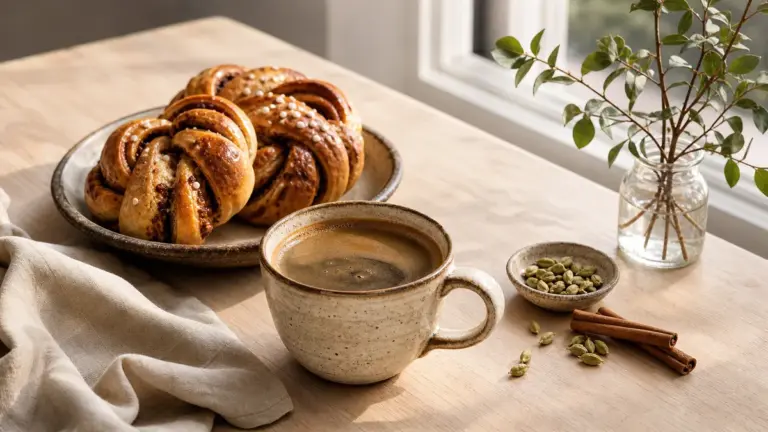
Coffee brings people together by giving them a shared activity and a familiar way to offer hospitality. The role of coffee in social gatherings is less about the drink alone than the invitation, preparation and time spent together, whether at a family table, a charity coffee morning or a first date.
In short
- A coffee ritual can be as simple as offering a guest their usual mug; it need not be a formal ceremony.
- UNESCO documents coffee’s place in hospitality, weddings, engagement ceremonies and the passing on of family traditions.
- Macmillan’s first Coffee Morning took place in 1990, followed by a national event in 1991.
- For meetings and dates, agree the setting and purpose rather than assuming that “coffee” means the same thing to everyone.
- Good hosting includes people who choose tea, decaffeinated coffee or another drink, without requiring an explanation.
Why coffee gives people a reason to gather
“Shall we have a coffee?” offers an activity without demanding an elaborate occasion. There is something to prepare, somewhere to sit and a natural opening question: how do you take yours?
A useful way to understand this is as a social ritual, a repeated action with a meaning beyond its practical purpose. Making a drink supplies refreshment; remembering a visitor’s preferred cup can also communicate attention. Setting out cups before anyone arrives turns an ordinary table into a place prepared for company.
Coffee also gives a gathering a loose structure: arriving, choosing, serving, talking and perhaps accepting a refill. This is an interpretation of how hospitality works, not evidence that coffee itself causes friendship. UNESCO’s accounts of Arabic and Turkish coffee support the distinction: they describe shared practices, conversation and welcome, rather than simply a beverage.
Our coffee culture guide places these everyday encounters within the wider subject. Here, the focus is on what happens between the people around the table.
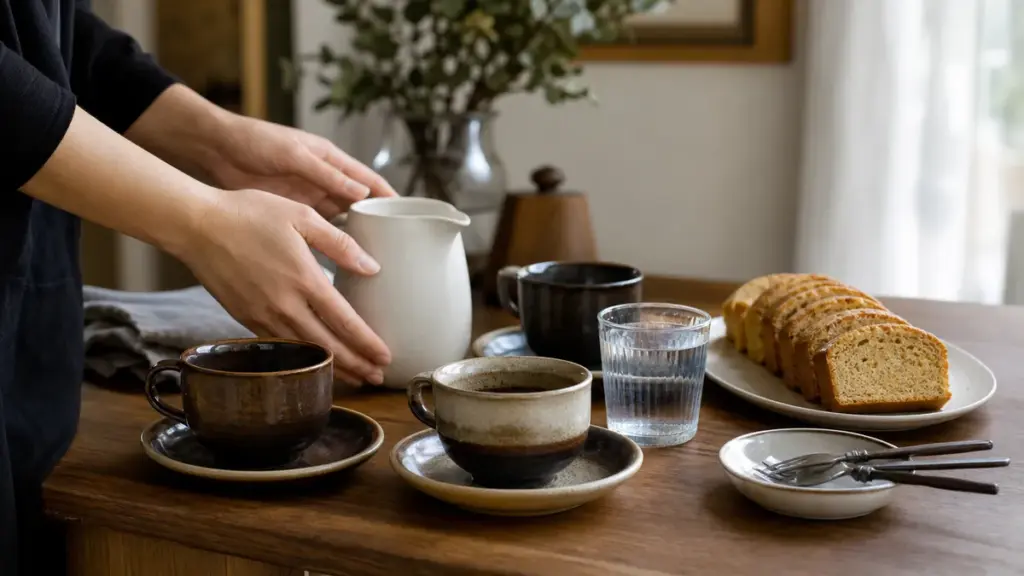
Social rituals, ceremonies and celebrations
Not every coffee gathering is ceremonial. Nevertheless, formal traditions make the social meaning particularly visible: who prepares the coffee, who receives it first and how guests respond can all matter.
Hospitality made visible
UNESCO describes Arabic coffee as a symbol of generosity, hospitality and respect. Its current heritage listing records serving coffee at weddings and tribal gatherings, including gatherings concerned with reconciliation and conflict resolution. It also describes poetry, discussion and the exchange of memories accompanying coffee.
The important point is not that a cup automatically settles a disagreement. Rather, serving and accepting hospitality can form part of the setting in which people meet and speak.
These customs belong to particular communities and settings, not to one uniform “Arab etiquette”. Read Arabic coffee hospitality for the traditions themselves, rather than treating a brief example as a complete guide to participation.
Coffee at significant family occasions
UNESCO’s account of Turkish coffee identifies its role in engagement ceremonies and holidays, alongside ordinary conversations between friends. It also describes knowledge passing between family members through observation and participation.
Here, preparation is part of the occasion, not merely something completed before the occasion begins. The person learning to prepare and serve coffee is also learning how the family welcomes others.
If invited to a tradition unfamiliar to you, ask your host what to do and follow their lead. A respectful question is more useful than confidently applying an etiquette rule borrowed from another country. For a broader comparison, see coffee customs in different cultures.
Coffee mornings and charity: a shared purpose
A charity coffee morning joins a social invitation to a practical purpose. People can contribute by hosting, baking, helping to serve, attending or donating, rather than needing to take on the same role.
Macmillan Cancer Support records its first Coffee Morning in 1990 and its national expansion the following year. Its events now include home gatherings, workplace events, school fundraisers and community groups. This variety is part of the format’s usefulness: the gathering can fit the people and place rather than requiring a single elaborate programme.
For organisers, the strongest starting point is a clear invitation. Say who the event supports, where it takes place and what participation involves. Keep the welcome separate from any expectation to donate, and avoid putting guests on the spot about their personal connection to the cause.
Food deserves preparation too. Current Food Standards Agency guidance for England, Wales and Northern Ireland recommends retaining packaging and recording recipes or ingredient lists so that guests can check what food contains. Registration requirements depend on the activity; ask the local authority if unsure. Organisers in Scotland should consult Scottish guidance.
A cake table is not a substitute for a welcome. Nominate someone to greet arrivals, introduce people and notice anyone sitting alone, rather than leaving every volunteer occupied with serving.
Meetings: making room for conversation
Coffee can accompany a planned discussion or be the reason to pause work altogether. Those are different purposes, and it helps to make the distinction explicit.
Visit Sweden describes fika, the Swedish social coffee break, as time to slow down and enjoy company, commonly with something sweet. Its guidance includes fika at home, in cafés and at work, where breaks are often scheduled into the day.
For a workplace gathering, the useful principle is shared time, not compulsory coffee drinking. Invite colleagues who bring their own drink, make room for shift patterns and avoid allowing the same small group to determine every arrangement.
For a meeting with an agenda, consider offering drinks before the discussion begins. This lets the host attend to arrivals without repeatedly interrupting the meeting to make individual orders.
Use a suitable private space for sensitive conversations. An informal atmosphere does not remove the need for confidentiality, and a café table is not an appropriate setting for every personnel or business discussion. The broader relationship between gathering places and public life belongs in coffee and society.
Dating culture: a modest invitation with clear boundaries
Coffee can make a useful first-date format because the proposed activity is straightforward. Visit Sweden explicitly describes fika as a more relaxed date option than dinner. That is a cultural example, not proof that everyone finds coffee dates comfortable or romantic.
Clarity matters more than the drink. If you mean a date, say so kindly; “we should get coffee” can otherwise leave the other person guessing whether the invitation is social, romantic or professional.
Agree a place where you can hear one another and where both people feel comfortable. Leave each person free to finish the meeting without pressure to order again or continue elsewhere.
Hertfordshire Constabulary advises meeting a new date in a public place, considering a daytime meeting and telling someone where you are going and when you expect to return. A coffee shop can fit that advice, but no venue guarantees safety.
Ordering is not a compatibility test. Someone choosing tea, declining food or asking to leave has not failed the occasion. The point is to discover whether you enjoy talking together, not whether your drink preferences match.
Family traditions: belonging through repetition
Family coffee traditions need not have a formal name. A useful example might be a pot prepared after Sunday lunch, a particular set of cups brought out for visitors or an adult child learning how a parent likes their drink. These are illustrations, not customs shared by every household.
Their significance lies in repetition and participation. The action becomes recognisable: this is how guests are welcomed here, or how the family settles down after a meal.
UNESCO’s descriptions of Arabic and Turkish coffee show this passing-on process in documented traditions. Knowledge is learned through watching and taking part, rather than only through written instructions.
For a family wanting to preserve its own practice, record more than the recipe. Ask who usually prepared the coffee, when the cups were used and which visits people remember. A brewing method explains how to reproduce the drink; those details explain why anyone wants to.
Allow the tradition to change with the people. Serving a different drink, moving the gathering earlier or sharing preparation duties need not diminish its meaning. For further regional context without assuming that neighbouring communities share identical customs, explore Asian coffee traditions.
What makes a coffee gathering genuinely welcoming?
The deeper distinction is between sharing a ritual and requiring conformity. A gathering can have familiar cups, a preferred preparation method and an established order of serving without making every guest drink the same thing.
The cultural sources here support coffee’s association with hospitality and shared occasions. They do not establish that drinking coffee, rather than gathering, listening or receiving attention, produces stronger relationships. It is more accurate to describe coffee as part of the social arrangement than as a treatment for loneliness or a guarantee of connection.
That distinction changes how to host. Concentrate on the invitation, introductions, seating and conversation before worrying about an impressive brewing display.
A practical hosting checklist
- Explain the occasion. State whether this is a casual catch-up, fundraiser, meeting or celebration, and give clear arrival details.
- Ask about drinks and access needs. Offer alternatives without asking guests to justify their choices. Check whether the room and seating work for those attending.
- Keep preparation manageable. Choose a serving arrangement that lets the host spend time with guests rather than remain occupied throughout.
- Make introductions. Give people an opening beyond their names, such as a shared interest, without disclosing anything private.
- Handle food information carefully. Retain packaging and ingredient details; do not guess when someone asks about allergens.
- Leave room to decline. Accept “no thank you” to a refill, food, a donation or a longer stay.
The role of coffee in social gatherings is best served when the drink supports the encounter rather than becoming a condition of belonging.
FAQ
Do you need specialist coffee equipment to host a gathering?
No, specialist equipment is not necessary for this kind of gathering. Choose a preparation method you can manage comfortably and ask guests what they would enjoy. Unless tasting coffee is the stated purpose, there is little reason to make equipment the centre of attention. Give yourself time to sit down and join the conversation.
How can an online coffee gathering work?
Give an online coffee gathering a clear purpose and let everyone bring their own drink. Invite a manageable group, make introductions and allow people to finish speaking before moving on. There is no need to synchronise recipes or equipment. Treat it as a conversation with refreshments, rather than another presentation to watch.
Should a coffee gathering include a tasting activity?
Include a tasting only if it suits the guests and the invitation. A brief, optional comparison can give interested people something concrete to discuss, but nobody should feel examined on their ability to identify flavours. For a mixed group, leave plenty of time for conversation unrelated to coffee and welcome other drinks equally.
Where to go next
Start with Coffee Culture for the wider subject, then Coffee in Different Cultures to understand how expectations change between communities. Arabic Coffee Traditions explores hospitality in greater detail, while Coffee and Society considers the relationship between coffee, gathering places and public life.
Sources
-
UNESCO, Arabic coffee, a symbol of generosity, current Representative List entry, extended in 2024.
https://ich.unesco.org/en/RL/arabic-coffee-a-symbol-of-generosity-02111
Documents hospitality, weddings, reconciliation gatherings, conversation and transmission between generations. -
UNESCO, Turkish coffee culture and tradition, 2013 inscription and current heritage description.
https://ich.unesco.org/en/RL/-00645
Documents conversation, engagement ceremonies, holidays and learning within families. -
Macmillan Cancer Support, About Macmillan Coffee Morning, current 2026 page.
https://www.macmillan.org.uk/coffee-morning/about
Provides the event’s origins and examples of participating settings. -
Visit Sweden, Fika like a Swede, updated 11 September 2026.
https://visitsweden.com/what-to-do/food-drink/swedish-kitchen/all-about-swedish-fika/
Describes fika as a social break at home, at work and in cafés, including its use as a date. -
Food Standards Agency, Providing food at community and charity events, updated 4 September 2026, published on GOV.UK.
https://www.gov.uk/government/publications/providing-food-at-community-and-charity-events/providing-food-at-community-and-charity-events
Guidance applying to England, Wales and Northern Ireland on registration, food safety and ingredient information. -
Hertfordshire Constabulary, Online dating: Opt for a neutral meeting place, undated, current page checked November 2026.
https://www.herts.police.uk/police-forces/hertfordshire-constabulary/areas/campaigns/online-dating/opt-for-a-neutral-meeting-place/
Provides advice on public meeting places, daytime meetings and sharing plans with someone trusted.
This article was researched using UNESCO heritage descriptions, official tourism guidance, the charity’s own history, food-safety guidance and police advice; hosting suggestions and interpretations are distinguished from documented cultural practices.
Last checked: November 2026