Coffee cultivation developed from harvesting forest plants in Ethiopia into terrace farming in Yemen, colonial export agriculture and today’s varied systems of intensive, shaded and specialty production. It was not a simple march towards bigger farms: growers repeatedly changed their planting, labour and crop management in response to trade, disease and local conditions.
In short
- Forest coffee and managed coffee farms still coexist. Older growing systems did not simply disappear.
- Yemen became an early centre of commercial cultivation, adapting coffee to mountainous, comparatively dry conditions.
- Colonial expansion spread coffee plants worldwide through systems that included slavery and compulsory cultivation.
- Leaf rust reshaped farming, encouraging replacement crops, disease management and resistant varieties.
- Modern specialty farming combines attention to distinctive flavour with plant breeding, processing knowledge and, in some projects, forest conservation.
Forest coffee: farming before the plantation
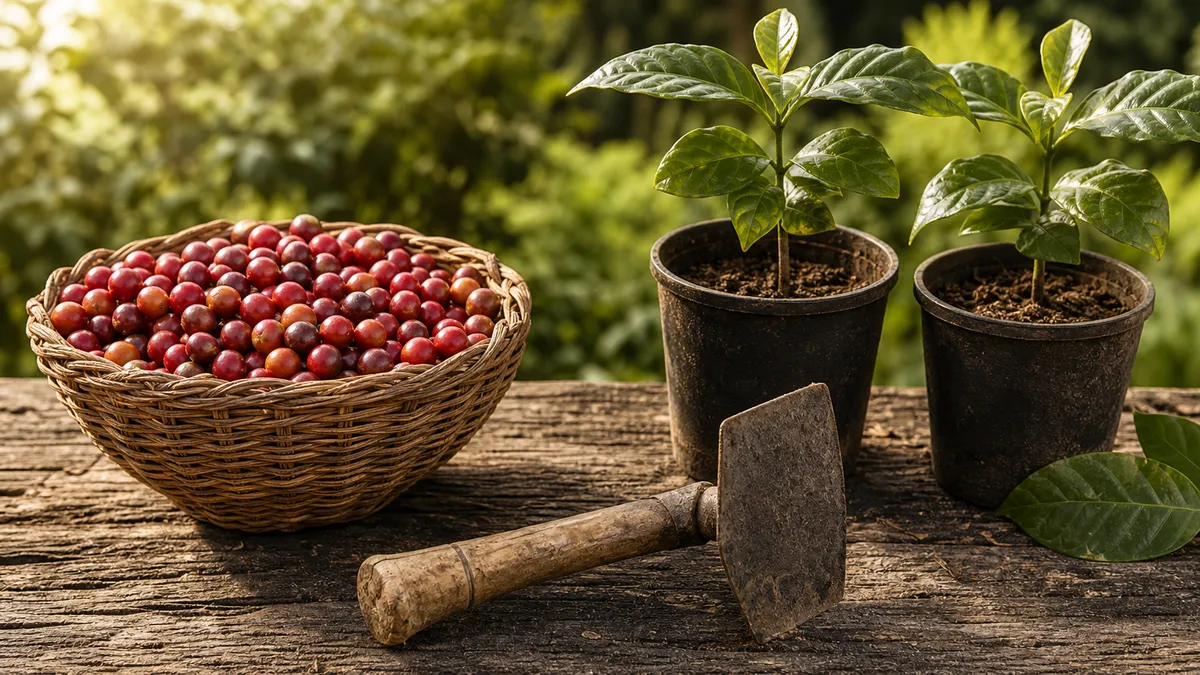
Arabica coffee, Coffea arabica, grows naturally beneath the canopy of humid forests in Ethiopia and neighbouring South Sudan. Its starting point was therefore not a cleared field of evenly spaced bushes, but a small tree growing among other vegetation.
“Forest coffee” describes coffee gathered from plants within forest. “Semi-forest coffee” involves more intervention: growers thin overhead trees and clear undergrowth to make coffee plants more accessible and productive. Gathering and cultivation can overlap rather than forming two neatly separated activities.
Research in south-western Ethiopia shows why the distinction matters. Managed semi-forest plots can retain forest cover while having fewer tree species and a simpler structure than less disturbed forest. Trees overhead are valuable, but their presence alone does not prove that a farm preserves an intact ecosystem.
These systems remain part of coffee production, not merely its distant past. At Ethiopia’s Yayu reserve, Kew describes wild coffee within protected forest and farming around its edges and transition zones. Forest conservation and commercial production meet here, although they are not the same activity.
For the wider story beyond farming, start with coffee history.
Yemeni terraces: adapting a forest plant
Yemen’s importance lies in turning coffee into an established commercial crop. World Coffee Research places the movement of seeds from south-western Ethiopia to Yemen in the mid-fifteenth century. This is a useful historical benchmark, not a precise date for the first person to plant a coffee seed.
Cultivation there required a different relationship with the environment. FAO describes coffee grown on mountains and in valleys, mostly on terraces, using both rainfall and irrigation. A forest-origin plant became part of a farming system adapted to comparatively dry conditions.
Terraces create planting platforms on steep ground. They make the slope workable, but coffee cultivation still depends on water, soil care and the maintenance of the growing space. The achievement was not simply moving a plant across the Red Sea: it was learning how to keep it productive in a different setting.
A valuable contemporary account comes from the Royal Danish expedition to Yemen in 1762 and 1763. Its observations describe carefully cultivated, irrigated hillside coffee, terraced slopes and some trees retained for shade. This is evidence of skilled, managed agriculture, not coffee left to grow unattended.
The commercial connections belong to coffee’s early trade. Here, the central change was agricultural: growers established and maintained coffee beyond its natural forest home.
Colonial plantations: plants, land and coerced labour
European colonial networks carried coffee through Asia, the Caribbean and the Americas. World Coffee Research records seeds sent from India to Java in 1696 and 1699, followed by a plant taken from Java to Amsterdam in 1706. Botanical collections helped plants move between growing regions.
That movement also narrowed the genetic foundations of cultivation. Much of the coffee planted outside Ethiopia descended from limited founding material. Typica and Bourbon became especially influential arabica lineages, rather than representing the full diversity of coffee in its native forests.
The word “plantation” can hide the conditions under which expansion happened. In nineteenth-century Brazil, coffee production relied extensively on enslaved labour. In Java, Dutch authorities imposed compulsory agricultural production, including coffee; the Cultivation System introduced in 1830 extended colonial demands on land and work.
These were not identical labour arrangements. Slavery, compulsory cultivation and later contracted labour need to be distinguished, rather than gathered under the comfortable phrase “traditional farming”. Who controlled the land and who could refuse the work mattered as much as planting technique.
Colonial expansion should therefore not be treated as a story of botanical ingenuity alone. The international coffee crop was also built through coercion and unequal control over production. Historical farming objects offer another way into that material history, alongside the written record.
Leaf rust: a recurring agricultural turning point
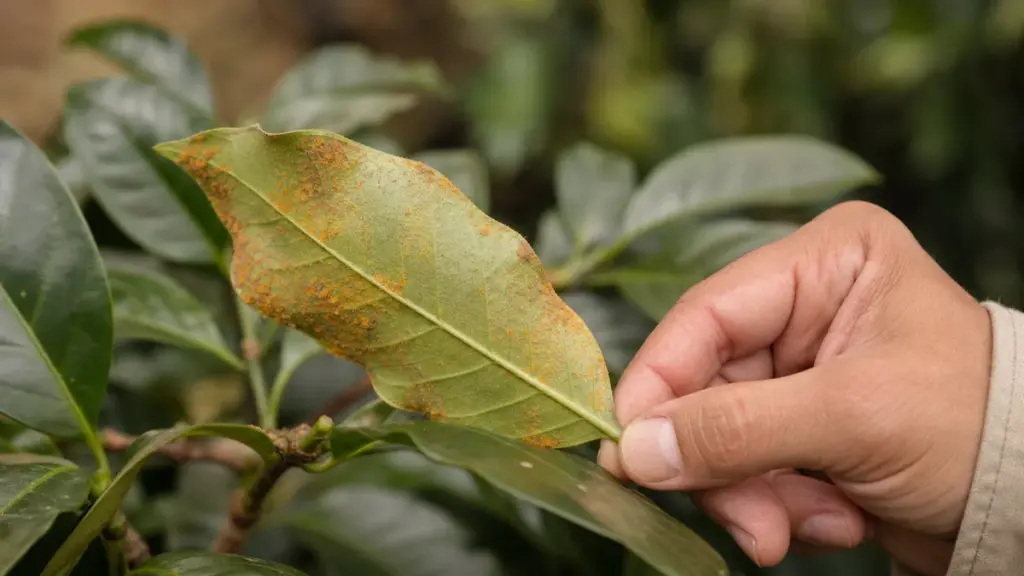
Coffee leaf rust is caused by the fungus Hemileia vastatrix. Orange spore masses develop beneath infected leaves, which can fall prematurely. Losing foliage weakens the plant’s capacity to sustain production.
The fungus was scientifically described in 1869 from material sent from Ceylon, now Sri Lanka. Over subsequent years, rust helped undermine the island’s coffee industry, and plantations shifted towards tea. This was a prolonged agricultural crisis, not the disappearance of an entire crop in one season.
Rust was detected in Brazil in 1970. Its arrival in the Americas made disease management an increasingly pressing part of cultivation.
Later outbreaks showed that the problem had not been settled. Avelino and colleagues examined epidemics affecting Colombia from 2008 to 2011 and Central America during 2012 and 2013. Their analysis identified interacting influences, including weather, susceptible and ageing plants, and growers’ ability to maintain their farms.
That distinction matters: a disease outbreak is not explained by the fungus alone. Plant condition, management and environmental conditions affect how severely infection develops. The authors proposed responses including resistant cultivars, early warning systems, training and better-adapted crop management.
Technification: managing coffee more intensively
“Technification” means reorganising cultivation around more intensive management. In parts of Latin America, especially during the 1970s and 1980s, this included denser planting, reduced shade and greater use of agricultural inputs such as fertilisers and pesticides.
It was more than adding machines. Decisions about planting density, varieties and canopy cover changed the growing environment itself. A diversified, shaded plot and a densely planted open-sun field could produce the same crop through substantially different systems.
A peer-reviewed review of Latin American coffee farming links this intensification to several pressures, including demand, agricultural policy and attempts to address rust. It also describes the benefits that more diverse agroforestry systems can provide, including habitat, soil conservation and additional products for farming households.
Neither “traditional” nor “modern” is a sufficient verdict on a farm. The useful questions concern what changed, why it changed and what happened to productivity, ecological functions and the people doing the work.
A short timeline of coffee cultivation
| Date | Verified development | Agricultural significance |
|---|---|---|
| Mid-fifteenth century | World Coffee Research places the movement of Ethiopian coffee seeds to Yemen in this period | An early foundation for commercial cultivation |
| 1696 and 1699 | Coffee seeds were sent from India to Java | Founding material for the Typica lineage |
| 1830 | The Dutch Cultivation System began in Java | Colonial authorities expanded compulsory export-crop production |
| 1869 | Hemileia vastatrix was scientifically described | A landmark in understanding coffee leaf rust |
| 1970 | Coffee rust was detected in Brazil | Disease management became more urgent in the Americas |
| 2012 and 2013 | Severe rust epidemics affected Central America | Renewed pressure for farm renovation and coordinated responses |
Modern specialty farming: quality and resilience together
Modern specialty production gives attention to differences between coffees, rather than treating every harvest as interchangeable. The Specialty Coffee Association’s definition recognises distinctive attributes, including flavour and information about origin, production and processing.
This makes agricultural detail relevant to the buyer. A named producer, variety or processing method can communicate something meaningful about the coffee. None, however, should be treated as an automatic guarantee of good flavour or responsible farming.
Processing becomes an explicit technical discipline
Post-harvest work sits beside cultivation rather than replacing it. Coffee Quality Institute courses cover harvesting, pre-cleaning and processing methods, while its processing programme promotes scientific understanding and more consistent procedures.
The modern change is not that farmers suddenly discovered care or observation. It is that processing knowledge is increasingly formalised, taught and communicated across the supply chain. Field work and the treatment of harvested cherries are understood as connected parts of quality production.
Breeding adds choices, not a universal answer
Plant breeding offers another response to disease and changing conditions. World Coffee Research describes F1 hybrids, the first generation produced by crossing genetically distinct parents, as a way to combine useful characteristics.
Its trials investigate productivity, cup quality and resilience. The organisation also cautions that hybrids will not outperform a well-adapted established variety everywhere. Local suitability remains essential.
There are practical limitations too. Seed saved from an F1 plant does not reliably reproduce the same characteristics, so propagation requires particular care. A promising plant is only useful when growers can obtain suitable planting material and manage it successfully.
Kew’s work at Yayu provides a different, complementary example: improving the quality and market recognition of coffee associated with existing forest-edge farming. Modern cultivation can therefore involve new genetics, better handling or renewed support for established systems.
Coffee cultivation through the ages is best understood as accumulated adaptation, with gains and losses at every stage. The strongest question to ask of a modern farm is not whether it looks old-fashioned or advanced, but how its choices fit its plants, environment and growers.
FAQ
Is forest coffee necessarily untouched by people?
No, the term does not always mean an entirely unmanaged ecosystem. Forest coffee and semi-forest coffee describe different degrees of intervention, and terminology needs context. Ethiopian research documents growers thinning the canopy and clearing undergrowth in semi-forest systems. Such management can retain tree cover while changing tree diversity and forest structure.
Are Typica and Bourbon different coffee species?
No, Typica and Bourbon are varieties within Coffea arabica. Their names matter historically because their descendants account for much cultivated arabica outside Ethiopia. Species, variety and growing region are different categories: a variety name describes plant material, while a country or regional name tells you where the coffee was grown.
Does specialty coffee have to be grown under shade?
No, the Specialty Coffee Association’s definition does not require a particular shade system. It centres on distinctive attributes and the value attached to them. Shade management is a separate farming characteristic that needs its own evidence. A specialty description should not be read as proof of forest conservation, organic production or a particular labour arrangement.
Where to go next
Read History of Coffee to place these agricultural changes within the broader chronology, then Coffee’s Role in Early Trade for the networks connecting growers and buyers. Historical Artefacts provides a material perspective, while Coffee in the Ottoman Empire follows the consumption history beyond the farm.
Sources
-
Royal Botanic Gardens, Kew, Aaron P. Davis, How growing, and drinking, coffee can help protect forests, 2021.
https://www.kew.org/read-and-watch/specialty-ethiopia-coffee-forest-biodiversity -
Jimma University repository, Aerts and colleagues, Semi-forest coffee cultivation and the conservation of Ethiopian Afromontane rainforest fragments, 2010.
https://repository.ju.edu.et/handle/123456789/1237 -
World Coffee Research, Yemeni coffee: how genetically diverse is it?, 2020, subsequently updated with reference to 2021 research.
https://worldcoffeeresearch.org/news/2020/yemeni-coffee-how-genetically-diverse-is-it -
FAO, hosted by United Nations in Yemen, Assessment Report: Coffee value chain in Yemen: Export potential and investment opportunities, 2025. Executive summary.
https://yemen.un.org/en/290202-fao-yemen-assessment-report-coffee-value-chain-yemen-export-potential-and-investment -
Archives of Natural History, Coffee and qat on the Royal Danish expedition to Arabia: botanical, ethnobotanical and commercial observations made in Yemen 1762 to 1763, 2015. Publisher’s article record and indexed text.
https://doi.org/10.3366/anh.2015.0283 -
World Coffee Research, Coffee varieties catalog, including Typica, undated maintained reference.
https://varieties.worldcoffeeresearch.org/
https://varieties.worldcoffeeresearch.org/varieties/typica -
Cambridge University Press, Herbert S. Klein and Francisco Vidal Luna, Feeding the World: Brazil’s Transformation into a Modern Agricultural Economy, 2019. Publisher’s excerpt and publication details.
https://assets.cambridge.org/97811084/73095/excerpt/9781108473095_excerpt.pdf
https://assets.cambridge.org/97811084/73095/frontmatter/9781108473095_frontmatter.pdf -
Rijksmuseum, Forced and Indentured Labour, undated collection essay.
https://www.rijksmuseum.nl/en/collection/node/Forced-and-Indentured-Labour–47d003d1e6744b419496c736390fffa9 -
American Phytopathological Society, Phil A. Arneson, Coffee rust, The Plant Health Instructor, 2001, updated 2011.
https://www.apsnet.org/edcenter/pdlessons/Pages/CoffeeRust.aspx -
Food Security, Jacques Avelino and colleagues, The coffee rust crises in Colombia and Central America (2008 to 2013): impacts, plausible causes and proposed solutions, 2015.
https://link.springer.com/article/10.1007/s12571-015-0446-9 -
Agronomy for Sustainable Development, Transformation of coffee-growing landscapes across Latin America. A review, 2021.
https://link.springer.com/article/10.1007/s13593-021-00712-0 -
Specialty Coffee Association, What is Specialty Coffee, undated maintained definition page.
https://sca.coffee/what-is-specialty-coffee -
Coffee Quality Institute, Processing Program and CQI certifications in Post-Harvest Processing, undated maintained programme pages.
https://www.coffeeinstitute.org/education/processing/courses
https://www.coffeeinstitute.org/certification/people/post-harvest-processing -
World Coffee Research, F1 Hybrid Trials, undated maintained research programme page.
https://worldcoffeeresearch.org/programs/next-generation-f1-hybrid-varieties
Research combined scholarly histories, published agricultural research and institutional sources, distinguishing documented dates from uncertain beginnings and research findings from programme objectives.
Last checked: November 2026