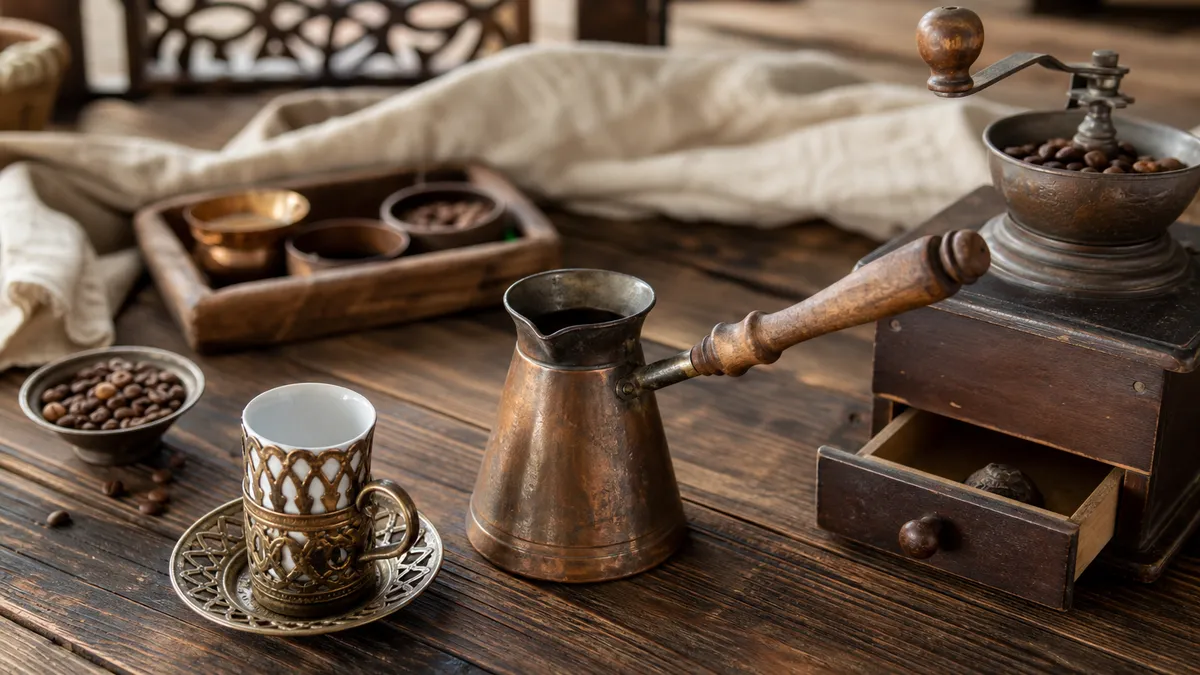
Historical coffee artefacts survive as brewing pots, cups and cup holders, roasters, grinders and coffeehouse tokens, alongside broken pottery recovered by archaeologists. Museum collections preserve both elaborate serving ware and practical equipment, revealing how people prepared coffee, handled hot vessels and organised its sale.
In short
- A cezve is a long-handled coffee brewing pot; ibrik and ibriq require more care because their meanings vary with language and context.
- The fincan is the cup, while the zarf is its separate holder, usually made to protect the fingers from heat.
- Surviving equipment includes a hand-powered coffee mill dated about 1750 and an American coffee roaster dated 1800 to 1850.
- London coffeehouse tokens preserve business names, addresses and imagery, sometimes connecting an establishment with a particular historical event.
- An object’s manufacture date, ownership history and museum acquisition date are different things. A convincing identification keeps them separate.
What historical coffee artefacts can tell us
A useful way to approach an unfamiliar object is to ask where it belongs in the sequence: roasting, grinding, brewing, serving or selling. That turns a display of attractive antiques into evidence of work, hospitality and exchange.
Consider the difference between a grinder and a decorated cup. The grinder invites questions about labour and preparation; the cup invites questions about handling, presentation and the setting in which coffee was offered. Neither supplies the whole story alone.
For the wider chronology, start with coffee history. Here, the focus is the surviving evidence: what an object is, what its catalogue record supports and where interpretation must stop.
Cezves and ibriks: identifying the brewing vessel
The cezve, the Turkish name for a long-handled coffee brewing pot, is one of the most recognisable forms. The British Museum’s coffee exhibition guide distinguishes these pots from other regional brewing and serving vessels rather than treating every coffee pot as the same object.
Ibrik needs more careful reading. The related term ibriq can describe a spouted vessel, with an additional word identifying its use. An old catalogue entry containing that name is therefore not, by itself, proof of a particular coffee-making method.
One especially informative survivor is the British Museum’s top-handled coffee pot from Zanzibar, registration number 2014,2011.156. Its inscription names the maker and dates manufacture to 1155 AH, corresponding to 1742 to 1743 in the Gregorian calendar.
That combination is more useful than appearance alone: the vessel carries evidence about who made it and when. Notice, too, that its registration number begins with 2014, not its eighteenth-century manufacture date.
When comparing pots, look at the handle position, opening, spout and any lid before accepting a familiar name. Treat these as questions for the catalogue, not a shortcut to an attribution.
Ottoman cups: fincan and zarf
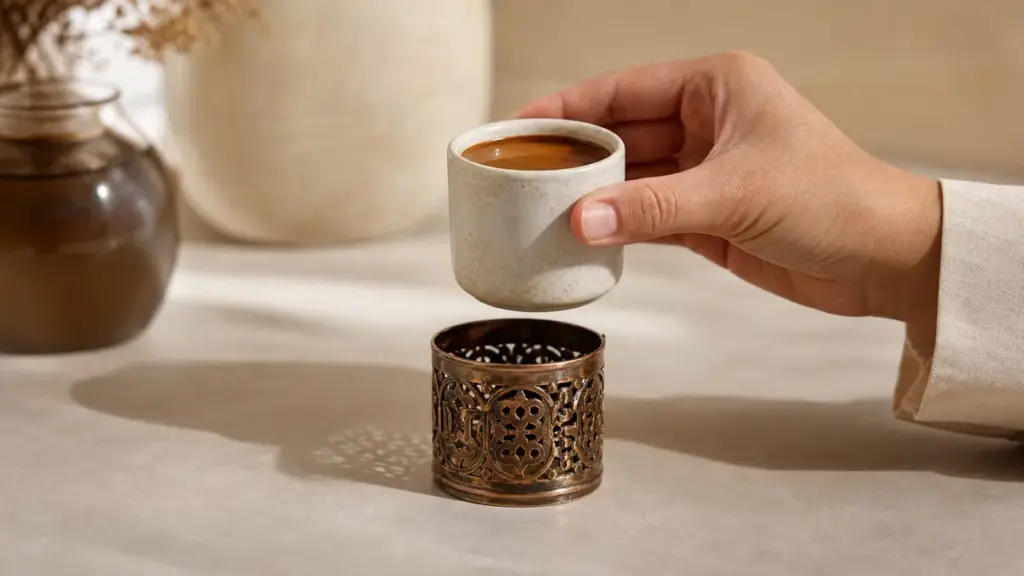
A fincan is a cup, strongly associated in Ottoman material culture with coffee drinking. A zarf is the separate holder surrounding the cup. Keeping those terms apart helps explain an arrangement that can otherwise look like two nested drinking vessels.
The British Museum holds an eighteenth-century Kütahya coffee cup, G.325, decorated with stylised pomegranates and foliage. Its record identifies the production place as Kütahya and the material as pottery. Those details matter: “Ottoman”, “Kütahya” and “porcelain” are not interchangeable descriptions.
Kütahya and İznik should also remain distinct. Pera Museum’s account of coffee ceramics describes limited cup production in sixteenth-century İznik and the later importance of Kütahya production. A floral design alone is not a reason to label an Ottoman cup “İznik”.
Why the holder matters
The zarf solved a practical problem: how to hold a small hot cup. It also provided another surface for ornament.
Although zarfs are often associated with metalwork, they were not exclusively metal. The British Museum holds a Sèvres hard-paste porcelain zarf dated 1830 to 1832, decorated with gold and platinum on a dark blue ground. Here, hard-paste porcelain means the high-fired ceramic body, not a metal holder with porcelain decoration.
Read cup and holder together where their association is documented. If a museum catalogues them separately, do not assume that two visually compatible pieces began life as a matching set.
Early roasters and grinders: evidence of preparation
Serving ware shows the finished occasion; preparation tools bring the work back into view.
Pera Museum describes coffee roasting pans that had to be kept moving over the fire, followed by covered and cylindrical forms. The movement helped expose the beans more evenly to heat. This is a useful mechanical explanation, but it should not be turned into an unsupported claim about one surviving pan being the first roaster.
The Henry Ford collection preserves an American coffee roaster dated 1800 to 1850, object 30.297.5, made from sheet iron, wrought iron and wood. Its broad date range is worth retaining. Replacing that range with a single year would make the description neater but less accurate.
A surviving hand-powered mill
The Smithsonian’s National Museum of American History holds a wall-mounted coffee mill from the Copp family collection, DL.006834, dated about 1750. It combines hardwood components with iron grinding plates and a hand crank.
The mechanism is straightforward: beans enter at the top, and turning the crank rotates the burrs, the grinding surfaces that reduce them to grounds. Unlike a decorative pot, this object helps the reader reconstruct a physical task.
Its catalogue also illustrates the value of household provenance, the documented history connecting an object with its owners or users. The family association adds context that the mechanism alone cannot provide.
These tools concern preparation after harvest. For the separate history of growing the crop, see coffee cultivation.
Coffeehouse tokens: small objects with precise addresses
Coffeehouse tokens are especially useful because their inscriptions can identify businesses rather than merely suggest a style or period.
London Museum’s copper-alloy token 96.66/880 was issued by Robert Hayes at the Turk’s Head coffeehouse in Panyer Alley. The museum explains that businesses issued trade tokens as small change when low-denomination coins were scarce.
The record connects this token with a specific disruption. Panyer Alley burned on 4 September 1666, during the Great Fire of London, and Hayes subsequently reopened in the Barbican. The token’s business name and address therefore contribute to a history that can be checked against another location.
The British Museum’s Money gallery guide documents further London coffeehouse tokens from the 1660s, including one issued by Solyman’s coffeehouse in 1666. Designs include a sultan’s head and a hand pouring from a coffee pot.
Do not describe every token as brass or pewter without checking its record. For the London Museum example, copper alloy is the supported identification.
Tokens show local commercial exchange, not the whole journey of the beans. Follow early coffee trade for that broader subject.
Museum collections worth exploring
Begin with a documented object rather than a general search for “antique coffee”. An accession or registration number makes it much easier to return to the same evidence.
| Collection | Useful starting point | What to examine |
|---|---|---|
| British Museum | Kütahya cup G.325, porcelain zarf 1987,1201.1 and documented coffeehouse tokens | Materials, terminology and production dates |
| Topkapı Palace Museum | Coffee services, cups and zarfs documented by collection curator Ömür Tufan | Objects made for or collected within an Ottoman court setting |
| Victoria and Albert Museum | London silver coffee pot M.398-1921 and Limehouse porcelain pot C.638&A-1924 | Different materials and approaches to serving coffee |
| London Museum | Robert Hayes’s Turk’s Head token 96.66/880 | Connections between inscriptions, businesses and places |
Topkapı: court collections with international connections
In his 2022 study of Topkapı Palace’s European porcelain collection, curator Ömür Tufan documents coffee services, Russian cups with zarfs and an eighteenth-century Dutch Delft coffee pot.
These are objects preserved in an Ottoman palace collection, but that does not make every piece Ottoman-manufactured. The distinction between where something was made and where it was used is essential.
The V&A: silver and porcelain
The V&A documents a London silver coffee pot dated 1681 to 1682, museum number M.398-1921. Its discussion of early teapots also warns that tea and coffee vessels could resemble one another closely enough for an inscription to become decisive.
For porcelain, the museum identifies a blue-and-white Limehouse coffee pot and cover dated about 1745 to 1748, C.638&A-1924. Comparing these records is more revealing than assuming there was one fixed European coffee-pot shape.
Check current display information before making a special visit. Collection ownership and gallery availability are separate questions.
Dating historical artefacts: reading the evidence
Start by separating manufacture, decoration, use and acquisition. They need not share a date.
The Rijksmuseum’s Meissen coffee pot BK-17323 makes this unusually clear. Its porcelain is dated about 1720, its painted decoration about 1720 to 1725, and its silver-gilt mount about 1722 to 1726. One object can therefore have several meaningful dates without the record being contradictory.
Use this sequence when reading a catalogue:
- Record the object number. This identifies the particular item, rather than a similar-looking example.
- Copy the date exactly. Preserve “about”, century-level dates and ranges.
- Separate materials and components. Ask whether the body, decoration and fittings have different attributions.
- Read inscriptions alongside the description. Establish whether they name a maker, owner, business or date.
- Check provenance and find context. Distinguish documented ownership from an archaeological findspot.
Broken objects deserve attention too. Joanita Vroom’s 2023 archaeological study discusses Kütahya coffee cups recovered from refuse deposits, pits and wells in Athens. Such fragments supply evidence of consumption beyond the intact sets selected for display.
The safest conclusion is sometimes modest: a catalogue supports a period and production centre, but not a named original owner. Historical artefacts become more informative when that uncertainty remains visible.
A short timeline of surviving objects
These are dates attached to particular objects, not claims about when each type was invented.
| Date | Surviving evidence | Collection |
|---|---|---|
| 1666 | Solyman’s coffeehouse token | British Museum |
| 1681 to 1682 | London silver coffee pot, M.398-1921 | V&A |
| 1742 to 1743 | Inscribed top-handled coffee pot from Zanzibar, 2014,2011.156 | British Museum |
| About 1750 | Copp family hand-powered coffee mill, DL.006834 | Smithsonian |
| 1800 to 1850 | Iron-and-wood coffee roaster, 30.297.5 | The Henry Ford |
FAQ
Does the earliest surviving example tell us when an object was invented?
No: a surviving example establishes that the object existed by its supported date, not necessarily when its design originated. This article’s timeline deliberately identifies particular museum objects rather than inventions. A claim about the first cezve, grinder or roasting pan would require a separate examination of documentary and archaeological evidence.
Can a cup made outside the Ottoman Empire still belong in Ottoman coffee history?
Yes: manufacture and use are different parts of an object’s history. Topkapı’s documented collection includes European-made coffee services and cups. Such objects can illuminate Ottoman court consumption without being described as Ottoman-made. Always retain both parts of the attribution when the catalogue provides them.
Is every object shown in an exhibition guide owned by that museum?
No: an exhibition can include loans as well as the organising museum’s own objects. The British Museum’s coffee guide, for example, identifies some cups and silver zarfs as belonging to private collections. Check the lender or credit line before treating an exhibition photograph as evidence of permanent museum ownership.
Where to go next
Read History of Coffee to place these historical artefacts within the wider chronology, then Origin and Discovery for the evidence concerning coffee’s beginnings. Legends and Myths helps separate memorable stories from supported history, while Coffee’s Role in Early Trade follows the movement of coffee beyond the surviving equipment.
Sources
-
British Museum, Life in a cup: coffee culture in the Islamic world, large-print exhibition guide, 2021. Regional vessel terminology, inscribed Zanzibar pot, cup holders and collection credits.
https://www.britishmuseum.org/sites/default/files/2021-10/Life_in_a_cup_coffee_culture_in_the_Islamic_world_large_print_guide_1021.pdf -
Pera Museum, Coffee Break: The Adventure of Coffee in Kütahya Tiles and Ceramics, undated digital publication. Fincan terminology, ceramic production and roasting equipment.
https://www.peramuseum.org/Images/pdf/digital-publications/Kahve-Molasi-en.pdf -
British Museum, Coffee-cup, G.325, undated collection record.
https://www.britishmuseum.org/collection/object/W_G-325 -
British Museum, Zarf, 1987,1201.1, undated collection record, referencing Aileen Dawson’s 1994 catalogue.
https://www.britishmuseum.org/collection/object/H_1987-1201-1 -
Smithsonian, National Museum of American History, Coffee Mill, DL.006834, undated collection record.
https://www.americanhistory.si.edu/collections/object/nmah_315243 -
The Henry Ford, Coffee Roaster, 1800-1850, 30.297.5, undated collection record.
https://www.thehenryford.org/collections/explore/artifact/2633 -
British Museum, Money, Room 68 large-print gallery guide, 2020. Coffeehouse tokens and their designs.
https://www.britishmuseum.org/sites/default/files/2021-05/Money_Gallery_LPG_2020_Room_68.pdf -
London Museum, The Turk’s Head Coffee House, 96.66/880, undated collection record.
https://www.londonmuseum.org.uk/collections/v/object-294736/the-turks-head-coffee-house/ -
Millî Saraylar, Ömür Tufan, Topkapı Sarayı Avrupa Porselenleri Koleksiyonu, 2022, issue 23, pages 128 to 159.
https://dergipark.org.tr/en/download/issue-full-file/73645 -
Victoria and Albert Museum, Teapot design through time, undated article. Early silver coffee pot and the identification of similar beverage vessels.
https://www.vam.ac.uk/articles/teapots-through-time/ -
Victoria and Albert Museum, Olivia Tracey, East London Porcelain and the World, 28 April 2026. Limehouse coffee pot and cover.
https://www.vam.ac.uk/blog/museum-life/east-london-porcelain-and-the-world -
Rijksmuseum, Coffee pot, BK-17323, undated collection record. Separate dates for porcelain, decoration and mount.
https://www.rijksmuseum.nl/en/collection/object/Coffee-pot–cd908af9e67604a0fb19b46d86fc865b -
Joanita Vroom, Historical Archaeology, “They Were Just Eating to Live”: The Social Archaeology of Ottoman Foodways and Ceramics, 2023, volume 57, pages 1231 to 1253.
https://link.springer.com/article/10.1007/s41636-023-00476-2
Research used museum object records, institutional collection publications and peer-reviewed archaeology, retaining the sources’ dating qualifications and distinguishing exhibition loans from collection holdings.
Last checked: November 2026