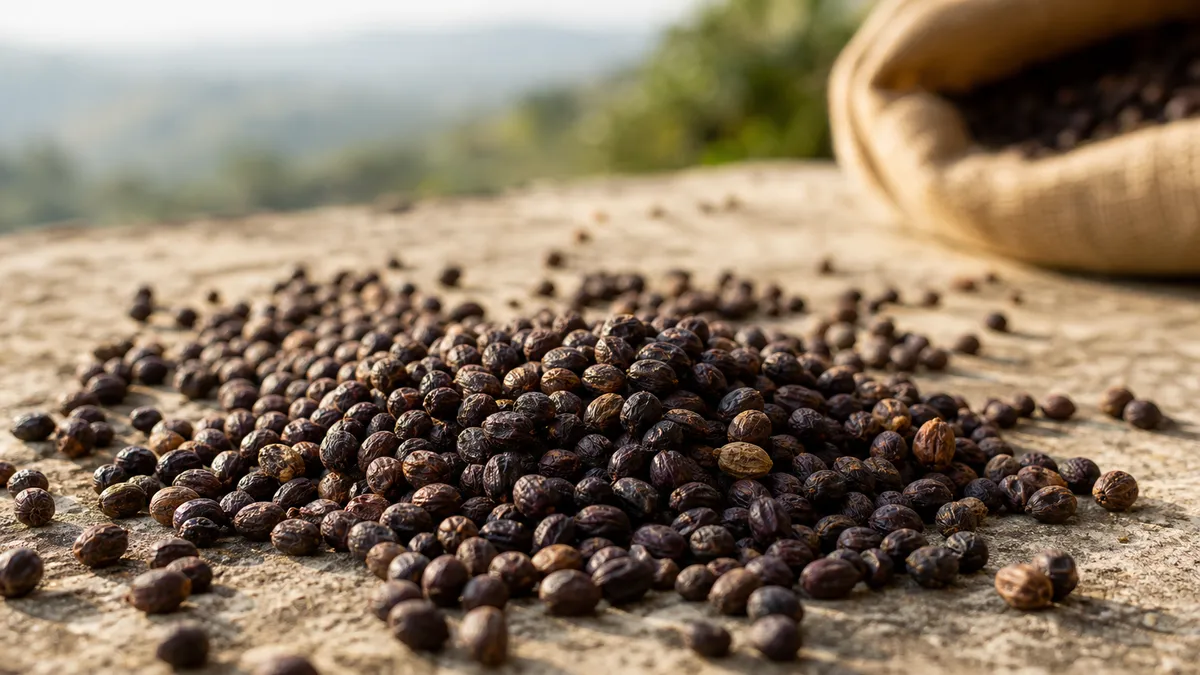
Yemeni coffee can be richly sweet and full-bodied, with chocolate, dried-fruit and spice notes; other lots reveal berries, flowers and brighter acidity. Yemen is the starting point of coffee’s oldest commercial growing tradition, but neither its history nor its origin name guarantees how an individual coffee will taste.
In short
- Look for a named lot: ask for its growing area, harvest, processing details and exporter, rather than relying on “Mocha” alone.
- Natural processing is central: the coffee fruit is dried around the seeds before the dried outer layers are removed.
- Yemenia is a genetic population: it is not one genetically uniform commercial cultivar.
- Local names need interpretation: Udaini, Tufahi, Dawairi and Jaadi do not reliably identify separate genetic varieties.
- Qishr uses the husk: this traditional drink belongs to the same broad coffee-fruit tradition as cascara, rather than being an ordinary brew of roasted beans.
What does Yemeni coffee taste like?
Think chocolate, dried fruit and aromatic spice as useful starting points, not a national recipe. Sweet Maria’s describes a Sanani lot with malt-like sweetness, dried apricot, prune, woody spices and a thick body. Those are the importer’s tasting observations for that coffee, not ingredients added to it.
There is another side to the origin. Royal Coffee’s assessment of a Sa’dah lot found raspberry, rose and chocolate with a creamy texture, showing why “heavy and earthy” is an incomplete description of Yemeni coffee. Its different roast trials also produced different balances of fruit, sweetness and body.
For a first purchase, choose by the specific tasting description, not by romantic language about age or rarity. If you enjoy dried-fruit sweetness and substantial texture, seek those notes explicitly; if you prefer floral, brighter coffee, ask the roaster whether the lot offers that character.
Yemen origin fact panel
| Feature | What to know |
|---|---|
| Altitude | FAO reports an approximate national growing range of 700 to 3,000 metres above sea level. This is a broad range, not a specification for every lot. |
| Species and local names | Coffea arabica. Common farmer names include Udaini, Dawairi, Tufahi and Jaadi, but these are not dependable genetic identifiers. |
| Main processing | Natural, or dry processing, with whole cherries dried before hulling. Rooftops and raised beds are documented drying surfaces. |
| Harvest months | Timing varies by locality. Royal documents October 2020 to February 2021 for its Sa’dah supply; FAO describes main and secondary seasons influenced by water availability. Do not apply one calendar to every district. |
| Typical cup possibilities | Chocolate, dried fruit and spice; some lots show berries, flowers and creamy texture. These are sensory possibilities, not an origin-wide guarantee. |
Mocha and the oldest commercial coffee tradition
Yemen’s historical importance is different from coffee’s botanical origin. World Coffee Research identifies Ethiopia as arabica’s evolutionary centre and Yemen as the place where it became a commercial crop, with historical records placing its introduction from Ethiopia in the mid-fifteenth century.
Mocha, also written Mokha or Al-Mokha, is the Red Sea port whose name became associated with the coffee traded through it. The beans came from inland growing areas: the port name is not the name of a single farm or a uniform genetic variety. The British Museum records the expansion of European trade through Mokha during the seventeenth and eighteenth centuries.
A short timeline helps separate the stages:
- Mid-fifteenth century: historical records place the movement of coffee seeds from Ethiopia to Yemen and the beginning of commercial cultivation there.
- Early sixteenth century: Yemeni coffee beans were important exports to Mecca and Cairo, with trade spreading towards the Levant and Turkey.
- Seventeenth and eighteenth centuries: European trade through Mokha expanded, while cultivation elsewhere gradually ended Yemen’s commercial monopoly.
That history makes Yemen foundational, not the botanical birthplace of the species. The distinction matters when a packet compresses centuries of cultivation and trade into a phrase such as “the original coffee”. For the wider geographical context, see our guide to the middle east.
Mountain terraces and scarce water
Coffee growing in Yemen is closely associated with mountain terraces. These stepped plots make cultivation possible on difficult slopes while helping conserve soil and scarce water, according to FAO’s account of the country’s traditional farming systems. The terraces are working infrastructure, not simply a striking background to the crop.
Aridity does not mean the trees need no water. The FAO and IFC value-chain assessment identifies irrigation management, rainwater collection and storage as major constraints, alongside damage from floods and drought. A dry growing environment can therefore face both insufficient water and destructive rainfall.
It is useful to distinguish two questions when reading an origin description: how water reaches the tree, and how water is used after harvest. Choosing dry processing does not remove the agricultural need for reliable moisture.
Nor should a harsh environment automatically be treated as proof of superior flavour. The practical questions are whether trees are well managed, fruit is picked appropriately and the harvest is protected through processing and storage.
Why dry processing matters
In natural processing, the harvested coffee cherry is dried with its seeds still inside. Hulling then removes the dried outer material to release the green coffee beans. Royal’s documented Khulani supply used whole-fruit drying on rooftops and raised beds.
The traditional method is not inherently careless, but handling matters. Wageningen’s Bani Matar field study documented drying on the ground and tarpaulins, identified quality risks from dust and drying conditions, and also described specialist companies operating drying centres. That study concerns particular farmers and supply chains, not every Yemeni producer.
The useful buying question is therefore not merely “Is it natural?” Ask how the cherries were selected, where they were dried, and how the coffee was stored. A processing label describes the broad route from fruit to bean; it does not tell you how consistently that route was managed.
For tasting, keep fruit character and cleanliness as separate judgements. Enjoying an unusual coffee does not require accepting every unwanted flavour as part of its heritage.
Qishr and cascara: coffee beyond the bean
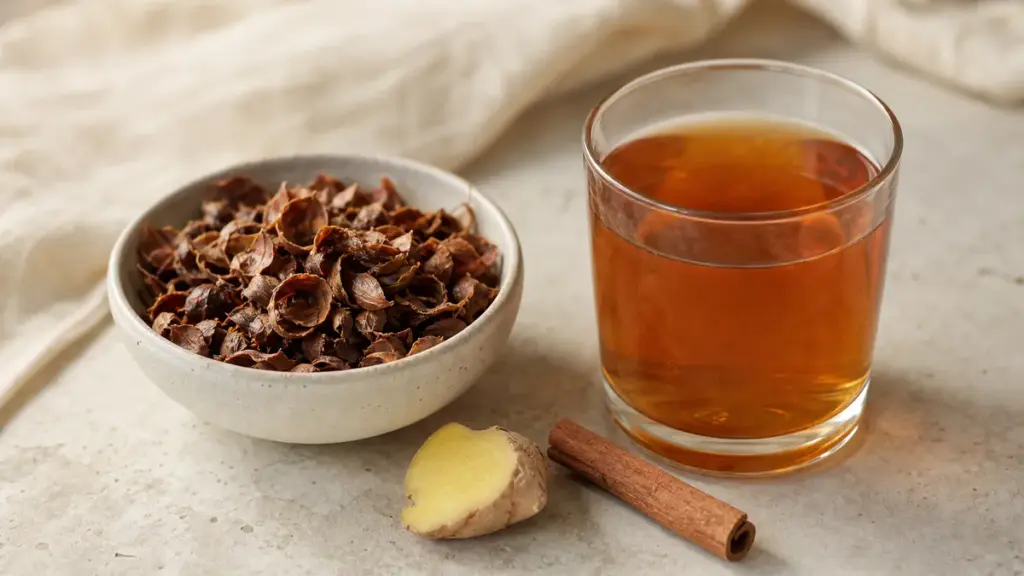
Qishr is a Yemeni drink made from coffee husks, often with spices and sugar. The British Museum describes preparations using ginger, cinnamon or cardamom and records its place in domestic coffee culture. It is not simply a weaker version of roasted-bean coffee: the starting material is different.
Cascara is the broader coffee-trade term for separated coffee-cherry pulp or husk used for infusions. The material can be separated before or after drying, depending on processing. Qishr and cascara therefore overlap in their use of coffee fruit, but qishr also names a particular Yemeni preparation and cultural tradition.
Do not assume that something made from fruit rather than beans is caffeine-free. Coffee-cherry material contains caffeine, although its presence alone does not establish the amount in a particular prepared drink. For trying qishr at home, use material specifically supplied for drinking and follow the supplier’s preparation instructions, rather than treating unidentified milling husks as an interchangeable ingredient.
What Yemenia research actually found
From genetic clusters to a commercial name
World Coffee Research’s account of research published in 2020 supported Yemen’s role as a secondary dispersal centre for arabica. This is the broad historical-genetic picture: plants cultivated in Yemen contributed substantially to the arabica subsequently grown elsewhere.
The more specific finding came from Christophe Montagnon of RD2 Vision and collaborators including Qima Coffee. Their 2021 study in Genetic Resources and Crop Evolution identified a distinctive New-Yemen genetic cluster, alongside other groups represented in Yemeni coffee. It was not associated with the worldwide cultivated varieties included in their comparison.
Qima announced the finding in August 2020 under the name Yemenia, describing it as a mother population within Coffea arabica. A mother population is a broader ancestral genetic grouping, not one uniform cultivar. “New” refers to scientific identification, not to trees newly created or introduced into Yemen.
Claims that it “never spread anywhere else” need qualification. The research found the cluster only in Yemeni material within the comparisons studied; that is stronger evidence than a marketing description, but not an exhaustive historical inventory of every coffee tree. A larger study published in December 2022 confirmed New-Yemen and found none of its compared worldwide cultivated varieties related to that cluster.
Why Udaini is not a genetic guarantee
A separate paper published on 20 August 2022 examined farmer names across 148 farms and genetically analysed 88 trees. It found no significant overall association between those names and genetic identity. Udaini and Tufahi occurred across the genetic groups; Dawairi and Jaadi were also genetically diverse.
These names often refer to geography or visible plant characteristics. They remain meaningful farmer vocabulary, but should not be presented as dependable labels for genetically uniform varieties. Equally, a Yemenia label does not establish that every bean in a commercial lot has been genetically authenticated. Ask what evidence supports the description.
The findings establish genetic diversity, not guaranteed drought resistance, disease resistance or exceptional flavour for every tree. The original researchers discussed breeding potential; practical performance still requires evaluation rather than inference from ancestry alone.
Conflict, supply and choosing Yemeni coffee
Conflict affects the route from terrace to buyer. Wageningen’s 2023 assessment documented reduced sector support, disrupted transport and road closures. More recently, FAO’s country brief dated 13 October 2026 reported renewed conflict and continuing acute food insecurity. The latter is national context, not a coffee export forecast.
Avoid treating these difficulties as a romantic explanation for rarity. Ask the seller what is known about the actual shipment: its harvest, exporter, storage history and traceability. A useful description should explain the coffee, not merely repeat the country’s difficulties.
The factors behind an offer include labour-intensive terrace farming, harvesting, drying, sorting, transport and the work needed to preserve lot identity. The FAO and IFC assessment identifies constraints throughout that chain. Those factors explain why buying conditions differ, but do not prove that an individual offer represents better coffee or better farmer returns.
For a UK buyer, request:
- Growing area and producer information, as specifically as the seller can substantiate.
- Harvest and roast details, with an explanation of any long interval.
- Processing and storage information, beyond the word “natural”.
- The basis of genetic claims, distinguishing farmer names from testing.
- Itemised written quotations for workplace or wholesale orders, including delivery terms and VAT treatment.
Choose Yemeni coffee for a clearly described cup and a supply chain the seller can explain. Its history makes it worth understanding; the individual lot should still earn your enthusiasm.
FAQ
Can I judge Yemeni coffee by an auction score?
An auction score describes the coffee assessed, not every coffee from Yemen or every later shipment carrying a similar name. Request the identity of the lot, who assessed it and whether the score applies to the coffee being offered. For your own choice, give a clear flavour description and traceability at least as much attention as a headline number.
Does buying Yemeni coffee guarantee that farmers benefit?
No, the origin name alone does not establish how farmers were paid or how value was shared. The FAO and IFC assessment describes dependence on intermediaries and constraints on farmers’ access to markets. Ask the seller to explain the purchasing relationship and substantiate any specific claims about farmer support, rather than assuming a retail offer demonstrates the outcome.
Does Yemeni coffee have to taste heavy?
No, documented lots include floral, berry-like and comparatively delicate expressions as well as fuller chocolate-led profiles. Royal Coffee’s Sa’dah assessment illustrates that range, including changes produced by different roast trials. If heavy texture is not your preference, ask the roaster specifically for a brighter, more floral lot rather than ruling out the country altogether.
Where to go next
Read Middle East, our regional guide, to place Yemen within the surrounding coffee-growing area. Use it as the next step from this country profile, while judging any Yemeni coffee by its own provenance and cup description.
Sources
-
World Coffee Research, Yemeni coffee: how genetically diverse is it?, 2020, updated December 2021.
https://worldcoffeeresearch.org/news/2020/yemeni-coffee-how-genetically-diverse-is-it -
Royal Coffee, CJ1413: Crown Jewel Yemen Sa’dah Khulani Traditional Natural, 2021. Primary sourcing, roast and sensory report.
https://cdn.royalcoffee.com/wp-content/uploads/2021/04/30105204/CJ1413-Crown-Jewel-Yemen-Sadah-Khulani-Traditional-Natural.pdf -
Sweet Maria’s, Yemen Mokha Sanani, undated live lot record, retrieved November 2026. Primary importer tasting observations.
https://www.sweetmarias.com/collections/latest-additions/products/yemen-mokha-sanani-8736 -
British Museum, Coffee cups, collection interpretation reproduced on Google Arts & Culture, undated.
https://artsandculture.google.com/asset/coffee-cups/ngHv2Tqs7kh33A -
FAO, Yemen’s coffee and honey carry centuries of heritage to global markets, 11 October 2026.
https://fao.sitefinity.cloud/neareast/news/details/yemen-coffee-and-honey-carry-centuries-of-heritage-to-global-markets/en -
FAO and IFC, Coffee value chain in Yemen: Export potential and investment opportunities, retrieved report dated 2023.
https://yemen.un.org/en/download/179154/290202 -
Wageningen Economic Research, Al-Najjar and colleagues, Understanding coffee farming practices and prospects in Yemen: A case study from Bani Matar, Report 2023-044, 2023.
https://edepot.wur.nl/589422 -
Montagnon, Mahyoub, Solano and Sheibani, Unveiling a unique genetic diversity of cultivated Coffea arabica L. in its main domestication center: Yemen, Genetic Resources and Crop Evolution, 2021, DOI 10.1007/s10722-021-01139-y.
https://d-nb.info/1230750908/34 -
Qima Coffee, Yemenia, undated project account recording the August 2020 announcement. Used for Qima’s terminology, not as independent performance evidence.
https://www.qimacoffee.com/yemenia -
Montagnon, Rossi, Guercio and Sheibani, Vernacular Names and Genetics of Cultivated Coffee (Coffea arabica) in Yemen, Agronomy, 12, article 1970, 20 August 2022.
https://mdpi-res.com/d_attachment/agronomy/agronomy-12-01970/article_deploy/agronomy-12-01970.pdf -
Montagnon and colleagues, Deciphering Early Movements and Domestication of Coffea arabica through a Comprehensive Genetic Diversity Study Covering Ethiopia and Yemen, Agronomy, 12, article 3203, 16 December 2022.
https://mdpi-res.com/d_attachment/agronomy/agronomy-12-03203/article_deploy/agronomy-12-03203.pdf -
European Commission, Commission Implementing Regulation (EU) 2022/47, 2022. Used for the definition of coffee-cherry pulp and cascara, not to state UK authorisation.
https://eur-lex.europa.eu/legal-content/EN/TXT/PDF/?uri=CELEX%3A32022R0047 -
European Commission, Summary of the notification: Coffee cherry pulp, notification 2020-1762, undated summary. Used for ingredient composition only.
https://food.ec.europa.eu/document/download/e3794720-7d8c-4407-a7d8-d993d8536c03_en?filename=novel-food_sum_ongoing-not_2020-1762.pdf -
FAO GIEWS, Country Brief: Yemen, 13 October 2026.
https://cb.apps.fao.org/country.jsp?code=YEM
This article was researched using retrieved genetic studies, agricultural assessments, museum interpretation and primary importer records, with lot-specific observations distinguished from national characteristics.
Last checked: November 2026