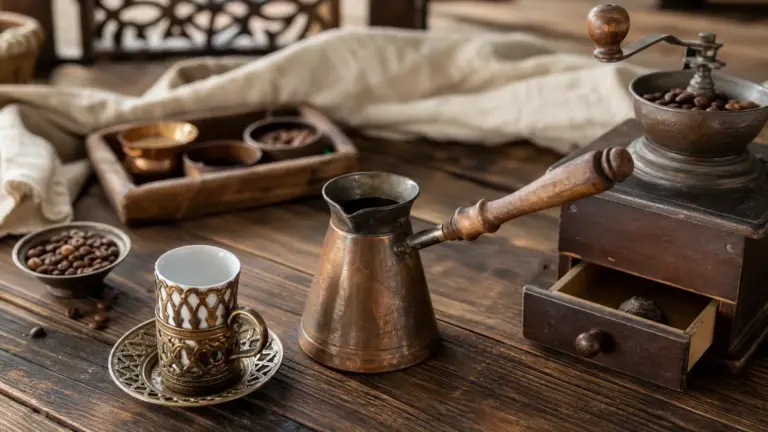
The history of coffee begins with wild arabica in Ethiopia and develops through Yemen’s cultivation and Sufi drinking traditions, before spreading through the Ottoman world and Europe. Colonial plantations, enslaved labour, industrial production and new brewing technologies then transformed it into a global drink, with instant coffee, espresso and speciality coffee following different but connected paths.
In short
- Ethiopia’s wild coffee and Yemen’s development of cultivation and drinking traditions are different parts of the origin story.
- Coffee travelled through Islamic trade, pilgrimage and social networks before European coffeehouses adopted it.
- Colonial expansion depended on coercion and slavery, not simply the movement of plants.
- Late nineteenth-century leaf rust helped change which coffee species were cultivated commercially.
- Instant, espresso and speciality coffee overlap: the familiar “waves” are a useful interpretation, not a universal timetable.
Where the history begins: wild coffee in Ethiopia
Wild Coffea arabica, the species called arabica, grows in Ethiopian forests. That botanical origin is firmer ground than any claim identifying the first person to drink coffee. People could gather and use the plant long before anyone left a surviving written account.
The evidence for early consumption is patchy. Historian Michel Tuchscherer describes wild Ethiopian coffee being traded by the late fifteenth century, while stressing how little we know about the beginnings of its use. Gathering fruit, consuming preparations made from it, cultivating trees and brewing roasted seeds are separate developments, not necessarily one discovery.
This is why the Ethiopian goatherd Kaldi belongs to folklore rather than a verified timeline. The story gives coffee a memorable discoverer, but it cannot establish when coffee drinking began.
For the closer investigation, read origin and discovery. This article follows the connected narrative; the history guide maps the individual historical subjects.

Yemen: cultivation, Sufi practice and a trading network
Across the Red Sea, Yemen became central to coffee’s development as a cultivated crop and a brewed drink. Sufis, Muslims practising devotional traditions that can include prolonged remembrance and prayer, used coffee during night-time observances.
The dating needs care. The British Museum presents traditions placing this use in the late fourteenth or early fifteenth century. Other historical accounts emphasise fifteenth-century figures and acknowledge competing explanations of who introduced it. These are not grounds for assigning a precise invention date or a single inventor.
What becomes clearer is the growth of a coffee economy. During the second half of the sixteenth century, Yemeni farmers cultivated coffee intensively on mountain terraces. Trading networks connected Yemen’s ports with Jiddah and Cairo, carrying coffee beyond its devotional setting.
Al-Mokha, commonly written Mocha, became closely associated with that trade. Coffee’s expansion was therefore agricultural and commercial as well as religious: farmers supplied the crop, merchants moved it, and drinkers created new occasions for consuming it.
Coffee spreads through the Ottoman world
Trade and pilgrimage helped take coffee across the Arabian Peninsula, into Egypt and the Levant, and onwards to Istanbul. By the early sixteenth century it had reached the Ottoman capital; by the early seventeenth century it was known across a much wider area, from Morocco to India.
Coffee also moved from religious practice into everyday hospitality. People drank it at home and in public coffeehouses, making preparation, serving vessels and shared drinking part of its social identity.
Its acceptance was not smooth. Religious and political authorities sometimes tried to prohibit coffee or restrict the places where it was consumed. Yet repeated opposition did not prevent coffee from becoming embedded in daily life.
The crucial point is that Europe did not invent the coffeehouse. Europeans encountered an existing drink and social practice through contact with the Ottoman and wider Islamic worlds.
Europe adopts the drink and the coffeehouse
Coffee entered European life through commercial connections with established coffee-drinking societies. Its history is better understood as exchange and adaptation than as a sudden European discovery.
London provides a particularly clear example. Around 1652, Pasqua Rosée opened a coffeehouse in St Michael’s Alley with the support of his employer, the merchant Daniel Edwards. Both had experienced coffee culture in Smyrna, now Izmir, and sought to reproduce it in London’s commercial centre.
That connection matters. The London coffeehouse was not an isolated English invention: imported beans, overseas trading experience and an Ottoman model of public consumption came together in one business.
European enthusiasm also created demand that merchants and imperial powers wanted to supply directly. The next major transformation was not another way of serving coffee, but a change in where it grew and who controlled its production.
The more colourful discovery and introduction stories need their own scrutiny. Coffee legends and myths separates memorable narratives from claims supported by historical evidence.
Colonial plantations change the scale of coffee
During the eighteenth century, coffee production expanded in European-controlled territories across Asia and the Americas. Yemen remained part of the trade, but it no longer occupied the same position as plantations supplied competing sources.
Dutch-controlled Java, Surinam and French Saint-Domingue became important to this changing system. Their histories should not be compressed into heroic accounts of adventurous Europeans carrying seedlings overseas. Moving a plant was only the beginning; securing land and compelling people to cultivate it made plantation expansion possible.
Historian Tamira Combrink’s research shows how enslaved labour in Surinam and Saint-Domingue was central to the growth of European coffee consumption. Java developed through different forms of colonial compulsion, including the cultivation system introduced in 1830.
Brazil’s nineteenth-century expansion likewise rested heavily on enslaved labour before production shifted towards other labour arrangements. Its rise connected growing overseas demand with a plantation economy in the country’s south-east.
Coffee’s globalisation consequently has two inseparable histories: expanding access for drinkers and exploitation in production. A narrative concerned only with coffeehouses, inventions and famous merchants leaves out the people whose work supplied the beans.
Leaf rust and the rise of robusta
Plantation expansion also exposed the vulnerability of relying heavily on one species. By the middle of the nineteenth century, commercial coffee came overwhelmingly from arabica.
Coffee leaf rust, a fungal disease, subsequently devastated arabica cultivation across much of Asia. Growers and colonial agricultural institutions sought alternatives, including liberica and then Coffea canephora, the species traded as robusta.
Kew records canephora’s scientific naming in 1897, while noting that people in coastal West Africa had already cultivated it on a small scale much earlier. Scientific description should not be mistaken for local discovery.
Robusta offered useful agricultural characteristics, including adaptation to warmer conditions and resistance to leaf rust. Its cultivation expanded rapidly from the early twentieth century.
The distinction remains essential: arabica and canephora are species, not roasting styles or grades of quality. Their commercial histories reflect disease, climate and agricultural decisions as well as flavour preferences.
Industrialisation brings branded and instant coffee
Industrialisation changed coffee after harvest too. In the United States, large businesses increasingly sold packaged, branded coffee rather than leaving consumers to buy green beans and roast them at home.
Packaging became part of the product. UC Davis Library’s archival exhibition records sealed roasted-coffee cans in the late nineteenth century and Hills Brothers’ introduction of vacuum-packed ground coffee in 1900. The brand and package increasingly mediated the relationship between drinker and crop.
Instant coffee carried convenience further by supplying a soluble coffee extract. A major commercial milestone was Nestlé’s launch of Nescafé in 1938, following work to find a use for surplus Brazilian coffee.
That date is a product launch, not proof that instant coffee was invented then. It illustrates a wider historical connection: developments in food manufacturing could respond to agricultural surpluses while changing how people prepared their daily drink.
Espresso becomes a different kind of coffee
Espresso developed along another industrial path: making coffee quickly for individual customers.
Early pressure-brewing inventions did not immediately produce the concentrated, crema-topped drink familiar today. Luigi Bezzera’s 1901 patent incorporated multiple brewing groups, allowing fresh servings to be prepared for customers using steam pressure to drive water through coffee.
The decisive post-war change involved higher-pressure piston systems. Achille Gaggia patented a lever-operated piston mechanism in 1947, and the first Gaggia lever machines appeared in 1948. Their characteristic crema, the foam on the surface, helped distinguish the new drink from earlier espresso.
In 1961, Faema’s E61 introduced an electric pump into this developing system. The operator controlled the extraction without having to supply the brewing force manually.
Espresso therefore has no single satisfactory birthday. The machine concept, individual preparation and modern high-pressure drink emerged at different stages. Treating them as one invention obscures what each development changed.
The coffee waves, and what they leave out
Recent coffee history is often organised into three waves. The framework is especially associated with American consumption and is useful if treated as an interpretation rather than a worldwide calendar.
The first wave describes mass-market coffee: large brands, packaged products and convenience. Its achievement was distribution and everyday familiarity, although the identity of the farm or producer was often hidden behind branding.
The second wave describes renewed interest in coffee quality and the coffee-shop experience. Peet’s opened in Berkeley in 1966, and Starbucks followed in Seattle in 1971. This period connected speciality beans, home preparation and, increasingly, coffeehouse businesses.
The third wave puts greater emphasis on origin, farming, processing, freshness and deliberate brewing. Rather than treating coffee mainly as a branded flavour, it asks how a particular crop acquired its characteristics.
These categories overlap. They also cannot adequately describe the much older drinking traditions of Ethiopia, Yemen or the Ottoman world. Calling something “third wave” does not make it the third stage of everyone’s history.
Contemporary speciality coffee is also reconsidering how quality is assessed. The Specialty Coffee Association’s Coffee Value Assessment separates physical characteristics, sensory description, preferences and information such as origin traceability. Meanwhile, Kew’s work highlights an older issue with renewed urgency: protecting wild coffee diversity as a resource for future cultivation.
The complete history of coffee is not a straight march towards one ideal cup. It is a continuing negotiation between agriculture, labour, commerce, technology and the different things drinkers value.
A verified coffee timeline
Early entries use periods where the evidence does not justify a precise year.
| Date or period | Development | How to read it |
|---|---|---|
| Late fourteenth to fifteenth century | Traditions connect Yemeni Sufis with coffee drinking | The exact beginnings remain uncertain |
| Late fifteenth century | Wild Ethiopian coffee was being traded | Evidence of trade, not a discovery date |
| Early sixteenth century | Coffee reached Istanbul | Part of its spread through Islamic networks |
| About 1652 | Pasqua Rosée’s London coffeehouse opened | An adaptation of an existing overseas practice |
| Eighteenth century | Colonial plantation production expanded | Slavery and coercion were central |
| 1897 | Coffea canephora was scientifically named | Local cultivation preceded scientific naming |
| 1901 | Bezzera patented an individual-serving brewing system | An important stage in espresso’s development |
| 1938 | Nescafé launched | A commercial milestone for soluble coffee |
| 1948 | Gaggia lever machines appeared | A key step towards modern espresso |
| 1961 | Faema E61 introduced electric-pump brewing | Brewing force no longer depended on the operator |
| 1966 and 1971 | Peet’s and Starbucks respectively opened | Reference points in American second-wave history |
FAQ
Where did coffee originate?
Wild arabica, Coffea arabica, grows in Ethiopian forests, which is the plant’s botanical origin. Yemen then developed coffee as a cultivated crop and a brewed drink, so the origin story has two connected parts rather than one moment of discovery.
Is the story of Kaldi and the dancing goats true?
It is folklore. The Ethiopian goatherd gives coffee a memorable discoverer, but the story cannot establish when coffee drinking began, and the evidence for early use is patchy.
When did coffee reach Britain?
Around 1652, Pasqua Rosée opened a coffeehouse in St Michael’s Alley in London, with the support of the merchant Daniel Edwards. Both had experienced coffee culture in Smyrna, now Izmir, and copied an existing Ottoman practice.
Who invented espresso?
No single person. Luigi Bezzera’s 1901 patent allowed fresh individual servings, Achille Gaggia patented a lever piston mechanism in 1947 with machines following in 1948, and Faema’s E61 introduced an electric pump in 1961.
When did instant coffee become a major product?
Nestlé launched Nescafé in 1938, after work to find a use for surplus Brazilian coffee. That date marks a commercial milestone, not the invention of instant coffee.
Where to go next
Use History of Coffee to choose a focused historical subject after this chronological overview. Read Origin and Discovery for the evidence surrounding Ethiopia and Yemen, then Legends and Myths to understand why familiar coffee stories need careful qualification.
Sources
-
Cambridge University Press, Michel Tuchscherer, “Coffee in the Red Sea Area from the Sixteenth to the Nineteenth Century”, in The Global Coffee Economy in Africa, Asia, and Latin America, 2003, online publication 2009. Retrieved chapter summary.
https://www.cambridge.org/core/books/abs/global-coffee-economy-in-africa-asia-and-latin-america-15001989/coffee-in-the-red-sea-area-from-the-sixteenth-to-the-nineteenth-century/8EDB621854C8AF5514BF39D6325171CE -
British Museum, Life in a cup: coffee culture in the Islamic world, exhibition large-print guide, 2021.
https://www.britishmuseum.org/sites/default/files/2021-10/Life_in_a_cup_coffee_culture_in_the_Islamic_world_large_print_guide_1021.pdf -
Encyclopaedia Iranica, Sayyed ʿAlī Al-e Dāwūd, “Coffee”, 1992, updated 2013.
https://www.iranicaonline.org/articles/coffee-ar/ -
The Courtauld, Illuminating Objects, “From East to West”, undated.
https://sites.courtauld.ac.uk/illuminating-objects/illuminating-objects-home/queen-anne-silver-coffee-pot/from-east-to-west/ -
Tamira Combrink, Slavery & Abolition, “Slave-based coffee in the eighteenth century and the role of the Dutch in global commodity chains”, 2021.
https://www.tandfonline.com/doi/pdf/10.1080/0144039X.2020.1860465 -
Cambridge University Press, Herbert S. Klein and Francisco Vidal Luna, “Antecedents”, in Feeding the World, online publication 2018. Retrieved chapter summary.
https://www.cambridge.org/core/books/feeding-the-world/antecedents/9B74B43EA0950B55E64905E240AA880B -
Royal Botanic Gardens, Kew, Aaron P. Davis, “A high extinction threat for wild coffee could rattle the sector”, 2019.
https://www.kew.org/read-and-watch/high-extinction-threat-coffee -
University of California, Davis Library, Brewed Awakening: The Evolution of the Coffee Industry, exhibition 2025 to 2026: “The First Wave of Coffee”, “The Second Wave of Coffee” and “The Third Wave of Coffee”.
https://library.ucdavis.edu/exhibit/brewed-awakening/first-wave/
https://library.ucdavis.edu/exhibit/brewed-awakening/second-wave/
https://library.ucdavis.edu/exhibit/brewed-awakening/third-wave/ -
Nestlé, “The timeline of Nestlé’s company history”, undated, 1938 entry. Used for the company’s product-launch history, not as independent evidence of invention.
https://www.nestle.com/about/history/nestle-company-history -
Jonathan Morris, Food & History, “Making Italian Espresso, Making Espresso Italian”, volume 8, issue 2, 2010. Author manuscript held by the University of Hertfordshire.
https://uhra.herts.ac.uk/id/eprint/2694/1/jm2.pdf -
Specialty Coffee Association, “Coffee Value Assessment”, current programme overview, undated.
https://sca.coffee/value-assessment
The article was researched through retrieved historical scholarship, museum interpretation, archival exhibitions, botanical research and official programme and company records, with uncertain origins distinguished from documented milestones.
Last checked: November 2026