Nobody can identify the first person who discovered coffee. Wild arabica grows in Ethiopia’s forests, but the earliest reliable historical accounts place coffee drinking in fifteenth-century Yemen, especially among Sufi religious communities. The familiar story of Kaldi and his lively goats is a legend, not an eyewitness account.
In short
- Separate the origin of the plant from the development of the drink: they are different historical questions.
- Ethiopia is central to arabica’s natural origins, although its native range also includes South Sudan.
- Evidence for fifteenth-century Yemeni coffee drinking comes substantially from later written accounts, not a surviving record of someone’s first cup.
- Al-Jaziri’s Umdat al-Safwa is a crucial early source, commonly dated to 1587, but its dating and status need qualification.
- Coffee spread through religious contacts, travel and trade before European coffeehouses became part of the story.
What does “discovering coffee” actually mean?
The question sounds simple until we ask what someone supposedly discovered. Was it the edible fruit, the stimulating effect of eating it, a drink made from its husks, or the practice of roasting and brewing its seeds?
Those need not have happened together. Nor should we assume that one person invented every stage of a preparation that other people subsequently copied unchanged.
For a beginner, the essential distinction is between botanical origin, meaning where a plant occurs naturally, and documented use, meaning what surviving evidence tells us people did with it. Botanical research can establish a native population without identifying its first human users. A written account can describe drinking without explaining when people first began gathering or cultivating the plant.
This article follows that distinction rather than choosing a single discovery scene. For the wider sequence, the history of coffee hub places these beginnings alongside coffee’s later development.

Wild arabica in Ethiopia
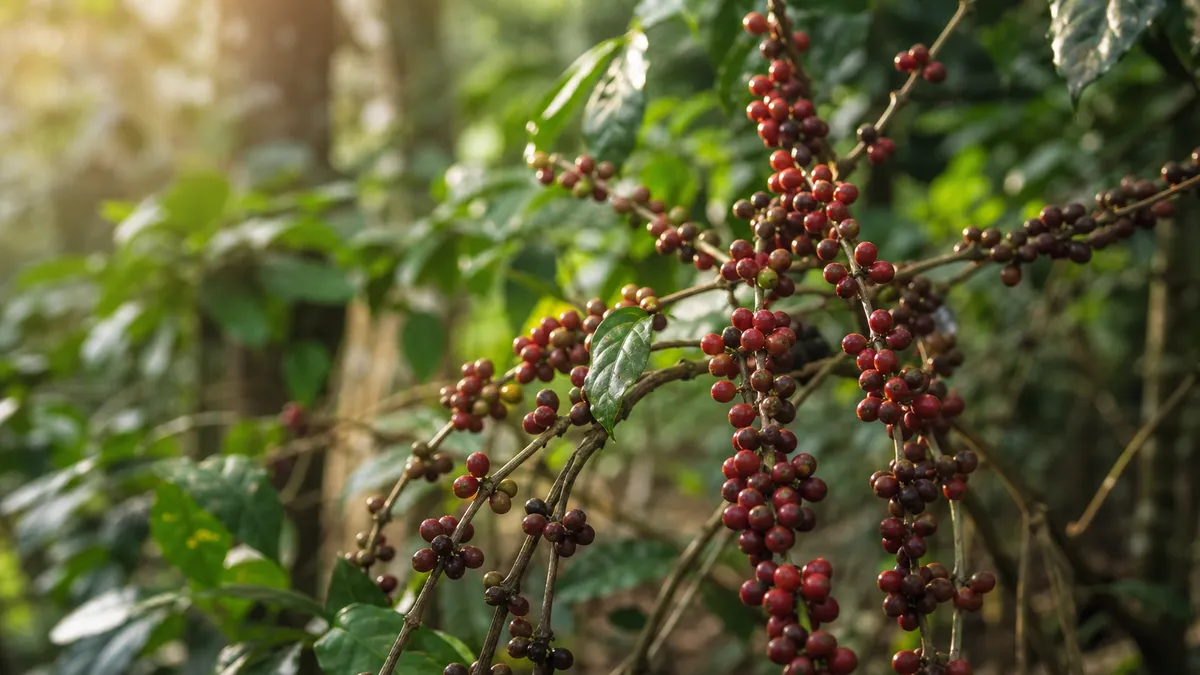
Arabica, the species Coffea arabica, grows wild or semi-wild beneath the canopy of Ethiopian highland forests. Southwestern Ethiopia is particularly important to its natural distribution and diversity.
Ethiopia’s place in this history is therefore more substantial than a picturesque association with a goatherd. It is supported by botanical research into living coffee populations.
There is an important qualification: arabica’s natural range does not stop at Ethiopia’s modern border. Genetic research published in 2021 confirmed that populations on South Sudan’s Boma Plateau form part of the species’ natural distribution and are genetically distinct from the Ethiopian material examined.
“Arabica originated in Ethiopia” is useful shorthand, but “arabica is native to Ethiopia and South Sudan” is more precise. Neither statement identifies where somebody first prepared a coffee drink.
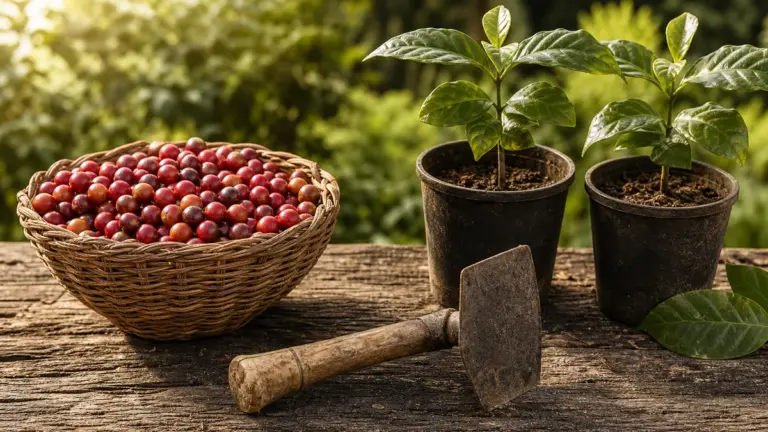
It also helps to picture the plant correctly. Coffee does not grow as a ready-to-roast brown bean. Its seeds develop inside a fruit, commonly called a coffee cherry. Historical uses of coffee therefore need not refer exclusively to the roasted seeds familiar today.
Before the written record: Oromo traditions
Oromo coffee traditions show why the history should not begin and end with a brewed drink. Ethnographic research, based on interviews and observation, documents coffee’s importance in food preparations, ceremonies and social relationships.
One preparation is buna qalaa, often translated as “slaughtered coffee”. Researchers describe coffee berries or beans opened and cooked with butter, with details varying between accounts and communities. Its ceremonial meaning matters as much as its ingredients.
There are also oral traditions of chewing coffee and preparing mashed or ground coffee mixed with butter into portable balls. Bula Sirika Wayessa’s study records such accounts and discusses a later written description in James Bruce’s Travels to Discover the Source of the Nile, published in 1790.
These sources establish that coffee has uses beyond brewing. They do not establish a securely dated sequence in which prehistoric chewing led to butter balls and then to the first roasted drink.
That distinction should not diminish oral history. Oral traditions preserve cultural knowledge and understandings that written archives may overlook. The narrower limitation is chronological: a tradition recorded recently, or described by a later traveller, cannot by itself date its beginning centuries earlier.
Wayessa explicitly acknowledges the lack of substantiation for claims that the Oromo were the first people to recognise coffee’s stimulating effect. Responsible history can recognise their deep relationship with coffee without assigning an unsupported discovery date.
Fifteenth-century Yemen: where the evidence becomes firmer
The earliest reliable historical accounts of coffee drinking point to Yemen in the fifteenth century. Sufis, Muslims practising devotional disciplines, are central to those accounts because coffee helped them remain awake during religious observances.
Historian Jonathan Morris describes the adoption of an infusion made from dried coffee-fruit material by Yemeni Sufis during the second half of that century. This is a reminder not to imagine the earliest drink automatically as a modern cup of roasted-bean coffee.
A major source is Abd al-Qadir al-Jaziri’s Umdat al-Safwa fi hill al-qahwa. This work concerns coffee’s history and the arguments over whether drinking it was religiously permissible. Its account links coffee’s early Yemeni adoption with al-Dhabhani, a religious scholar associated with Aden.
The crucial qualification is that al-Jaziri was looking backwards. His work is an early source for the history of coffee, but not an eyewitness record of its supposed discovery.
Its date also needs care. The work is commonly dated to 1587, or 1587 to 1588 when the Islamic-calendar date is expressed as a Gregorian span. Morris describes a text written in the 1550s, while other scholarship uses the later dating. It is safer to identify it as a sixteenth-century work than to imply an uncontested moment of composition.
Nor should it be called unconditionally the oldest surviving text about coffee. A critical edition published in 2026 examines a medical treatise attributed to the Ottoman physician al-Qusuni, dating it no later than 1566. That qualification changes a bibliographical superlative, not the broader evidence placing early coffee drinking in Yemen.
Bun and qahwa: the words are not interchangeable
Historical vocabulary creates another trap. A reference to a substance with a familiar-sounding name is not automatically evidence of the drink we recognise.
Useful distinctions are:
- Bun or bunn: the coffee berry, sometimes specifically its seed or kernel.
- Qishr: the husk or outer fruit material, and also a drink prepared from it.
- Qahwa: the beverage, with a meaning that changed over time.
The Arabic word qahwa had previously referred to wine. In coffee contexts, expressions such as qahwat al-bunn helped identify the coffee-based drink.
Calling early coffee a dark infusion can describe its appearance, but “dark infusion” should not be presented as a precise, universal translation of qahwa. Nor does the word’s earlier association with wine mean that coffee was necessarily fermented or alcoholic.
Scholars differ over the timing of the word’s change in meaning. Suggestions linking its origin to the Ethiopian region of Kaffa also exist, but should not be treated as a settled explanation.
For the reader, the practical rule is straightforward: ask what the passage says people prepared. A name without identifiable ingredients or a preparation method is weak evidence for dating coffee drinking.
Kaldi and the goats: a memorable story, not a discovery record
In the familiar legend, an Ethiopian goatherd notices that his animals become unusually energetic after eating coffee fruit. He investigates, and the discovery eventually reaches a religious community.
It is an effective story because it gives a complicated development a visible beginning: animals, fruit, curiosity and a revelation.
But the documentary trail is much later than the supposed event. A recognisable goatherd-and-restless-animals story appears in Antonio Faustus Naironi’s coffee treatise of 1671. The Plant Humanities Lab notes that this account is set in Yemen, rather than the Ethiopia familiar from modern retellings.
A date for a story’s publication is not a date for the event it describes. The existence of that text establishes that a version of the tale was circulating by then; it does not verify its characters or their actions.
The story belongs in coffee’s cultural history, clearly labelled as legend. Our legends and myths article considers such stories in more detail.
How coffee use spread
Coffee’s early expansion was not simply a plant moving across a map. People carried ingredients, preparation methods and reasons for drinking it.
Religious contacts helped coffee move beyond its early Yemeni setting. Historical accounts describe its arrival in Mecca towards the end of the fifteenth century and its consumption among Yemeni residents at Cairo’s al-Azhar in the early sixteenth century.
Trade then supported wider circulation. Keiko Ota’s research argues that existing Indian Ocean commercial networks helped coffee become an international beverage before cultivation expanded extensively into European colonies.
Coffee also moved from devotional settings into everyday social use. By the middle of the sixteenth century, it had reached Istanbul; European coffee-drinking culture developed later.
These are connected developments, not proof of a single uninterrupted recipe. Husks, seeds and combinations of the two appear in historical accounts, and preparation varied between places.
The later expansion of cultivation and coffeehouses belongs to the complete history. Here, the important point is that the spread of a recognised drink is better documented than its first invention.
A short timeline of the evidence
| Date or period | What the evidence supports | What it does not establish |
|---|---|---|
| Second half of the fifteenth century | Historical accounts place coffee drinking among Yemeni Sufis | A named inventor or an exact first-cup date |
| Early sixteenth century | Accounts describe coffee drinking among Yemeni residents at Cairo’s al-Azhar | The first occasion coffee crossed the Red Sea |
| By 1566 | The medical treatise attributed to al-Qusuni was written no later than this date, according to its 2026 critical edition | An eyewitness account of coffee’s discovery |
| 1587 to 1588, commonly cited dating | Al-Jaziri’s major work preserves early history and legal controversy | A contemporary fifteenth-century discovery record |
| 1671 | Naironi’s published treatise contains a recognisable restless-animals origin story | Verification of the modern Kaldi legend |
| 1790 | Bruce’s published travel account describes coffee-and-fat provisions | A secure date for the beginning of that practice |
How to judge an origin claim
A useful historical test is to ask three questions: when was the evidence produced, what exactly does it identify, and how close was its author to the event?
A later manuscript may preserve valuable earlier testimony. A field study may document a living tradition with great care. Neither should be made to answer a different question from the one its evidence supports.
Objects require similar discipline. A vessel’s age alone does not establish that it held coffee; identification depends on its context and supporting evidence. The historical artefacts guide explores that material side of the record.
Coffee’s origin and discovery are best understood as several connected histories: a native African plant, culturally important local uses, an early Yemeni drinking tradition and an expanding network of consumers. The missing first discoverer is a limit of the evidence, not a gap that needs filling with a confident story.
FAQ
Was the first coffee drink made from roasted beans?
We cannot establish the first preparation with confidence. Historical accounts distinguish drinks made from coffee husks from those made from the seeds, sometimes with both used together. Morris describes dried-fruit infusion in early Yemeni Sufi use. It is therefore misleading to turn every early reference to coffee into a cup prepared from roasted and ground beans.
Could people have used coffee before the fifteenth century?
Yes, earlier use is possible, but possibility is not a securely dated record. Oromo traditions document a relationship with coffee that cannot be reduced to the surviving Arabic written history. The difficulty is establishing when particular practices began. Historians should leave room for earlier use without presenting an unsupported century or discoverer as fact.
Did older medical writers describe coffee?
Some older histories identify substances mentioned by early physicians as coffee, but that identification is disputed. Juhan Björn’s manuscript research distinguishes coffee, bunn, from bunk, an aromatic or medicinal substance found in earlier texts. A similar-sounding word alone is not enough to establish that a writer knew coffee as a beverage.
Where to go next
Start with History of Coffee to find the relevant period, or read The Complete History of Coffee for the connected chronology beyond these beginnings. Legends and Myths examines the stories surrounding coffee’s discovery, while Historical Artefacts explains what surviving objects can contribute to the evidence.
Sources
-
Royal Botanic Gardens, Kew, and research collaborators. Krishnan and colleagues, “Validating South Sudan as a Center of Origin for Coffea arabica: Implications for Conservation and Coffee Crop Improvement”, Frontiers in Sustainable Food Systems, volume 5, article 761611, 2021.
https://kew.iro.bl.uk/entities/publication/12467f8d-15ba-4c66-abe4-658ce2c6188c
Genetic research supporting South Sudan’s inclusion in arabica’s native distribution. -
Communications Biology. “Lessons from Ethiopian coffee landscapes for global conservation in a post-wild world”, 2024.
https://www.nature.com/articles/s42003-024-06381-5
Research synthesis describing wild and semi-wild arabica in Ethiopian forests. -
Specialty Coffee Association. Jonathan Morris, “Vessels Through the Ages”, 25 Magazine, issue 4, 2018.
https://sca.coffee/sca-news/25-magazine/issue-4/vessels-ages-25-magazine-issue-4-f6c48
Historian’s account of early preparations, Yemeni Sufis and al-Jaziri. -
Hosei University, Institute of Comparative Economic Studies. Keiko Ota, “Coffee as a Global Beverage before 1700”, Journal of International Economic Studies, volume 32, pages 43 to 55, 2018.
https://core.ac.uk/download/pdf/223201571.pdf
Historical research using Arabic chronicles and travel accounts, including translated passages from al-Jaziri. -
Uppsala University, Department of Linguistics and Philology. Juhan Björn, “On the Properties and Benefits of Coffee: Attributed to Muḥammad Badr al-Dīn al-Qūṣūnī”, Orientalia Suecana, volume 75, pages 1 to 20, 2026.
https://journals.uu.se/orientaliasuecana/article/download/671/1060
Critical manuscript edition and analysis addressing early texts, terminology and dating. -
African Diaspora Archaeology Newsletter. Bula Sirika Wayessa, “Buna Qalaa: A Quest for Traditional Uses of Coffee Among Oromo People with Special Emphasis on Wallaga, Ethiopia”, volume 14, issue 3, article 3, 2011.
https://library.sweetmarias.com/wp-content/uploads/2020/08/Buna-Qalaa_-A-Quest-for-Traditional-Uses-of-Coffee-Among-Oromo-Pe.pdf
Field research, oral traditions and discussion of later written descriptions of coffee foods. -
Üniversitepark Bülten. Ayehu Bacha, Lenin Kuto, Dereje Fufa and Kamil Mohammed, “Buna Qalaa Ritual of the Boorana Oromo”, volume 7, issue 1, pages 26 to 39, 2018.
https://www.unibulletin.com/index/arsiv/25/118/buna-qalaa-ritual-of-the-boorana-oromo
Ethnographic study based on interviews, focus groups and observation. -
Dumbarton Oaks, Plant Humanities Lab. “Arabica Coffee: Cultivating Connection and Climate Resilience”, undated web essay.
https://lab.plant-humanities.org/coffee
Scholarly botanical history tracing the published restless-animals story to Naironi’s 1671 treatise. -
William H. Ukers. All About Coffee, 1922, chapters on early history and coffee literature, digitised by Project Gutenberg.
https://www.gutenberg.org/files/28500/28500-h/28500-h.htm
Historical reference reproducing manuscript material and describing al-Jaziri’s work; its older interpretations were checked against later scholarship.
Research combined botanical studies, ethnographic field research, historians’ analyses and a critical manuscript edition, distinguishing reported earlier events from the dates of surviving texts.
Last checked: November 2026