Finding specialty coffee retailers in the UK starts with looking for clear information about the coffee, sensible freshness advice and help choosing beans for your brewing method. Shortlist sellers who explain what they sell, then try a small order before committing to a subscription or a larger supply.
In short
- Choose by traceability, roast information, useful advice and dependable fulfilment, not packaging alone.
- Ask when the coffee was roasted, when the seller recommends brewing it and which coffee suits your equipment.
- Compare local roasters, independent stockists and online sellers using the same criteria.
- Try a coffee before subscribing, then check how to change, pause or end deliveries.
- Treat vague sourcing stories and unsupported environmental claims as reasons to ask for evidence.
What to look for in specialty coffee retailers
The Specialty Coffee Association, or SCA, defines specialty coffee through distinctive attributes that give a coffee or coffee experience additional value. Its definition includes flavour and aroma, but also information such as origin, production practices and the people behind the coffee.
For shopping purposes, turn that broad definition into a practical question: can this retailer explain why this particular coffee is worth choosing for you? A useful answer connects the coffee’s character with your preferences and brewing equipment.
Look for:
- Identifiable coffee: origin information, with a producer, co-operative, washing station or region where available.
- An understandable description: flavour, roast style and intended brewing use explained without requiring specialist knowledge.
- Freshness information: an identifiable roast date and advice about when to start brewing.
- Helpful service: someone willing to discuss grind, brewing and an unsuitable purchase.
- Clear ordering arrangements: dispatch information, delivery coverage and accessible contact details.
Do not turn this into a contest for the longest product description. Ask whether the information helps you choose, rather than merely sounding impressive. The broader buying and storing guide puts retailer selection alongside the other decisions involved in buying beans.
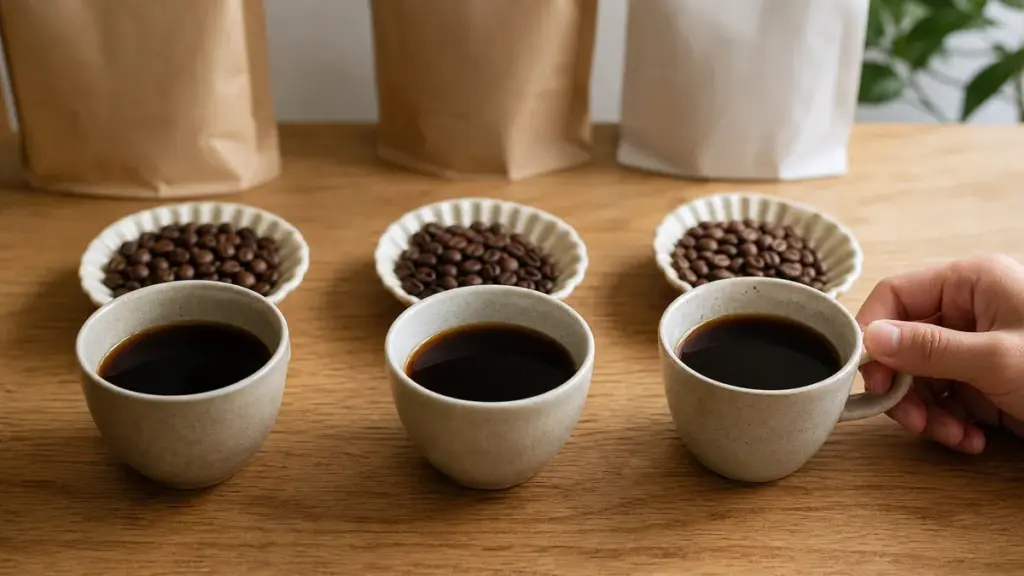
Finding online roasters
Start with searches that describe what you actually want: “UK coffee roaster chocolate espresso”, “specialty decaf whole beans” or “filter coffee roaster UK”. Also ask cafés whose coffee you enjoy which roaster supplies them.
Treat directories, social recommendations and search rankings as discovery tools. Open the retailer’s own website before judging its current range or ordering arrangements.
Check the product page and the practical details
Read a specific coffee listing, not just the brand’s story. Can you identify the coffee, choose whole beans or the appropriate grind, and understand the intended flavour?
Then look beyond the product page. Find the business’s contact details, dispatch arrangements and delivery information for your postcode. For UK distance selling, GOV.UK guidance identifies business identity, contact information, delivery arrangements and relevant contract information among the details sellers must provide.
Distinguish dispatch from arrival. A roast schedule tells you when production happens; a delivery estimate tells you when the parcel might reach you. Ask about both if you need coffee for a particular date.
If the range is confusing, send a short message before ordering:
“I use a cafetière and drink coffee with milk. I prefer chocolate and nut flavours to sharp fruit flavours. Which of your current coffees would you suggest?”
Judge the response by how well it addresses your needs, not how much terminology it contains. Our guide to buying coffee beans covers choosing the coffee itself in more detail.
Finding local roasters and independent shops
Search for both “coffee roaster” and “specialty coffee shop” with your town or nearest city. Before travelling, confirm whether the premises welcome retail visitors and whether opening hours differ from production hours.
A local roaster is worth investigating if you want direct advice about its own coffees. An independent shop stocking several roasters is worth trying if you want to compare different approaches in one place. Neither arrangement removes the need to inspect the actual bag.
If a shop serves the coffee it sells, ask whether you can order the same coffee as a drink. Explain how you intend to brew it at home: tasting a café espresso can help you assess your preferences, but do not use it as a promise that a different brewing method will produce an identical cup.
Use this comparison to choose where to begin. These are suggested shopping routes, not a ranking of retailer quality.
| Retailer type | Most useful when you want | What to investigate | Main limitation to check |
|---|---|---|---|
| Local roaster | A conversation about its own range | Retail access, roast advice and brewing support | Whether its current range suits you |
| Independent stockist | Several roasters in one place | Dates on individual bags and staff familiarity | Whether advice covers the specific coffee |
| Online roaster | Detailed research before ordering | Product information, dispatch and support | Whether you can sample before committing |
| Multi-roaster online shop | Comparison across different roasters | Roaster identity, dates and fulfilment details | Whether information is equally clear for every listing |
Questions to ask before buying
You do not need to interview the seller exhaustively. Choose the questions that resolve your uncertainty.
- “Which coffee suits my brewer and the flavours I enjoy?” Give your brewing method, whether you add milk and one flavour preference.
- “When was this batch roasted?” Ask about the actual stock, rather than a general roasting schedule.
- “When would you start brewing it?” Request advice for that coffee and your method.
- “Where does it come from?” Ask what the named origin represents: a farm, co-operative, processing station, region or blend.
- “Can you grind it for my equipment?” Name the brewer rather than asking vaguely for “medium”.
- “What should I do if I cannot get a good result?” Look for an accessible support route and a willingness to troubleshoot.
Freshly roasted coffee releases carbon dioxide, a process called degassing. SCA research reporting explains that the rate varies with factors including roast conditions, the coffee and storage conditions. That is why a useful retailer should offer context rather than insist that every coffee has the same ideal brewing age.
Keep the detailed freshness decisions separate from retailer selection. Read buying fresh coffee for freshness choices and roast dates and best-before dates for interpreting the different dates.
Choosing a coffee subscription
Choose a subscription after you have established that you enjoy the retailer’s coffee and advice. Decide first whether you want a familiar coffee repeated or a changing selection chosen for you.
Before subscribing, check:
- Whether you choose individual coffees or receive the retailer’s selection.
- Whether you can specify brewing method, grind and flavour preferences.
- Whether changing selections can include processing styles you would rather avoid.
- How to change the quantity or delivery interval.
- How to skip, pause or end the arrangement, including any action deadline.
- What happens when your chosen coffee becomes unavailable.
- Whether a gift subscription ends automatically or continues.
Look for instructions showing how those controls work. For example, Square Mile’s published subscription FAQ says customers can use their account to skip, pause, move a subscription date and adjust frequency. This is an example of the information to seek, not an independent assessment of its service.
Set the delivery interval around your actual consumption. Keep a simple note of when you open and finish a bag before choosing a recurring schedule.
Looking beyond tasting notes and scores
Once the basics are covered, examine how the retailer supports its more detailed claims.
Useful descriptions versus impressive language
World Coffee Research’s Sensory Lexicon provides defined references for coffee’s flavour, aroma and texture attributes. Its purpose is to make sensory description more consistent and measurable.
Use retail tasting notes as a starting point for a conversation. Ask what the seller means by “bright”, “wine-like” or “chocolatey”, and which coffee is the less adventurous choice if that is what you want. For interpreting the rest of the label, see how to read a coffee bag.
What a quality score does not answer
The SCA’s Coffee Value Assessment separates physical characteristics, sensory description, impressions of quality and information such as traceability. It does not reduce the whole assessment to one number.
If a retailer displays a score, ask who assessed the coffee and which assessment method was used. Then return to the question that matters for your purchase: does its described character suit your taste and brewing method?
Sourcing and environmental evidence
Ask what a sourcing claim means in practice. Who produced the coffee? What relationship is being described? What evidence is available?
Apply the same approach to environmental language. The Competition and Markets Authority advises shoppers not to rely on vague slogans and to look for supporting evidence, including practical disposal information. Ask where packaging can actually be collected or processed, rather than treating its appearance as proof of an environmental benefit.
Red flags and a simple first-order checklist
These warning signs are reasons to investigate, not automatic proof of poor coffee:
- “Fresh” without an explanation. Ask for the batch’s roast date and intended brewing window.
- A sourcing story with little identifiable information. Ask what can be traced and what remains unknown.
- One recommendation for every customer. Check whether the seller has considered your brewer and preferences.
- Environmental slogans without evidence. Ask for the specific claim, its basis and disposal instructions.
- Unclear subscription controls or unreachable support. Resolve those uncertainties before signing up.
Marketing copy can become detached from the details a buyer needs. Give the retailer an opportunity to answer a straightforward question, then judge the answer.
For your first order:
- Choose one coffee that fits your stated preferences.
- Record the seller’s brewing and resting advice.
- Check that the delivered bag matches the listing and your chosen grind.
- Brew with a familiar method before changing several variables.
- Contact the retailer with your recipe and a concrete description if the result disappoints.
For finding specialty coffee retailers, that small trial is more useful than trying to identify a universally “best” seller. Look for a retailer whose information, coffee and support work together.
FAQ
Must a retailer roast its own coffee to be worth using?
No. Assess a stockist by the coffee and service it provides, rather than requiring it to own a roaster. Ask who roasted each coffee, inspect the bag’s information and check whether staff can explain the differences between available choices. Use the same selection criteria you would apply when buying directly from a roaster.
Should I reject a retailer that does not publish coffee scores?
No. Treat a published score as optional information, not your only screening test. The SCA’s Coffee Value Assessment considers several dimensions of coffee rather than relying on a single score. For an everyday purchase, prioritise understandable flavour information, useful traceability, appropriate freshness advice and help choosing something you will enjoy.
What if my first bag tastes disappointing?
Ask the retailer for brewing help before deciding whether to buy again. Describe your brewer, grind, coffee and water quantities, timing, and what you taste, such as sharp sourness or a dry, bitter finish. Judge the response by whether it offers a clear next step. If the recommended style simply does not appeal, explain that when seeking an alternative.
Where to go next
Read Buying and Storing Coffee Beans to choose your first bag, then How to Read a Coffee Bag to assess its information. Buying Fresh Coffee and Roast Dates and Best-Before Dates explain the freshness decisions to make once you have found a retailer you want to try.
Sources
-
Specialty Coffee Association, What is Specialty Coffee, undated current web page, retrieved November 2026. Definition and the role of sensory and informational attributes.
https://sca.coffee/what-is-specialty-coffee -
Specialty Coffee Association, Coffee Value Assessment, undated current framework page, retrieved November 2026. Physical, descriptive, affective and extrinsic assessment.
https://sca.coffee/value-assessment -
World Coffee Research, Sensory Lexicon, version 2.0, 2017. Purpose and reference-based description of sensory attributes.
https://worldcoffeeresearch.org/resources/sensory-lexicon -
Specialty Coffee Association, Preserving Freshness: A Race Against Time, 25 Magazine, issue 4, undated web version, retrieved November 2026. Reporting on freshness research and factors affecting degassing.
https://sca.coffee/sca-news/25-magazine/issue-4/preserving-freshness-race-time-25-magazine-issue-4-2spkp -
GOV.UK, Online and distance selling: Distance selling, undated current guidance, retrieved November 2026. Seller identity, contact, delivery and contract information.
https://www.gov.uk/online-and-distance-selling-for-businesses -
Square Mile Coffee Roasters, Subscription & Rewards FAQs, undated current retailer page, retrieved November 2026. Retailer-published example of subscription management controls, not independent performance evidence.
https://shop.squaremilecoffee.com/pages/subscription-faq -
Competition and Markets Authority, Green claims code for shoppers, 2021. Evaluating environmental slogans, supporting evidence and disposal information.
https://www.gov.uk/government/publications/green-claims-code-for-shoppers/green-claims-code-for-shoppers
This guide was researched using retrieved association resources, sensory research references, official UK consumer guidance and one retailer’s published subscription information; no retailer testing was undertaken.
Last checked: November 2026