Yes, you can freeze coffee beans to slow their loss of freshness, provided you keep out air and moisture. Divide them into airtight portions before freezing, then either let a portion reach room temperature while still sealed or grind a single dose straight from frozen if your grinder permits it.
In short
- Keep your current supply separate from your frozen reserves, rather than opening the same frozen bag every day.
- Freeze coffee you already enjoy drinking. Freezing preserves remaining quality; it does not restore lost aroma.
- Use dry, freezer-suitable, airtight packaging, with as little trapped air as practical.
- A domestic freezer at around -18 degrees Celsius is suitable. There is no need for specialist deep-freezing equipment.
- For a larger portion, thaw overnight without opening the packaging. For direct grinding, remove only the dose you will use immediately.
What the evidence says about freezing coffee
Roasted coffee changes through several processes: aromatic compounds escape, carbon dioxide leaves the beans, and oxidation alters flavour compounds. Lower temperatures slow many of these changes, while protective packaging limits exposure to oxygen and moisture. Freezing and sealing therefore do different jobs: cold slows deterioration, and the package controls the surrounding environment.
The Specialty Coffee Association’s literature review on staling found that most studies involving refrigeration or freezing reported slower staling reactions. It also identified weaknesses in the evidence, including inconsistent methods and frequent reliance on aroma measurements rather than tasting brewed coffee. That distinction matters when someone promises that frozen beans will taste completely unchanged.
A controlled study published in Beverages in 2018 compared freezer-stored, room-temperature-stored and newly roasted whole-bean coffee after nine weeks. Consumers assessed the smell of the freshly ground samples, alongside instrumental measurements of aroma compounds.
For the dark roast, the frozen coffee smelled more similar to the newly roasted sample than the room-temperature-stored coffee did. Differences between storage conditions were less pronounced for the light roast. However, the experiment used one coffee roasted to two levels, and participants did not taste the brewed drinks.
The evidence supports freezing as a preservation method, not a universal guarantee of identical flavour. It does not establish one storage deadline for every roast, package and domestic freezer.
For the broader buying and storage decisions, start with buying and storing coffee.
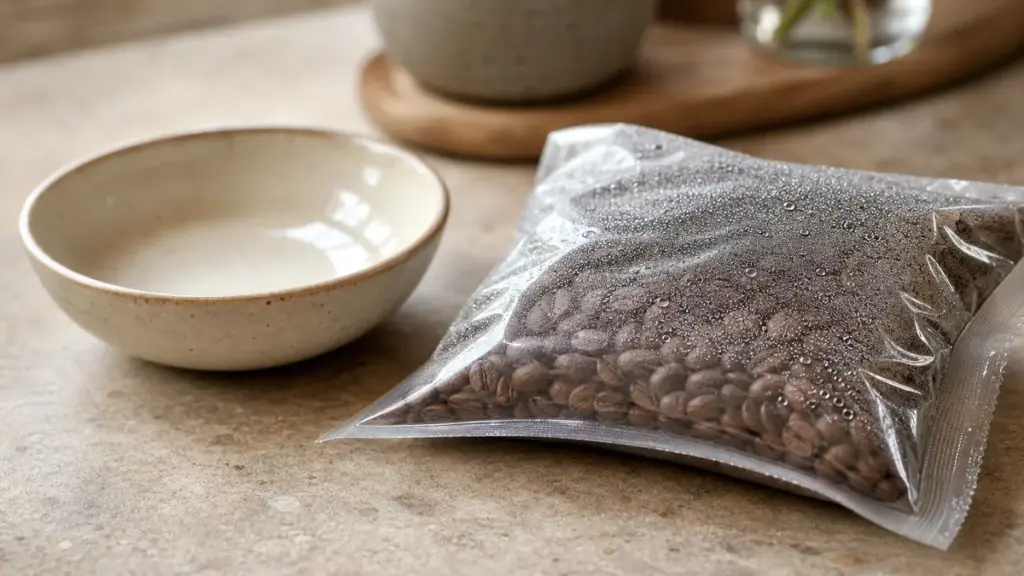
Best Practices for Freezing Coffee
The most useful rule is to decide how you will use the coffee before choosing the portion size. A sealed reserve bag that you thaw once needs a different arrangement from a collection of individual espresso doses.
1. Choose the right moment
If possible, taste the coffee before freezing most of it. When it is brewing well and showing the flavours you want to preserve, set aside your immediate supply and package the remainder.
Very recently roasted coffee releases carbon dioxide, a process called degassing. Resting recommendations vary with the coffee and brewing method, so follow the roaster’s advice rather than treating a particular day after roasting as a universal freezing date. See roast dates and best-before dates for the distinction between ageing, readiness to brew and date labels.
2. Weigh useful portions
For occasional coffees, freeze one brewing dose per package. For regular use, freeze enough for a short run of brewing, then thaw that portion once.
For example, a 20 g portion could match your existing filter recipe using 320 g of water, approximately 320 ml when measured cold. That is a coffee-to-water ratio of 1:16 by weight. These are illustrative quantities, not a special recipe required for frozen coffee.
Alternatively, a 100 g portion provides five doses of 20 g. Choose whichever arrangement avoids repeatedly opening frozen reserves.
3. Package the beans dry and airtight
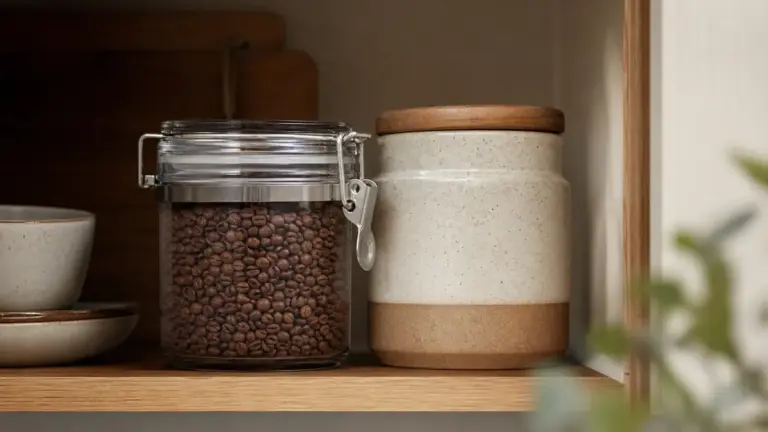
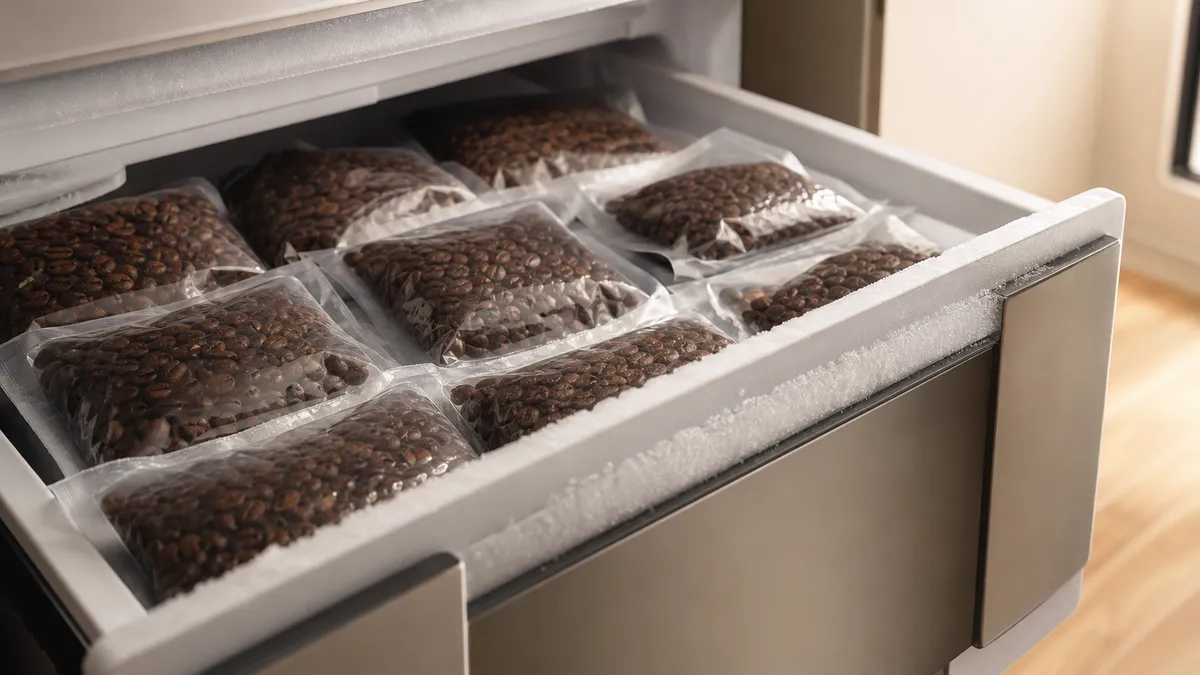
Use food-contact packaging suitable for freezer storage. Vacuum-sealed pouches are a practical choice because they remove much of the surrounding air, but a sound airtight container can also work.
With a flexible freezer bag, gently expel excess air before closing it. With a rigid container, choose a size reasonably close to the quantity of beans rather than leaving a large empty space. Keep beans out of the sealing area and check that the closure is complete.
Everything should be clean and thoroughly dry. Do not wash beans or add water before storage.
4. Record what you have frozen
Label each portion with the coffee name, roast date if supplied, freezing date and weight. Keep a brief note of the grinder setting and recipe if you intend to revisit the coffee occasionally.
These records are for organisation, not proof that flavour remains unchanged. They make it easier to use older portions first and compare results meaningfully.
5. Freeze the portions and leave them sealed
Use a domestic freezer operating at around -18 degrees Celsius, consistent with UK food-storage guidance. Keep the packages protected from damage and avoid leaving them out while searching through your reserves.
There is no useful reason to open a packet to check its aroma during storage. That would exchange the protected atmosphere for room air without telling you how the eventual brew will taste.
6. Thaw a larger portion without opening it
Remove the sealed portion the evening before you need it and leave it at room temperature overnight. Do not break the seal until the beans have reached room temperature. Overnight is a convenient allowance, not a precisely validated thawing time for every package size.
Dry any moisture from the outside before opening. Then treat the beans as your current supply: keep them sealed between uses and grind only what you need.
This method applies to dry roasted coffee beans, not to milk-based drinks or other perishable foods.
7. Alternatively, grind a single dose from frozen
If the grinder’s instructions permit it, take out one pre-weighed dose, open it immediately before grinding and brew without leaving the cold beans exposed on the worktop. Do not pour frozen reserves into a hopper for gradual use.
If you cannot establish that frozen beans are suitable for your grinder, use the sealed-thawing method instead.
Airtight packaging and condensation
Coffee is hygroscopic, meaning it takes up moisture from its surroundings. It can also retain surrounding odours, which makes the freezer’s packaging barrier particularly important.
Condensation occurs when humid air meets a sufficiently cold surface. Opening a cold bag gives room air access to the beans, where moisture may collect. Keeping the package sealed while it warms allows outside condensation to remain outside rather than introducing fresh humid air around the coffee.
This explains the apparent contradiction between “thaw before opening” and “grind from frozen”. They are different workflows:
- A multi-use portion: warm it while sealed, then open and use normally.
- A single dose: open just before immediate grinding, with no remainder to store.
For packaging, inspect the actual closure rather than trusting the word “coffee” on the container. A folded paper bag is not an airtight freezer package. An intact retail bag may be useful, but if its suitability is uncertain, add a freezer-suitable outer barrier or repack the beans.
Vacuum sealing is useful, but not a cure for poor handling. A damaged pouch or incomplete seal defeats its purpose. For everyday cupboard arrangements after thawing, see coffee storage tips.
Grinding coffee from frozen: what changes?
A controlled experiment published in Scientific Reports in 2016 found that colder roasted beans produced a narrower distribution of ground particle sizes and a smaller average particle size in the equipment tested. Particle-size distribution means the spread from small fragments to larger pieces, rather than simply the grinder’s nominal setting.
That gives direct-from-frozen grinding a scientific basis, but it does not prove that every grinder produces better-tasting coffee this way. The study measured grinding behaviour, not a universal sensory improvement, and included temperatures far below those of a domestic freezer.
The practical consequence is to check the setting rather than assume it transfers unchanged. If frozen beans grind differently, your usual espresso flow or filter drawdown may change.
Keep dose, water quantity and brewing method constant while adjusting the grind. If you alternate between frozen and room-temperature beans, record separate settings where needed. Consistency of handling is more useful than trying to reproduce laboratory cooling conditions at home.
For a workplace bean-to-cup machine, the cautious approach is to thaw reserve portions while sealed before loading them. Direct-from-frozen grinding should not be assumed suitable for an integrated grinder simply because it worked in research equipment.
Troubleshooting frozen coffee
The following are likely explanations, not diagnoses. Compare with an unfrozen portion where possible before blaming the freezer.
| Symptom | Likely cause | Fix |
|---|---|---|
| Food-like or unfamiliar odour | Inadequate protection from surrounding odours | Check closures and use sound freezer-suitable packaging |
| Droplets on cold beans after opening | Humid room air has reached cold surfaces | Thaw the next multi-use portion completely while sealed |
| Espresso flow or filter drawdown has changed | Frozen beans may grind differently | Keep the recipe constant and adjust the grind |
| Coffee still tastes flat after freezing | It may already have lost aroma before storage | Freeze future portions while they still taste good |
| Results vary between portions | Different handling, seals or bean temperatures | Standardise packaging and choose one thawing or grinding routine |
Avoid repeatedly thawing, opening and refreezing the same supply. The practical concern is renewed exposure to oxygen and moisture, not evidence that one accidental temperature change automatically destroys coffee.
FAQ
Can you freeze ground coffee?
Yes, although whole beans are preferable when you have the option. Grinding increases exposed surface area and accelerates aroma loss, so package ground coffee promptly in airtight brewing portions. Freezing cannot recover aroma already lost before packaging. For the wider differences, read whole beans vs ground coffee.
How long will frozen coffee stay good?
There is no single well-supported household limit that guarantees unchanged flavour. The nine-week controlled study supports aroma preservation under its particular conditions, not indefinite storage or a universal expiry date. Label portions, use older stocks first and judge the brewed result rather than relying on an unsupported promise measured in months or years.
Is freezing necessary for every bag?
No, freezing is most useful for reserve coffee rather than coffee you are already using steadily. If a bag will be finished soon, normal airtight storage avoids extra handling. Freeze the surplus that would otherwise wait, with portions sized so you can thaw each one once and use it conveniently.
Where to go next
Read Buying and Storing Coffee for the overall storage decision, then Coffee Storage Tips for handling your current supply after thawing. Roast Dates and Best-Before Dates explains when coffee is ready to brew, while Whole Beans vs Ground Coffee helps you choose what to freeze and when to grind.
Sources
-
Specialty Coffee Association, What is the Shelf Life of Roasted Coffee? A Literature Review on Coffee Staling, 2012. Literature review explaining staling mechanisms and limitations in earlier research.
URL: https://sca.coffee/sca-news/2012/02/15/what-is-the-shelf-life-of-roasted-coffee-a-literature-review-on-coffee-staling-bjcx7 -
Beverages, MDPI, The Effects of Storage Temperature on the Aroma of Whole Bean Arabica Coffee Evaluated by Coffee Consumers and HS-SPME-GC-MS, 2018, volume 4, article 68. Controlled storage experiment assessing ground-coffee aroma, not brewed flavour.
URL: https://www.mdpi.com/2306-5710/4/3/68/pdf -
Uman et al., Scientific Reports, The effect of bean origin and temperature on grinding roasted coffee, 2016, volume 6, article 24483. Controlled grinding experiment.
URL: https://www.nature.com/articles/srep24483.pdf -
National Coffee Association, Storage and shelf life, undated. Consumer guidance on moisture, odours, airtight storage and freezing.
URL: https://www.aboutcoffee.org/beans/storage-and-shelf-life/ -
Food Standards Agency, GOV.UK, How to chill, freeze and defrost food safely, 2017, current retrieved page. Used for the domestic freezer temperature and packaging guidance, not for coffee-specific thawing advice.
URL: https://www.gov.uk/government/publications/how-to-chill-freeze-and-defrost-food-safely/how-to-chill-freeze-and-defrost-food-safely -
Square Mile Coffee Roasters, Rest Is Best, undated. Roaster guidance on degassing and resting, treated as practical advice rather than a universal standard.
URL: https://shop.squaremilecoffee.com/blogs/all/rest-is-best -
Cravens Coffee, Should You Freeze Your Coffee?, undated. Used specifically for its sealed, overnight thawing procedure and portioning guidance.
URL: https://cravenscoffee.com/pages/should-you-freeze-your-coffee -
Kairos Coffee, Should You Freeze Coffee Beans? Myths, Rules, and a Practical Protocol, 2026. Used for practical portioning and reserve-supply handling, not its broader shelf-life claims.
URL: https://www.kairos-coffee.com/blogs/coffee-beans/should-you-freeze-coffee-beans
Research combined retrieved peer-reviewed experiments, the SCA staling review, UK freezer guidance and clearly distinguished practical roaster advice; no first-hand testing is claimed.
Last checked: November 2026