Choose a UK coffee subscription by matching the coffee and grind to your brewing equipment, then setting deliveries around how much you actually use. Before subscribing, check the recurring billing terms, delivery arrangements and the exact steps for pausing or cancelling, not just the description of the first bag.
In short
- Choose whole beans if you grind at home; otherwise select a grind specifically suited to your brewer.
- Calculate your weekly use in grams before choosing bag size and delivery frequency.
- Check the billing date, dispatch date and deadline for changing the next order separately.
- Look for clear controls to skip, pause, change and cancel deliveries.
- Compare the regular delivered price per kilogram yourself, and check the disposal instructions for each packaging component.
Start with your coffee subscription priorities
The right subscription should fit your routine without requiring constant correction. Start by deciding whether you want a dependable everyday coffee, a changing selection or a mixture of both.
Write down what you enjoy in plain language: chocolatey rather than citrusy, full-bodied rather than delicate, or suitable for milk rather than mainly drunk black. Ask the supplier to match those preferences instead of choosing solely by country, packaging or an unfamiliar tasting description.
Our coffee subscription guide explains the wider category. Here, the comparison criteria are brewing compatibility, control over selection, delivery flexibility and the amount of attention the subscription needs.
| Your priority | Look for | Main trade-off |
|---|---|---|
| A familiar everyday drink | A repeatable selection with clear substitution rules | Less variety |
| Exploring different coffees | A rotating selection with useful information about each delivery | You may not enjoy every selection equally |
| Brewing without a grinder | A named grind option for your equipment | You cannot adjust the grind afterwards |
| Learning to make espresso | Whole beans and the ability to repeat a coffee | Changing coffee adds another variable |
| An irregular routine | Adjustable quantities, delivery dates and a clear pause function | You still need to monitor your next order |
My recommendation is to prioritise control over novelty for your first subscription. Establish a delivery rhythm that works, then decide how adventurous you want the coffee selection to become.
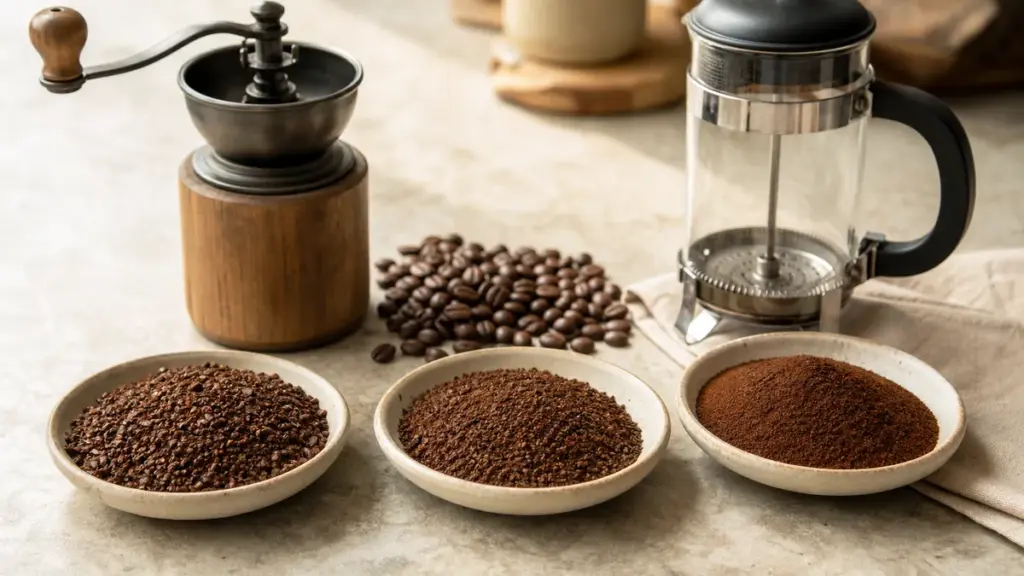
Match whole beans and grind to your brewer
Whole beans give you control over grinding immediately before brewing. Grinding accelerates gas and aroma loss, so pre-ground coffee involves a freshness compromise, but it remains a practical choice if you do not own a grinder.
The important distinction is not simply “beans or ground”. It is whether the supplier can prepare coffee appropriately for your particular equipment.
As starting points:
- Cafetière: select the supplier’s cafetière or French press grind, commonly coarse.
- Drip filter machine: choose its filter-machine option, commonly medium.
- AeroPress: the manufacturer recommends medium-fine as a starting point.
- Espresso machine: fine grinding is required, with adjustment to suit the coffee and equipment.
These descriptions are starting points, not interchangeable specifications. Tell the supplier your brewer’s make and model if the choices are unclear. A single “ground” option deserves a question before you subscribe.
For espresso, whole beans are the more flexible choice because they let you adjust the grind. If you need pre-ground espresso, ask whether the supplier’s option suits your machine rather than assuming every espresso-labelled grind will work.
Also check whether you can change between whole bean and ground, or change the grind setting, without starting a new subscription. That is useful if you buy a grinder later.
For closer attention to the roaster and coffee selection, explore craft subscriptions, rather than expecting this decision guide to rank individual services.
Calculate quantity before choosing frequency
Choose the amount of coffee first, then the delivery interval. A calendar month is not necessarily the right unit for your drinking habits.
Use this calculation:
Weekly coffee requirement = grams used per brew × brews per day × brewing days per week
For an illustrative household making two separate brews daily, each using 15 g:
15 g × 2 × 7 = 210 g per week
At that assumed rate, a 250 g bag lasts about eight days, while 500 g lasts about seventeen days. These are consumption calculations, not recommended doses or freshness guarantees. They exclude guests, spillage, grinder retention and coffee used while adjusting a recipe.
For a shared pot, count the total coffee weighed into the brewer, not the number of people drinking it. For a mixed routine, calculate each brewing method separately and add the totals.
Then compare your requirement with the supplier’s available bag sizes and intervals. Check whether “monthly” means a calendar-month schedule or a fixed number of weeks.
After the first few deliveries, use your remaining coffee as feedback. Repeatedly opening a new parcel while an older bag remains untouched suggests that you should reduce the quantity or extend the interval. Running out repeatedly suggests the opposite.
Check renewal, billing, pausing and cancellation
Treat the subscription as a recurring agreement, not simply a convenient repeat purchase. Save the terms and order confirmation when you sign up.
Understand what renews
Check whether you are buying:
- An ongoing subscription that continues until ended.
- A fixed-term arrangement that stops automatically.
- A fixed-term arrangement that renews unless you act.
Ask about minimum commitments, what happens after any introductory offer, and whether changing the coffee affects the agreement. For gifts, establish who controls the account and whether the recipient must activate deliveries.
Separate the important dates
Identify the payment date, order-processing deadline, dispatch date and expected arrival window. They may be different.
As one supplier example checked in November 2026, Square Mile states that subscription orders are dispatched on the roast day following the payment date. Its FAQ also says orders are processed at 8.30 am UK time and cannot be cancelled through its normal process once processed for roasting. This illustrates why “cancel anytime” needs to be read alongside the next-order deadline.
Pact’s published terms provide account controls to cancel, pause, reschedule, skip or bring forward deliveries. They also distinguish changes made before billing from those that take effect only for a later shipment.
These are examples of published supplier arrangements, not guarantees about every service.
Test what the controls mean
Before subscribing, find out:
- Does skip omit one delivery only?
- Does pause last indefinitely, or restart automatically?
- Does cancel end future recurring deliveries?
- Can an order already being prepared still proceed?
- Will you receive written confirmation of the change?
Check how future price changes are communicated and whether you can end the subscription before an increase applies. Pact’s terms, for example, allow product prices to change while protecting orders already confirmed by dispatch confirmation email. Do not assume a first-order promotion fixes subsequent terms.
Legal timing: government draft guidance published in October 2026 describes a proposed subscription regime intended for contracts entered into from 1 January 2027. The retrieved document explicitly says the relevant regime is not yet in force and the draft regulations require parliamentary approval. Do not treat those draft provisions as current cancellation rights.
Check delivery and freshness together
Ask what “freshly roasted” means operationally: whether the bag carries a roast date, how soon it is dispatched after roasting, and what arrival window applies to your postcode.
Distinguish dispatch promises from delivery guarantees. Check coverage for Northern Ireland, islands and remote addresses where relevant, rather than relying on a general “UK delivery” headline.
For letterbox delivery, confirm the parcel dimensions and whether they change with larger orders. Also establish what happens if a parcel is missing, damaged or delivered while you are away.
Coffee changes after roasting as carbon dioxide escapes and aroma compounds change. Laboratory and sensory work summarised by the Specialty Coffee Association shows that storage conditions and packaging matter, so there is no sensible reason to judge freshness by the roast date alone.
Ask the roaster when it recommends starting that particular coffee. Once opened, keep it well sealed in a cool, dry place away from direct light and heat.
Examine packaging claims, not just appearances
Assess the coffee bag and outer parcel separately. Ask for disposal instructions covering the bag, valve, closure and any liners, rather than assuming the instructions for the cardboard box apply to everything inside.
Recycle Now lists coffee pouches among plastic films accepted at relevant collection points. That does not mean every coffee bag belongs in your household recycling bin. Check the specific material, supplier instructions and receiving scheme.
Likewise, ask whether a compostability claim means home composting or industrial treatment, and where that packaging can actually go. The Competition and Markets Authority’s Green Claims Code stresses that environmental claims should be clear, substantiated and not misleading through omitted information.
Do not assume a paper-like appearance establishes recyclability. Prefer precise instructions that you can follow locally over a broad claim such as “eco-friendly”.
Packaging must also protect the coffee. SCA research summaries identify oxygen, moisture and temperature as drivers of staling. A useful comparison therefore considers both protection during storage and the packaging’s practical disposal route.
Compare price per kilogram on the same basis
Compare the regular delivered price per kilogram, not just the headline subscription payment.
For your own calculation, add the coffee payment and any compulsory delivery or recurring extras for the same shipment, then divide by the net coffee weight in kilograms. Use the same VAT basis for every comparison, and calculate introductory and ongoing arrangements separately.
Check the weight of coffee rather than the parcel weight, and exclude accessories when comparing coffee alone. For a bespoke or workplace arrangement, request an itemised written quotation showing coffee quantities, delivery, recurring extras and VAT treatment.
Finally, consider what you will actually drink. Ordering more than you can use is not a good fit merely because the unit comparison looks attractive.
Your final subscription checklist
Before confirming, make sure you can answer all of these:
- [ ] The coffee suits how I drink it, including milk or decaf preferences.
- [ ] The beans or grind match my brewing equipment.
- [ ] The quantity and interval match my measured consumption.
- [ ] I understand substitutions and how to reject unsuitable selections.
- [ ] I know the regular billing terms and how changes are communicated.
- [ ] I can find the skip, pause and cancellation instructions.
- [ ] I know the deadline for changing the next order.
- [ ] Delivery works for my postcode and availability.
- [ ] I have checked packaging disposal instructions.
If discovery matters most, explore unusual coffee clubs after settling these practical requirements. Novelty should be something you choose, not an unexpected consequence of unclear selection rules.
FAQ
Can I subscribe if I only drink coffee at weekends?
Yes, provided the quantity and delivery interval fit your weekend consumption. Calculate the grams you use across those brewing days rather than assuming daily use. Look for adjustable intervals and smaller quantities, and ask about the coffee’s recommended use window. If deliveries keep accumulating, occasional orders may suit you better.
Is a subscription a good gift for someone whose tastes I do not know?
It can be, but recipient choice is more useful than a surprise grind or roast. Check whether the recipient can select beans or ground coffee, choose the first delivery date and manage subsequent deliveries. Establish whether the arrangement ends automatically, and avoid committing someone else to ongoing payments without their agreement.
What should I record when trying a new subscription?
Record the coffee, roast date, arrival date, brewing recipe and a few plain tasting notes. Keep the recipe consistent initially so you can judge the selection rather than several changes at once. Also record whether you finished the bag before the next delivery. That helps you assess both enjoyment and subscription fit.
Where to go next
Read Coffee Subscription Services for the wider overview, then Craft Coffee Subscriptions if roaster selection is your next priority. Unique Coffee Clubs is the next read for discovery-led formats once the practical details of choosing a UK coffee subscription are settled.
Sources
-
Specialty Coffee Association, Coffee Decoded: What is “freshly roasted” coffee?, undated webpage, retrieved November 2026.
https://sca.coffee/sca-news/coffee-decoded-9-fresh-coffee -
Specialty Coffee Association, Preserving Freshness: A Race Against Time, 25 Magazine, Issue 4, undated webpage, retrieved November 2026. This article summarises laboratory and sensory research; the full handbook was not consulted.
https://sca.coffee/sca-news/25-magazine/issue-4/preserving-freshness-race-time-25-magazine-issue-4-2spkp -
AeroPress, What Grind Size Should I Use?, undated manufacturer guidance, retrieved November 2026.
https://aeropress.com/pages/what-grind-size-should-i-use -
Pact Coffee, Terms of Supply, undated live terms, retrieved November 2026.
https://www.pactcoffee.com/terms-of-supply -
Square Mile Coffee Roasters, FAQ, undated live guidance, retrieved November 2026.
https://shop.squaremilecoffee.com/pages/faq -
Recycle Now, Plastic bags and wrapping, undated live recycling guidance, retrieved November 2026.
https://www.recyclenow.com/recycle-an-item/plastic-bags-and-wrapping -
Competition and Markets Authority, Making environmental claims on goods and services, 2021.
https://www.gov.uk/government/publications/green-claims-code-making-environmental-claims/environmental-claims-on-goods-and-services -
UK Government, Draft Guidance on Consumer Subscription Contracts, October 2026, particularly pages 6 and 7.
https://assets.publishing.service.gov.uk/media/6acf97da2de3184ccf8b814e/subscription-contracts-rules-guidance.pdf
Researched using retrieved supplier terms, manufacturer brewing guidance, SCA research summaries, official recycling advice and government guidance; consumption examples are illustrative calculations, not first-hand tests.
Last checked: November 2026