Buying and storing coffee beans well means choosing coffee that suits your brewing method, buying an amount you can use promptly, and protecting it from air, moisture and heat. Buy whole beans if you can grind them before brewing, keep your everyday supply sealed in a cool, dark cupboard, and freeze surplus coffee in separate airtight portions.
In short
- Start by buying enough for roughly one to two weeks, then adjust to your actual consumption.
- A roast date tells you when coffee was roasted; a best-before date concerns quality, not safety.
- Ask the roaster about resting time rather than assuming the newest roast will taste best immediately.
- Judge a container by its seal, cleanliness and protection from light, not simply whether it is ceramic, metal or glass.
- For straightforward freezer storage, divide beans into portions and let each portion reach room temperature while still sealed.
Where to buy coffee beans
Choose a seller by the information and help they provide, rather than by the type of shop alone. A useful buying checklist is: clear product details, intact packaging, understandable freshness information and advice that matches your equipment.
Consider these routes:
- Direct from a roaster: ask which coffee suits your brewer, when it was roasted and when they recommend opening it.
- A coffee shop selling retail bags: ask whether you can try the coffee as a drink before choosing a bag.
- A specialist retailer: compare the information available across its range, including roast dates and recommended brewing methods.
- A supermarket: inspect the packaging and dates, and choose a manageable quantity rather than dismissing or accepting the coffee solely because of where it is sold.
- A subscription: check that you can adjust deliveries or pause them when beans accumulate.
These are selection criteria, not a ranking of retailers. For a more detailed assessment of sellers, see finding specialty coffee retailers.
For your first purchase, tell the seller how you brew and what you enjoy: coffee with milk, something gently fruity, or a more pronounced roasted flavour. That is a more useful starting conversation than asking for their “best” beans without any context.
Read the bag for useful information
You do not need to understand every production detail before buying. Start with the information that helps you choose and manage the coffee:
- Whole beans or ground: check the format, and the intended brewing method if buying ground coffee.
- Roast date and best-before date: distinguish the two rather than treating them as interchangeable.
- Roast description and brewing recommendation: use these as guidance from that particular roaster.
- Flavour description: look for a general direction you enjoy, rather than expecting every named note to appear distinctly.
- Net weight: decide whether you can finish the bag within your intended buying cycle.
Roast descriptions are not perfectly consistent between sellers. The National Coffee Association notes that one roaster’s dark roast may differ from another’s, while “espresso roast” describes an intended use rather than one fixed roast level.
Tasting notes are descriptions of the coffee, not a promise that everyone will perceive exactly the same flavours. Square Mile’s account of its quality-control process shows that roasters may revise those descriptions as a coffee changes. Treat them as a useful invitation to taste, not an examination you can fail.
Understand roast dates without chasing the newest bag
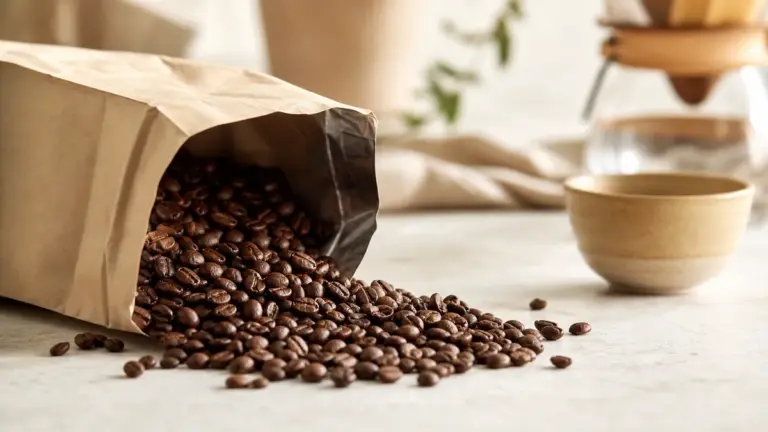
Freshly roasted coffee releases trapped carbon dioxide, a process called degassing. Resting means allowing some of that gas to escape before brewing; it does not mean leaving the bag open.
There is no single resting period that suits every coffee. Roast profile affects gas release, and roasters give different recommendations for their products and brewing methods. As one practical example, Square Mile recommends resting its filter coffee for 5 to 14 days and espresso coffee for 7 to 14 days. Those are that roaster’s recommendations, not universal deadlines.
Ask when the seller expects the coffee to be ready, especially if you need it immediately. For the buying decision in more detail, see buying fresh coffee.
A best-before date answers a different question. Food Standards Scotland explains that it concerns quality rather than safety. It does not reveal the roast date, and you should not calculate one backwards unless the producer explicitly explains its dating system.
Nor does passing that date automatically make dry coffee unsafe. However, beans exposed to moisture can develop mould. Do not brew visibly mouldy coffee.
Buy an amount you will actually use
The National Coffee Association suggests buying smaller batches sufficient for one or two weeks. Use that as a starting point for managing supplies, not a claim that coffee becomes undrinkable immediately afterwards.
Calculate your needs from the coffee you actually use:
Coffee required in grams = grams used per brew × brews per day × days between purchases.
For example, assume you use 18 g per brew, make two brews daily, and buy every seven days:
18 g × 2 × 7 = 252 g per week.
Those are illustrative assumptions, not a recommended dose or drinking frequency. Include any coffee discarded while adjusting a grinder if that materially changes your consumption.
At work, record how much coffee the team uses over a representative period. Headcount alone is a poor purchasing method if you have not established who drinks coffee, how often they brew and whether visitors use the machine.
Before holidays or quieter office periods, reduce the next order or freeze the surplus. Avoid opening several bags simply to compare their aromas if you cannot use them steadily.
Choose whole beans or ground coffee realistically
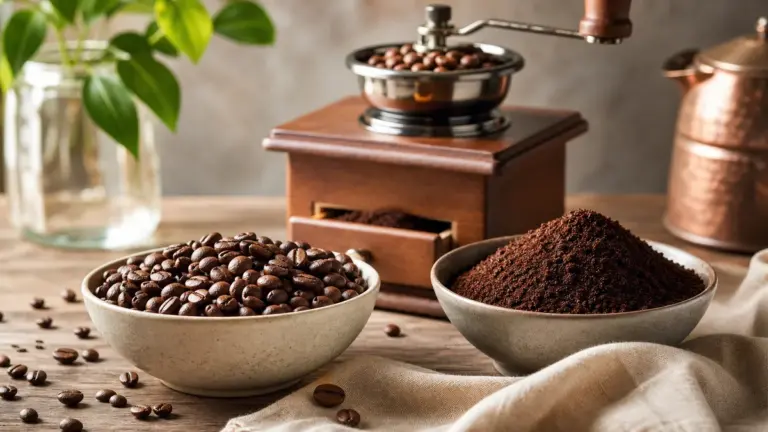
Whole beans are the better starting point for preserving freshness when you have a suitable grinder. Grinding increases the exposed surface and releases trapped gas rapidly, so grind only what you need immediately before brewing.
Ground coffee remains a practical choice if you do not have a grinder. Ask the seller for a grind suited to your brewer, choose a manageable pack and reseal it promptly.
The decision should fit your routine. Buying whole beans is not useful if you then grind the entire bag for convenience. Equally, there is no need to postpone making coffee because your current equipment requires you to buy it ground.
Choose storage by the seal, not the material
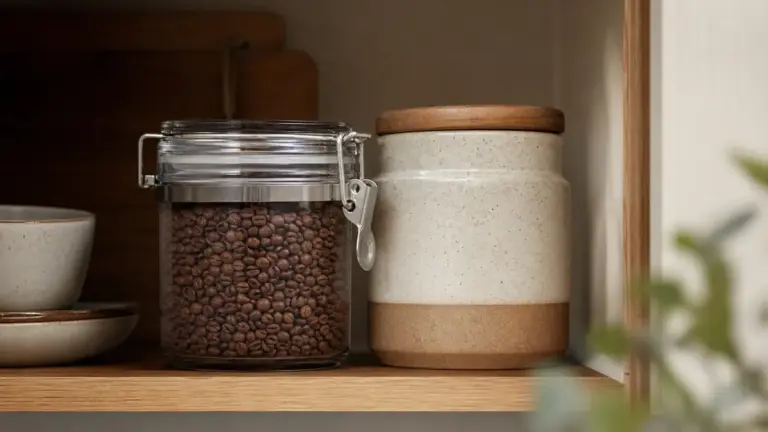
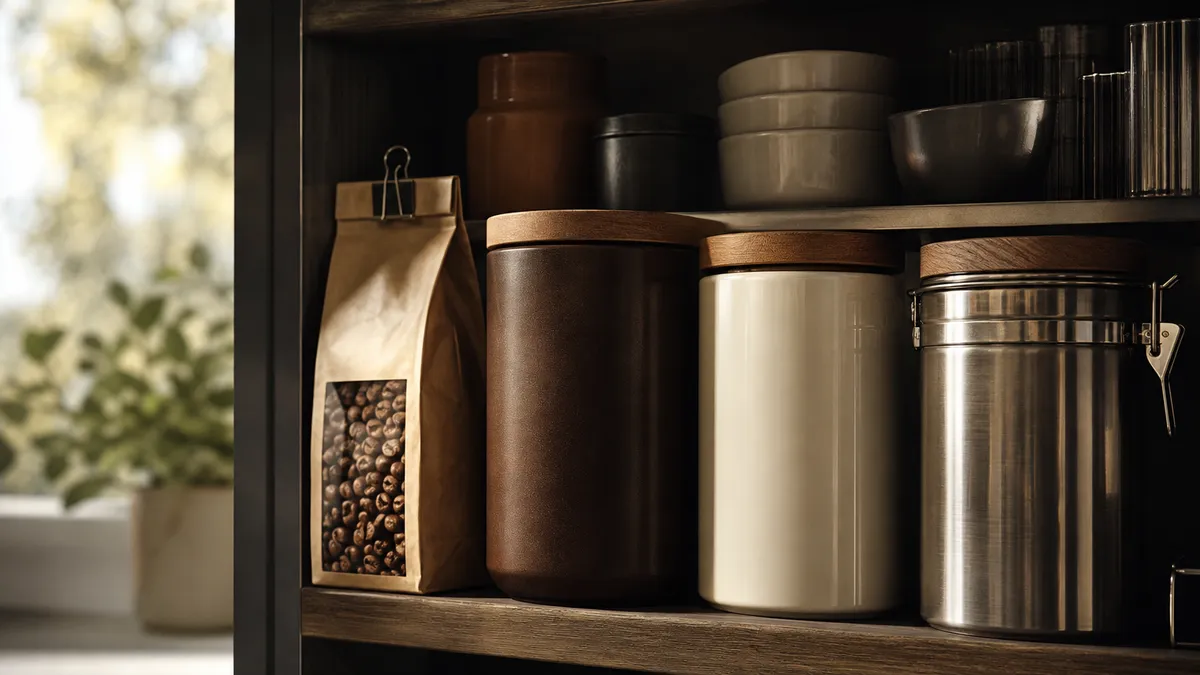
For everyday use, choose a clean, dry, food-safe container with a dependable closure, then keep it away from heat and light. Ceramic and non-reactive metal are sensible options; a clear airtight jar needs a dark cupboard.
The following comparison uses three criteria: closure, light protection and everyday handling.
| Storage option | What to check | Main limitation | Best suited to |
|---|---|---|---|
| Original resealable bag | Intact material and a closure that seals properly | A folded or clipped opening may not be airtight | Coffee supplied in effective resealable packaging |
| Opaque ceramic or metal canister | Gasket, lid fit and a completely dry interior | Material alone does not establish airtightness | An everyday supply kept in a cupboard |
| Clear airtight jar | Sound seal and storage away from light | Poor choice for a sunny worktop | Readers who already have a suitable jar |
| Airtight freezer portions | Freezer-suitable packaging and secure seals | Requires portioning and careful thawing | Surplus beans not needed soon |
Advice about decanting needs some qualification. Although general consumer guidance often recommends an airtight canister, a controlled packaging study published in 2022 found that its tested bag with an integrated screw cap preserved chemical freshness indicators better than the tested canister, clip and tape arrangements.
That does not prove every bag beats every canister. The study measured chemical indicators, not a universal consumer taste deadline, and was funded by Tchibo and Zurich University of Applied Sciences.
The useful lesson is to avoid assuming that transferring coffee automatically improves storage. If the supplied packaging closes effectively, assess it before replacing it with a jar.
A practical routine for storing coffee beans
- Choose the location first. Use a cool, dark cupboard, away from the oven, dishwasher and direct sunlight.
- Keep the container dry. After cleaning, allow it to dry completely before adding coffee.
- Keep the product details. Retain the bag or record the coffee name, roast date and opening date.
- Open only the supply you need. Leave other bags sealed until required.
- Close the bag or lid after each use. Do not leave coffee exposed while you complete the rest of your kitchen routine.
For a bean-to-cup machine, a useful stock-control approach is to add beans according to expected use rather than treating the hopper as your reserve storage container. Keep the remaining supply sealed separately and follow the machine’s instructions.
If the coffee changes noticeably, check storage alongside brewing variables rather than blaming the beans immediately.
| Symptom | Likely explanation | What to do |
|---|---|---|
| Muted aroma and increasingly stale flavour | Ageing, potentially accelerated by air or heat | Check the seal and location; buy a smaller quantity next time |
| Coffee has picked up surrounding smells | Exposure to odours through unsuitable storage | Use a clean, odour-free container with a secure closure |
| Condensation appears after freezer removal | Cold coffee has met humid air | For future portions, thaw completely while sealed |
| Visible mould | Moisture exposure | Discard the affected coffee |
Freeze surplus coffee in separate portions
Freezing can slow the changes responsible for staling. It preserves the coffee’s existing condition; it does not restore aroma already lost.
For a straightforward household routine:
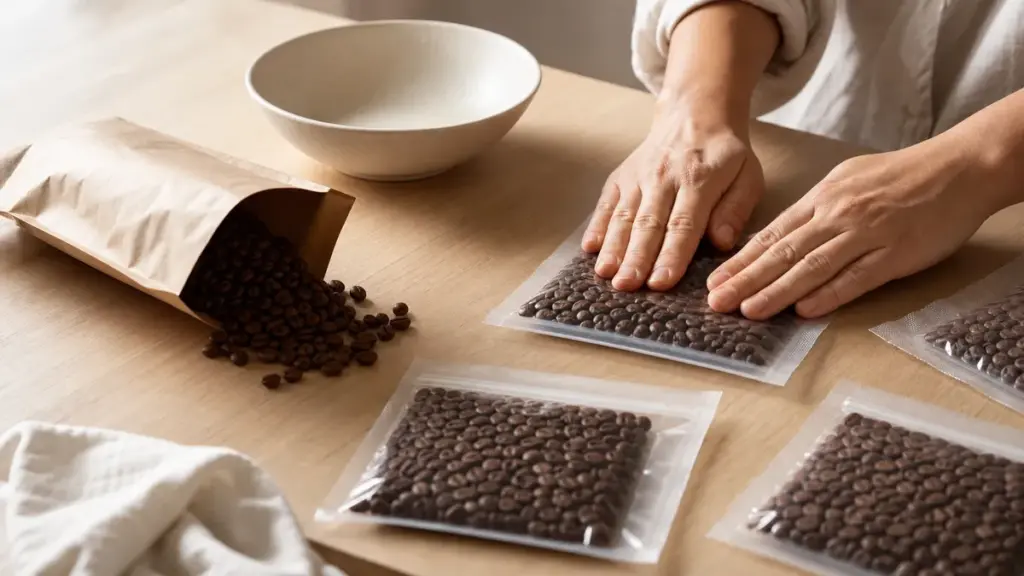
- Divide beans into portions you can use conveniently, such as your measured weekly requirement.
- Seal each portion in airtight, freezer-suitable packaging, removing excess air from flexible bags.
- Record the coffee name, roast date and freezing date.
- Remove one portion when needed and let it reach room temperature before opening.
- Keep that thawed portion sealed in your normal cupboard storage while you use it.
The sealed thaw matters because moisture can condense on cold beans exposed to room air. Avoid repeatedly opening a large frozen reserve when separate portions would make handling simpler.
Published advice differs on taking small amounts from a frozen container. This guide recommends separately sealed portions because they provide an uncomplicated way to limit moisture exposure. It is a handling recommendation, not a claim that every other method ruins coffee.
Common mistakes when buying and storing coffee beans
- Buying more than your routine supports. A large bag can seem convenient, but it may remain open far longer than intended. Calculate consumption before choosing the size.
- Assuming the newest roast is ready immediately. Freshness and readiness are not identical. Ask for the roaster’s resting advice.
- Choosing a decorative jar without checking its closure. Appearance tells you little about the seal. Inspect the lid and gasket.
- Treating the fridge as the default storage place. Coffee can take up moisture and odours. A cool cupboard is the simpler everyday choice.
- Expecting freezing to reverse staleness. Freeze surplus while you still enjoy it, not after it has become disappointing.
FAQ
Are oily coffee beans necessarily old?
No, surface oil alone does not establish how old coffee is. The National Coffee Association describes an oily surface as a feature of darker roasting. Check the dates and storage history rather than judging freshness by shine alone. Oiliness is not a substitute for assessing the coffee’s aroma and brewed flavour.
Does a one-way valve prove that coffee is fresh?
No, a one-way valve is a packaging feature, not evidence of a recent roast. It allows gas released by roasted coffee to escape without simply leaving the package open. Freshness still depends on the coffee’s age, packaging integrity and storage conditions, so inspect the dates and the rest of the bag as well.
Can a storage container keep coffee fresh indefinitely?
No, even effective packaging cannot preserve roasted coffee indefinitely. It can reduce exposure to conditions that accelerate deterioration, but the coffee continues changing. Match the quantity to your consumption, keep it properly sealed and consider freezing surplus. A container is part of a sensible routine, not a replacement for one.
Where to go next
Read Buying Fresh Coffee for a closer look at choosing coffee by freshness, then Finding Specialty Coffee Retailers for help assessing sellers. Return to Buying and Storing Coffee for the wider topic and more focused guidance on individual buying and storage decisions.
Sources
- National Coffee Association, Storage and shelf life, undated, current page retrieved November 2026.
https://www.aboutcoffee.org/beans/storage-and-shelf-life/ - National Coffee Association, Roasts, undated, current page retrieved November 2026.
https://www.aboutcoffee.org/beans/roasts/ - Specialty Coffee Association, Emma Sage, What is the Shelf Life of Roasted Coffee? A Literature Review on Coffee Staling, 2012.
https://sca.coffee/sca-news/2012/02/15/what-is-the-shelf-life-of-roasted-coffee-a-literature-review-on-coffee-staling-bjcx7 - Specialty Coffee Association, Samo Smrke, The Science of Coffee Freshness, Expo Lectures 2019, lecture and transcript, 2019.
https://sca.coffee/sca-news/podcast/81/the-science-of-coffee-freshness-samo-smrke-expo-lectures-2019-6lrbe - Zurich University of Applied Sciences and Tchibo, Smrke and colleagues, Effects of different coffee storage methods on coffee freshness after opening of packages, Food Packaging and Shelf Life, volume 33, article 100893, 2022. Full text retrieved through an accessible copy.
https://scispace.com/pdf/effects-of-different-coffee-storage-methods-on-coffee-2ak5wjps.pdf - Square Mile Coffee Roasters, Rest Is Best, undated, current page retrieved November 2026. Used as a roaster-specific recommendation, not a universal standard.
https://shop.squaremilecoffee.com/blogs/all/rest-is-best - Square Mile Coffee Roasters, Flavour notes, and why they change., 2017.
- Capresso, Storing Coffee, undated, manufacturer’s consumer guidance retrieved November 2026.
https://www.capresso.com/media/wysiwyg/Storing_Coffee.pdf - Food Standards Scotland, Use-by and best-before dates, undated, current page retrieved November 2026.
https://www.foodstandards.gov.scot/consumer-advice/food-labels/use-by-and-best-before-dates
This guide was researched using food-authority guidance, coffee-industry references, a controlled packaging study and clearly identified producer advice; it does not report first-hand testing.
Last checked: November 2026