Coffee leaf rust is a fungal disease that damages coffee leaves; the coffee berry borer is a beetle whose offspring feed inside the seeds we roast as beans. Both threaten harvests and farmers’ livelihoods, but they require different responses: rust management protects the plant’s foliage, while borer management interrupts an insect hidden inside the fruit. [1, 6]
In short
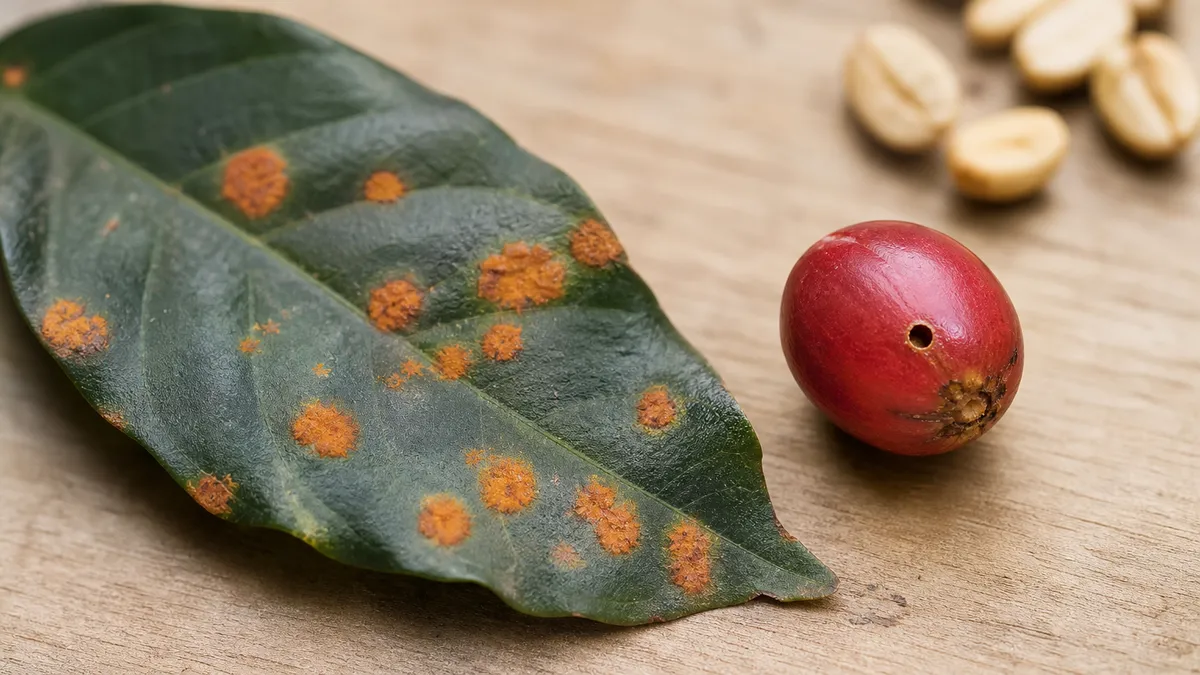
- Look underneath the leaf: orange, powdery patches are characteristic of coffee leaf rust. [1]
- Look at the blossom end of the cherry: a small, round entry hole can indicate coffee berry borer. [6]
- Timing matters: borers become much harder to control once they penetrate the seed. [8]
- The 2012 to 2013 Central American rust epidemic was a regional emergency, with effects extending into subsequent harvests. [4]
- Neither shade nor resistant varieties provide a universal shield: local conditions and continued monitoring matter. [2, 10]
Coffee leaf rust and coffee berry borer compared
These are two of coffee farming’s most consequential biological threats, not two names for the same problem. One attacks the plant’s ability to support a crop; the other damages the crop directly. [1, 6]
| Feature | Coffee leaf rust | Coffee berry borer |
|---|---|---|
| Scientific name | Hemileia vastatrix | Hypothenemus hampei |
| Organism | Parasitic fungus | Small beetle |
| Main target | Leaves | Cherries and their seeds |
| Characteristic sign | Yellow patches above, orange spores underneath | Small entry hole, internal tunnels and feeding damage |
| Management priority | Protect foliage and reduce disease development | Remove breeding sites and target exposed beetles |
Sources: [1, 6, 8].
For the wider growing system, start with coffee farming. Other insects, fungi and plant disorders belong in the broader guide to coffee pests and diseases.
What coffee leaf rust does to a plant
Hemileia vastatrix is an obligate biotroph: a fungus that needs living host tissue to grow. Its spores germinate when suitable moisture and temperature conditions coincide, and infection enters through stomata, the tiny pores on the underside of the leaf. [1]
Early symptoms include pale or yellowish patches. Underneath, the fungus produces the orange, powdery spore masses that give rust its name. Rain splash and wind help distribute spores, allowing repeated infection within and between plantings. [1]
Severely affected leaves fall prematurely. Losing foliage reduces the plant’s photosynthetic capacity, meaning less energy is available to support fruit and new growth. Heavy infection can therefore damage more than the current harvest: weakened branches and reduced growth can compromise the next crop too. [1, 4]
This delayed effect matters when interpreting reports. A field may still carry cherries when rust becomes conspicuous, yet suffer its greatest production setback later. Counting orange leaves alone does not measure the full agricultural damage. [4]
Rust history: Ceylon and the Central American crisis
A short timeline
- 1869: a contemporary account records coffee leaf disease appearing in Ceylon, now Sri Lanka. The fungus was scientifically described that year. [3]
- 2012: a major rust epidemic developed across Central America, becoming a defining regional coffee crisis. [4]
- 2013: emergency responses included national measures in Costa Rica, Honduras and Guatemala, alongside a regional programme coordinated through PROMECAFE. [4]
Ceylon’s experience became a warning about relying on extensive plantings of susceptible coffee. Rust helped undermine its coffee industry and contributed to the subsequent shift towards tea. This was a prolonged agricultural transformation, not the disappearance of an entire crop overnight. [1]
Historical sources differ on the earliest local reports. The American Phytopathological Society’s teaching account mentions disease reported in 1867; the contemporary account published by Daniel Morris in 1879 dates its first observation to May 1869. Here, 1869 identifies the documented epidemic and scientific description, rather than claiming that no earlier symptoms occurred. [1, 3]
What happened in 2012 to 2013?
The Central American epidemic reflected interacting vulnerabilities: susceptible plants, management constraints and weather favourable to disease. Researchers identified reduced differences between daytime and night-time temperatures as a plausible contributor, not a complete explanation on its own. [4]
Avelino and colleagues reported that Central American production fell 16% in the 2012 to 2013 harvest compared with 2011 to 2012. They explicitly cautioned that changes in total production are not an exact measure of rust losses, because coffee output also varies naturally between years. [4]
Emergency responses combined disease control, technical support and assistance to affected communities. The consequences were uneven and persistent: FEWS NET later documented continuing difficulties for small growers and agricultural labourers even where aggregate production was recovering. [4, 5]
What the coffee berry borer does inside a cherry
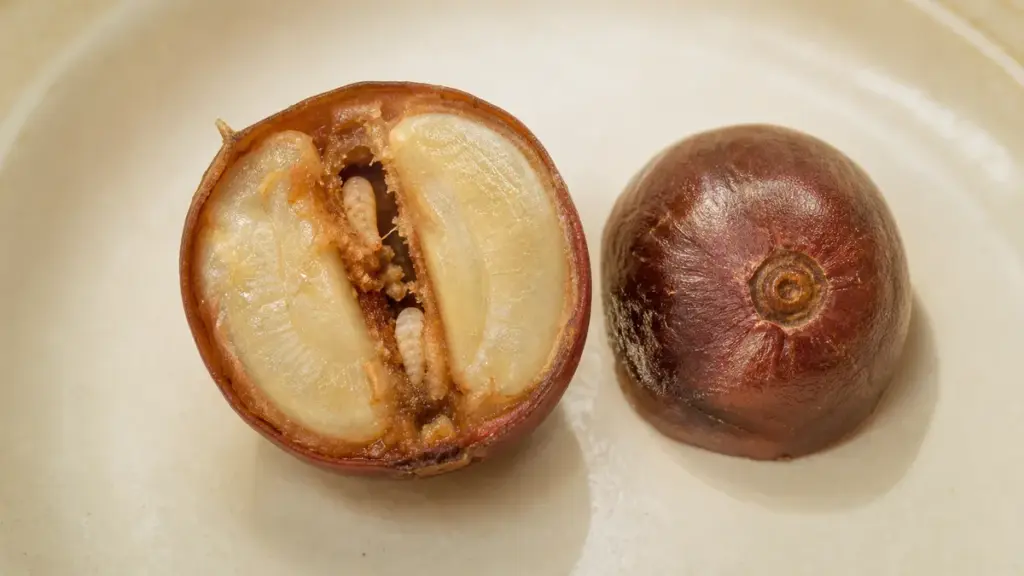
The coffee berry borer, Hypothenemus hampei, is a small, dark beetle. The adult female typically drills through the floral disc, the scar at the blossom end of the cherry, opposite its stalk. [6]
She can begin entering before the seed is suitable for reproduction. Once it has developed sufficiently, she penetrates the endosperm, the seed’s food-storage tissue, and excavates galleries where she lays eggs. The larvae feed inside, removing material from the future coffee bean. [7]
This produces the perforations and tunnels associated with broca damage. Broca is the Spanish name commonly used for the pest; in green coffee, the resulting damage is an insect defect, not a processing method or coffee variety. Laboratory assessment distinguishes extensive boring from less diagnostic surface marks. [6, 11]
The protective enclosure creates the central control problem. Once females and their offspring are inside the seed, surface-applied insecticides cannot effectively reach them. The biological control fungus Beauveria bassiana is also much less useful against this concealed stage. Finding a hole does not necessarily mean there is still time to kill the insect with a spray. [8]
Old fruit keeps the problem going. Borers can survive and reproduce in cherries remaining on trees or lying on the ground. A Colombian field experiment demonstrated that infested fallen fruit could act as a reservoir from which beetles attacked developing cherries on nearby trees. [6, 7]
How climate affects spread and outbreak risk
Climate affects these threats differently. It can change where conditions are suitable, how quickly organisms develop and when vulnerable stages of the crop are available. It does not replace the importance of plant material, farm management or the movement of infested material. [2, 8, 9]
For berry borer, temperature influences development and reproduction. Jaramillo and colleagues combined temperature-dependent biology with climate modelling to examine East African risk. Their results projected increased pressure in several coffee-growing areas as conditions warmed, including places previously constrained by cooler temperatures. These were modelled projections, not measurements of future infestation. [9]
Rust needs suitable leaf moisture as well as temperature. Its response is therefore not simply “hotter means worse”. Rainfall timing, wet leaves, shade and the condition of the host plant all affect whether an epidemic develops. [2, 4]
Shade illustrates the trade-off. It can cool a planting, but may also prolong conditions favourable to rust infection. Researchers have reported both higher and lower rust under shade, partly because shade also changes fruit load and plant stress. The useful question is how a particular canopy behaves on a particular farm, not whether all shaded coffee is protected or endangered. [2]
How farmers manage both threats
The strongest approach is integrated pest management, meaning monitoring and combining appropriate measures rather than relying on a single treatment. The practical sequence differs for a leaf disease and an insect living inside fruit. [2, 8]
Managing rust
A rust programme brings together suitable planting material, nutrition, pruning, canopy management and disease monitoring. Fungicides may form part of it, but should follow local agronomic advice and the applicable product authorisation. Waiting until widespread leaf fall has occurred leaves little foliage to protect. [2]
Resistant varieties are valuable, but resistance is not permanent immunity. A 2025 international field study assessed 29 arabica varieties at 23 sites and found that resistance depended on both genetics and growing environment. No tested variety was immune across the trial. [10]
This is why a variety’s reputation should be checked against local performance. Seedlings should be selected for the growing conditions and disease pressures where they will actually be planted, rather than chosen solely because a catalogue calls them resistant. [10]
Managing berry borer
A practical sequence is:
- Inspect and sample fruit. Record infestation and, where trained to do so, open sampled cherries to establish how far beetles have penetrated.
- Harvest thoroughly. Remove ripe and overripe cherries rather than leaving a continuing supply of breeding material.
- Clear residual fruit. Collect dried cherries, often called raisins, and manage fallen infested fruit using locally recommended sanitation methods.
- Target exposed insects. Use monitoring to time approved treatments while beetles remain accessible.
- Contain movement. Handle collected fruit and transport containers so beetles do not escape into other plantings. [8]
Alcohol-baited traps can help indicate beetle activity, but they do not replace fruit sampling or sanitation. Beauveria bassiana, a fungus that infects insects, can contribute to control when conditions and application timing suit it. Neither is a substitute for removing breeding reservoirs. [6, 8]
These principles apply across farming systems. For the separate questions of certification and permitted inputs, see organic farming.
Why the economic damage extends beyond lost beans
Rust reduces productive leaf area and can force farmers to rehabilitate damaged plants. Berry borer removes seed material and reduces the quantity and quality of saleable coffee. Both also create additional work in monitoring, treatment, harvesting and sorting. [2, 6]
During the Central American rust crisis, the burden extended to workers who depended on seasonal harvesting income. FEWS NET found that disease, coffee-market conditions and climatic problems combined to restrict food access among vulnerable households. Attributing every lost job or production decline to rust alone would misrepresent that evidence. [5]
For a small farm, the timing is especially difficult: extra work is needed just when the harvest provides less income. This creates a feedback problem, because reduced capacity to maintain the crop can increase vulnerability to further damage. Research on the regional rust crisis identified constrained farm management as part of that pattern. [4]
For buyers, a useful implication is to ask suppliers about grower support, planting material and monitoring, rather than treating an undamaged delivered lot as proof that producing it was straightforward. Coffee leaf rust and coffee berry borer are agricultural problems whose consequences continue through the supply chain.
FAQ
Are coffee berry borer and coffee berry disease the same thing?
No. Coffee berry borer is an insect, Hypothenemus hampei, whereas coffee berry disease is a fungal disease. Similar names can obscure very different problems, so advice should identify the organism rather than refer vaguely to “berry damage”. A treatment intended for one should not be assumed to control the other. [10]
Does rust resistance protect coffee against berry borer?
No. Resistance to Hemileia vastatrix concerns the plant’s response to a fungus, not protection against a beetle entering its fruit. A planting selected for rust resistance still needs borer monitoring and appropriate sanitation. The two management programmes overlap in farm organisation, but not in their biological targets. [8, 10]
Can a hole in a green bean prove that berry borer caused it?
Not always. Characteristic boring and internal tunnels support identification, but minor surface damage can be difficult to distinguish from mechanical damage or damage by other insects. The FDA’s laboratory guidance therefore considers both the nature of the damage and identification of the insect where possible. [11]
Where to go next
Read Coffee Pests and Diseases to place these two threats among the other problems affecting coffee crops. Smallholder Farms and Co-operatives explains the organisations through which growers can share support, while The Economics of Coffee Farming provides the wider context for understanding recovery after a damaged harvest.
Sources
Numbered references identify the sources used for the corresponding claims.
-
American Phytopathological Society, Phil A. Arneson. Coffee rust, The Plant Health Instructor, 2001, updated 2011.
https://www.apsnet.org/edcenter/pdlessons/Pages/CoffeeRust.aspx -
CATIE, Elias de Melo Virginio Filho and Carlos Astorga Domian. Prevention and control of coffee leaf rust: Handbook of best practices for extension agents and facilitators, first edition, August 2019. Hosted by World Coffee Research.
https://worldcoffeeresearch.org/download/2c60c505-bf82-4934-bd0b-816a05957761 -
Nature, Daniel Morris. Coffee-Leaf Disease of Ceylon and Southern India, 1879, volume 20, pages 557 to 559. Historical details checked against the indexed abstract.
https://www.nature.com/articles/020557a0 -
Avelino and colleagues, Food Security. The coffee rust crises in Colombia and Central America (2008 to 2013): impacts, plausible causes and proposed solutions, 2015.
https://link.springer.com/article/10.1007/s12571-015-0446-9 -
FEWS NET. The impact of the coffee rust outbreak on the coffee sector in Central America, May 2016.
https://fews.net/latin-america-and-caribbean/special-report/may-2016 -
University of Hawai‘i at Mānoa, CTAHR. Coffee Berry Borer (CBB), undated extension webpage.
https://www.ctahr.hawaii.edu/site/CBBManage.aspx -
Constantino and colleagues, Neotropical Entomology. Coffee Berry Borer (Hypothenemus hampei) Emergence from Ground Fruits Across Varying Altitudes and Climate Cycles, and the Effect on Coffee Tree Infestation, 2021.
https://link.springer.com/content/pdf/10.1007/s13744-021-00863-5.pdf -
University of Hawai‘i at Mānoa, CTAHR, with collaborating agencies. Recommendations for Coffee Berry Borer Integrated Pest Management in Hawai‘i 2020, IP-47, July 2020.
https://www.ctahr.hawaii.edu/oc/freepubs/pdf/IP-47.pdf -
Jaramillo and colleagues, PLOS ONE. Some Like It Hot: The Influence and Implications of Climate Change on Coffee Berry Borer (Hypothenemus hampei) and Coffee Production in East Africa, 2011.
https://journals.plos.org/plosone/article?id=10.1371/journal.pone.0024528 -
World Coffee Research and international collaborators, Frontiers in Plant Science. Global Coffea arabica variety trials reveal genotype-by-environment interactions in resistance to coffee leaf rust (Hemileia vastatrix), 2025.
https://www.frontiersin.org/journals/plant-science/articles/10.3389/fpls.2025.1583595/full -
US Food and Drug Administration. Macroanalytical Procedures Manual, V-1: Beverages and Beverage Materials, online edition, publication year not stated. Used for insect-damage identification, not UK grading requirements.
https://www.fda.gov/food/laboratory-methods-food/mpm-v-1-beverages-and-beverage-materials
This article was researched using plant-pathology guidance, agricultural extension publications, original field research, climate modelling and historical evidence, distinguishing observed outcomes from projections.
Last checked: November 2026