Coffee farming means growing a perennial crop for the seeds inside its fruit, known as coffee cherries. Farmers raise planting material in nurseries, establish trees in the field, manage their soil and canopy, then harvest ripe cherries, with the timing and techniques shaped by the variety, climate and terrain.
In short
- Match the planting material to the site, disease risks and available management, not just its reputation for flavour.
- Spacing, shade, nutrition and pruning work together; none has a single correct setting for every farm.
- Flowering to harvest commonly takes about 7 to 9 months for arabica and 9 to 11 months for robusta.
- Compare yields only when the product is specified: fresh cherry, dried parchment and green coffee are different measurements.
- Harvest planning must include workers, safe handling and enough processing capacity for the fruit picked.
How coffee farming begins: choosing the site and plant
The familiar commercial crops are arabica, Coffea arabica, and robusta, the trade name commonly used for Coffea canephora. Within these species, farmers choose varieties with different growth habits, disease responses and production potential. A variety is not a processing method or a geographical origin.
Before planting, farmers assess drainage, rainfall distribution, exposure, soil condition and access. Coffee needs water, but waterlogged soil is unsuitable. A site must also allow workers to reach the trees and move harvested fruit without avoidable delays.
The best planting choice is therefore a local agronomic decision. A promising variety still needs suitable conditions and management. Our coffee farming hub provides the wider route through these decisions; this guide follows their sequence from nursery to harvest.
Propagation and nurseries
Many established arabica varieties are grown from selected seed. Freshness and provenance matter: coffee seed has limited storage life under ordinary conditions, and unidentified planting material can introduce problems before the field is planted.
Vegetative propagation produces plants from existing plant tissue rather than seed. Rooted cuttings are important in clonal robusta production, while tissue culture and cuttings are used for many arabica F1 hybrids. An F1 hybrid is the first generation from a cross between selected parents; seed collected from that hybrid generally does not reproduce its combination of characteristics reliably.
Nurseries provide controlled shade, watering and protection while roots and leaves develop. Good practice includes keeping plants sufficiently separated, monitoring disease and rejecting damaged plants rather than filling the field with weak replacements.
Before transplanting, seedlings are gradually exposed to brighter conditions. This process, called hardening, reduces the abrupt change between nursery shelter and the field. Nursery duration varies with the planting material and conditions, so a calendar date alone is not a reliable test of readiness.
Planting and spacing
Planting layout determines much of the farm’s later work. Trees need room for their eventual canopy, while workers and equipment need access for pruning, crop protection and harvesting.
Published recommendations illustrate why spacing must be regional. FAO’s arabica manual for Lao PDR describes 2 m between rows and 1.5 m between plants. Uganda’s coffee authority gives examples of 2.4 m by 2.4 m for arabica and 3 m by 3 m for robusta. These are recommendations for their respective contexts, not interchangeable global rules.
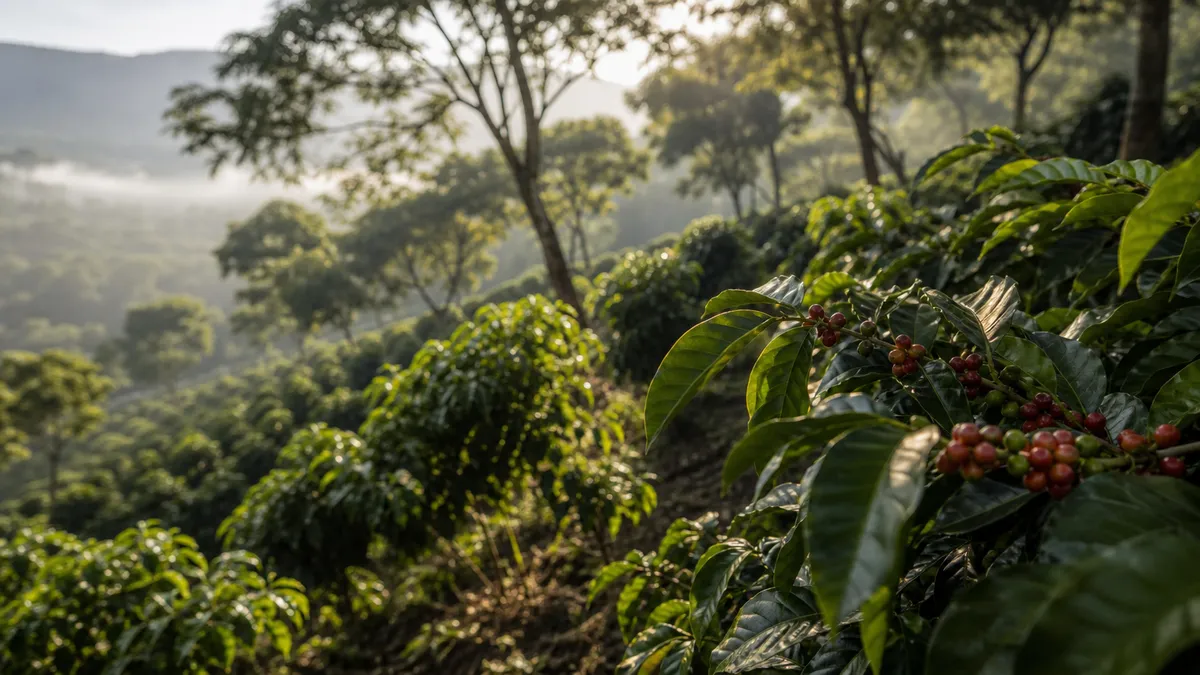
On slopes, contour planting and suitable ground cover help limit erosion. Planting should coincide with dependable soil moisture, with temporary protection and supplementary watering where establishment conditions require them.
A practical establishment checklist is:
- Confirm the planting material: identity, health and a trustworthy nursery source.
- Assess the field: drainage, exposure, erosion risk and access.
- Plan the complete layout: coffee rows, shade trees and working routes together.
- Prepare for establishment: suitable planting conditions, mulch and water provision.
- Inspect after planting: replace failures and address stress before gaps become permanent.
This is a planning sequence, not a substitute for local extension advice.
Shade, soil and nutrition
Managing shade
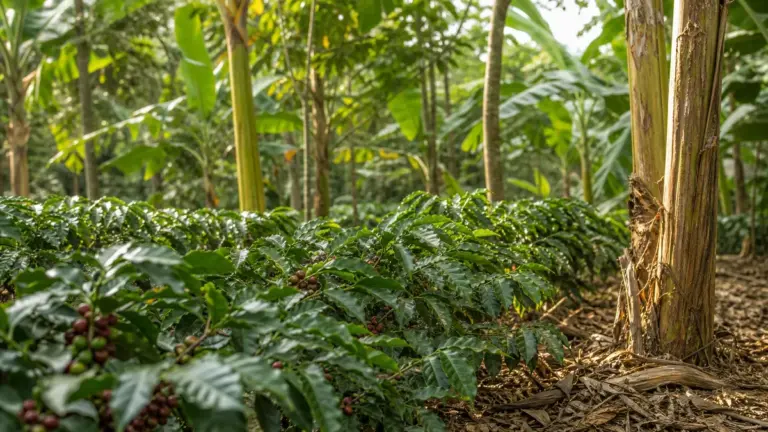
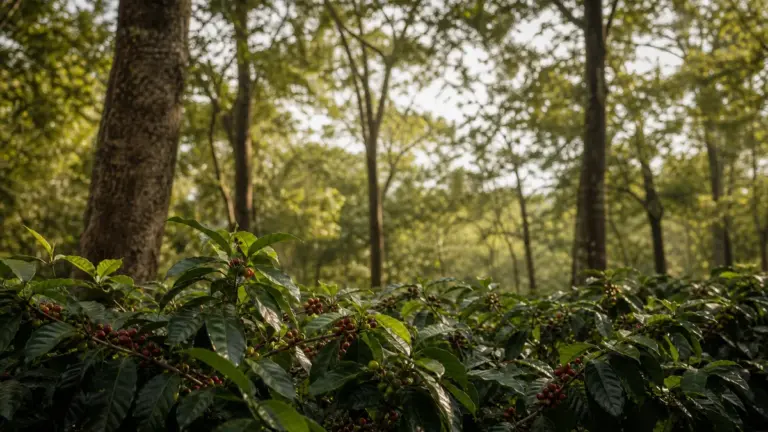
Shade trees can moderate excessive heat, provide leaf litter and protect young coffee. Growing coffee alongside trees is a form of agroforestry: agricultural crops and woody plants share the same production area.
However, shade needs management. Tree species, canopy density and pruning affect the conditions around the coffee. The objective is a suitable canopy, not simply the largest number of trees.
India’s Coffee Board recommends managed shade within its production system and warns against indiscriminate shade-tree removal. That guidance should not be turned into a universal shade percentage for every origin.
Feeding the crop and protecting the soil
Harvesting removes nutrients from the farm. Fallen leaves and prunings recycle some nutrients, but do not automatically replace everything exported in the crop.
Soil and leaf analysis help guide nutrition. Nitrogen supports plant growth, phosphorus contributes to energy transfer and root development, and potassium is involved in water balance and fruit development. Applying fertiliser without understanding the soil and crop’s needs can miss the actual limitation.
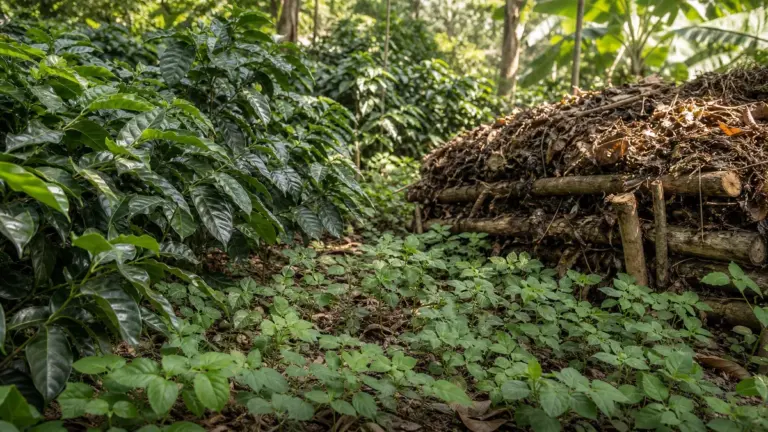
Mulch and ground cover help protect soil and conserve moisture. Weed management should reduce competition without unnecessarily exposing sloping ground. For the wider environmental choices, see sustainable farming practices.
Pruning, stumping and renewal
Pruning maintains a workable tree shape and a supply of productive growth. It also helps balance the crop with the foliage needed to support it. Farmers remove unwanted shoots, manage crowding and renew declining branches or stems.
Training systems differ. Some arabica systems maintain a single main stem; other systems, including robusta management described by Uganda’s coffee authority, retain several selected stems. Copying a pruning diagram without knowing its intended system can produce the wrong tree.
Stumping is a more substantial renewal operation: the established stem is cut back and replacement shoots are trained from regrowth. It renews the above-ground structure but interrupts production.
FAO’s Lao manual describes full stumping at roughly 0.5 m above soil level, with crop loss for one and often two years. That is a regional example, not a universal cutting specification. The practical decision is how to renew ageing trees without leaving the whole farm unproductive together.
From flowering to ripe cherry
In seasonal growing areas, rain following a dry period helps synchronise flowering. Several flowering events can create several groups of fruit at different stages, which complicates harvesting.
The International Trade Centre gives typical flowering-to-harvest intervals of 7 to 9 months for arabica and 9 to 11 months for robusta. These are useful guides, not fixed deadlines. Conditions and planting material affect the actual crop calendar.
The flowers are followed by fruit development, seed filling and ripening. For the underlying anatomy and development, read coffee plant biology and life cycle.
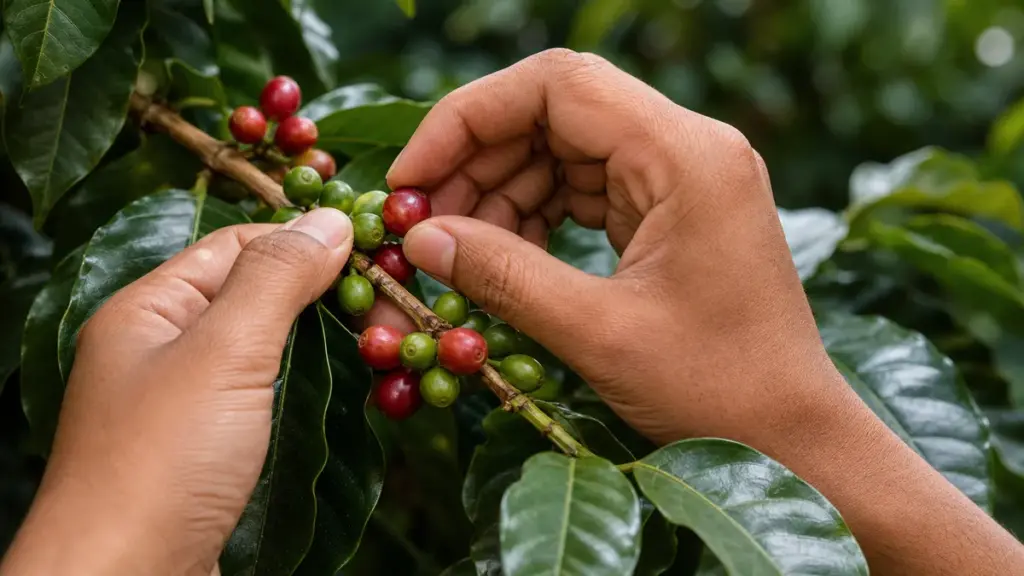
Harvesters must recognise ripeness for the variety concerned. Many coffees ripen red, but yellow-fruited types also exist, so “pick only red cherries” is not a rule for every coffee plant.
Harvesting and labour
Selective picking removes ripe cherries while leaving less mature fruit for another pass. It requires repeated visits when ripening is uneven. Strip picking removes fruit together, while mechanised systems depend on suitable terrain and crop conditions.
Labour planning extends beyond picking. Nursery work, weeding, nutrition, pruning, shade management and moving fruit all need attention. A harvest plan must connect the number of available workers with the amount of fruit that can be handled properly.
Clean collection containers and prompt handling protect the crop after picking. FAO’s Lao guidance specifies processing cherries on the day of harvest. India’s Coffee Board likewise warns against prolonged heaping and delayed pulping.
Harvesting is therefore not the finishing line. It is the handover between growing a sound crop and preserving it through processing.
Understanding coffee yields
A yield figure is useful only when its units and product are clear. Fresh cherry includes fruit material and water that are absent from clean green coffee, the unroasted seed after processing and hulling.
The following are Ugandan reference ranges published by the Uganda Coffee Development Authority, not global averages or promises for a new planting.
| Coffee type | Published green-coffee yield | How to interpret it |
|---|---|---|
| Arabica | 500 to 1,600 kg per hectare | A regional reference range, not a universal target |
| Robusta | 600 to 1,200 kg per hectare | Compare with records using the same product basis |
Kew’s 2023 account independently reports the same typical robusta range for Uganda, while noting substantial variation with location, inputs and management.
For meaningful comparisons, ask whether the figure covers mature bearing trees or the whole planted area, whether it represents one harvest or several years, and whether processing losses are included. Tree density alone cannot explain productivity.
Threats and the economics of keeping a farm productive
Coffee leaf rust damages foliage, while coffee berry borer attacks the fruit and seeds. Other pests and diseases vary by location. Integrated management combines monitoring, healthy planting material, sanitation, canopy management and appropriate interventions rather than relying on a single treatment.
Heat, drought and poorly timed rainfall also disrupt production. Resilience depends on matching the planting material and management to the site, then revising that management as conditions change.
Farm economics should be assessed across the growing and renewal cycle. Include establishment, family and hired labour, nutrition, tools, crop protection, transport and any processing undertaken. Record saleable output and income separately, allowing for periods when young or renewed trees are not producing.
To assess expenditure per kilogram, divide the relevant expenditure by saleable output measured on a consistent basis. Family labour should not disappear from the assessment simply because no wage was paid. For purchased inputs or services, obtain itemised written quotations.
The useful test of coffee farming is not the largest crop in isolation, but whether the farm can keep producing while supporting the people and resources behind it.
FAQ
Does coffee need volcanic soil?
No, volcanic soil is not a requirement for coffee farming. Coffee can grow in different soil types, provided their physical and chemical conditions are suitable. Drainage, rooting conditions, organic matter and nutrient availability are more useful assessments than the word “volcanic” on its own. Soil testing helps establish what a particular field needs.
Is shade-grown coffee automatically organic?
No, shade-grown and organic describe different things. Shade-grown refers to the tree canopy under which coffee grows; organic refers to a defined production and certification system. A shaded farm may use inputs that organic certification does not permit. Treat the terms separately and ask what evidence supports each claim.
Can farmers save seed from any coffee tree?
No, seed suitability depends on the planting material and how it was produced. Selected seed is widely used for established arabica varieties, but seed collected from an F1 hybrid generally produces variable offspring rather than reliable copies of the parent. Farmers should follow variety-specific propagation guidance and use recognised planting-material sources.
Where to go next
Use Coffee Farming to find the individual guides behind each stage of the farming year. Read Coffee Plant Biology and Life Cycle for the plant mechanisms behind flowering and fruiting, then Sustainable Farming Practices for a closer examination of environmental management choices.
Sources
- FAO, Arabica coffee manual for Lao-PDR, first published August 2005. Regional extension guidance, used selectively rather than as a universal prescription:
– Chapter 1, “Coffee plant & site selection”: https://www.fao.org/4/ae939e/ae939e03.htm
– Chapter 2, “Nursery management”: https://www.fao.org/4/ae939e/ae939e04.htm
– Chapter 3, “Field management & planting trees”: https://www.fao.org/4/ae939e/ae939e05.htm
– Chapter 4, “Plant nutrition & fertiliser management”: https://www.fao.org/4/ae939e/ae939e06.htm
– Chapter 5, “Pruning and tree management”: https://www.fao.org/4/ae939e/ae939e07.htm
– Chapter 6, “Harvesting and processing”: https://www.fao.org/4/ae939e/ae939e08.htm
– Chapter 9, “Pests and diseases”: https://www.fao.org/4/ae939e/ae939e0b.htm - World Coffee Research, “F1 Hybrid Trials”, undated live resource.
https://worldcoffeeresearch.org/programs/next-generation-f1-hybrid-varieties - CIRAD, “Coffee: Plant and uses”, undated live resource.
https://www.cirad.fr/en/our-activities-our-impact/tropical-value-chains/coffee/plant-and-uses - Uganda Coffee Development Authority, “Fact Sheet” and “Establishing a coffee farm”, undated agronomic sections. The surrounding website contains dated market entries, which were not treated as publication dates for the agronomic material.
– https://new.ugandacoffee.go.ug/node/30
– https://new.ugandacoffee.go.ug/establishing-coffee-farm - Coffee Board of India, “Planter: Agronomic Practices”, undated live resource.
https://coffeeboard.gov.in/planter.aspx - International Trade Centre, The Coffee Guide, fourth edition, 2021.
https://www.intracen.org/media/5718 - Royal Botanic Gardens, Kew, Davis and colleagues, The wild coffee resources of Uganda: a precious heritage, 2023.
https://www.kew.org/sites/default/files/2024-01/The%20Wild%20Coffee%20Resources%20of%20Uganda.pdf - International Coffee Organization, Coffee Development Report 2019: Overview, ED 2318/19, 16 September 2019.
https://www.ico.org/documents/cy2018-19/ed-2318e-overview-flagship-report.pdf - University of Florida IFAS Extension, Coffee Growing in the Florida Home Landscape, HS1056, live edition retrieved November 2026. Used for the existence of yellow-fruited coffee, not for commercial-farm yield recommendations.
https://ask.ifas.ufl.edu/publication/HS306
This article was researched using live-retrieved agricultural extension manuals, research-organisation resources and institutional reference publications, with regional recommendations distinguished from general principles.
Last checked: November 2026