Breeders develop disease-resistant and climate-resilient coffee varieties by crossing plants with useful inherited traits, then testing their offspring for disease resistance, productivity, flavour and performance under environmental stress. The aim is not one indestructible coffee tree, but a choice of locally suitable varieties: resistance to leaf rust does not automatically confer drought tolerance, heat tolerance or protection against insect pests.
In short
- Disease resistance, heat tolerance and drought tolerance are separate traits that need separate testing.
- Coffee berry borer is an insect pest, not a disease. Rust-resistant trees still need pest management.
- Bunn and colleagues’ 2015 modelling projected roughly half of global climatic suitability for coffee could be lost by 2050, not that half the harvest would necessarily disappear.
- World Coffee Research’s Innovea network combines international field trials with DNA-informed breeding, while national programmes develop locally suitable varieties.
- A promising plant must also deliver acceptable flavour, manageable growing requirements and planting material that farmers can obtain reliably.
What breeders are trying to protect
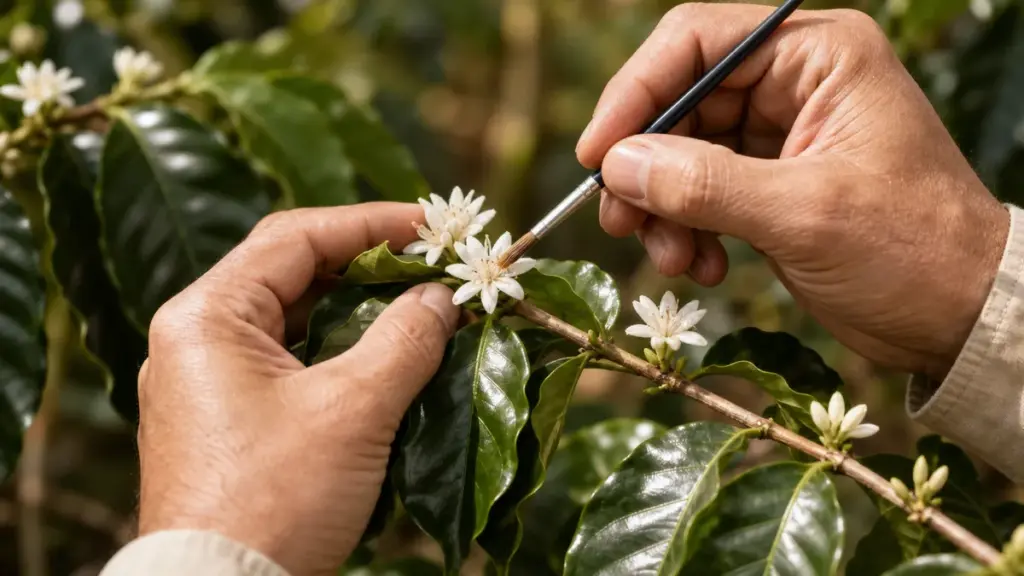
A coffee variety is a recognisable group of plants within a species, selected or maintained for particular characteristics. Breeding brings useful characteristics together through controlled crosses and selection. Our guide to coffee species and varieties explains the terminology in more detail.
The challenge is to improve several characteristics together. A tree that survives drought but produces little saleable coffee is not a complete solution; neither is a productive tree whose disease resistance fails in its intended growing region.
| Breeding target | What successful performance means | What must not be assumed |
|---|---|---|
| Disease resistance | Less infection or disease development under relevant pathogen pressure | Resistance works everywhere or lasts indefinitely |
| Heat tolerance | Useful plant function and crop performance in hotter conditions | A heat-tolerant plant also tolerates dry soil |
| Drought tolerance | Maintaining function, recovering and producing under water shortage | Survival alone proves dependable harvests |
| Climatic adaptability | Acceptable performance across relevant environments | The same variety suits every farm |
These are evaluation criteria, not interchangeable labels. “Climate-resilient” is useful only when the claim explains resilience to what, under which conditions, and measured how.
Leaf rust and berry borer need different answers
Breeding against coffee leaf rust
Coffee leaf rust is caused by the fungus Hemileia vastatrix. It attacks leaves, producing characteristic orange spore masses; severe infection can cause premature leaf fall and reduce production.
An important source of resistance is the Timor Hybrid, a naturally occurring cross between arabica and Coffea canephora, the species traded as robusta. Breeders have crossed its descendants with cultivated arabicas to introduce useful resistance while selecting for other desirable characteristics. This transfer of genetic material through crossing is called introgression.
Resistance is not a permanent shield. The fungus evolves, and a variety’s response can differ between locations. A 2025 international field study evaluated 29 varieties at 23 sites: none was completely immune across the sites studied.
That finding supports careful wording. Some older promotional explanations described particular hybrids as immune; a safer practical description is resistance demonstrated under specified conditions, with continued monitoring.
Managing coffee berry borer
Coffee berry borer, Hypothenemus hampei, is a beetle. Females bore into coffee cherries, and their offspring feed within the seeds, damaging the beans themselves.
A rust-resistance claim says nothing about protection against this insect. Breeding research can investigate pest-related traits, but farmers should not treat a disease-resistant variety as a replacement for integrated pest management: combining monitoring, crop hygiene and appropriate biological or other controls.
Removing residual cherries matters because beetles can persist and reproduce in fruit left on trees or the ground. University of Hawai‘i guidance also covers targeted use of the insect-killing fungus Beauveria bassiana. These are management measures, distinct from breeding resistance into the coffee plant.
What climate projections actually tell us
Bunn and colleagues’ 2015 study, A bitter cup, modelled climatic suitability for arabica and robusta under different emissions scenarios. Its headline finding was a global suitability loss of about 50% by 2050.
The underlying measure needs care. For arabica, the study reported a 49% reduction in its accumulated suitability score under the intermediate RCP 6.0 scenario, one of the emissions pathways it examined. This was a modelled change in climatic suitability, not a prediction that precisely 49% of existing farms would close or that production would fall by the same proportion.
The distinction matters because climate suitability, cultivated area and harvested output are different things. The modelling does not establish what future breeding and farm management will achieve.
Nor is replacing arabica with robusta a universal answer. The same study projected substantial suitability losses for robusta. Our arabica and robusta comparison covers their broader differences; neither species should be described as climate-proof.
Heat and drought are separate stresses
Heat concerns temperature; drought concerns water availability. They can occur together, but evidence for tolerance of one cannot simply be borrowed for the other.
Controlled experiments help researchers investigate the mechanisms. A 2020 study exposed potted arabica and robusta plants to drought, rising temperatures and their combination, measuring photosynthetic function and recovery. Responses differed between the tested plants, and combined severe stress exposed limitations that a single-stress test would miss.
That is valuable physiological evidence, not proof of dependable farm yields. Breeders still need field assessment through productive seasons, including recovery after difficult weather.
How the global breeding pipeline works
World Coffee Research, usually shortened to WCR, works with national coffee research programmes rather than replacing them. Its Innovea Global Breeding Network shares breeding material, field information and genetic tools so countries can develop varieties suited to their own farmers and environments.
A simplified breeding pipeline looks like this:
- Set the target. Identify the diseases, environmental stresses, production requirements and quality expectations that matter locally.
- Choose parents and cross them. Bring together useful genetic diversity rather than selecting on appearance alone.
- Measure the offspring. Compare growth, disease response, production and quality in structured trials.
- Use DNA information alongside field results. Genomic selection uses genetic data and measured performance to help identify promising breeding material.
- Test across environments and multiply suitable material. National programmes select candidates for local development, while seed and nursery systems provide traceable plants.
DNA tools improve selection; they do not make field testing unnecessary. Innovea uses conventional crossing and selection supported by modern genetics, not genetic modification.
As checked in November 2026, WCR described Innovea as an 11-country network covering arabica and robusta. Its November 2025 expansion announcement said distribution of new robusta candidates for partner testing was planned to begin in 2027. Those candidates are breeding material, not finished varieties already available to every farmer.
Existing varieties also need better testing
Creating new crosses is only part of the work. WCR’s International Multilocation Variety Trial compares existing varieties across growing environments, helping establish where they perform well.
Its CafeClima platform connects variety-performance evidence with climate projections. It uses “climate analogues”, places whose present conditions resemble another location’s projected future climate, to inform replanting decisions. These are estimates to support judgement, not guarantees for an individual farm.
The wider coffee varieties guide provides a route into the named varieties behind these programmes.
What F1 hybrids and other species contribute
F1 hybrids combine distinct parents
An F1 hybrid is the first-generation offspring of a particular cross between genetically distinct parents. Some benefit from hybrid vigour, meaning stronger performance in characteristics such as growth or productivity.
An F1 designation does not itself promise rust resistance, drought tolerance or excellent flavour. Those characteristics depend on the parents and must be assessed in the resulting plants.
Propagation is a practical constraint. Seed saved from an F1 plant produces a second generation in which characteristics separate into different combinations, rather than reliably reproducing the original hybrid. Many coffee F1s therefore depend on specialist clonal propagation, which reproduces selected plants. The distinction is between obtaining the intended variety and merely growing its descendants.
Other species broaden the possibilities
Breeders and botanists also investigate less widely cultivated coffee species. These are not newly invented plants: some are existing species being reconsidered as crops or potential genetic resources.
A 2021 study of Coffea stenophylla combined sensory assessment with climatic analysis. It found arabica-like flavour and growing conditions with mean annual temperatures 6.2 to 6.8°C higher than those associated with arabica.
That is not a controlled experiment showing that any stenophylla tree can withstand an extra 6.8°C. It describes a difference between climatic growing ranges. Kew also cautioned that reported drought tolerance required further research.
The opportunity is substantial, but flavour and climatic promise alone do not establish a ready replacement crop. Agronomic performance, reliable propagation and compatibility with production and processing systems still matter.
Why farmers cannot adopt every promising variety immediately
A successful breeding result must become a workable farming decision. WCR’s replanting guidance asks users to assess local climate, disease pressure, soil, management capacity, propagation requirements and planting-material quality together.
The trade-offs are specific. A productive variety may require nutrition and management that a farm cannot reliably provide. A suitable hybrid may be difficult to obtain through local nurseries. Replanting also creates a transition before replacement trees contribute a harvest.
For that reason, adoption should not be judged simply as willingness or reluctance to embrace science. Farmers need credible local evidence, healthy plants with verifiable identity, appropriate technical support and a feasible transition.
Quality deserves the same scrutiny. Resistance does not establish flavour, but neither does it establish poor flavour. WCR’s international trial programme assesses cup quality alongside agronomic performance because both matter.
For UK buyers, a useful question is therefore not “Is this a traditional or modern variety?” but “What evidence supports this coffee’s quality and the producer’s planting choices?” Disease-resistant and climate-resilient varieties earn their place through demonstrated performance, not reassuring names.
FAQ
Are these coffees genetically modified?
Not necessarily, and WCR’s breeding programmes discussed here do not use genetic modification. Controlled pollination crosses selected parent plants; DNA analysis helps breeders understand and select their offspring. Using genetic information is not the same as genetically engineering a plant. “Hybrid” describes parentage, not a particular laboratory modification method.
Can a variety be resistant in one country but susceptible in another?
Yes. Disease resistance depends on the interaction between the plant, the pathogen population and growing conditions. International field trials show that varieties can respond differently between sites. A resistance rating should therefore be read alongside local recommendations and recent observations, rather than treated as a permanent worldwide guarantee.
What should a buyer ask about a “climate-resilient” coffee?
Ask which stress the claim concerns and what evidence supports it. Useful distinctions include heat versus drought, plant survival versus harvested production, and controlled experiments versus local field trials. Also ask whether the claim concerns an established commercial variety or an experimental candidate. The phrase alone does not establish dependable performance.
Where to go next
Read Coffee Varieties to place breeding programmes within the wider variety family tree. Ethiopian Yirgacheffe and Colombian Supremo Explained helps distinguish other kinds of coffee names, while Peaberry Coffee explains another bean description that should not be confused with a breeding claim.
Sources
-
World Coffee Research, History of Arabica, undated, current online catalogue.
https://varieties.worldcoffeeresearch.org/arabica-2/history-of-arabica
Background on breeding groups, introgression and hybrid development. -
Berny Mier y Teran and colleagues, Global Coffea arabica variety trials reveal genotype-by-environment interactions in resistance to coffee leaf rust (Hemileia vastatrix), Frontiers in Plant Science, 2025.
https://pmc.ncbi.nlm.nih.gov/articles/PMC12202487/
Primary international field evidence on rust resistance. -
University of Hawai‘i, CTAHR, Coffee Berry Borer, undated extension resource.
https://www.ctahr.hawaii.edu/site/CBBManage.aspx
Pest biology, damage and the importance of crop hygiene. -
University of Hawai‘i, CTAHR, Recommendations for Coffee Berry Borer Integrated Pest Management in Hawai‘i 2020, IP-47, July 2020.
https://www.hawaiicoffeeed.com/uploads/2/6/7/7/26772370/ip-47_updated_081420.pdf
Monitoring, sanitation and biological-control guidance. -
Bunn and colleagues, A bitter cup: climate change profile of global production of Arabica and Robusta coffee, Climatic Change, volume 129, 2015.
https://sites.evergreen.edu/terroir/wp-content/uploads/sites/134/2015/10/coffee-climate-change-global-maps.pdf
Retrieved author paper for the climate projections and their measurement basis. -
Dubberstein and colleagues, Resilient and Sensitive Key Points of the Photosynthetic Machinery of Coffea spp. to the Single and Superimposed Exposure to Severe Drought and Heat Stresses, Frontiers in Plant Science, 2020.
https://www.frontiersin.org/journals/plant-science/articles/10.3389/fpls.2020.01049/full
Primary controlled-experiment evidence on separate and combined stresses. -
World Coffee Research, Innovea Global Breeding Network, undated, current programme page.
https://worldcoffeeresearch.org/programs/global-breeding-network
Network structure, genomic selection and national breeding roles. -
World Coffee Research, World Coffee Research brings robusta into the Innovea Global Breeding Network, 20 November 2025.
https://worldcoffeeresearch.org/news/2025/world-coffee-research-brings-robusta-into-the-innovea-global-breeding-network
Robusta expansion and planned distribution for testing. -
World Coffee Research, International Multi-location Variety Trial produces initial global results, 1 December 2022.
https://worldcoffeeresearch.org/news/2022/imlvt-global-results
Multi-environment evaluation and cup-quality assessment. -
World Coffee Research, CafeClima, current resource page, 2026.
https://worldcoffeeresearch.org/resources/cafeclima
Climate analogues and variety-performance modelling. -
World Coffee Research, F1 Hybrids Explainer, 2019.
https://worldcoffeeresearch.org/news/2019/f1-hybrids-explainer
Hybrid vigour, propagation and conventional crossing. Older immunity wording is qualified using the later field study above. -
Davis and colleagues, Arabica-like flavour in a heat-tolerant wild coffee species, Nature Plants, 2021, retrieved abstract.
https://pubmed.ncbi.nlm.nih.gov/33875832/
Primary sensory and climatic evidence concerning stenophylla. -
Royal Botanic Gardens, Kew, ‘Forgotten’ coffee species that grows at higher temperatures and boasts a superior flavour could help to futureproof the coffee industry under climate change, says new study, 2021.
https://www.kew.org/about-us/press-media/forgotten-coffee-species-futureproofing-industry-against-climate-change
Research context and the qualification on drought tolerance. -
World Coffee Research, Replanting Arabica Coffee Farms: Practical Tools for Your Supply Chain, undated, current resource.
https://worldcoffeeresearch.org/programs/replanting-guide-tools
Local suitability, management requirements and planting-material traceability.
Research combined retrieved primary studies with breeding-programme documentation and university extension guidance, distinguishing model projections, controlled experiments and field observations.
Last checked: November 2026