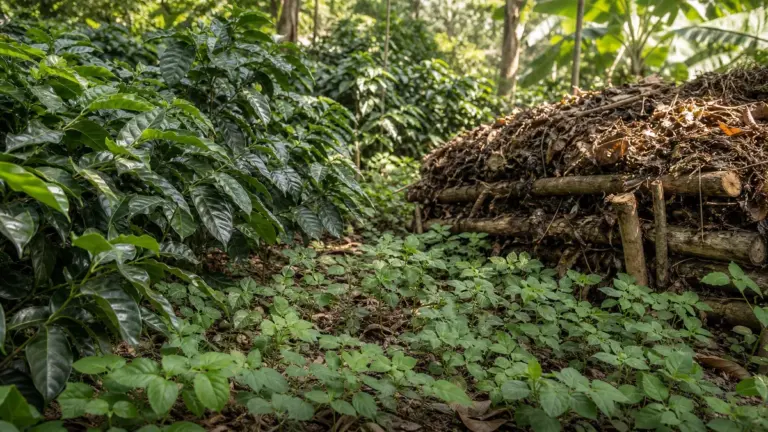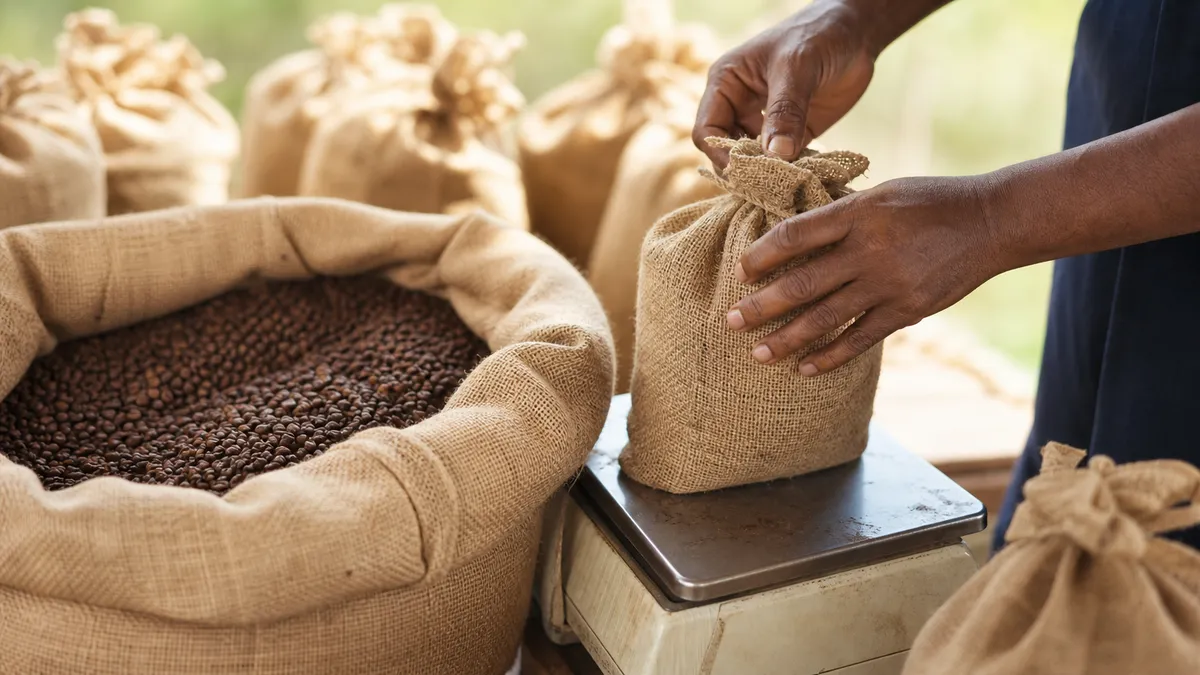
Smallholder coffee farms are small, usually family-managed businesses that grow and sell coffee, sometimes independently and sometimes through a co-operative. A co-operative lets farmers jointly own and control services such as processing and marketing, without necessarily combining their land into one farm. Smallholders supply most of the world’s coffee, but their share of farms is much larger than their share of production.
In short
- Count farms and coffee separately: a percentage of farms is not a percentage of production.
- Check the definition: “smallholder” can describe a farm’s area, its reliance on family labour or a country-specific category.
- Ownership matters: supplying a washing station does not, by itself, make a farmer a co-operative member.
- Shared services need shared oversight: processing equipment is useful only alongside competent management and accountable leadership.
- Ask who participates: women’s work on a family farm does not necessarily translate into membership, voting rights or control of earnings.
How much coffee comes from smallholders?
The International Trade Centre’s The Coffee Guide, fourth edition, reports that 94.5% of coffee farms were smaller than 5 hectares, with about 84% smaller than 2 hectares. It separately estimates that farms below 5 hectares contributed up to 67% of global production. These estimates draw on Enveritas’s 2018 Global Farm Study, not a November 2026 census.
The same guide gives an 80% production share using country-specific smallholder classifications rather than a uniform area threshold. The figures therefore describe different groupings. This article uses the below-5-hectare estimate when discussing production: smallholders supply a majority, but “almost all farms” does not mean “almost all coffee”.
For the wider growing context, start with our coffee farming guide.
What a smallholder farm actually does
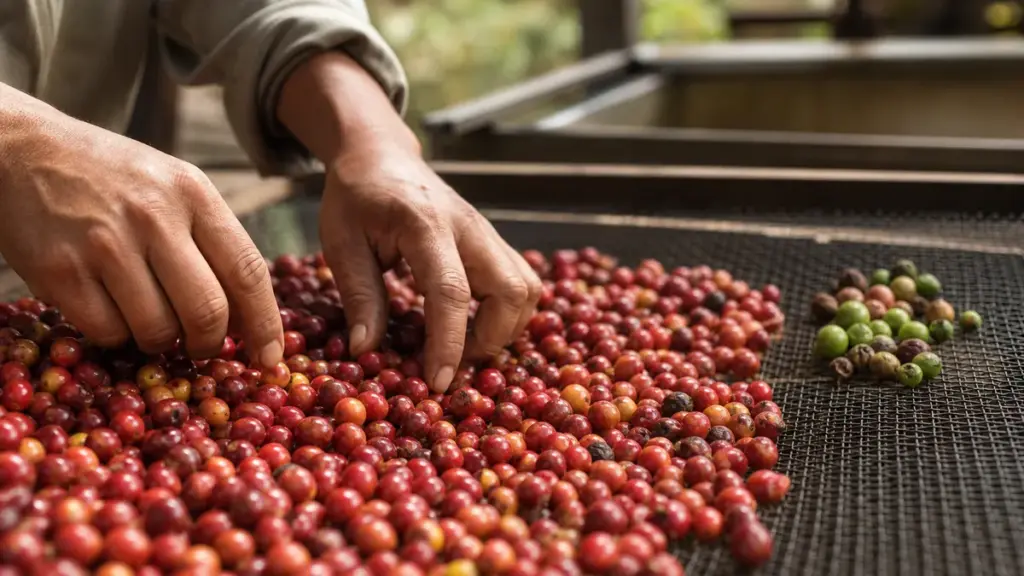
“Smallholder” is not a synonym for amateur. A useful distinction is between the scale of the business and how it is organised. Fairtrade’s small-scale producer standard, for example, emphasises family management and predominantly family labour, while allowing seasonal workers alongside family members during busy periods such as harvest. That is a different test from simply drawing a line at a particular number of hectares.
Coffee may also be only part of the household’s farming activity. TechnoServe’s work in East Africa describes farmers growing food crops for household consumption while relying on coffee as an important source of income. Its support combined agricultural advice with business training, record-keeping and connections to buyers and financial services.
This helps explain why farming skill alone is not enough. Growing a good crop and operating a successful coffee business are related but different tasks. A farmer also needs a workable route from harvest to buyer, which is where collective organisation can help. TechnoServe’s programme addressed farm production, processing, finance and market connections together rather than treating any one intervention as sufficient.
The details of crop protection belong in coffee pests and diseases, rather than in the ownership model.
How coffee co-operatives are organised
A co-operative is a jointly owned, democratically controlled enterprise established to meet members’ shared needs. Under the International Cooperative Alliance’s principles, primary co-operatives give members equal voting rights: one member, one vote. Members also control how surpluses are allocated, which can include reserves, business development or benefits linked to their transactions with the co-operative.
Joining does not inherently transfer a farmer’s land to the organisation. Think of it as owning part of a shared business that serves individual farms, rather than automatically creating one collective farm. The practical activities vary, and several arrangements can overlap.
| Arrangement | Who belongs or controls it? | Main purpose |
|---|---|---|
| Primary producer co-operative | Individual farmer members | Organise services and business on members’ behalf |
| Co-operative processing business | Farmer members through their organisation | Operate shared facilities, such as a wet mill |
| Union or higher-level organisation | Member producer organisations | Coordinate representation and activities above the local group |
| Producer association | Members under its own constitution | Organise shared interests, potentially without the legal form of a co-operative |
Fairtrade’s explanatory guidance recognises both co-operatives and associations, as well as higher-level organisations whose direct members are other producer organisations. Legal forms and constitutions still matter: “producer group” and “co-operative” should not be treated as interchangeable labels.
For a buyer, the revealing question is not simply “Is there a co-operative?” Ask: what does it own, what does it do, and how do farmers control it?
From individual deliveries to a shared coffee lot
A wet mill, often called a washing station, handles the early processing of coffee fruit. TechnoServe’s processing guide illustrates how a shared facility can connect many small deliveries to recorded batches. A simplified washed-coffee route looks like this:
- Receive and sort the fruit. Check deliveries and remove unsuitable cherries and foreign material.
- Weigh and record acceptance. Use an accurate scale and issue a receipt.
- Process the batch. Remove the fruit skin and pulp, then manage fermentation, washing and drying.
- Keep batches identifiable. Maintain records through processing and storage.
- Reconcile deliveries and output. Connect farmers’ deliveries with the coffee produced and any subsequent settlement.
This is also a traceability system: a documented connection between suppliers, processing batches and the resulting coffee. Pooling deliveries need not mean abandoning those records.
Shared equipment also creates shared constraints. TechnoServe identifies drying space as a frequent wet-mill bottleneck, so the processing machine’s capacity alone cannot determine how much fruit a station should accept.
Collective marketing: what changes when farmers sell together?
Collective marketing creates an organisation that can coordinate sales and services beyond an individual farm. In TechnoServe’s Coffee Initiative, support included linking co-operatives with buyers seeking high-quality coffee, alongside relationships with banks, exporters and other service providers. The co-operative was therefore part of a trading network, not a replacement for every other participant.
Colombia offers another model. The Federación Nacional de Cafeteros describes a purchase-guarantee system delivered through coffee-grower co-operatives and purchasing points. Its stated purpose includes ensuring that growers can find a buyer offering a market-linked price and immediate payment. That is a particular national arrangement, not a promise attached to every coffee co-operative worldwide.
When evaluating a sales arrangement, separate its functions. Who receives the farmer’s coffee? Who processes it? Who signs the export contract? Who pays the farmer, and when? Asking these questions is more useful than assuming that fewer intermediaries automatically means a better outcome.
Our guide to the economics of coffee farming explores the wider business pressures behind those decisions.
Benefits and problems: why management matters
A co-operative’s potential strength is coordination. Members can develop shared services and democratic oversight instead of each household having to organise everything alone. But member ownership is a structure, not proof that the business is well run. The ICA’s principles explicitly connect ownership with participation, accountability and member education.
TechnoServe’s report on the first phase of its Coffee Initiative makes the distinction particularly clear. It describes support for business planning, equipment operation, accounting, inventory and quality control, but also identifies transparent governance as a major challenge. Some supported wet mills experienced corruption problems; independent audits and accessible reporting helped expose them. These are programme findings, not a failure rate for coffee co-operatives generally.
The practical questions are therefore quite ordinary:
- Can members understand the accounts?
- Are management responsibilities clear?
- Can members challenge decisions without depending on personal connections?
- Are delivery records consistent with the organisation’s sales?
- Does the organisation explain what happens to any surplus?
Fairtrade’s governance guidance calls for a clear separation between elected oversight and management, transparent administration and meaningful member participation. These are useful matters to investigate, although a written rule should not be mistaken for evidence of everyday practice.
Nor does collective ownership remove trading risk. TechnoServe documented working-capital shortages and difficulties arising when market conditions changed after coffee had been committed for sale. A shared enterprise still needs enough liquidity and appropriate risk management to keep operating through harvest.
Women in coffee: labour is not the same as influence
Women may contribute as farm operators, family workers, employees or business owners. Those roles should not be collapsed into a single category. The International Coffee Organization’s September 2018 report estimated that women operated 20% to 30% of coffee farms, while documenting unequal access to land, finance, information and training. This is a historical estimate, not a current census.
The report combines a review of research with analysis of household data and cautions that geographical coverage is uneven. Its findings support examining barriers, rather than assuming every producing community has the same pattern.
For co-operatives, ask who can join in their own right, attend training, vote and stand for leadership. Also ask who controls the proceeds of coffee sales. A household’s membership does not answer all those questions for every adult within it. The ICO specifically recommends inviting female household members into producer-group participation and strengthening women’s roles in governance.
What UK coffee buyers should ask
Use a co-operative’s name as a starting point for questions, not as the whole sourcing story. Before treating “smallholder-grown” or “co-operative coffee” as evidence of a particular benefit, ask the roaster or supplier:
- Which organisation supplied this coffee? Request its name and the relevant harvest or lot.
- What is its role? Distinguish collection, processing, marketing and export.
- What can be traced? Ask whether the documentation identifies a producer group, processing batch or individual farm.
- What supports the claimed benefit? Look for a specific explanation rather than a general ethical description.
- Who participates? Ask about membership, leadership and women’s involvement.
These are editorial checks, not a certification scheme. They help turn the language of smallholder farms and co-operatives into questions a supplier can actually answer.
FAQ
Are co-operatives and Fairtrade the same thing?
No. A co-operative is an ownership and governance model; Fairtrade is a standards and certification system. Fairtrade’s small-scale producer framework applies to organised farming groups and includes democratic decision-making requirements. Its guidance recognises co-operatives, associations and other eligible producer organisations, so neither term should be used as shorthand for the other.
Can smallholder farms employ workers?
Yes. Reliance on family labour does not mean that no outside labour is used. Fairtrade’s small-scale producer standard, for example, allows seasonal workers alongside family members during peak periods such as harvest. That is a scheme-specific definition, but it illustrates why “smallholder” should not be read as “family members only, throughout the year”.
Does a co-operative have to distribute all its surplus to members?
No. Under the International Cooperative Alliance’s principles, members can allocate surplus to developing the co-operative, establishing reserves, benefiting members in proportion to their business with it or supporting other approved activities. When assessing an organisation, ask how those decisions are made and explained, rather than assuming that retained surplus is necessarily improper.
Where to go next
Read Coffee Farming for the broader production system, then The Economics of Coffee Farming for the business behind the harvest. Coffee Pests and Diseases explains crop-protection pressures, while coffee leaf rust and coffee berry borer examines those particular threats in greater detail.
Sources
-
International Trade Centre, The Coffee Guide, fourth edition, 2021, Chapter 3, especially printed pages 89 to 90. Reports Enveritas’s 2018 farm-size and production estimates.
https://www.intracen.org/media/5718 -
International Cooperative Alliance, Cooperative identity, values & principles, undated webpage, setting out the Statement on the Cooperative Identity adopted in 1995.
https://www.ica.coop/en/cooperatives/cooperative-identity -
Fairtrade International, Fairtrade Standard for Small-scale Producer Organizations, version 03.04.2019_v2.10, retrieved November 2026.
https://www.fairtrade.net/content/dam/fairtrade/fairtrade-international/standards/small-scale-producer/SPO_EN.pdf -
Fairtrade International, Explanatory Document for the Fairtrade Standard for Small-scale Producer Organizations, 8 October 2020. Explanatory guidance, not the certification standard itself.
https://www.fairtrade.net/content/dam/fairtrade/fairtrade-international/standards/small-scale-producer/2020.10.08_SPO_Expl_Doc.pdf -
TechnoServe, Coffee Initiative, undated project overview, retrieved November 2026.
https://www.technoserve.org/fight-poverty/projects/coffee-initiative/ -
TechnoServe, Coffee Wet Mill Processing Guide, undated PDF, hosted in its March 2022 uploads directory.
https://www.technoserve.org/wp-content/uploads/2022/03/TechnoServe-Wet-Mill-Processing-Guide.pdf -
TechnoServe, The Coffee Initiative: Phase One Final Report, 2008 to 2011, undated report, hosted in its May 2013 uploads directory.
https://www.technoserve.org/wp-content/uploads/2013/05/coffee-initiative-phase-one-final-report.pdf -
Federación Nacional de Cafeteros de Colombia, Garantía de compra, undated webpage, retrieved November 2026.
https://federaciondecafeteros.org/garantia-de-compra/ -
International Coffee Organization, Gender equality in the coffee sector, September 2018.
https://ico.org/documents/cy2017-18/icc-122-11e-gender-equality.pdf -
Fairtrade International, Standards for small-scale producers, undated webpage, retrieved November 2026.
https://www.fairtrade.net/en/why-fairtrade/how-we-do-it/standards/who-we-have-standards-for/standards-for-small-scale-producer-organisations.html
This article was researched from retrieved institutional publications, producer-organisation guidance and programme reports, distinguishing historical estimates, scheme requirements and programme findings from universal claims.
Last checked: November 2026