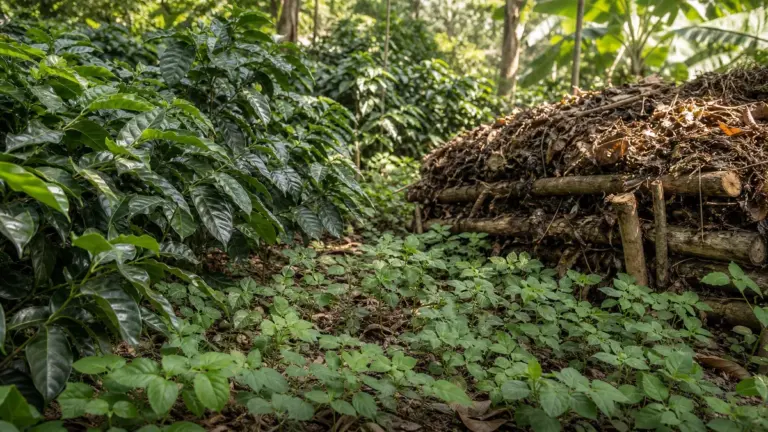
Regenerative agriculture in coffee means farming with the aim of restoring soil health and improving the wider farm ecosystem while keeping coffee production viable. It commonly involves ground cover, compost, reduced soil disturbance and greater plant diversity, but there is no single universally agreed definition or standard: the useful question is what changed on the farm, and what evidence shows an improvement.
In short
- A farming practice is an action, such as applying compost; an outcome is a measured change, such as better water infiltration.
- Cover crops protect the ground while growing. Mulch protects it with material left on the surface.
- Coffee research supports benefits from particular combinations of practices, not a universal promise attached to the word “regenerative”.
- Private certification standards exist, but their requirements differ. Ask which scheme applies to the coffee.
- A credible claim identifies the farms, starting conditions, measurements and period covered.
What regenerative agriculture means in coffee
For this article, regenerative agriculture means a locally adapted approach intended to restore soil and ecosystem functions while supporting viable coffee farming. That is a working definition, not a globally agreed rulebook.
A review published in 2020 found definitions built around practices, intended outcomes, or both. This distinction matters: planting a cover crop demonstrates that something was done, but does not by itself demonstrate increased soil carbon or improved coffee yields.
Coffee-sector organisations are developing more specific frameworks. The Global Coffee Platform’s RegenCoffee guidance, for example, sets out a shared language of definitions, principles and expected outcomes. Such frameworks help clarify the discussion without making every programme identical.
Nor does a newer name mean every technique is new. Colombia’s Cenicafé published guidance on ground cover, mulch, contour planting and living barriers in 2004. Regenerative programmes can bring established methods together with explicit restoration goals and monitoring.
For the wider production system, start with coffee farming. The distinction here is between adopting worthwhile practices and demonstrating that they restore something.
How regenerative practices support soil health
Soil health means the soil’s capacity to function as a living system. In practical terms, that includes supporting roots, allowing water and air to move, cycling nutrients and sustaining soil organisms.
Organic matter, material derived from living things, helps support these functions. Roots and microorganisms also help form soil aggregates, the small clusters of particles whose arrangement influences pore space and water movement. Healthy soil is therefore more than soil with a dark colour.
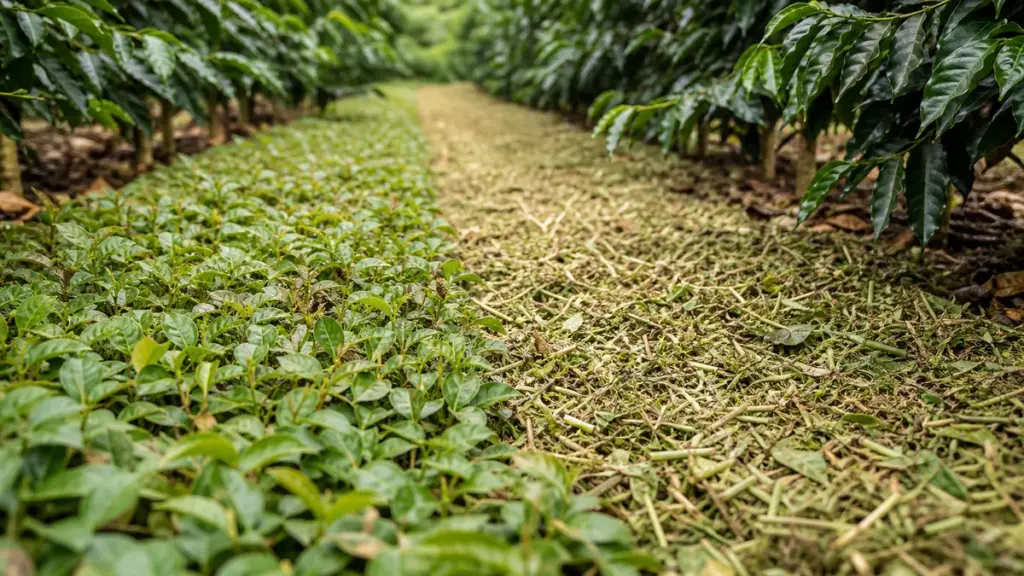
On sloping coffee land, protecting the surface is particularly relevant. Cenicafé recommends measures including contour planting, living barriers, ground cover and mulch to control erosion. Preventing fertile soil from washing away is a concrete goal, even where changes in carbon storage remain uncertain.
| Practice | Intended function | What to examine |
|---|---|---|
| Living ground cover | Protect soil and maintain living roots | Ground coverage and competition with coffee |
| Surface mulch | Cushion rainfall impact and cover exposed soil | Bare patches and movement of material |
| Compost application | Return decomposed organic material and nutrients | Compost quality and crop response |
| Contour planting and living barriers | Limit erosion on slopes | Runoff routes and sediment movement |
| Reduced soil disturbance | Protect soil structure and habitat | Cultivation methods and soil condition |
These are assessment prompts, not a universal prescription. The broader range of environmental approaches belongs in sustainable farming practices.
Cover crops are managed plants, not neglected weeds
Cover crops are plants grown primarily to protect and improve soil rather than provide the main harvest. In coffee, they can occupy spaces between coffee plants, with cut material subsequently left as mulch.
Living roots supply carbon compounds that feed soil organisms. Above ground, cover protects the surface. However, a vigorous companion plant can also compete with coffee for water and nutrients, so species choice, placement and cutting matter.
The objective is not simply “more vegetation”. It is useful vegetation managed for the conditions of that farm.
Composting returns material, but quality matters
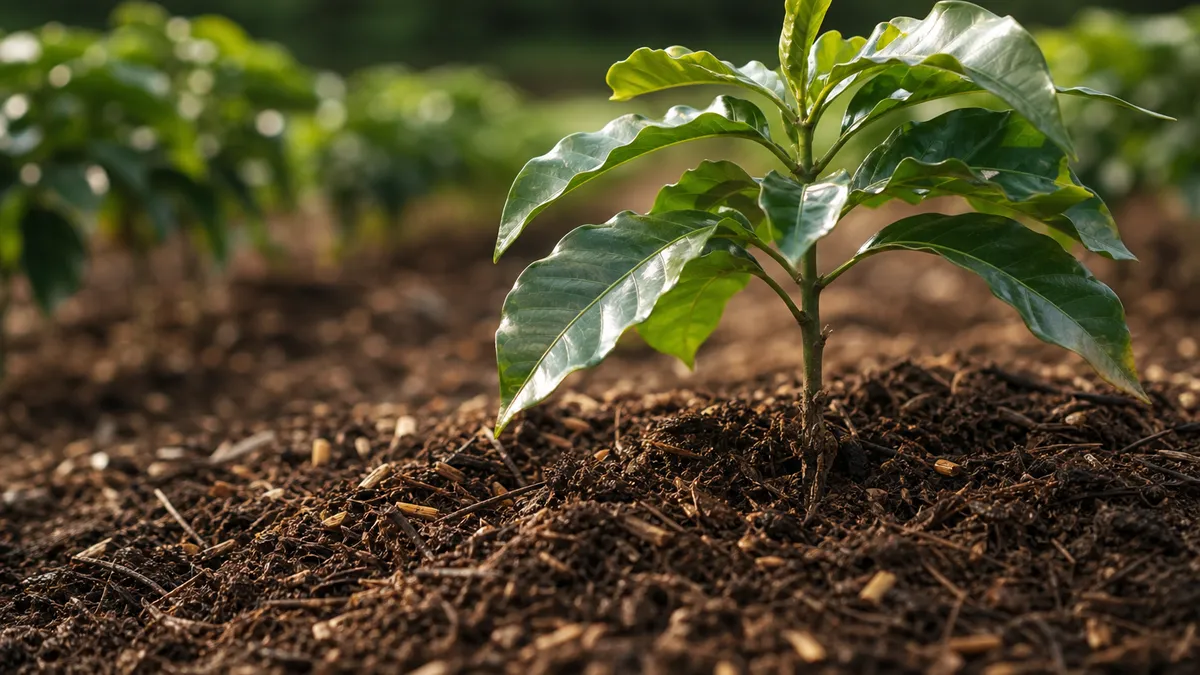
Coffee pulp, pruning residues and other organic materials can be composted. Composting is controlled biological decomposition, predominantly with oxygen, rather than simply leaving fresh waste in a heap.
The CIAT practical guide describes managing moisture and aeration, including turning conventional compost heaps. It also warns that poor-quality compost can damage crop growth. Mature compost and undecomposed processing residues are not interchangeable.
Compost should therefore be treated as a managed soil amendment, not proof that a farm’s nutrient requirements have disappeared. Its composition and the crop’s needs still matter.
Trees are one part of the system
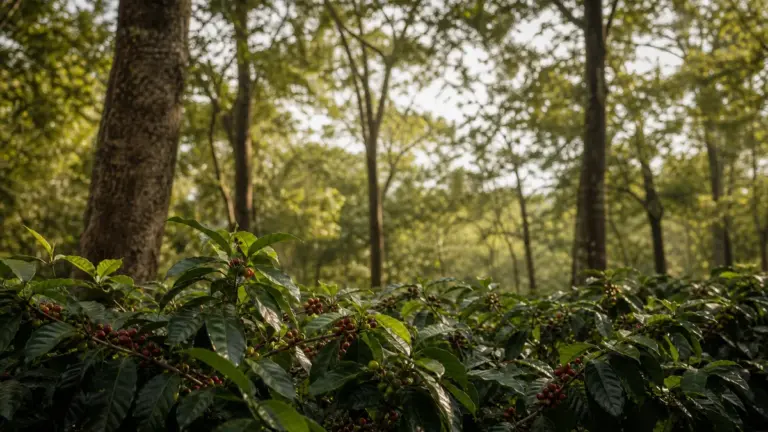
Agroforestry means growing coffee with trees. It can contribute shade, leaf litter and a more diverse farm structure, but tree selection and management must account for competition and local conditions.
A shaded farm is not automatically regenerative, just as a regenerative claim does not describe the amount or quality of shade. See shade-grown coffee for that separate question.
What the evidence shows so far
The strongest reading of the evidence is that particular practices can improve particular functions under particular conditions. “Regenerative coffee works” is too broad to be a useful scientific conclusion.
Research also needs to distinguish a management package from its individual components. If an experiment combines ground cover, manure, hedges and retained residues, improved results cannot automatically be attributed to ground cover alone.
Positive findings from coffee experiments
A Brazilian field study published in 2026 examined long-term soil management at the Federal University of Lavras. Coffee husk application combined with signal grass between rows produced the most consistently positive responses across the soil-health indicators and agronomic performance assessed.
The study also reported higher coffee yield and beverage quality than bare-soil management. Its drought assessment, however, involved laboratory incubation of soils. That is useful evidence about soil responses, not proof that the treatment prevents crop losses during every field drought.
Soil carbon needs careful measurement
Carbon storage is where attractive claims particularly need restraint. Soil organic carbon is the carbon contained in soil organic matter; measuring an increase requires more than observing abundant leaf litter.
A 2013 study of long-term coffee experiments in Costa Rica and Nicaragua found increases in surface-layer soil carbon alongside losses deeper in the profile. It found no significant difference in soil carbon stocks between shaded and unshaded systems at the depths assessed.
The lesson is methodological: sampling depth, starting conditions and changes through time matter. A surface improvement cannot automatically be presented as an increase across the whole soil profile, and adding trees does not guarantee additional soil carbon.
Examples from documented coffee projects
COMSA, Honduras: a farmer training and implementation example
The International Coffee Organization’s Coffee Development Report 2022-23 describes regenerative work by COMSA, a producer organisation in Honduras. Its case study includes shade and fruit trees, cover crops, composting coffee-processing residues and practical farmer training at Finca Fortaleza.
This illustrates how practices can be combined and shared between growers. It is an implementation case study, not a controlled experiment establishing the effect of each intervention. Its reported benefits should be read with that distinction in mind.
Mulungu, Democratic Republic of Congo: a replicated field trial
A 2026 paper reports a 34-month experiment on degraded coffee land at INERA’s Mulungu Research Station. Researchers tested packages combining cover crops or intercrops with manure, retained residues and hedges.
Some packages significantly increased coffee yield, while all reduced coffee-tree mortality. Yet most measured soil chemical properties showed little change during the study, and elephant grass hedges reduced coffee productivity near plot edges.
That combination of benefits and limitations is informative. Recovery can be uneven, and a useful practice in one position can create competition in another.
Certifications and regenerative coffee claims
Regenerative and organic are not synonyms. Some regenerative frameworks require organic certification as a starting point; the broad term itself does not establish that requirement.
Regenerative Organic Certified, administered by the Regenerative Organic Alliance, uses USDA Organic or an accepted international equivalent as its baseline. It adds requirements covering soil health and land management, animal welfare, and farmer and worker fairness. For the separate meaning of organic production, see organic farming.
The Rainforest Alliance also has a distinct Regenerative Agriculture Standard. It was published in September 2025, and its farm requirements took effect on 1 March 2026. Its existence does not make every Rainforest Alliance claim a claim against that particular standard.
Certification makes a claim more specific by identifying requirements and an assurance process. It should not be interpreted as a guarantee that every environmental indicator has already improved.
For UK-facing marketing, the Competition and Markets Authority’s Green Claims Code calls for truthful, clear and substantiated environmental claims. Broad wording needs evidence matching its breadth, not merely a photograph of healthy-looking plants.
How to assess a regenerative agriculture claim
For a coffee bag or workplace supplier, use this short check:
- Identify the scope. Which farms, producer group and coffee does the claim cover?
- Ask what changed. Request the actual practices, not just the programme name.
- Separate action from result. “Farmers trained” and “soil carbon increased” require different evidence.
- Look for a baseline. Ask what was measured before changes began and how later measurements were compared.
- Check verification. Identify the certification scheme, audit coverage or published research supporting the claim.
These questions are an editorial assessment method, not an additional certification standard. They help distinguish an ambition, an implemented practice and a demonstrated outcome.
Also ask how farmers receive agronomic advice and support during the transition. The Global Coffee Platform recognises that changing practices can create short-term production uncertainty and require additional resources.
The most useful regenerative agriculture claim is a bounded one: what improved, where, over what period, and according to which measurement?
FAQ
Does regenerative coffee taste better?
Not necessarily. The Brazilian study discussed above reported improved beverage quality under one management treatment, but that does not establish a flavour advantage for all coffee sold as regenerative. Treat the farming claim and the cup-quality claim separately: evidence supporting one does not automatically support the other.
Does regenerative farming eliminate coffee pests and diseases?
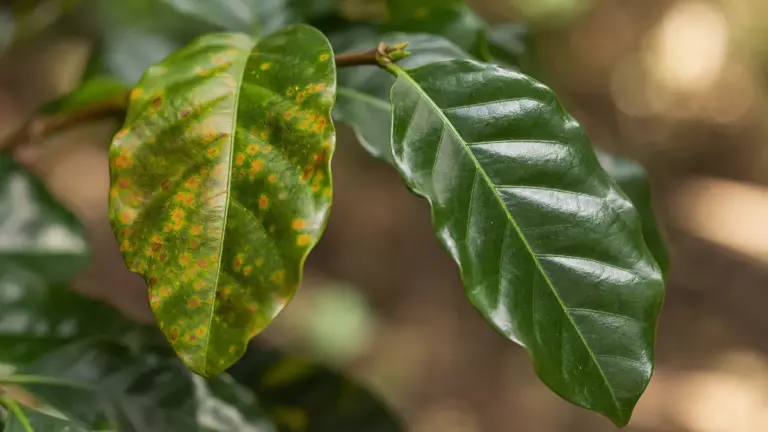
No, a regenerative label is not evidence that a crop is protected from every pest or disease. Soil restoration and plant diversity do not establish immunity. Farmers still need to identify problems and choose appropriate responses, and buyers should be cautious about claims that present an entire farming approach as a universal cure.
Can an uncertified farm use regenerative practices?
Yes. A farmer can use ground cover, compost or erosion-control measures without joining a regenerative certification scheme. Certification and farming activity are different things. Without certification, however, buyers need other evidence to assess a claim, such as documented management changes, monitoring results and a clear explanation of which coffee and farms are covered.
Where to go next
Read Coffee Farming for the wider production system, then Sustainable Farming Practices to compare regenerative agriculture with other approaches. Shade-Grown Coffee explains tree cover in greater depth, while Organic Farming clarifies why organic certification and regenerative claims should not be treated as interchangeable.
Sources
-
Newton and colleagues, Frontiers in Sustainable Food Systems. What Is Regenerative Agriculture? A Review of Scholar and Practitioner Definitions Based on Processes and Outcomes, 2020.
https://www.frontiersin.org/journals/sustainable-food-systems/articles/10.3389/fsufs.2020.577723/full -
Global Coffee Platform. GCP RegenCoffee Guidance, undated web overview, checked November 2026.
https://www.globalcoffeeplatform.org/our-work/tools/regencoffee/ -
Cenicafé. Cartilla 6: Conservación de los suelos de la zona cafetera, 2004.
https://publicaciones.cenicafe.org/index.php/libros_manuales/article/view/3184 -
USDA Natural Resources Conservation Service. Principles for High Functioning Soils, 2021 factsheet.
https://www.nrcs.usda.gov/sites/default/files/2022-12/NRCS-Principles-for-High-Functioning-Soils-Factsheet-2021-English.pdf -
Pulleman, Rahn and Valle, International Center for Tropical Agriculture. Regenerative agriculture for low-carbon and resilient coffee farms: A practical guidebook, version 1.0, July 2023. Developed with financial support from Nestlé.
https://www.nestle.com/sites/default/files/2024-07/regenerative-coffee-farms-guidebook-2023.pdf -
Vilela and colleagues, Plant and Soil. Long-term soil health and microbiome responses to sustainable management under drought stress in tropical coffee agroecosystems, 2026.
https://link.springer.com/article/10.1007/s11104-026-08639-9 -
Agriculture, Ecosystems & Environment. Sink or source: The potential of coffee agroforestry systems to sequester atmospheric CO₂ into soil organic carbon, 2013. Publisher abstract retrieved.
https://www.sciencedirect.com/science/article/pii/S0167880913001229 -
International Coffee Organization. Coffee Development Report 2022-23: Beyond Coffee, Towards a Circular Coffee Economy, fourth edition, Box B.3.
https://www.icocoffee.org/documents/cy2024-25/coffee-development-report-2022-23.pdf -
Ntamwira and colleagues, Frontiers in Agronomy. Integrated management packages accelerate agroecological recovery and improve the economic viability of degraded coffee systems, 2026.
https://www.frontiersin.org/journals/agronomy/articles/10.3389/fagro.2026.1824812/full -
Regenerative Organic Alliance. Framework for Regenerative Organic Certified, version 4.1, effective 27 June 2023.
https://regenorganic.org/wp-content/uploads/2023/03/Regenerative-Organic-Certified-Framework.pdf -
Rainforest Alliance. How the Rainforest Alliance Developed the Regenerative Agriculture Standard, 2026; Regenerative Agriculture Standard: Farm Requirements, version 1.0, effective March 2026.
https://knowledge.rainforest-alliance.org/docs/how-the-rainforest-alliance-developed-the-regenerative-agriculture-standard
https://knowledge.rainforest-alliance.org/docs/rainforest-alliance-regenerative-agriculture-standard-farm-requirements-v10 -
Competition and Markets Authority. Making environmental claims on goods and services, 2021, current online guidance checked November 2026.
https://www.gov.uk/government/publications/green-claims-code-making-environmental-claims/environmental-claims-on-goods-and-services
Research combined peer-reviewed coffee experiments and definition reviews with agronomic guidance, certification documents and an ICO project account, distinguishing measured findings from programme descriptions.
Last checked: November 2026