The economics of coffee farming depend on how much saleable coffee a farm produces, what the farmer receives for it, and the resources needed to grow and harvest it. Many farmers struggle because uncertain earnings must support both the next crop and the household, while unpaid family labour can hide how little the business really returns.
In short
- Sales revenue is not profit: production expenses, equipment replacement and family labour all matter.
- Farmgate prices describe payment to the producer, not the export value or the amount paid for roasted coffee.
- Higher yields help only when the additional coffee earns more than the additional work and inputs require.
- A living income concerns the whole household and all its income sources, not coffee sales alone.
- Buyers should look for documented producer payments, dependable purchasing commitments and evidence of household outcomes.
How the economics of coffee farming work
A coffee farm is both a business and, often, part of a household’s livelihood. Its accounts need to answer different questions: did coffee sales cover the season’s bills, did they reward the work involved, and did the household earn enough to live decently?
These answers can differ. A family may finish a harvest with cash left over but have little provision for replacing ageing trees or equipment. Alternatively, coffee may provide a reasonable return for the days worked while a very small holding produces too little total income to support the family.
Keep three measures separate:
- Revenue: the proceeds from selling coffee, before expenses.
- Farm profit: what remains after the specified production expenses, with the treatment of family labour clearly stated.
- Household income: net earnings from coffee, other crops, employment and other sources.
This article concentrates on those financial relationships. For the agricultural context, start with our coffee farming guide.
What belongs in the cost of production?
Production involves more than fertiliser and harvest wages. The International Coffee Organization distinguishes cash spending from full economic costs, which also recognise unpaid family labour and the gradual use of long-lived assets.
| Account category | What to include | What overlooking it hides |
|---|---|---|
| Paid labour | Cultivation, harvesting and processing work | The resources needed to bring in the crop |
| Inputs | Plant nutrition and crop protection | Recurring seasonal requirements |
| Family labour | Unpaid work by household members | Whether farming adequately rewards their time |
| Long-lived assets | Establishment of trees and depreciation of equipment | Future replacement needs |
| Finance | Interest on borrowing | The burden of financing production |
Depreciation means allocating an asset’s use across its working life rather than treating equipment as if it lasts forever. Establishing a plantation likewise needs to be distinguished from maintaining an existing crop.
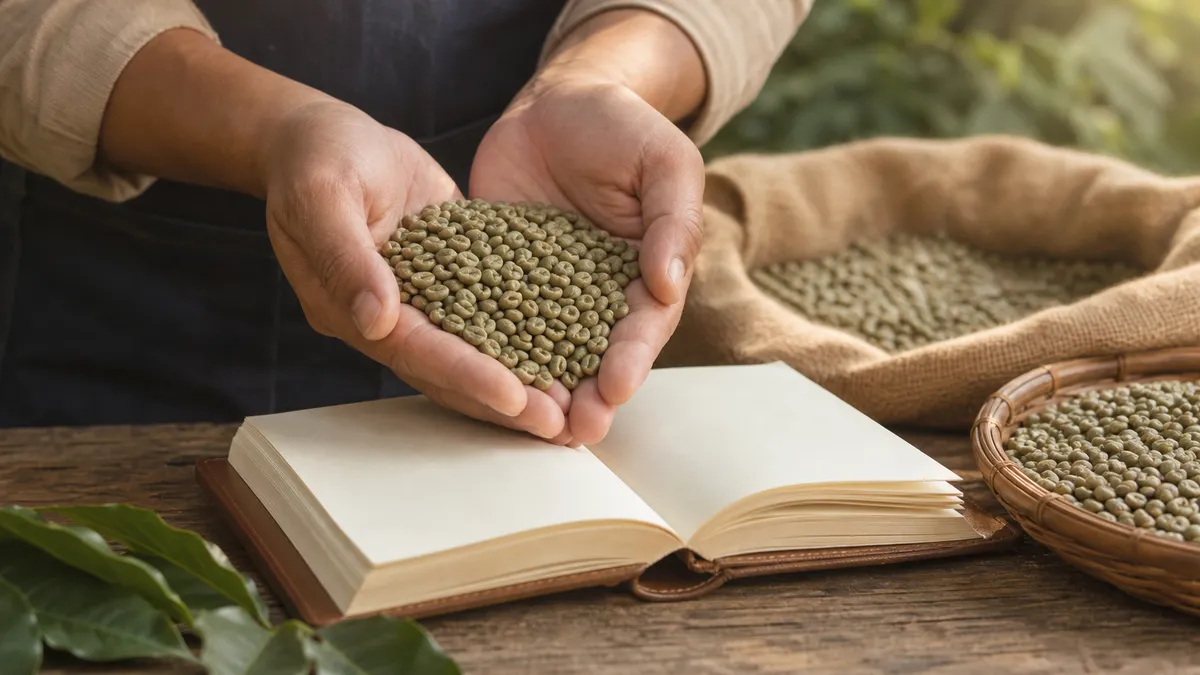
Family labour is particularly easy to overlook because no wage payment necessarily appears in the notebook. Recording the days worked makes it possible to examine the return to that labour, rather than assuming that everything left after cash expenses is profit.
Labour is a major component of coffee production. The ICO’s 2019 assessment identified it as the largest expense in many production systems, although the balance varies between origins and farming methods. There is no single worldwide production figure that fairly represents every farm.
What farmgate prices actually tell you
The farmgate price is the payment received by the producer for coffee at the point of sale. Despite the name, that transaction might happen at a collection point, washing station or co-operative rather than beside the farm gate.
The product being sold matters. Farmers may deliver whole coffee cherries, parchment coffee, meaning processed beans still inside their papery protective layer, or fully milled green coffee. These products embody different amounts of processing work and do not have equivalent weights.
A meaningful comparison therefore needs the product form, weight, quality, transaction date and any deductions. Comparing payment for a kilogram of fresh cherries with payment for a kilogram of export-ready green beans tells you very little without that context.
Free on board, usually shortened to FOB, describes a later export stage. It incorporates activities such as processing, domestic transport and export preparation. A published FOB payment is not evidence that the individual farmer received that same payment.
Transparency is useful only when it explains the transaction. Ask who was paid, what they delivered, which services were included and what ultimately reached the producer.
Why price volatility is so difficult to manage
Price volatility means that market values fluctuate, sometimes sharply. The ICO identifies changing supply conditions, particularly weather-related shocks, as important drivers of coffee market instability.
A shortage can strengthen the market, but it does not necessarily improve every farmer’s position. A grower whose harvest has failed has less coffee to sell. Rising labour and input requirements can also absorb part of the benefit of stronger selling conditions.
Nor can farms adjust instantly to market signals. Coffee planting decisions commit growers to trees and varieties whose performance unfolds over a long period. Increasing production is not simply a matter of turning up a machine.
The result is a mismatch between decisions and outcomes. Work and inputs are committed before the final harvest and sale are known. During prolonged weak markets, farmers may reduce seasonal inputs or postpone investment, which the ICO associates with greater vulnerability to pests, disease and climate pressures.
Yields matter, but kilograms are not the whole answer
Yield measures output relative to land area, commonly expressed as kilograms of green coffee per hectare. Comparisons must state the product basis: cherry weight and green-bean weight are not interchangeable.
Higher saleable output can spread some fixed requirements across more coffee. But the relevant question is not simply “Can this farm produce more?” It is “What additional work, inputs and risk are needed, and what remains afterwards?”
World Coffee Research’s varieties catalogue helps explain why this is farm-specific. Varieties differ in expected yield, nutritional requirements, disease resistance and suitability for local conditions. A variety described as productive is not automatically the best economic choice everywhere.
Crop losses complicate the calculation further. A farm may already have committed labour and inputs before damage reduces the harvest. Our guide to coffee leaf rust and coffee berry borer explains those threats without treating disease management as a purely financial problem.
Land area also matters. Improving output from a very small holding may improve earnings without generating enough total household income. Productivity and a living income are related, but they are not the same measure.
Seasonal cash flow, borrowing and debt
Cash flow concerns when payments arrive and when obligations must be met. It is different from profitability: a potentially viable harvest does not pay a bill that falls due before the coffee is sold.
Borrowing can help finance production and investment. The difficulty is that repayment obligations remain even when weather, disease or falling market values undermine the expected return.
GIZ’s living-income toolkit identifies this as a particular risk for farmers investing in their farms. It also describes circumstances in which immediate cash needs encourage growers to sell their future harvest early on unfavourable terms.
For a useful assessment, keep a seasonal payment calendar alongside the production account. Record when inputs and labour must be paid, when coffee payments are expected, and when borrowing must be repaid. Keep repayment of loan principal separate from interest and operating expenses, so the same underlying expenditure is not counted twice.
The practical question is not merely whether finance is available. It is whether its timing and conditions fit the crop and whether the household could withstand a disappointing harvest.
Premiums: useful, but not a complete solution
A premium is an additional payment above a defined reference or base. Its meaning depends on the agreement: it might reward quality, organic production or participation in a particular trading system.
Do not assume that every premium becomes extra household income. Ask who receives it, what requirements accompany it and how much coffee qualifies for the arrangement.
Fairtrade, for example, distinguishes its minimum-price protection from the Fairtrade Premium. Its coffee guidance explains that the Premium supports producer-selected business or community investment, while organically grown coffee attracts an additional payment. Those mechanisms should not be described as if they were all individual wage supplements.
Independent research reviewed by the Columbia Center on Sustainable Investment found mixed evidence on certification’s income effects. Benefits depend partly on market access, certification requirements and how returns are distributed.
Producer organisations can help farmers negotiate and reach markets. For how collective selling and shared services work, see smallholder farms and co-operatives. The useful test remains what members receive after the organisation has carried out its work.
The living income gap
A living income is the net annual household income needed for a decent standard of living in a particular place. The Living Income Community of Practice includes food, housing, healthcare, education, transport and provision for unexpected events.
The living income gap is the shortfall between that benchmark and actual net household income from all sources. It is not the difference between coffee revenue and production expenses.
A Wageningen University & Research working paper published in October 2024 analysed 340 Kenyan coffee-farming households using data for July 2020 to June 2021. It reported that only 9% earned a living income. This was observational household research, not an experiment, and the result describes that sample and period, not all Kenyan farmers or the whole coffee sector.
More recent modelling illustrates the importance of distinguishing evidence types. TechnoServe’s August 2026 account of a study with Sustainable Food Lab reported that, using a 2023 baseline, modelled typical household incomes fell below living-income benchmarks in all seven origins examined. These were modelled typical households, not a count of every household below the threshold.
Together, such work shows why “the farmer made a profit” is an incomplete answer. A positive farm return can coexist with a substantial household shortfall.
What buyers can do
Our suggested approach is to judge sourcing by evidence and purchasing practice, rather than reassuring language alone.
- Ask for traceability with context. Identify the producer or organisation, harvest and product form behind any payment claim.
- Distinguish farmgate from export reporting. Ask suppliers what is known about payments to individual growers and what remains an estimate.
- Examine the commitment. Ask whether purchasing relationships provide dependable volumes and timely payment, rather than an isolated exceptional lot.
- Ask what premiums achieve. Look for information on qualifying volumes, recipients, additional requirements and producer decisions.
- Request livelihood evidence. Ask whether suppliers assess net household income, family labour and workers’ conditions, not just yields or training attendance.
For UK workplace buyers, put these questions into an itemised written quotation and sourcing questionnaire. Request the evidence separately from promotional claims.
The economics of coffee farming are not solved by one label or one productive harvest. The more useful buying question is whether the relationship helps producers earn adequately, plan ahead and withstand a difficult season.
FAQ
Does buying more expensive coffee guarantee that farmers benefit?
No, the retail transaction alone does not show what reached the farmer. Coffee passes through processing, transport, importing, roasting and distribution, each involving work and commercial arrangements. Look instead for a clearly identified producer, an explained payment basis and evidence connecting the purchase to producer returns.
Can a coffee household earn a living income partly outside farming?
Yes, a living-income assessment includes income from sources beyond coffee. Other crops, employment, businesses and remittances can contribute. That does not remove the need to examine whether coffee itself adequately rewards the labour and resources devoted to it. The household assessment and the coffee-enterprise assessment answer different questions.
Does a living income for the farm owner mean workers receive a living wage?
No, these are separate measures. Living income concerns the net income of a self-employed household, while a living wage concerns remuneration for employed workers. A sourcing assessment should therefore examine hired workers’ pay and conditions separately rather than treating an adequately supported farm household as proof of adequate treatment for everyone working there.
Where to go next
Read Coffee Farming for the wider production system, then Coffee Leaf Rust and Coffee Berry Borer to understand how crop damage affects a season’s prospects. Smallholder Farms and Co-operatives explains how farm scale, collective selling and shared services shape producers’ options.
Sources
-
International Coffee Organization, Coffee Development Report 2019: Growing for Prosperity, Overview, 2019.
https://ico.org/documents/cy2018-19/ed-2318e-overview-flagship-report.pdf -
International Coffee Organization, Profitability of Coffee Farming in Selected Latin American Countries, Council presentation, 28 March 2019, indexed extract on cash outlays and full economic costs.
https://dev.ico.org/documents/cy2018-19/Presentations/council-item-8-icc-124-6-profitability.pdf -
Cafe Imports, Transparency, undated, terminology and supply-chain explanation. Used for transaction definitions, not its hypothetical monetary examples.
https://www.cafeimports.com/europe/blog/transparency/ -
International Coffee Organization and UNIDO, Sustainability & Resilience of the Coffee Global Value Chain: Towards a Coffee Investment Vehicle, Global Coffee Funding Mechanisms, June 2024.
https://www.icocoffee.org/documents/cy2023-24/report-global-coffee-funding-mechanisms-june-2024-e.pdf -
World Coffee Research, Coffee Varieties Catalog, live resource, undated.
https://worldcoffeeresearch.org/resources/coffee-varieties-catalog -
GIZ, Guiding Steps Towards Living Income in the Supply Chain: How to Mainstream Living Income in Your Company’s Activities, June 2020.
https://www.icocoffee.org/wp-content/uploads/2022/11/LivingIncomePrivateSectorToolkit.pdf -
Living Income Community of Practice, The Concept, undated.
https://www.living-income.com/the-concept -
Wageningen University & Research, Waarts, Suter and van Asten, Return on Household Labour: A Means to Accelerate the Path to a Living Income for Smallholder Coffee Farming Households, working paper, October 2024.
https://edepot.wur.nl/675187 -
Fairtrade, Coffee, UK product guidance, undated, live page.
https://www.fairtrade.net/uk-en/products-and-producers/fairtrade-products/coffee.html -
Columbia Center on Sustainable Investment, Responsible Coffee Sourcing: Towards a Living Income for Producers, July 2021.
https://ccsi.columbia.edu/sites/default/files/content/pics/CCSI%20Responsible%20Coffee%20Sourcing%20Report.pdf -
TechnoServe, Regenerative Coffee Production and the Living Income Gap: 3 Takeaways, 25 August 2026.
https://www.technoserve.org/blog/living-income-gap-coffee/
This article was researched using institutional reports, published research, programme guidance and primary supply-chain explanations, distinguishing observed household findings from modelled scenarios.
Last checked: November 2026