Shade-grown coffee is coffee cultivated beneath trees rather than in an open, full-sun plantation. A diverse shade canopy can provide valuable wildlife habitat, but “shade-grown” alone tells you little about its quality: the ecological evidence is stronger than any promise of better flavour.
In short
- Shade systems range from a few planted tree species to coffee beneath a retained native forest canopy.
- Research generally finds greater bird species diversity in more shaded coffee, but results vary between regions and groups of wildlife.
- Dense shade can reduce coffee yield. The response depends on the cultivar, growing conditions and management.
- Slower cherry ripening can improve quality in some settings, but shade does not guarantee a sweeter or more complex cup.
- Smithsonian Bird Friendly certification requires organic certification and qualifying habitat conditions, not simply the presence of trees.
What counts as shade-grown coffee?
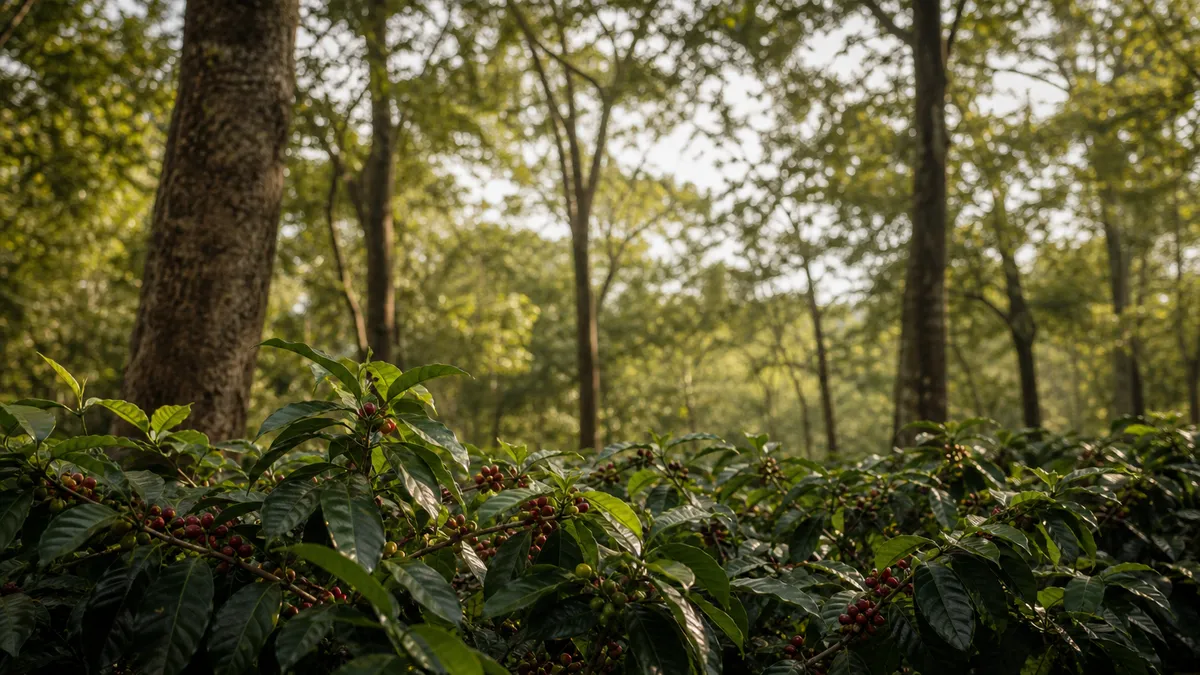
Shade-grown coffee is an example of agroforestry, growing a crop alongside trees. Those trees might be remnants of native forest, deliberately planted shade trees, or a mixture of fruit, timber and other useful species.
The distinction matters. A plantation shaded by one regularly pruned tree species is structurally different from coffee growing beneath a tall, varied canopy with several vegetation layers. Both can be described as shaded, but they do not provide equivalent habitat.
The wider choices involved in establishing and managing a plantation are covered in coffee farming. Here, the useful question is not simply whether trees are present, but what kind of tree cover the farm maintains.
The five shade systems
A widely used classification developed from Mexican coffee systems distinguishes five categories. These describe farming systems, not universal certification grades or fixed canopy percentages.
| System | What grows above the coffee? | Main distinction |
|---|---|---|
| Unshaded or full-sun monoculture | No overhead shade-tree canopy | Coffee grows in an open plantation |
| Shaded monoculture | Usually one or a few deliberately managed shade species | Simple tree cover, often regularly pruned |
| Commercial polyculture | A planted mixture of shade and commercially useful trees | More diverse than shaded monoculture, managed around production |
| Traditional polyculture | Retained forest trees mixed with useful planted species | Several vegetation layers and multiple crops or products |
| Rustic | Much of the original native forest canopy is retained above coffee | The most forest-like end of the classification |
Polyculture means growing several kinds of plants together. Rustic coffee is still managed agricultural land, not untouched forest.
Real farms do not always fit neatly into these categories. Treat the table as a way to ask better questions, rather than a ladder on which every farm has an obvious position.
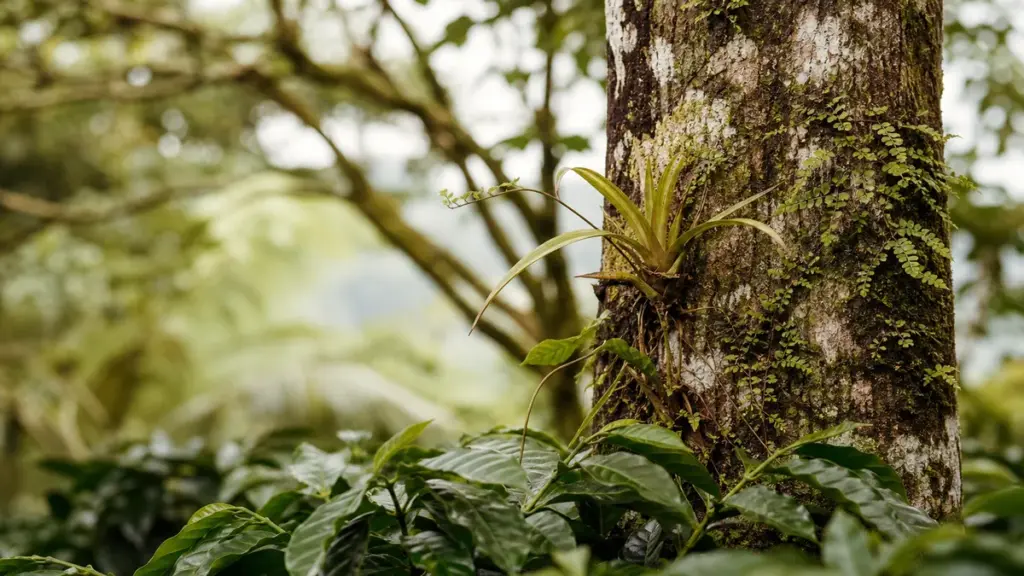
The biodiversity and bird habitat case
The strongest case for shade-grown coffee concerns habitat. Trees, foliage at different heights, fruit and associated insects provide resources that a treeless plantation cannot offer in the same way.
A 2024 meta-analysis combining 69 studies found higher species diversity in high-shade coffee than in sun or low-shade systems. Bird species diversity increased with shade across the comparisons examined. However, the regional results differed: some African comparisons found greater overall animal abundance in less shaded systems.
That distinction is useful. Species diversity concerns the variety of species present; abundance concerns how many individuals are present. More animals does not necessarily mean a more varied community.
Helpful habitat is not a replacement for forest
A shaded farm can support wildlife while still lacking species that depend on less disturbed forest. Field research in southern Mexico found that shade coffee supported many birds, but its bird community differed from that of natural forest, particularly for disturbance-sensitive species.
Keeping existing native forest and improving habitat on farmland are therefore complementary aims. Clearing forest to establish “shade-grown” coffee is not an ecological improvement simply because some trees remain.
Birds can also help the crop. In a Jamaican field experiment, coffee plants enclosed to exclude birds suffered more coffee berry borer infestation and damage than accessible control plants. That is experimental evidence of pest control in that setting, not proof that every shaded farm will experience the same result.
For the wider relationship between habitat, soils and farm management, see sustainable farming practices.
What shade changes for the coffee plant
A canopy changes the coffee plant’s immediate growing environment, or microclimate. Research on coffee agroforestry indicates that shade management can moderate temperature and precipitation extremes, potentially helping farms adapt to more variable conditions.
This is not a simple “more shade is better” relationship. Trees intercept light that would otherwise reach coffee leaves. Their effects also depend on their species, arrangement and management, alongside the climate in which the coffee grows.
Think of shade as something a farmer manages, not an environmental accessory added once and forgotten. Pruning and tree selection must accommodate both the crop and the habitat.
The underlying plant processes are explained in coffee plant biology. Shade is one influence on those processes, not a substitute for suitable growing conditions.
The yield trade-off
A 2022 meta-analysis found different yield responses among arabica cultivars: some were relatively neutral, some performed best at intermediate shade, and others declined as shade increased. Across the dataset, yields tended to be highest in full sun or low to moderate shade, with denser shade generally reducing production.
The authors cautiously concluded that roughly 10% to 40% shade often had little negative effect on yield, with benefits in some cases. That is a research finding across particular studies, not a recommended setting for every farm.
A second global meta-analysis likewise found that yield differences were strongly influenced by site conditions and management. A single universal “shade penalty” would conceal that variation.
Nor is coffee yield the only output. Mixed systems can provide fruit, timber and other useful products. Assessing them solely by the coffee harvest misses part of their purpose, although those additional outputs do not automatically compensate for a smaller coffee crop.
Does shade-grown coffee taste better?
Sometimes, but the label cannot tell you whether it does. There is a plausible biological mechanism and supporting experimental evidence, alongside studies showing no improvement or an adverse effect.
Shade can delay cherry development and ripening. In a controlled Costa Rican study published in 2006, shade delayed ripening by up to a month and improved bean characteristics and beverage quality under the conditions tested.
That supports a careful claim: changing the light environment can change fruit development and the resulting cup. It does not support a universal claim that shaded beans contain more sweetness or always produce more complex flavours.
Why studies reach different answers
Research on farms in southern Colombia illustrates the limitation. At the higher-altitude study location, shade was associated with lower scores for several sensory attributes, including sweetness and preference. At the lower-altitude location, it had no significant effect on the sensory attributes assessed.
These were farm comparisons rather than an identical repeat of the Costa Rican experiment. Different sites, cultivars and growing conditions help explain why findings cannot simply be transferred from one setting to another.
For a buyer, the practical distinction is between habitat evidence and cup evidence. A certification can tell you that specified farming conditions were met. It cannot tell you that you will prefer the flavour to another coffee.
Ask separately what supports the habitat claim and what supports the tasting description. Neither answer should be borrowed from the other.
What Bird Friendly certification actually requires
Ordinary “shade-grown” wording is not equivalent to Smithsonian Bird Friendly certification. Bird Friendly adds third-party verification of habitat requirements, and the farm must already hold organic certification.
For planted, managed shade, the Smithsonian’s published norms specify:
- At least 40% canopy cover, including after pruning.
- A main canopy at least 12 m high.
- A native backbone species, meaning the predominant shade species, representing no more than 60% of shade trees.
- The remaining trees distributed among at least 10 additional species, each accounting for at least 1% of the shade trees.
- Distinct vegetation layers, including an upper layer of native trees at least 15 m high.
The detailed diversity rule is therefore stronger than the shorthand “10 woody species in total”. These are headline requirements, not the complete inspection checklist.
The programme also requires separation and traceability of certified coffee through handling and sale. Its standards address production and habitat, not a guaranteed tasting score.
For a UK buyer seeking independently checked shade conditions, the Smithsonian seal provides more specific evidence than an unsupported canopy photograph or the word “natural”.
How to assess a shade-grown coffee claim
Use this short sequence when reading a bag, roaster’s description or workplace supplier’s information:
- Identify the claim. Is it simply “shade-grown”, or does it name a certification?
- Ask about the canopy. Request information on tree diversity, native species and vegetation layers, rather than accepting “grown under trees” as a complete description.
- Look for traceability. Ask which farm or producer group supplied the coffee and whether the evidence applies to the product being sold.
- Separate ecology from flavour. Treat habitat documentation and tasting information as different forms of evidence.
- Prefer specific explanations. A clear account of what is maintained and checked is more useful than a broad claim of environmental superiority.
These are suggested purchasing questions, not an alternative certification system. A detailed answer helps you understand the claim; an independent inspection provides a different level of assurance.
Shade can also sit within wider approaches discussed under regenerative agriculture, but the terms are not interchangeable. For shade-grown coffee, judge the actual canopy and the evidence behind it, then judge the cup on its own merits.
FAQ
Is organic coffee always shade-grown?
No. Organic certification is not, by itself, evidence that a coffee meets Bird Friendly habitat criteria. Smithsonian Bird Friendly requires organic certification as a prerequisite and then adds its own shade and habitat requirements. Read organic farming for the separate production questions behind that label, and check canopy claims independently.
Can a blend be Bird Friendly certified?
Yes, provided the coffee sold under the seal meets the programme’s certified-product requirements. The Smithsonian requires certified beans to be handled separately and maintains product-purity and traceability rules. A blend is not disqualified simply because it combines coffees, but including some certified coffee does not make an otherwise uncertified blend Bird Friendly.
Can an uncertified farm still provide good wildlife habitat?
Yes. Certification is evidence of verified compliance, not the only route by which a farm can support wildlife. The Smithsonian notes that much shade-coffee research concerns farms with varying shade conditions rather than certified farms specifically. Without certification, buyers need other credible documentation and should not assume equivalent standards have been independently checked.
Where to go next
Read Coffee Farming for the wider production system, then Coffee Plant Biology and Life Cycle to understand the plant responses behind shade management. Sustainable Farming Practices puts habitat alongside other farm decisions, while Organic Farming explains the separate production standard required before Bird Friendly certification.
Sources
-
Moguel and Toledo, Conservation Biology: Biodiversity Conservation in Traditional Coffee Systems of Mexico (1999). Retrieved paper.
-
Manson and colleagues, Science of the Total Environment: Effect of shade on biodiversity within coffee farms: A meta-analysis (2024). Oxford Brookes University repository copy.
-
Tejeda-Cruz and Sutherland, Animal Conservation: Bird responses to shade coffee production (2004). Publisher record.
-
Kellermann and colleagues, Conservation Biology: Ecological and economic services provided by birds on Jamaican Blue Mountain coffee farms (2008). PubMed record and abstract.
-
Lin, Perfecto and Vandermeer, BioScience: Synergies between Agricultural Intensification and Climate Change Could Create Surprising Vulnerabilities for Crops (2008). Publisher DOI record.
-
Koutouleas and colleagues, Agronomy for Sustainable Development: Shade effects on yield across different Coffea arabica cultivars: how much is too much? A meta-analysis (2022). Publisher article.
-
Mokondoko and colleagues, Agriculture, Ecosystems & Environment: Biophysical drivers of yield gaps and ecosystem services across different coffee-based agroforestry management types: A global meta-analysis (2022). Publisher record and abstract.
-
Vaast and colleagues, Journal of the Science of Food and Agriculture: Fruit thinning and shade improve bean characteristics and beverage quality of coffee (Coffea arabica L.) under optimal conditions (2006). Publisher article.
-
Bosselmann and colleagues, Agriculture, Ecosystems & Environment: The influence of shade trees on coffee quality in small holder coffee agroforestry systems in Southern Colombia (2009). Retrieved pre-publication paper; University of Copenhagen publication record.
-
Smithsonian Migratory Bird Center: Norms for Production, Processing and Marketing of “Bird Friendly” Coffee (undated published PDF, no revision identifier displayed). Published norms.
-
Smithsonian’s National Zoo and Conservation Biology Institute: Become Bird Friendly Certified and Ecological Benefits of Shade-grown Coffee (undated live pages). Certification information; Ecological evidence overview.
This article was researched using retrieved scientific papers, publisher abstracts and Smithsonian certification documents, distinguishing experimental findings from farm comparisons and research syntheses.
Last checked: November 2026