Green coffee grading assesses unroasted beans by characteristics such as size, defects, moisture and, in some systems, growing altitude and cup quality. There is no single worldwide grading system: AA, Supremo and SHB describe different things, so none should be read as a universal promise of better flavour.
In short
- Screen numbers describe sieve openings in sixty-fourths of an inch: screen 18 is approximately 7.1 mm.
- The older SCA washed-arabica protocol uses a 350 g green sample, with zero Category 1 full defects and no more than five Category 2 full defects for its specialty physical grade.
- A defect count is weighted: several imperfect beans may equal one full defect.
- About 10% to 12% moisture is a useful green-coffee target. Water activity below 0.60 is a conservative storage target, not a universal SCA grading requirement.
- Ask which standard and edition a grade follows, then read the physical results alongside a tasting assessment.
What green coffee grading tells you
Green coffee is the hulled, unroasted coffee seed. Grading gives buyers and sellers a shared description of a lot, meaning an identified batch of coffee, rather than leaving them to negotiate over words such as “large”, “clean” or “good”.
Physical assessment examines the beans; sensory assessment examines the roasted, brewed coffee. The International Trade Centre describes national classifications that combine different criteria, including screen size, defects, density, altitude and cup quality. That variety is why apparently impressive grades cannot simply be ranked against one another.
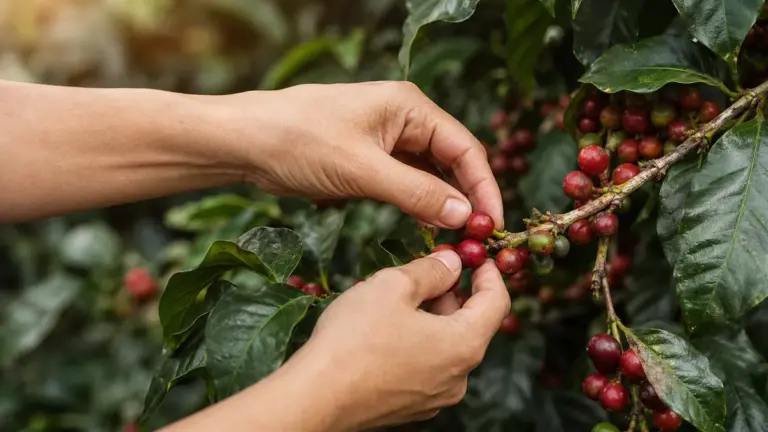
For the earlier stages, see our coffee harvesting guide. Here, the useful distinction is between what a grade measures and what you hope the coffee will taste like. A specification can establish the former without settling the latter.
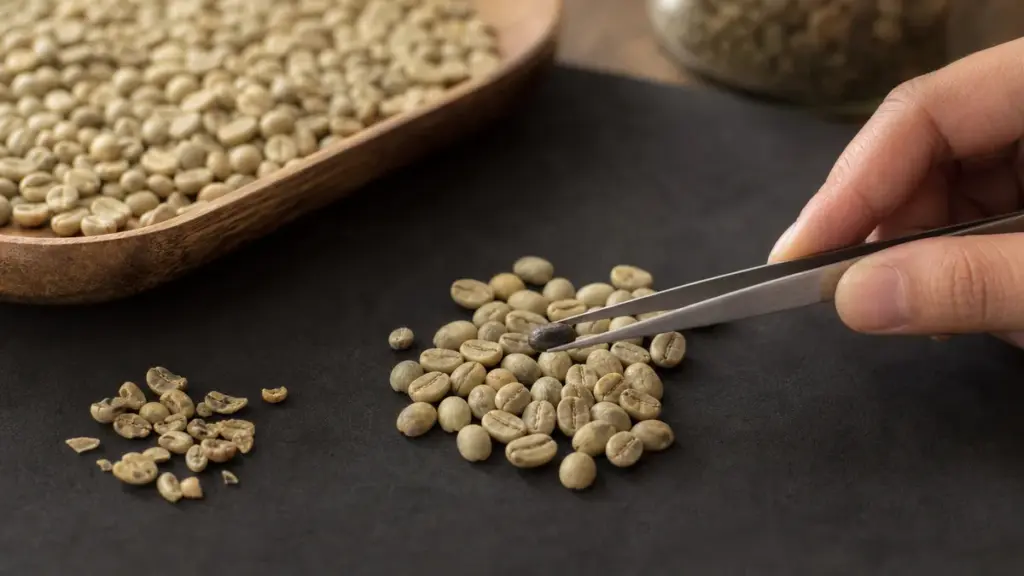
Green coffee screen sizes explained
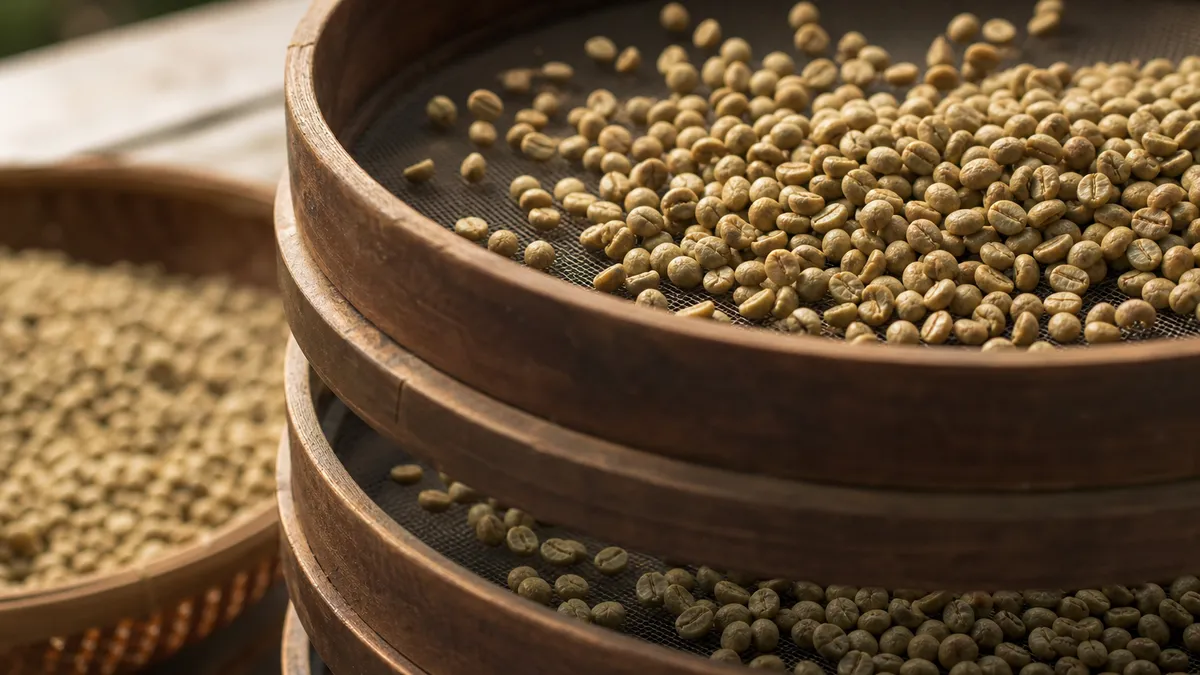
Coffee screens are sieves with carefully sized openings. In the traditional round-hole system, the number expresses the opening diameter in sixty-fourths of an inch, not the bean’s length.
For screen 18, the conversion is:
18 ÷ 64 × 25.4 = 7.14375 mm, normally rounded to 7.1 mm.
Larger screen numbers therefore mean larger openings. Beans retained on a screen have not passed through its holes under the test conditions. This is a size classification, not a measurement of every bean in every direction.
A useful screen report gives the proportion retained at each size, rather than describing the whole sample with one number. Read “screen 17 and above” together with its permitted undersize tolerance: without that tolerance, the description is incomplete.
Illustrative calculation: if 80 g of a 100 g test sample remains on a particular screen, that fraction represents 80% by mass. This example explains the arithmetic, not a prescribed sample size or passing threshold.
When comparing offers, ask for the screen distribution and the agreed test method. Do not assume that a larger opening means greater sweetness, or that two coffees carrying the same screen description will behave identically.
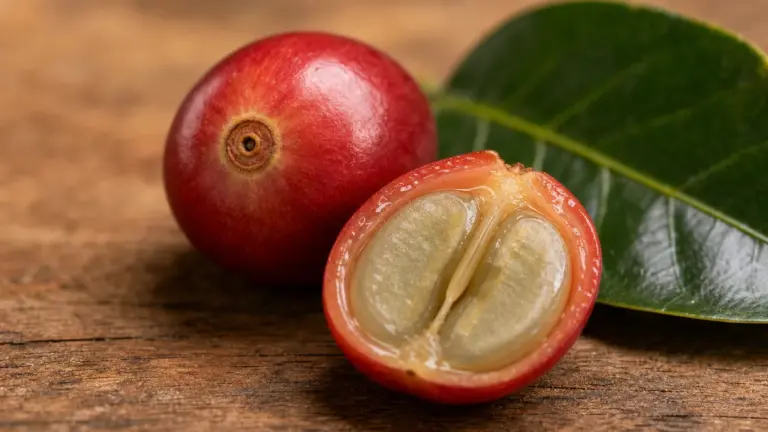
The shape and surrounding layers of the seed are explained in coffee cherry anatomy.
How SCA defect counting works
The older SCA Green Arabica Coffee Classification System assesses a 350 g green sample. Its specialty physical threshold is zero Category 1 full defects and no more than five Category 2 full defects. These are weighted defect equivalents, not simply five visibly imperfect beans.
Category 1 covers primary defects; Category 2 covers secondary defects. Examples from the SCAA handbook illustrate the weighting:
| Defect | Category | Items making one full defect |
|---|---|---|
| Full black bean | 1, primary | 1 |
| Full sour bean | 1, primary | 1 |
| Partial black bean | 2, secondary | 3 |
| Broken, chipped or cut bean | 2, secondary | 5 |
| Slight insect damage | 2, secondary | 10 |
For example, 10 broken beans ÷ 5 = two full secondary defects. Calling those beans “10 defects” would misrepresent this system.
Identification matters as much as counting. The protocol requires imperfections to match the handbook’s descriptions, not merely look unusual. If one bean has several defects, count the defect with the greatest impact on cup quality rather than counting the same bean repeatedly.
The June 2024 Coffee Value Assessment procedure also specifies rounding each defect type’s full-equivalent result down to a whole number before adding category totals. Keep the original bean counts as well as the converted figures, so someone else can audit the result.
These rules apply within a defined system. Do not transfer the sample weight, conversion factors or passing threshold to another national grading method without checking its requirements.
AA, Supremo and SHB are different kinds of grade
These familiar labels are useful, but they answer different questions.
| Label and context | What it describes | What it does not establish |
|---|---|---|
| AA, Kenya | A large-bean physical grade, associated with screen 18 | A guaranteed flavour profile or tasting score |
| Supremo, Colombia | A large-bean screen preparation, traditionally retained on screen 17 with a stated tolerance | A coffee variety or universal sensory ranking |
| SHB, Central American trade | “Strictly Hard Bean”, associated with growing-zone and altitude classifications | One worldwide altitude boundary or an SCA defect result |
AA: read it in its country context
Kenya’s Agriculture and Food Authority describes AA using an approximate screen opening of 7.2 mm. This rounded trade figure is close to, but not identical to, the mathematical conversion of screen 18.
Treat AA as a physical description. Ask for the separate cup assessment rather than interpreting the letters as a tasting verdict.
Supremo: size with a tolerance
Colombia’s National Coffee Growers Committee defined Supremo in its 2002 resolution as coffee retained on screen 17, allowing 5% below that screen provided it remained on screen 14. This is a useful documented example of why the tolerance belongs beside the grade name.
For an actual purchase, request the supplier’s current written specification rather than relying on the label alone.
SHB: check the origin’s definition
SHB means Strictly Hard Bean, but the classification is origin-specific. For example, ICAFE’s published Costa Rican procedure associates SHB categories with named growing areas and an altitude band of 1,200 to 1,700 m.
Do not apply that band to every country using SHB. Ask which national definition or contractual specification is intended.
Moisture and water activity measure different things
Moisture content measures how much water the coffee contains. On a wet basis, it expresses water as a percentage of the sample’s total mass. The older SCAA handbook specifies 10% to 12% moisture for washed coffee upon import, a useful practical target rather than a universal definition of quality.
Water activity, written aᵥ or more commonly a_w, describes how available that water is to participate in processes such as microbial growth. It is not a percentage moisture reading, and one measurement cannot simply replace the other.
A 2023 controlled storage and simulated-transport experiment by Anokye-Bempah and colleagues cites recommended storage ranges of 10% to 12% moisture and 0.40 to 0.60 water activity. Its experimental analysis treats 0.60 as a critical level. Below 0.60 is therefore a defensible conservative storage target, but not a universal SCA specialty-grade threshold.
The distinction matters because storage conditions can change the coffee after its original assessment. A result should identify when the sample was measured and which instrument and method were used.
For a useful report, request both readings, the measurement date and the acceptance limits. “Moisture fine” is not enough information to compare two lots.
The older SCA protocol, CVA and SCA-110
Three related references should not be confused.
The older green-grading protocol supplies the familiar specialty physical thresholds and defect-counting rules. Its handbook was written for washed arabica, so it should not be presented as a universally validated system for every species and processing method.
The Coffee Value Assessment, or CVA, separates physical, descriptive, affective and extrinsic assessments. In plain language, these examine the beans, describe the sensory experience, record perceived desirability and document information beyond the cup.
The June 2024 CVA physical procedure largely follows the older washed-arabica method, but does not require water activity or roasted quaker counting. It requires moisture meters calibrated against ISO 6673 and keeps physical results separate from tasters until sensory assessment is complete.
SCA-110, Green Coffee: Grading, Specifications, and Test Methods (for the Purpose of Trading) remains listed by the SCA as in development, checked in November 2026. It should not be described as an already published replacement standard.
How to read a green-coffee grading sheet
Use this short sequence when reviewing a supplier’s report:
- Identify the coffee. Match the lot code and sample date to the coffee being offered.
- Identify the rules. Ask for the grading system, edition, sample mass and agreed acceptance limits.
- Read the raw counts. Look for individual defect types, their conversion factors and separate category totals.
- Check size and condition. Request screen distribution, undersize tolerance, moisture and any water-activity result.
- Read the tasting assessment separately. Ask what was tasted, how it was prepared and whether the sample represents the offered lot.
This is a document-checking sequence, not a substitute for trained grading. If a report gives only a grade name, request the underlying results before treating it as a complete specification.
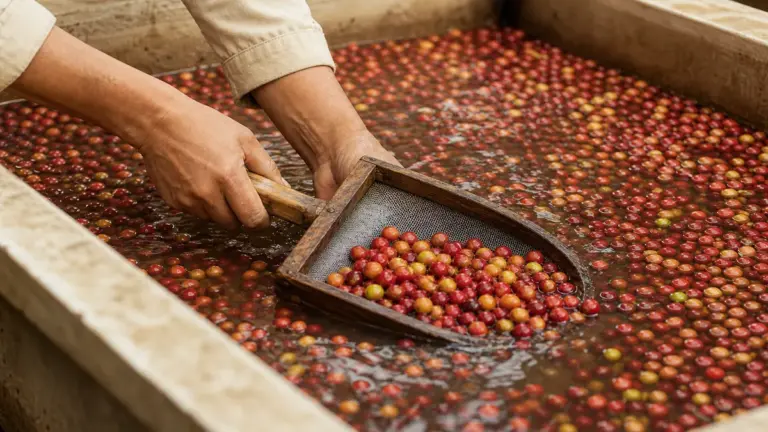
Earlier cherry sorting and floating should not be confused with this final assessment of green beans.
How grading relates to quality and commercial value
Grading helps describe what is being traded, but it does not create a universal ladder of drinking quality. The International Trade Centre identifies quality and availability as major influences on negotiations, alongside wider supply and demand.
A physical grade therefore provides part of the explanation for commercial value, not the whole explanation. Equally, a tasting description should not be used to fill gaps in a physical specification.
For UK buyers, compare like with like: the same stated preparation, comparable physical results and a representative tasting sample. Request itemised written quotations with the coffee specification attached. The useful outcome of green coffee grading is an accountable description of the lot, not an impressive label standing on its own.
FAQ
Can a coffee pass physical grading but taste disappointing?
Yes. Physical assessment and sensory assessment answer different questions, and passing a defect threshold does not establish a preferred flavour. Treat the physical report as evidence about the beans’ condition and preparation, then use a separate tasting assessment to decide whether the coffee suits its intended use.
Are quakers counted in the green sample?
Quaker assessment belongs to the roasted-coffee check in the older SCAA handbook. That handbook specifies no quakers in a 100 g roasted sample for its specialty grade. The June 2024 CVA physical procedure does not require quaker counting, so ask which assessment framework a supplier’s report follows.
Can I compare defect totals from different suppliers?
Only after checking how each total was produced. Ask for the sample mass, defect definitions, conversion factors and grading system. Under SCA-style counting, several damaged beans can represent one full defect. A bare figure such as “five defects” is therefore insufficient for a fair comparison.
Where to go next
Read Coffee Harvesting for the wider route from ripe fruit to a prepared lot, then Coffee Cherry Anatomy to understand the seed and its surrounding layers. Coffee Cherry Sorting and Floating explains an earlier sorting stage, helping distinguish fruit selection from green coffee grading.
Sources
-
Specialty Coffee Association of America, Arabica Green Coffee Defect Handbook, originally published 2004, revised 26 April 2013. Primary document retrieved from a third-party archive.
https://community-roast-world.s3.dualstack.ap-northeast-1.amazonaws.com/original/2X/c/c7996b42d1307af1820c3d7f8af057dcdf3064e6.pdf -
Specialty Coffee Association, Protocols and Best Practices, green-grading section, undated retrieved edition. Primary document hosted by the Specialty Coffee Institute of Thailand.
https://www.scith.coffee/wp-content/uploads/2021/03/SCA-Protocols-_-Best-Practices.pdf -
Specialty Coffee Association, A System to Assess Coffee Value, June 2024 edition, section 4.
-
Specialty Coffee Association, Coffee Value Assessment, undated live framework page, checked 2026.
https://sca.coffee/value-assessment -
Specialty Coffee Association, Standards, published standards and standards-in-development register, checked 2026.
https://sca.coffee/research/coffee-standards -
International Trade Centre, The Coffee Guide, fourth edition, 2021, chapters 3 and 5.
https://kenyacoffee.or.ke/resources/The%20Coffee%20Guide%204th%20Edition.pdf -
Agriculture and Food Authority, Kenya, Coffee Yearbook 2023/2024, Table 13.
-
Comité Nacional de Cafeteros, Colombia, Resolución Número 5 de 2002, 6 June 2002, section 10.2.
-
Instituto del Café de Costa Rica, Procedimiento llenado de Recibos de Café, code 2-P-3.1, version 1, undated, page 5.
https://www.icafe.cr/wp-content/uploads/disposiciones/documentos/D4.6/D4.6-3/D4.6-3-3-2-P-3.1.pdf -
Anokye-Bempah, L., and colleagues, The use of desiccants for proper moisture preservation in green coffee during storage and transportation, Journal of Agriculture and Food Research, volume 11, article 100478, 2023. Author-uploaded full text.
https://www.researchgate.net/publication/366211615_The_use_of_desiccants_for_proper_moisture_preservation_in_green_coffee_during_storage_and_transportation
This article was researched by comparing SCA documents, national grading references, the International Trade Centre’s trade guide and peer-reviewed storage research; no first-hand grading or testing is claimed.
Last checked: November 2026