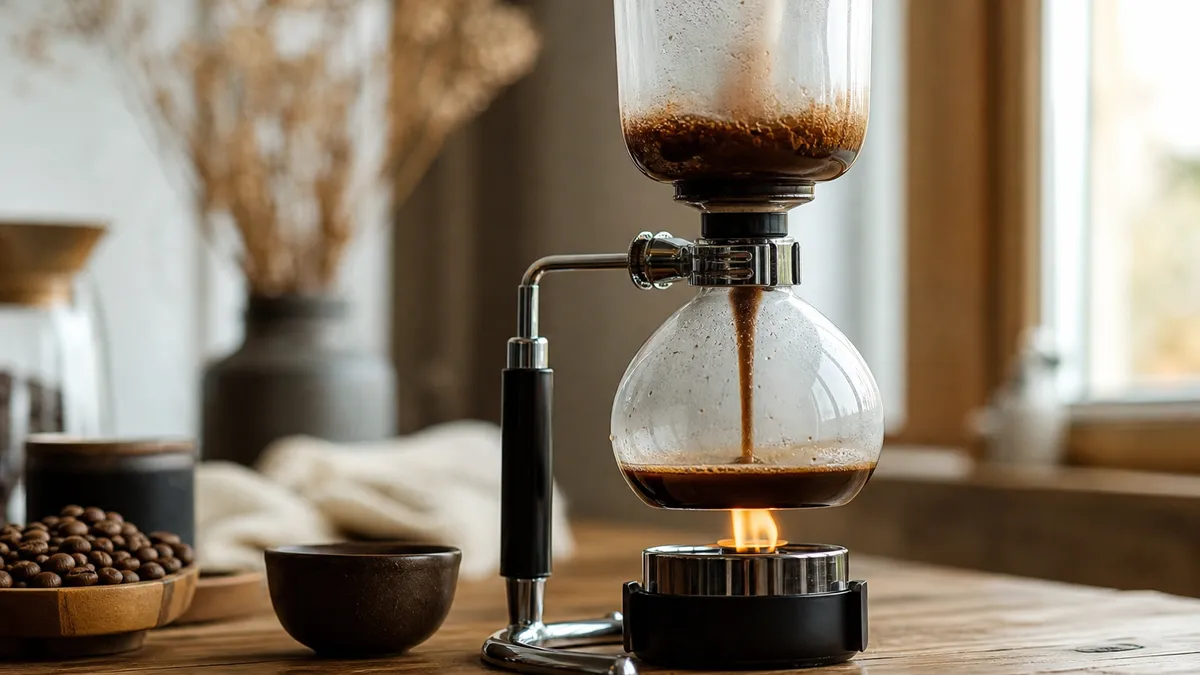
Siphon coffee makers brew coffee in two connected chambers: heat creates pressure that pushes hot water upwards, then cooling creates a partial vacuum that draws the filtered coffee back down. The result is immersion brewing with a theatrical finish, best suited to someone who enjoys making coffee as much as drinking it.
In short
- Water rises because pressure builds in the lower chamber, not because a vacuum sucks it upwards.
- Cloth, paper and metal filters are available, but compatibility depends on the brewer.
- For a suitable manual brewer, start with 24 g of coffee and 360 g of water, a coffee-to-water ratio of 1:15.
- Use only an approved heat source, and never let the lower chamber boil dry.
- Check replacement glass, seals and filter availability before choosing a brewer.
How siphon coffee makers work
A conventional glass siphon has a lower vessel for water, an upper brewing chamber, a connecting tube and a filter. A gasket, the flexible seal between the chambers, allows pressure to build below while the upper chamber remains open to the atmosphere.
The brewing cycle has three stages:
- Heating pushes water up. As water heats, evaporation increases the amount of water vapour in the lower chamber. Together with warming trapped air, this raises pressure and pushes liquid water up the tube. There is no vacuum lifting the water.
- Coffee steeps above. The grounds mix with the hot water in the upper chamber. A little water normally remains below; do not increase the heat to chase it upwards.
- Cooling brings coffee down. Removing the heat lets water vapour cool and condense. Pressure below falls, creating a partial vacuum. Atmospheric pressure acting on the coffee above, assisted by gravity, drives it down through the filter.
“Vacuum draws the coffee down” is convenient shorthand. More precisely, the difference in pressure between the chambers drives the return flow.
For the wider equipment picture, start with the coffee machines guide.
Heat sources: flame is not compulsory
Choose the heat source by compatibility first, then by how much control and supervision you want. A burner that fits beneath the glass is not necessarily suitable for it.
| Heat source | What it offers | Main consideration |
|---|---|---|
| Alcohol burner | The traditional visible flame | Fuel handling, extinguishing and cooling need care |
| Approved gas burner | Adjustable flame | Must be designed and approved for the brewer |
| Halogen or beam heater | Heating without an exposed flame | Hot surfaces remain a hazard |
| Integrated electric heater | A programmed brewing cycle | Follow that model’s recipe and operating instructions |
Hario’s manual brewing guide lists gas, alcohol and its beam heater as options. Integrated electric vacuum brewers also exist, but their operating sequence can differ substantially from a manually heated glass siphon.
Do not assume stovetop or induction compatibility. Check the instructions for the exact brewer, rather than advice for another model that looks similar.
For a workplace, my recommendation is to treat a manually heated siphon as supervised demonstration equipment rather than a communal self-service machine. That judgement follows from its exposed hot glass, handling requirements and, with burners, flame management.
Filters and the flavour in the cup
Siphon brewing combines immersion, where the grounds steep together in water, with filtration during the return journey. A well-prepared cloth-filtered brew can have noticeable body without the gritty finish of an unfiltered drink.
The filter is part of the brewing system, not an interchangeable accessory chosen by diameter alone:
- Cloth is the traditional option supplied with many glass siphons. It needs thorough rinsing and careful storage between brews.
- Paper is an alternative on compatible models. Hario describes its paper-filtered siphon coffee as cleaner and a little lighter than its cloth-filtered version.
- Metal provides a reusable alternative on some brewers. Check both the filter and holder compatibility before changing from the supplied arrangement.
Do not assume every vacuum brewer accepts all three. Bodum’s ePEBO instructions, for example, require the supplied filter and explicitly prohibit paper filters.
For taste comparisons, keep the beans, dose and water quantity unchanged when trying another approved filter. Otherwise, you cannot tell whether the filter or the changed recipe produced the difference.
If you chiefly want to explore filtered coffee rather than the vacuum mechanism, compare pour-over brewers.
A practical starting method
This method is adapted from Hario’s manual siphon guidance. It is not a universal procedure for electric vacuum brewers, and your model’s safety instructions take priority.
Starting recipe: 24 g medium-ground coffee and 360 g water, approximately 360 ml before heating. That is a coffee-to-water ratio of 1:15 by weight. Hario’s accompanying guidance describes upper-chamber brewing temperatures of around 90 to 93°C, rather than a rolling boil.
Have the brewer, approved heater, scales, timer, suitable stirrer and upper-chamber stand ready before starting.
- Inspect and prepare. Check the glass, gasket and stand. Prepare the filter as its instructions require; a new cloth filter needs boiling-water preparation before first use.
- Measure the water. Add 360 g of hot water to the lower chamber only if your manual permits a hot-water start. Stay within its marked capacity.
- Fit the filter. Centre it in the upper chamber and secure its attachment. On the Hario arrangement, the chain passes through the tube and hooks beneath it.
- Heat and seal as instructed. Hario’s separate illustrated guide places the upper chamber loosely at an angle during heating, then seats it when the water begins boiling. Do not force the glass.
- Let the water rise. Once the transfer has settled, reduce an adjustable heater to the level needed to keep the water above. A small residual quantity below is normal.
- Add the coffee and start timing. Stir gently with a suitable non-metal stirrer, just enough to wet all the grounds.
- End the steep after about 60 seconds. Give a brief final stir and end heating using the approved procedure. Never move a lit alcohol burner.
- Allow drawdown and serve. Hario gives approximately 30 to 60 seconds for the coffee to return. Once it has finished, remove the upper chamber as instructed and place it in its stand.
Treat this as a repeatable starting point, not a contest to achieve an exact drawdown time. Record what happened before changing the next brew.
Troubleshooting
These checks combine manufacturer guidance with straightforward deductions from the pressure mechanism.
| Symptom | Likely cause | Fix |
|---|---|---|
| Little water rises | Poor seal or insufficient heating | Stop, cool and check assembly and approved heater |
| Drawdown is unusually slow | Grind too fine or filter obstructed | Clean the filter; try a slightly coarser grind |
| Coffee tastes of old coffee | Contaminated cloth | Clean according to instructions or replace it |
| Coffee falls back before the steep ends | Insufficient heat to maintain pressure | Check the heater setting and seal on the next cooled setup |
| Violent bubbling | Excessive heat | End or reduce heating as the manual directs |
Do not try to fix a stalled brewer by pulling hot chambers apart.
Skill and safety: establish a routine
The useful skills are modest: assemble a sound seal, wet the grounds consistently, manage heat and recognise when to stop. Practise without distractions before serving other people.
Set up on a stable, heat-resistant surface, away from flammable materials and children. Inspect the glass before each use; cracks, chips and serious scratches mean it should not be heated.
Keep the outside of the lower vessel dry before heating. Avoid touching hot glass with a wet cloth or setting it on a wet surface, because sudden temperature changes can cause breakage.
Never leave a burner unattended or refill it while lit or hot. Use the specified fuel and extinguishing method. Never heat the lower vessel dry, and keep hands and face away from escaping steam.
Cleaning and filter care
Let the equipment cool before cleaning. For manual glass parts, follow the manufacturer’s instructions on mild detergent, soft cleaning tools and dishwasher suitability; permission for a detached glass bowl does not mean the complete stand-and-burner assembly belongs in the dishwasher.
Rinse used cloth thoroughly, then follow its storage instructions. Hario advises keeping the cleaned cloth submerged in water in the refrigerator and changing that water regularly. Replace worn cloth rather than trying to compensate for it through the recipe.
Clean the filter and funnel after each brew. For electric models, disconnect the appliance first and do not immerse an electrical jug or base unless expressly permitted. Follow the model’s descaling instructions, which may depend on water hardness.
Better control: temperature, stirring and timing
The bubbling lower chamber is not a thermometer for the coffee above. The upper chamber loses heat to its surroundings, while the heater below continues supplying energy.
Barista Hustle’s published experiments found that adding grounds initially lowered the upper-chamber temperature by about 2 to 3°C. In its unmanaged tests, temperature then recovered and could continue rising. These are observations from particular experimental setups, not a promise that every siphon follows the same temperature curve.
This is why “leave it over the flame for longer” is an unreliable adjustment. You may change both contact time and temperature at once.
For useful comparisons, record the dose, water mass, grind setting, temperature if measured, time of adding coffee, end of heating and end of drawdown. Keep the stirring pattern consistent, too. Change one variable at a time, and judge the cup rather than the appearance of the spent grounds alone.
Who a siphon coffee maker suits
A siphon suits the curious manual brewer who wants to watch the process and is willing to clean the equipment afterwards. I would choose one for deliberate brewing sessions or supervised demonstrations, not for hurried preparation between meetings.
Before choosing, check:
- The stated capacity in millilitres, not just the number of “cups”.
- Availability of the correct replacement chambers and gasket.
- The supplied filter and approved alternatives.
- Heater compatibility and a safe place to use it.
- Where the hot upper chamber will rest after brewing.
The trade-off is participation. If that sounds enjoyable, siphon coffee makers offer a particularly visible way to learn brewing control. If it sounds like another task, consult coffee machine buying mistakes before committing to the ritual.
FAQ
Does a five-cup siphon make five mugs?
Not necessarily: check the millilitre capacity rather than the cup count. Hario lists its five-cup Technica at 600 ml, so “cup” does not mean a large office mug. Compare the manufacturer’s stated capacity with your own drinking vessels, and check whether the figure describes water capacity or finished beverage volume.
Can I use pre-ground coffee?
Yes, provided its grind suits your brewer’s instructions. Hario’s manual specifies a medium grind that is not too fine, while its separate online guide starts medium-fine. Those are practical starting descriptions, not identical particle-size specifications. Pre-ground coffee removes your ability to adjust grind, so use a consistent recipe and assess the result.
Can I put hot water into an electric siphon?
Only if its instructions permit it. A hot-water start appears in Hario’s manual-brewer guidance, but Bodum’s ePEBO instructions specify cold, clear water. Do not transfer shortcuts between different designs. The fill level, supplied filter and programmed cycle also need to follow the instructions for the exact appliance.
Where to go next
Read Pour-Over Brewers: V60, Chemex, Kalita Wave and Melitta Cone to compare another approach to filtered brewing, or Turkish Coffee Pots and Cezves to explore a different hands-on method. Cold Brew Coffee Makers offers another direction, while Coffee Machine Buying Mistakes helps you decide whether the preparation routine fits your habits.
Sources
- Hario UK, “Hario Syphon Brew Guide”, undated. Manual brewing sequence, heater options, filter choices and alternative recipe.
https://www.hario.co.uk/pages/brew-guides-syphon - Hario UK, “How to Brew Syphon Coffee at Home”, 18 September 2026. Starting recipe, temperature guidance, drawdown, cloth care and troubleshooting.
https://www.hario.co.uk/blogs/news/how-to-brew-syphon-coffee-at-home - HARIO, “Coffee Syphon: User’s Manual”, TCA common manual, revision code 1507. Manufacturer’s instructions, retrieved from a distributor-hosted copy.
https://essense.coffee/wp-content/uploads/2019/07/BE00-041-0000_manuale_HARIO-technica.pdf - HARIO Europe, “Coffee Siphon Technica”, undated. Claimed capacities, supplied equipment, filter compatibility and dishwasher limitations.
https://www.hario-europe.com/products/hario-coffee-siphon-technica - Hario USA, “‘Technica’ Coffee Syphon”, undated. Manufacturer’s explanation of upward pressure and return filtration.
https://www.hario-usa.com/products/coffee-syphon-technica - Bodum, “12428 ePEBO Double Wall Vacuum Coffee Maker: Instructions for Use”, undated. Manufacturer’s manual, retrieved from a retailer-hosted copy; electric operation, filter restrictions and cleaning.
https://www.williams-sonoma.com/netstorage/pdf/bodum-epebo-double-wall-coffee-maker-instructions.pdf - Barista Hustle, “IM 4.07 The Science Behind Syphons”, undated. Vapour pressure, condensation and return flow.
https://www.baristahustle.com/lesson/im-4-07-the-science-behind-syphons/ - Barista Hustle, “IM 4.08 Experiments with Syphon Coffee: Part 1”, undated. Original brewing-temperature experiments and dry-heating warning.
https://www.baristahustle.com/lesson/4-08-experimenting-with-syphon-coffee/ - Barista Hustle, “Syphon Scoresheet”, undated. Repeatable recipe recording, temperature monitoring, timing and agitation.
https://www.baristahustle.com/wp-content/uploads/2021/03/Syphon-Scoresheet.pdf
Research combined manufacturer manuals and published brewing guidance with Barista Hustle’s mechanism explanation and original experiments; no first-hand testing is claimed.
Last checked: November 2026