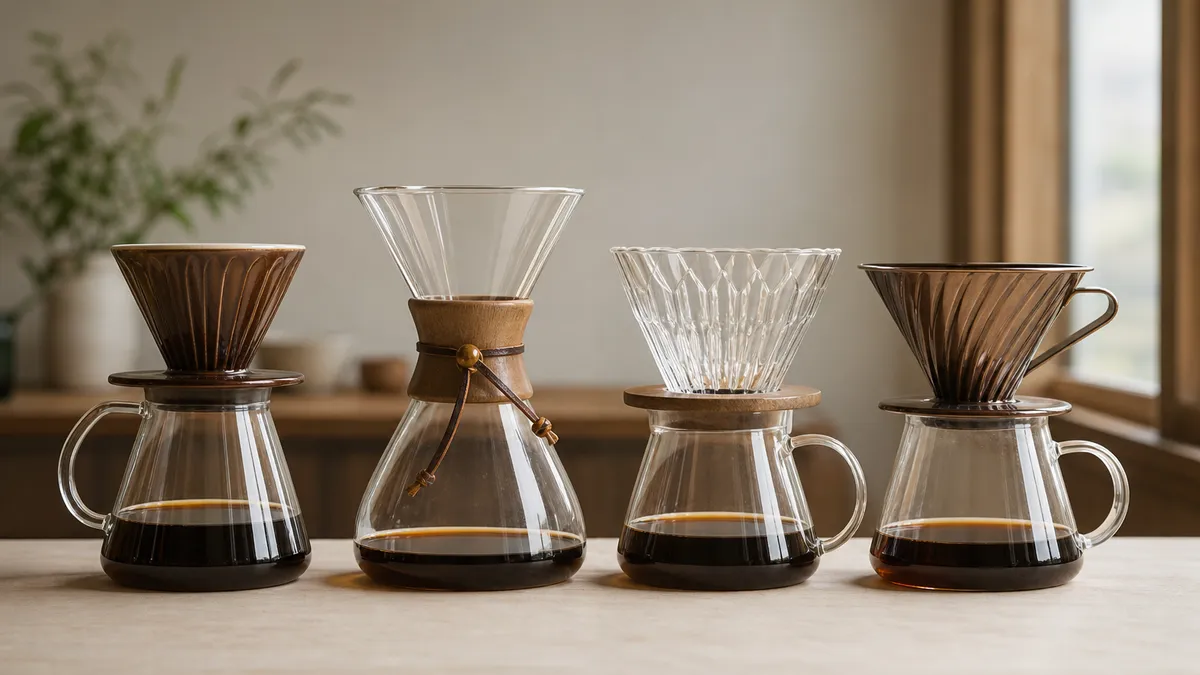
Choose the Hario V60 if you enjoy adjusting your brewing technique, the Chemex if you favour a particularly clear, light-textured cup, the Kalita Wave for its flat coffee bed, or a Melitta cone for a straightforward daily routine. These pour-over brewers all use gravity and paper filtration, but their shapes, drainage openings and matching papers change how you brew.
In short
- Match the paper to the brewer and its size: cone, bonded Chemex, fluted Wave and Melitta wedge papers are not interchangeable systems.
- The V60 has a 60° cone and one large outlet; the Wave has a flat bottom and three small outlets.
- Chemex recommends a medium-coarse grind and requires its pouring channel to remain open for escaping air.
- Manufacturer “cup” ratings are not standard mug measurements. Choose around the amount of finished coffee you actually drink.
- Our recommendation is to choose by brewing routine and filter availability first, rather than assuming one shape always makes better coffee.
Pour-over brewers compared
Pour-over means adding hot water by hand to ground coffee held in a filter, allowing the brewed coffee to drain into a mug or server. Unlike an automatic filter machine, the person pouring controls when and where water reaches the grounds.
The criteria here are flow control, paper requirements, starting grind, capacity and everyday handling. Recommendations are editorial judgements based on published designs and instructions, not a claim of side-by-side testing. For the wider equipment choices, start with our coffee machines guide.
| Brewer | Geometry and flow | Paper and starting grind | Capacity and who it suits |
|---|---|---|---|
| Hario V60 | Pointed 60° cone, spiral ribs and one large outlet; responsive to grind and pouring | Matching V60 cone paper; medium to medium-fine | Manufacturer rates 01 for 1 to 2 cups and 02 for 1 to 4; suits an interested learner |
| Chemex | Smooth funnel above an integrated flask; pouring channel also vents air | Matching bonded paper; medium-coarse | Six Cup Classic holds approximately 890 ml; suits shared brews and a preference for clarity |
| Kalita Wave | Flat bottom, three small outlets and a fluted filter | Matching Wave 155 or 185 paper; medium to medium-coarse | Manufacturer rates 155 for 1 to 2 cups and 185 for 2 to 4; suits readers who prefer a flat-bed routine |
| Melitta cone | Wedge-shaped brewing chamber; outlet arrangement varies by model | Matching wedge paper; medium | Choose the exact holder and paper size together; suits a simple daily filter routine |
Specifications are manufacturers’ published claims, checked in November 2026. Grind descriptions are starting points, not calibrated measurements.
How shape and drainage change the brew
Hario V60: an open outlet and a deep bed
The V60’s circular cone narrows to a point. Hario specifies a 60° angle, spiral internal ribs and a single large opening underneath.
Those ribs separate parts of the paper from the wall, providing space for air to escape. The large outlet leaves the paper, coffee bed and pouring technique doing much of the work of controlling drainage, rather than a small hole throttling the flow.
That responsiveness is the attraction and the challenge. A repeatable pour gives you a useful way to explore a coffee; an erratic pour introduces another variable. Avoid directing water onto exposed paper above the grounds, where it can take a route around rather than through the coffee.
Chemex: the paper and air channel matter
A Chemex combines a smooth-walled upper funnel with a serving flask below. Its pouring channel has a second job during brewing: allowing displaced air to leave the flask.
Open the folded paper with three layers facing the spout. Chemex explains that this thicker section helps prevent the wet paper collapsing into the channel and sealing it. A slow brew can therefore be an air-vent problem, not simply a grind problem.
The bonded paper is central to this brewing system. Chemex claims it is 20% to 30% thicker than most competing papers, although that is a manufacturer comparison, not an independently verified measurement across every alternative.
Kalita Wave: a flat bed and supported folds
The Wave has sloping sides but a flat brewing base, rather than a pointed cone. Three small drainage holes sit beneath the paper, whose 20 flutes limit contact with the brewer walls.
Kalita describes this combination as supporting even flow and extraction. The practical appeal is a flat coffee bed that is easy to distribute before pouring.
However, a flat bottom does not guarantee that every particle extracts equally. Nor should the flutes be treated as proof that no water can bypass the grounds. Keep the paper’s shape intact and distribute water across the coffee rather than relying on the geometry to correct an uneven pour.
Melitta: a wedge, not a pointed cone
The familiar Melitta paper has a straight bottom seam and opens into a wedge-shaped chamber. This differs from the circular, pointed V60.
Do not assume every Melitta holder has the same drainage. The current international porcelain 1×4 model has two outlets, while the US Signature model describes a single drip opening. Check the actual model rather than applying a blanket “one to three holes” description.
Smaller outlets can contribute more drainage resistance than the V60’s large opening, but hole count alone cannot predict brewing time. Paper, grind, dose and water level still matter.
Filter papers and flavour tendencies
Buy the intended paper before judging a brewer’s flavour. Substituting a different shape changes its fit and support, so you are no longer comparing the original systems.
- V60: use a matching cone paper and size. Fold its seam and rinse it as Hario directs.
- Chemex: use the specified bonded filter. Check compatibility carefully, because the Three Cup models use different papers from the larger Classic brewers.
- Wave: use the matching 155 or 185 fluted paper. Rinse gently without deliberately flattening its folds.
- Melitta: follow the holder’s stated paper size and fold the embossed bottom and side seams to help it seat correctly.
For flavour, treat descriptions as tendencies rather than promises. Chemex is the strongest candidate here for someone seeking a clear, light-textured, sometimes tea-like presentation, because its substantial paper filtration is a defining feature. That does not establish it as objectively the “cleanest” brewer under every recipe.
The V60 offers considerable scope to change the result through pouring and grind. Kalita markets the Wave around even extraction and a rich cup, but neither the Wave nor the Melitta wedge inherently guarantees greater sweetness or fuller body.
Here, body means the sensation of weight or texture in the mouth, not simply stronger flavour. If your aim is a more concentrated style of coffee rather than a different filter presentation, compare moka pots before choosing another dripper.
Grind and recipe differences
There is no universal pour-over grind setting. Hario’s UK guides themselves use both “medium” and “medium-fine”, while Chemex specifies medium-coarse and Kalita USA describes medium to medium-coarse.
Start with the maker’s guidance, then adjust for your coffee. Keep the dose, water and pouring pattern steady while changing grind, so you can understand what the adjustment did.
A repeatable starting method
The following is adapted from Hario UK’s V60 instructions. It is a starting recipe for a V60, not a claim that all four brewers should drain at the same speed.
- Prepare: fit the correct paper, rinse it with hot water and discard the rinse water.
- Dose: add 15 g coffee, starting medium to medium-fine, and gently level the bed.
- Heat: use brewing water at 92 to 94°C.
- Bloom: start the timer, pour 45 g water over the grounds and wait 30 to 45 seconds. Blooming is the initial wetting stage, when gas escapes from the coffee.
- Continue: pour gently in circles to 150 g total water, pause briefly, then continue to 250 g total.
- Drain: use 2 minutes 30 seconds to 3 minutes as an initial reference, then assess the taste.
The coffee-to-water ratio is approximately 1:16.7 by weight, calculated from 15 g coffee and 250 g water. The water dose is approximately 250 ml when measured cold, but weigh it for repeatability; it is not a promise of 250 ml of finished drink.
For the Wave, Kalita USA supplies a separate starting recipe: 20 g coffee to 320 g water, a 1:16 ratio, with 60 g used for the bloom. Try that before transplanting a V60 pouring schedule.
For Chemex, begin medium-coarse and check the air channel before adjusting a slow brew. For Melitta, begin around medium, fit the paper carefully and follow the exact holder’s instructions. Do not force either brewer to match the V60’s reference time.
Troubleshooting without chasing the stopwatch
| Symptom | Likely cause to investigate | First adjustment |
|---|---|---|
| Thin, sour coffee with unusually fast drainage | Grind too coarse or water missing parts of the bed | Grind slightly finer and wet the grounds evenly |
| Slow drainage and a harsh, drying cup | Grind too fine for the recipe | Try a slightly coarser grind |
| Chemex suddenly slows or stops | Paper sealing the air channel | Check the three-layer section faces the spout and the channel remains open |
| Paper folds inward during brewing | Wrong size or poor seating | Refit the correct paper according to the maker’s instructions |
These are diagnostic starting points, not proof that every sour cup is under-extracted or every bitter cup over-extracted.
Capacity, handling and ownership
Choose capacity around your mugs, not the number printed on a brewer. Chemex defines its cup as approximately 148 ml, making the Six Cup Classic’s stated capacity approximately 890 ml, not six large mugs.
Hario and Kalita publish cup ranges, but these should not be assumed equivalent to Chemex’s measure or your own serving size. Check the intended recipe and receiving vessel as well as the dripper size. Remember that brewing water and finished beverage volume are different.
For daily handling, ask yourself:
- Will the dripper sit securely on your mug or server?
- Do you want a separate dripper, or an integrated brewing and serving flask?
- Can you obtain the exact replacement papers readily?
- Will everyone using it follow the same measured recipe?
- Does the shape make cleaning and storage convenient in your kitchen or tea point?
For ownership costs, compare the complete setup: brewer, required server, papers, grinder, scales, kettle and replacement parts. Calculate recurring paper use from your expected number of brews, then assess coffee consumption from your chosen dose. For workplace purchases, request itemised written quotations stating what is included and the VAT basis.
Our judgement is that pour-over suits an interested individual or a small shared brewing ritual better than a queue of colleagues wanting coffee simultaneously. Choose it because someone wants to make the coffee by hand, not because it removes that task.
What the evidence says about brewer shape
Controlled sensory research supports the idea that basket geometry can change coffee flavour. A peer-reviewed study by Frost, Ristenpart and Guinard compared flat-bottom and semi-conical baskets and found perceptible differences, alongside differences in beverage strength.
However, the experiment used interchangeable baskets in an automatic brewer, not these four manual brewers. It therefore supports “shape can matter”, not “the Wave always tastes sweeter” or “the V60 always highlights acidity”.
The study also notes that grind descriptions lack standardised meanings. This helps explain why apparently conflicting recipes can both be useful: “medium” on one grinder or guide is not a fixed particle size.
For a fair home comparison, use the same coffee and water, keep the coffee-to-water ratio consistent, and optimise each brewer rather than imposing one grind on all four. Check your own water supplier’s published information, including hardness, instead of assuming all UK tap water is alike.
FAQ
Do I need a gooseneck kettle?
No, but a gooseneck kettle can make a controlled pour easier. Both Hario and Kalita’s published routines emphasise deliberate water delivery. Before adding equipment, try pouring gently and consistently with your existing kettle, provided you can do so safely. Choose a different kettle if controlling the stream remains awkward.
Can I use supermarket pre-ground filter coffee?
Yes, provided its grind allows the brewer to drain sensibly and produces a flavour you enjoy. The limitation is that you cannot adjust the grind yourself. Chemex’s medium-coarse recommendation and Hario’s medium to medium-fine guidance illustrate why the same bag may not work equally well in every brewer.
Can I put the brewers in a dishwasher?
Check the exact model rather than assuming a whole brand is dishwasher-safe. Chemex permits dishwasher cleaning of the Classic glass flask after removing its wooden collar and leather tie. The retrieved Kalita glass 155, stainless-steel 185 and Melitta porcelain 1×4 pages also specify dishwasher suitability, but their instructions should govern cleaning.
Where to go next
For alternatives to pour-over brewers, read Siphon Coffee Makers through our siphon brewer guide, or Turkish Coffee Pots and Cezves through our cezve guide to explore a different preparation tradition. Cold Brew Coffee Makers, covered in our cold brew equipment guide, is the useful next read if you want to investigate brewing without a hot-water pouring routine.
Sources
-
Hario UK, How to Brew Coffee with Hario V60 Coffee Dripper, 16 September 2026; Expert V60 Brew Guide, undated. Geometry, sizes, recipe, pouring and grind guidance.
https://www.hario.co.uk/blogs/news/how-to-brew-coffee-with-hario-v60-coffee-dripper
https://www.hario.co.uk/pages/brew-guides-v60-expert -
HARIO, Coffee Imagination: V60 Series, undated. Manufacturer explanation of cone shape, spiral ribs and the large outlet.
https://www.hario.cc/V60/v60series.html -
Chemex Corporation, Six Cup Classic CHEMEX, undated. Published capacity, cup definition, filter positioning, grind and cleaning instructions.
https://chemexcoffeemaker.com/collections/classic-series-nav/products/six-cup-classic-chemex -
Chemex Corporation, CHEMEX Bonded Filters Pre-folded Squares; FAQ, both undated. Paper-thickness claim, compatibility, filtration claims and air-channel troubleshooting.
https://chemexcoffeemaker.com/products/chemex-bonded-filters-pre-folded-squares
https://chemexcoffeemaker.com/pages/faq -
Kalita USA, Kalita Wave 185 Stainless Steel Coffee Dripper; Kalita Wave 155 Glass Coffee Dripper, both undated. Flat bottom, outlets, fluted papers, manufacturer cup ratings and care.
https://kalitausa.com/products/kalita-wave-185-stainless-steel-coffee-dripper
https://kalitausa.com/products/kalita-wave-155-glass-dripper -
Kalita USA, The Kalita Pour-Over Method for Exceptional Coffee, 2024. Dose, water, bloom, grind and pouring guidance.
https://kalitausa.com/blogs/news/brew-like-a-pro-the-kalita-pour-over-method-for-exceptional-coffee -
Melitta, Porcelain Coffee Filter, 1×4; Filters FAQ; Melitta USA, Signature Series 1-Cup Pour-Over Coffeemaker, all undated; Melitta, Calibra Operating Instructions, 2022. Holder variations, paper fitting, care and medium-grind guidance.
https://www.melitta-international.com/accessories/Manual-Coffee-Preparation/Coffeefilters-pots/Porcelain-Coffee-Filter,-1×4
https://www.melitta-international.com/footer-navi/melitta-expert-advice/FAQ/Filters
https://shoponline.melitta.com/products/signature-series-1-cup-pour-over-coffeemaker-porcelain-matte-black
https://www.melitta-international.com/content/dam/melitta-cp-c/me-cp/manuals/wasserkocher-milchaufsch%C3%A4umer-kaffeem%C3%BChlen/2022_BDA-Calibra_3325V1383.pdf.coredownload.pdf -
Frost, S. C., Ristenpart, W. D. and Guinard, J.-X., Effect of Basket Geometry on the Sensory Quality and Consumer Acceptance of Drip Brewed Coffee, Journal of Food Science, 2019. Controlled sensory research and limitations of grind terminology.
https://pages.uoregon.edu/chendon/coffee_literature/old_literature/2019%20J.%20Food%20Sci.%2C%20%20Basket%20geometry%20from%20sensory%20–%20no%20control%20for%20concentration.pdf -
Thames Water, Water Quality, undated. Example of an official postcode-based local water-information service.
https://www.thameswater.co.uk/help/water-and-waste-help/water-quality
Researched from manufacturer specifications and brewing instructions, a peer-reviewed sensory experiment and an official water-supplier resource; recommendations are editorial assessments, not first-hand testing.
Last checked: November 2026