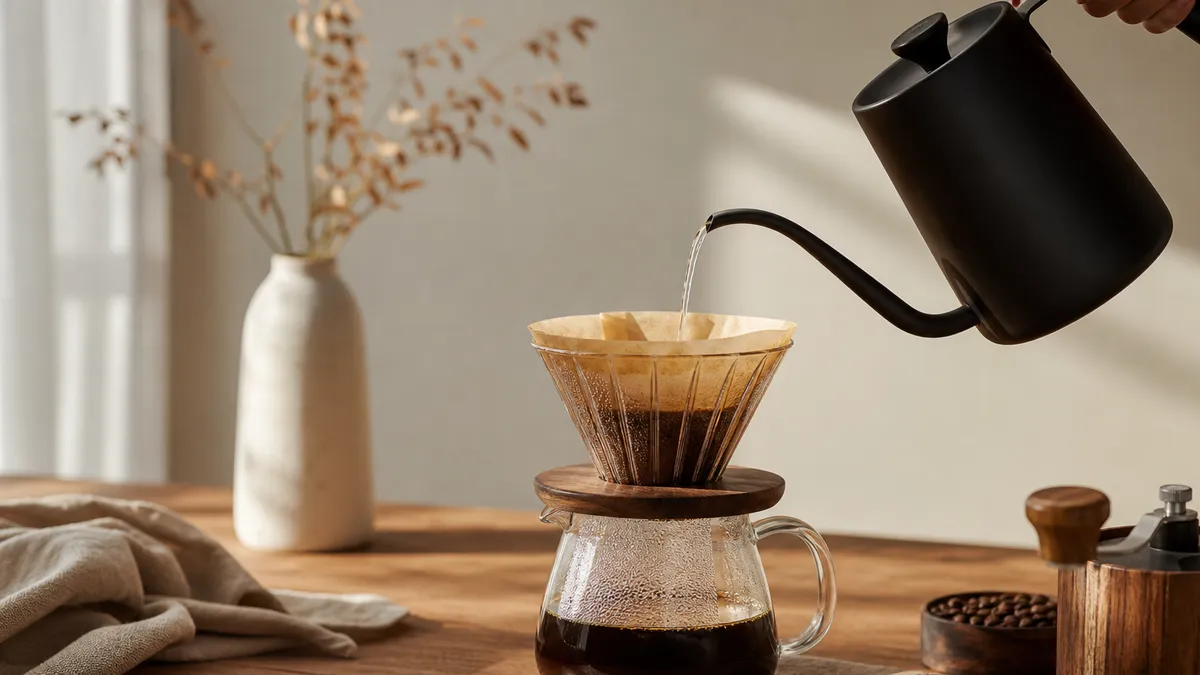
You do not need a gooseneck kettle to make good coffee, but it makes manual pour-over brewing easier to control. Its narrow, curved spout helps you direct a steady stream onto the grounds; adjustable temperature is a separate feature, available on some electric models.
In short
- Choose a gooseneck for controlled manual pour-over brewing, not simply because it looks like specialist coffee equipment.
- A narrow spout controls pouring. A variable-temperature heater controls water temperature. One does not guarantee the other.
- Compare practical capacity and minimum fill, rather than relying on a kettle’s advertised size.
- Stovetop models need an approved heat source; electric models need their supplied base and the correct electrical version.
- Prioritise comfortable handling, predictable flow and straightforward controls over extra display features.
When gooseneck kettles make a difference
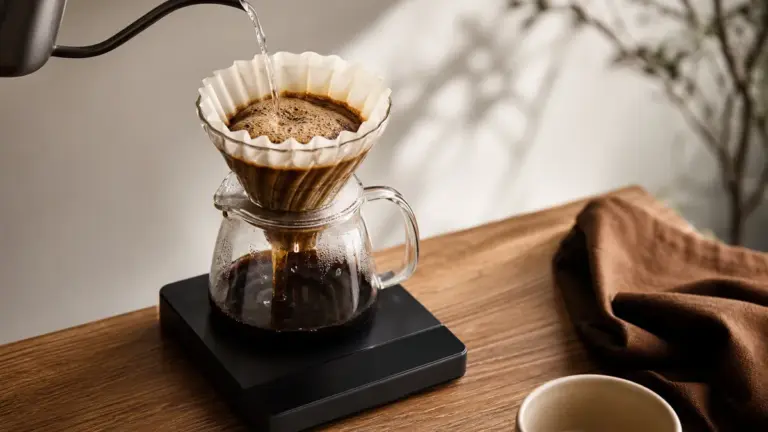
A gooseneck kettle is most useful when your brewing method asks you to wet the coffee gradually and distribute water deliberately. Hario’s V60 instructions, for example, call for a slow circular pour, avoiding the edges where the grounds meet the paper.
The kettle helps you follow that instruction without repeatedly flooding one patch of coffee. You can move the stream around the coffee bed, meaning the layer of ground coffee in the filter, and stop nearer your intended water weight.
Our buying judgement: choose a gooseneck when controlling the pour is the awkward part of your routine. If your ordinary kettle already gives you a manageable stream and repeatable results, there is no urgent reason to replace it.
The benefit is smaller for cafetière brewing, where the coffee steeps in the water rather than depending on a sequence of directed pours. A gooseneck also adds nothing to the extraction process inside an automatic filter brewer, espresso machine or bean-to-cup machine.
For a shared office kitchen, treat it as a tool for people making individual pour-overs, not automatically as the main communal kettle. See brewing accessories for the wider equipment picture.
What the spout actually controls
Three characteristics matter more than the length of the curved neck:
- Flow: can you maintain the stream your recipe needs?
- Placement: can you direct water accurately without an awkward wrist position?
- Stopping: can you finish the pour without an unwanted final surge?
Hario describes its Buono spout as helping users control both the amount and speed of pouring. Fellow similarly describes its Stagg spout as supporting a slow, controlled flow. These are manufacturer descriptions, not independent proof that either kettle produces better-tasting coffee.
Pouring also affects agitation, the movement of water and grounds. A controlled laboratory study published in Physics of Fluids in 2025 found that pour height and water flow could change mixing and extraction in its experimental arrangements.
That does not establish a universally best pouring style. Nor does it mean the thinnest possible trickle is always desirable. The useful feature is the ability to repeat a chosen pour, then change it deliberately.
Use coffee scales to measure the water delivered. A precise spout cannot tell you how much you have added.
Stovetop versus electric: which should you choose?
The comparison below uses heating method, temperature management, handling and suitability as its criteria. These are category-level buying judgements; individual models need checking against their manuals.
| Option | Pour control | Temperature management | Main limitation | Best suited to |
|---|---|---|---|---|
| Ordinary kettle | Depends on spout and handling | Boil-only or adjustable, depending on model | May be awkward for small, directed pours | General kitchen use and occasional pour-over |
| Stovetop gooseneck | Designed for directed pouring | Managed through the heat source, with a suitable thermometer if needed | Requires compatible hob and manual attention | Brewers happy to manage heating themselves |
| Boil-only electric gooseneck | Directed pouring with electric heating | Boils water without a selectable brewing target | Does not provide variable-temperature control | Brewers mainly seeking a different spout |
| Variable-temperature electric gooseneck | Directed pouring | Selectable target; some models also hold temperature | More controls and model-specific operating requirements | Regular pour-over brewing and repeatable temperature experiments |
Stovetop models
Check compatibility with your exact hob. Do not assume that every metal kettle works on induction, or that every vessel sold for pouring can be heated directly.
Also check how the handle sits relative to the heat source and whether the lid remains secure during pouring. Follow the manufacturer’s instructions rather than treating a coffee kettle as interchangeable with any saucepan.
Electric models
Check whether the model is boil-only or genuinely variable-temperature. For the latter, establish what happens when you lift it off its base: does temperature holding resume automatically, or must you restart it?
Buy the electrical version intended for UK use. Fellow’s US product page, for example, specifies a North American plug and supply voltage, illustrating why an overseas listing should not be treated as a UK specification.
Never put an electric kettle on a hob unless its manufacturer explicitly permits that use. Fellow specifically prohibits this for its Stagg electric kettles.
Temperature control: useful, but not a promise of better coffee
A variable-temperature kettle lets you repeat a selected heating target without judging it by eye or by a cooling pause.
For context, the SCA’s published 2017 Certified Home Brewer minimum requirements specify water reaching 92 to 96°C at the coffee, with further conditions on when that temperature must be reached and maintained. Those requirements concern automatic brewers. They are not a certification standard for gooseneck kettles.
Hario’s manual V60 guidance also suggests approximately 92 to 96°C. That makes this a reasonable starting region for that method, not an instruction that every coffee must use exactly the same temperature.
The display is not the coffee-bed temperature
The kettle’s selected target, its displayed reading and the temperature among the wet grounds are different measurements. Water transfers heat to the dripper, filter and coffee, so a kettle setting should not be presented as a guaranteed brewing temperature.
Preheating the brewer makes the preparation more repeatable. Hario’s instructions include rinsing the filter with hot water to warm the V60 and cup, then discarding that water.
For choosing a kettle, distinguish adjustment resolution from accuracy. Being able to select a setting in small increments does not, by itself, prove that the water remains within those increments of the target.
A temperature-hold function is useful when your recipe involves pauses. Check its operation and duration in the manual rather than assuming all electric goosenecks behave alike.
Capacity: look beyond the headline size
Compare the amount you may safely heat, not merely the vessel’s overall dimensions or an ambiguous size description.
As checked in November 2026, Hario lists practical Buono capacities of 500 ml, 600 ml and 800 ml. Fellow lists 0.9 litres for its Stagg EKG Pro. These are manufacturers’ published capacities, not independently measured results.
Your required fill includes brewing water and any water used for rinsing and preheating.
For an illustrative planning example, suppose you allow:
- 300 g of brewing water;
- approximately 100 ml for rinsing and preheating;
- additional water only where required by the kettle’s minimum-fill instructions.
That suggests planning around approximately 400 ml before considering any required remainder. The rinse allowance is an example, not a brewing standard.
Minimum fill deserves particular attention for small brews. Follow the markings and manual supplied with the exact version you buy, including instructions about reheating after some water has been poured away.
Capacity is also a handling decision. If possible, assess the kettle with a realistic amount of cold water inside. Look for a comfortable grip, a secure lid and a controlled finish to the pour, not simply the largest vessel available.
A simple way to practise controlled pouring
This is an editorial handling exercise, not a coffee recipe or performance test. Begin with cold water so you can learn the movement without handling hot water.
- Prepare the kettle. Add cold water within its permitted fill limits. Place a stable receiving jug on scales and tare them to zero.
- Pour a measured amount. Aim to deliver 100 g over 20 seconds. That is an average of 5 g per second, chosen simply as a practice target.
- Watch the stream. Seek a continuous flow rather than repeatedly switching between drips and a surge.
- Repeat the movement. Practise starting, directing and stopping the stream without exaggerated wrist movements.
- Move to your brewing recipe. Follow its temperature, water weight and timing, keeping those unchanged while you learn the kettle.
When brewing into a paper filter, follow the dripper maker’s pouring guidance. Filter selection and fit are separate issues, covered in coffee filters.
| Symptom | Likely cause to investigate | What to try |
|---|---|---|
| Water arrives in sudden surges | Tilt or grip is difficult to repeat | Practise with cold water and smaller changes in tilt |
| You repeatedly exceed the target weight | The stream continues while you finish the pour | Reduce flow as you approach the target |
| Coffee drains unusually slowly | Grind may be too fine, rather than the kettle being at fault | Follow the brewer’s troubleshooting advice; Hario suggests a coarser grind |
| White deposits develop inside | Limescale from the water supply | Check local hardness and follow the kettle’s cleaning instructions |
Water, cleaning and buying checks
Hardness varies with local water sources. The Drinking Water Inspectorate identifies dissolved calcium and magnesium as its cause and advises asking your water company for accurate local information.
Use your supplier’s postcode report rather than a single supposedly representative UK figure. Compare readings in the same units, commonly mg/L as calcium carbonate. Essex & Suffolk Water also explains that blended supplies can produce a hardness range rather than one fixed value.
Follow the kettle maker’s cleaning instructions. Do not assume that a product suitable for one kettle’s finish, seals or construction is approved for another.
For milk drinks, use equipment designed for milk. Fellow explicitly specifies fresh, clean water only for its electric kettles; milk frothers and pitchers cover the appropriate tools.
Before ordering, ask about replacement lids, cleaning access, warranty conditions and support for the exact UK version. For workplace purchasing, obtain an itemised written quotation and written confirmation that the intended use is covered.
UK consumer purchases must meet requirements including satisfactory quality, fitness for purpose and matching their description. A manufacturer’s warranty does not replace statutory rights. Business purchases need separate attention to the contract rather than an assumption that consumer protections apply unchanged.
FAQ
Can I practise with an ordinary kettle before buying?
Yes, try your existing kettle before deciding that its spout is the problem. Use cold water, a stable jug and scales to assess whether you can start, direct and stop a controlled stream. If the movement feels manageable, work on repeatability first. Our recommendation is to replace the kettle only when its handling is a genuine obstacle.
Does a gooseneck kettle make coffee stronger?
Not automatically. A laboratory study found that changing pour height and flow could change mixing and extraction, but owning a particular spout does not reproduce those experimental conditions. Treat strength as something to evaluate through a repeatable recipe, not as a guaranteed benefit printed on the kettle’s packaging.
Can I heat water elsewhere and transfer it into a pouring kettle?
Only use the receiving vessel in ways its manufacturer permits. Check its hot-water suitability and fill limits, and remember that a pouring vessel is not necessarily safe on a hob. Transferring water also introduces another thermal step, so do not assume the original heater’s temperature reading still describes the water reaching the coffee.
Should I choose app connectivity or simple controls?
Choose the controls you will actually use. Our preference is to prioritise readable temperature information, straightforward heating and predictable hold behaviour before connectivity. Fellow states that its EKG Updater app is not required to operate the kettle and does not remotely control its settings, showing why the precise function matters more than the presence of an app.
Where to go next
Read Brewing Accessories to decide where gooseneck kettles fit within your equipment set, then Scales for measuring water rather than judging it by eye. Filters explains another part of the pour-over setup, while Milk Frothers and Milk Pitchers covers equipment intended for milk rather than water.
Sources
-
Hario Europe, “V60 Drip Kettle Buono”, undated product page, checked 2026. Manufacturer descriptions of spout control and practical capacities of 500 ml, 600 ml and 800 ml.
https://www.hario-europe.com/products/hario-v60-drip-kettle-buono -
Hario UK, “Expert V60 Brew Guide”, undated, checked 2026. Pouring technique, preheating, temperature guidance and grind-related troubleshooting.
https://www.hario.co.uk/pages/brew-guides-v60-expert -
Fellow, “Stagg EKG Electric Kettle”, Pro and Pro Studio product information, undated, checked 2026. Manufacturer specifications, hold settings, electrical-version differences, water-only use, hob prohibition and app limitations.
https://fellowproducts.com/collections/kettles/products/stagg-ekg-electric-pour-over-kettle -
Fellow, “Stagg EKG Pro / Pro Studio Safety Manual”, revision R3, undated. Fill limits, positioning, hot-water precautions and operating restrictions. The retrieved manual covers North American versions; readers must follow the manual supplied with their own version.
https://cdn.shopify.com/s/files/1/0057/6235/1219/files/StaggEKGPro_Studio_SafetyManual_R3.pdf -
Specialty Coffee Association, “Certified Home Brewer Program: Minimum Certification Requirements”, 2017 edition. Historical published automatic-brewer temperature requirements and measurement location, not kettle certification.
https://sca.coffee/research/coffee-standards -
Park, E., Young, M. and Mathijssen, A. J. T. M., “Pour-over coffee: Mixing by a water jet impinging on a granular bed with avalanche dynamics”, Physics of Fluids, 37, 043332, 2025. Controlled laboratory experiments concerning pour height, flow, mixing and extraction.
https://bpb-us-w2.wpmucdn.com/web.sas.upenn.edu/dist/8/725/files/2025/04/30.pdf -
Drinking Water Inspectorate, “Water Hardness / Hard Water”, undated, checked 2026. Hardness minerals, reporting units, local variation and scale formation.
https://www.dwi.gov.uk/consumers/learn-more-about-your-water/water-hardness-hard-water/ -
Essex & Suffolk Water, “Hard Water Information and Advice Booklet”, undated, checked 2026. Local water reports, blended-supply variation and deposits associated with heating hard water.
https://www.eswater.co.uk/globalassets/customer-pdfs/taste-and-smells-pdfs/wtr0492_hard-water-advice-esw_mg.pdf -
GOV.UK, “Avoid unfair terms in sales contracts: Implied and statutory rights”, undated, checked 2026. Product requirements and the distinction between consumer and business contracts.
https://www.gov.uk/unfair-terms-in-sales-contracts/implied-rights -
GOV.UK, “Accepting returns and giving refunds: the law”, undated, checked 2026. Statutory remedies and the fact that warranty expiry does not automatically remove statutory rights.
https://www.gov.uk/accepting-returns-and-giving-refunds
Researched using manufacturer documentation, published SCA requirements, a peer-reviewed experimental paper, official water guidance and GOV.UK consumer guidance; no first-hand product testing was undertaken.
Last checked: November 2026