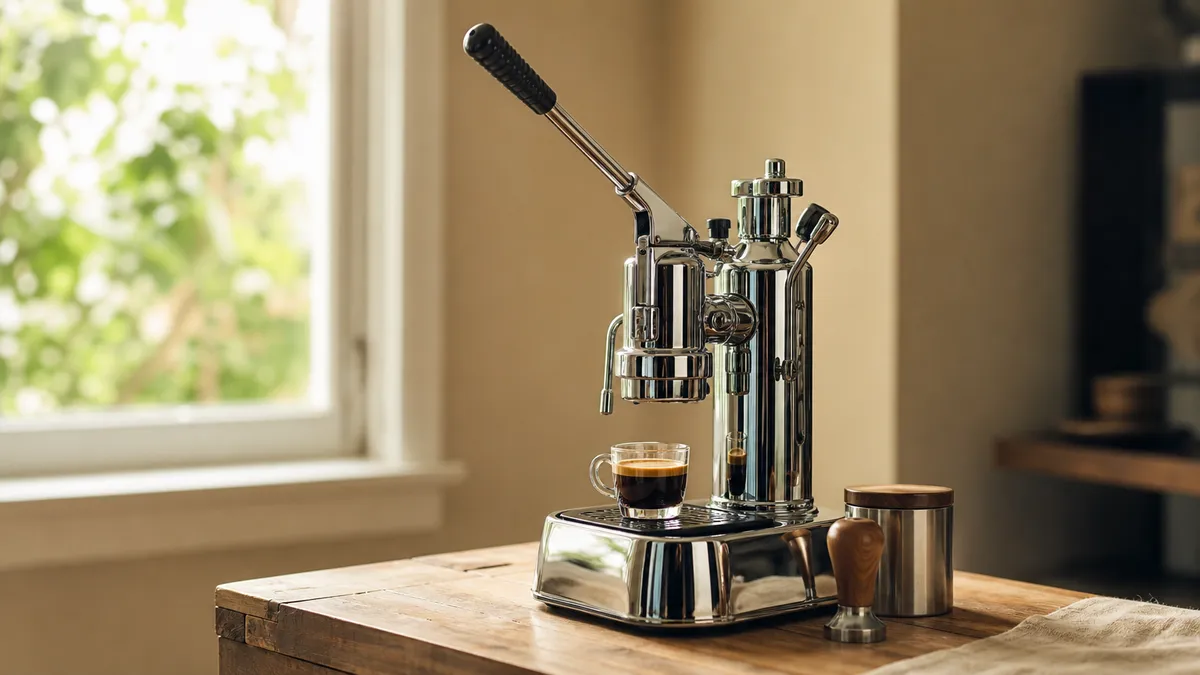
Manual lever espresso machines use a piston, powered by your arm or a spring, to push hot water through finely ground coffee. People love them for the physical involvement and control over extraction, but the reality includes careful preparation, temperature management and a workflow that rewards attention rather than haste.
In short
- Direct levers: your arm supplies the brewing force throughout extraction.
- Spring levers: you load a spring, which then drives the piston through the brewing stroke.
- Water supply is a separate distinction: some levers have heated boilers; others need hot water from a kettle.
- Check the exact model: the Olympia Cremina is a direct lever; the Cremina SL is spring-operated.
- Pressure is not a competition: Cafelat recommends brewing its Robot within 5 to 8 bar, not chasing the highest gauge reading.
What makes an espresso machine a manual lever?
The defining feature is how brewing pressure is generated. A lever moves a piston that pressurises the water above the coffee puck, the compacted bed of grounds inside the filter basket.
That does not necessarily mean the machine has no electricity. A boiler-equipped lever can heat water electrically and provide steam for milk, while leaving the brewing stroke to the operator or a spring. Other designs dispense with the boiler and require a kettle.
Nor does every espresso machine with a small operating lever belong in this category. A lever that switches on a pump or opens a valve is not the same as one that drives a brewing piston.
For the wider equipment choices, start with our coffee machines guide. Here, the useful distinction is between controlling a machine and physically supplying or storing its brewing force.
Direct lever versus spring lever
These designs offer different kinds of involvement. Compare them by the source of brewing force, the control available during extraction and the work required from the operator.
| Design | What produces brewing force? | What you control | Who it suits |
|---|---|---|---|
| Direct lever | Your arm, acting through the lever and piston | Pressure throughout the stroke, subject to the mechanism | Someone who wants hands-on experimentation |
| Spring lever | A compressed spring driving the piston | Preparation and pre-infusion, with further control depending on the model | Someone who enjoys a mechanical process with a spring-driven extraction |
| Kettle-fed direct lever | Your arm; water is heated separately | Manual pressure and the preparation of each water charge | An espresso drinker happy to manage a separate kettle |
The final row overlaps with the first: water supply and pressure mechanism are two different classifications.
Direct levers: your arm does the brewing
On a direct lever, changing the force on the handle changes the force applied to the piston. You remain involved throughout the extraction.
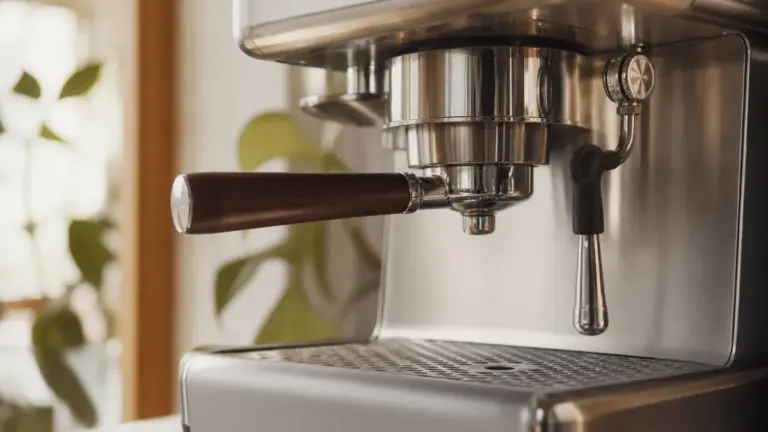
La Pavoni’s Europiccola and Olympia Express’s standard Cremina are boiler-fed examples. On the Cremina, lifting the lever admits water to the brewing chamber; lowering it forces water through the coffee. Flair machines and the Cafelat Robot demonstrate the kettle-fed approach.
The attraction is immediate feedback. You feel resistance rather than merely watching a timer. The disadvantage is that a repeatable shot requires a repeatable action as well as consistent coffee preparation.
Spring levers: you store the energy first
On a conventional spring lever, pulling the handle loads a substantial spring and allows water into the brewing chamber. After the prescribed controlled release, the spring drives the piston and the lever returns as espresso flows.
The Profitec Pro 800 and Londinium R24 are examples. They still need careful grinding, dosing and preparation, but your arm does not have to maintain the extraction force throughout the shot.
One naming correction matters: Olympia’s Cremina is a direct lever; its Cremina SL has a compression spring. Describing both simply as “Cremina” can lead to the wrong buying decision.
A brief history of the lever
Three milestones put the polished chrome into context:
- 1947: Achille Gaggia registered a lever-piston patent using a spring loaded by the lever.
- 1948: Gaggia’s Tipo Classica brought that mechanism into production.
- 1961: La Pavoni introduced the Europiccola, taking the lever format into the home.
This history helps explain the appeal, but age is not a brewing advantage in itself. A traditional mechanism still needs an appropriate grind, controlled water temperature and a sound operating routine.
Our guide to traditional coffee machines places this approach alongside other manually prepared espresso systems.
Skill and workflow: what making coffee involves
A lever does not remove the ordinary work of espresso. You still need to prepare a consistent dose, distribute the grounds, tamp evenly and measure the drink.
An espresso-capable burr grinder is particularly useful because small grind adjustments let you alter resistance without changing everything else. Scales help separate the dose, the dry coffee going in, from the yield, the espresso coming out.
A starting method for a kettle-fed direct lever
The following is a Flair 58-style starting routine, adapted from Flair’s guidance. It is not a universal recipe for every lever or basket.
- Preheat the equipment. Allow the electrically heated brew chamber and fitted portafilter to warm as directed. Flair specifies five minutes in its dialling-in guide.
- Choose a suitable temperature. For a medium roast, that guide suggests the medium preheat setting of 90 degrees Celsius and kettle water at a similar temperature.
- Weigh and prepare the coffee. Use 18 g only in a basket suited to that dose. Distribute the grounds and tamp level.
- Add the brew water. Fill and assemble the chamber according to the model’s instructions. Beverage yield is not the same as the amount of water needed to fill the system.
- Begin gently. Flair suggests approximately 3 bar for 5 to 10 seconds of pre-infusion, the initial wetting of the puck, before increasing to 6 or 7 bar.
- Measure the result. An initial target of 18 g in and 36 g out gives a dose-to-yield ratio of 1:2. Around 30 seconds is a starting reference, not a requirement to override taste.
- Change one variable. Keep dose and yield steady while adjusting grind. Record temperature, timing and pressure so that a good result can be repeated.
Do not transfer this handle movement to a spring machine. Its loading, release and stopping procedure may be quite different.
Troubleshooting without wrestling the lever
| Symptom | Likely cause | First response |
|---|---|---|
| Coffee rushes through with little resistance | Grind too coarse or insufficient coffee | Check dose, then grind finer |
| Little or no coffee flows | Grind too fine or excessive dose | Follow the safe depressurisation procedure; adjust the next shot |
| Sour, thin espresso from a kettle-fed machine | Insufficient extraction, potentially including inadequate preheating | Check thermal preparation, then adjust one brewing variable |
| Later shots become unpleasantly hot and harsh | Heat accumulation in a susceptible boiler-fed group | Follow the manufacturer’s cooling routine |
| Water escapes around the portafilter | Dirty sealing surfaces, incorrect fitting or a worn seal | Depressurise safely, then inspect and clean |
Never solve a blocked shot by applying uncontrolled force or removing a pressurised portafilter. Profitec explicitly warns against both actions on the Pro 800.
Temperature management: the less romantic part
Pressure gets the attention, but thermal preparation can determine whether an otherwise careful shot works.
Boiler-fed machines
A ready light or boiler gauge does not describe every part of the brewing system. The group, the assembly holding the piston and portafilter, has its own thermal behaviour.
La Pavoni’s current Europiccola-family manual recommends a pause after three to four consecutive coffees so that the group can return to the appropriate temperature. That is a model-specific instruction, not proof that every lever overheats.
More elaborate controls also need interpreting correctly. Profitec describes the Pro 800’s PID, an electronic temperature controller, as regulating boiler temperature. That should not be mistaken for direct measurement of water temperature inside the puck.
Kettle-fed machines
Cold metal takes heat from the brewing water. Flair therefore stresses preheating, although the method differs between its manually preheated and electrically heated designs.
The Robot has different thermal instructions again. Cafelat’s manual discusses using water straight from the boil and optional additional preheating. Follow the instructions for the actual machine rather than borrowing a routine from another lever.
For repeatability, keep the starting condition consistent: the same preheat procedure, water preparation and interval between filling and brewing.
Pressure profiling: the deeper attraction
A pressure profile describes how brewing pressure changes during a shot.
With a direct lever, you can wet the puck gently, increase pressure and then ease off towards the end. Cafelat’s Robot manual permits a gradual pressure decline but advises against sudden stop-start actions. A gauge makes these changes visible; without one, feel alone cannot tell you the exact pressure.
A conventional spring mechanism commonly produces a declining profile as its spring expands. However, neither the starting pressure nor the finishing pressure is universal. Spring characteristics, piston geometry and the point at which extraction begins all matter.
There is also a difference in published descriptions. Jonathan Gagné’s The Physics of Espresso illustrates declining lever-style profiles, while Olympia describes the Cremina SL as providing constant brewing pressure. These statements concern different designs and presentations, not a reason to assign every spring lever the same curve.
The practical lesson is to avoid assuming that all spring machines brew from roughly 9 bar down to 5 bar. Ask for the particular model’s documented behaviour.
Pressure and flow are also different measurements. Water still needs resistance from the prepared coffee bed. A more elaborate pressure routine is not a substitute for getting the grind and preparation right, and no profile guarantees sweetness or body.
Maintenance and safe ownership
Start with the cleaning instructions, not a generic pump-machine routine. Cafelat specifies hand cleaning for the Robot’s components, while La Pavoni calls for regular cleaning of the portafilter, basket and filter plate, plus steam-system cleaning after use.
Before buying, check access to replacement seals, approved lubricant, parts diagrams and competent servicing. A mechanical brewing system is not maintenance-free, and boiler-equipped models still contain electrical and pressure-related components.
Water deserves attention too. Hard water can leave limescale, but there is no useful single hardness figure for the whole UK. Obtain your own supplier’s local report and follow the machine maker’s water-treatment and descaling requirements.
Keep clear of a spring lever’s return path. Never open a pressurised boiler filler cap, and follow the manufacturer’s cooling and depressurisation procedure before refilling or maintenance.
Who manual lever espresso machines suit
Our judgement is that a lever suits someone who enjoys making espresso as much as drinking it. Choose a direct lever for active pressure control; consider a spring lever if the appeal is a spring-driven brewing stroke rather than maintaining force yourself.
Before deciding, try the full movement at a comfortable worktop height. Check overhead clearance, stability, portafilter access and the practical effort required. Also establish how milk will be prepared: the Robot does not steam it.
For a shared office, prioritise operator training, safe access and a demonstrated peak-time workflow over appearance. Consult commercial espresso machines before treating a domestic lever as workplace equipment.
If the desired experience is simply to insert something and press a button, pod or capsule machines are a more relevant comparison. Manual lever espresso machines make most sense when their involvement is the attraction, not an obstacle.
FAQ
Can a manual lever make real espresso without electricity?
Yes, a kettle-fed direct lever can generate espresso brewing pressure without an electrical pump or internal heater. Cafelat’s Robot is one example, although you must supply hot water separately. The complete setup therefore still needs a way to heat water, and milk steaming requires separate equipment.
Does the pressure gauge show boiler pressure or brewing pressure?
It depends on the machine and the gauge’s connection. Profitec identifies the Pro 800’s standard gauge as a boiler-pressure gauge, whereas the Robot’s optional gauge measures pressure inside the brewing basket. Read the specification carefully: the presence of a dial does not establish what it measures.
Can I stop a spring-lever shot at my chosen yield?
You may be able to stop collecting espresso without stopping the mechanism. Profitec instructs Pro 800 owners to remove the cup at the desired yield and let the remaining liquid enter the drip tray. The portafilter must remain fitted until the lever has returned to its neutral position.
Where to go next
Read Coffee Machines to compare the wider equipment families, then Traditional Coffee Machines for the surrounding espresso choices. Commercial Espresso Machines is the useful next read when training, service and shared-workplace operation matter more than a personal brewing ritual.
Sources
Dates below identify document editions where available. Undated live pages were retrieved in November 2026; manufacturer descriptions are treated as claimed specifications, not independent performance tests.
-
S1. Gaggia North America, “Our History”, undated. Historical entries for 1947 and 1948.
https://www.gaggia-na.com/pages/history -
S2. La Pavoni, Europiccola / Professional / Stradivari Operating Instructions, 2024 document. Operation, temperature management, cleaning, troubleshooting and safety.
https://www.lapavoni.com/media/usermanual/12 -
S3. La Pavoni, “Europiccola Lusso”, undated. Manufacturer’s historical and mechanism description.
https://lapavoni.com/en/products/domestic-machines/europiccola-lusso -
S4. Olympia Express, “Cremina”, undated. Direct-lever mechanism.
https://www.olympia-express.ch/en/products/cremina -
S5. Olympia Express, “Cremina SL”, undated. Spring mechanism and claimed constant brewing pressure.
https://www.olympia-express.ch/en/products/cremina-sl -
S6. Profitec, “Pro 800”, undated. Claimed configuration, boiler-temperature control and gauge type.
https://www.profitec-espresso.com/en/products/pro800 -
S7. Profitec, Pro 800 User Manual, current linked edition, undated. Brewing procedure and pressure-related warnings.
https://www.profitec-espresso.com/media/pages/produkte/pro800/b58c26b097-1782906242/ba-pro800.pdf -
S8. Londinium Espresso, “Londinium R24”, undated. Spring operation and the relationship between pre-infusion and effective spring pressure.
https://www.londiniumespresso.com/products/londinium-r24 -
S9. Cafelat, Robot Espresso Maker User Manual, version 2.0, June 2020. Workflow, thermal management, cleaning and gauge operation.
https://www.cafelat.com/uploads/1/5/3/6/15367184/robot_user_manual.pdf -
S10. Cafelat, “Cafelat Robot”, undated. Manufacturer’s brewing-pressure and handling guidance.
https://www.cafelat.com/robot.html -
S11. Flair Espresso, “Dialing-In Your Flair 58 Plus Manual Espresso Maker”, undated live page. Starting recipe, preheating and pressure routine.
https://flairespresso.com/blogs/news/dialing-in-flair-58-plus-manual-espresso-maker -
S12. Flair Espresso, “What temperature should I be brewing at?”, undated. Heat loss and preheating.
https://support.flairespresso.com/knowledge/what-temperature-should-i-be-brewing-at -
S13. Jonathan Gagné, The Physics of Espresso, 2025, chapter 9, “Beverage Types and Recipes”, publisher-authorised excerpt hosted by Decent Espresso. Pressure profiles and extraction behaviour; technical synthesis with original measurements.
https://decentespresso.com/f/0/gagne_chapter_vevs.pdf -
S14. Thames Water, “Hard water” and “Water quality”, undated live pages. Limescale and access to local water reports.
https://www.thameswater.co.uk/help/water-and-waste-help/water-quality/hard-water
https://www.thameswater.co.uk/help/water-and-waste-help/water-quality
Research combined manufacturer manuals and published specifications with a technical espresso reference and a UK water supplier’s guidance; no first-hand machine testing is claimed.
Last checked: November 2026