Coffee that tastes sharply sour may need more extraction, while harsh bitterness may call for less extraction, a less concentrated drink or a different roast. These are starting points, not diagnoses: first identify the sensation, then change one brewing variable at a time, because strength, roast and water can produce overlapping symptoms.
In short
- Thin and sour: try a slightly finer grind before changing the coffee dose.
- Harsh and drying: check whether the brew is flowing unusually slowly, then test a coarser grind.
- Overwhelming but otherwise balanced: try dilution before changing extraction.
- Flat whatever you adjust: compare fresher beans and different brewing water.
- Do not assume bitterness arrives only at the end: controlled filter-coffee research found early fractions could be both more sour and more bitter than later ones.
Start by identifying the taste
Before adjusting anything, describe the problem more precisely than “too strong”.
Sourness is the sharp taste associated with acids. Bitterness is a different taste, while astringency is a drying mouthfeel rather than bitterness itself. Coffee research evaluates these separately because they do not necessarily move together.
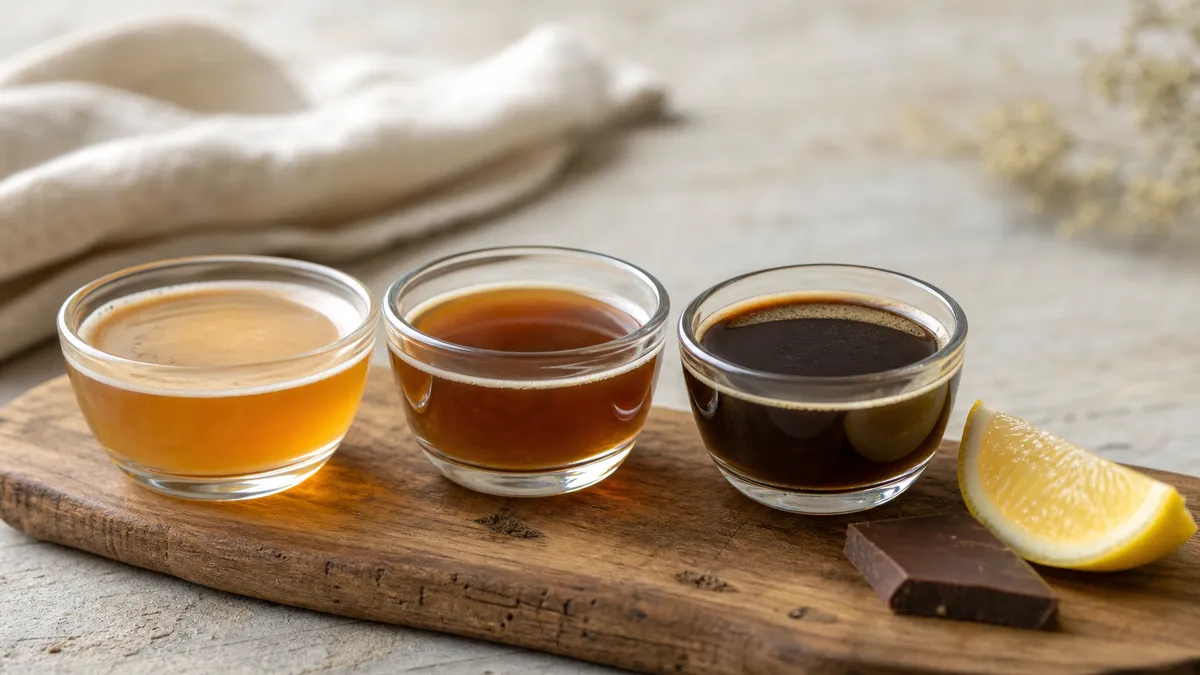
For a practical vocabulary, think of lemon juice for sourness, unsweetened cocoa for bitterness and the drying finish of strongly brewed tea for astringency. These are tasting reminders, not ingredients to add to your coffee.
People sometimes call an unpleasantly sharp coffee “bitter” when they mean sour. Controlled taste-identification experiments have documented this confusion; unfamiliar vocabulary and food associations appear to contribute, rather than the two sensations being interchangeable. The research does not establish that intense sourness universally becomes bitterness.
Write down what bothers you: “sharp and thin”, “smoky and lingering”, “dry after swallowing” or simply “too concentrated”. That description will make your next adjustment more useful.
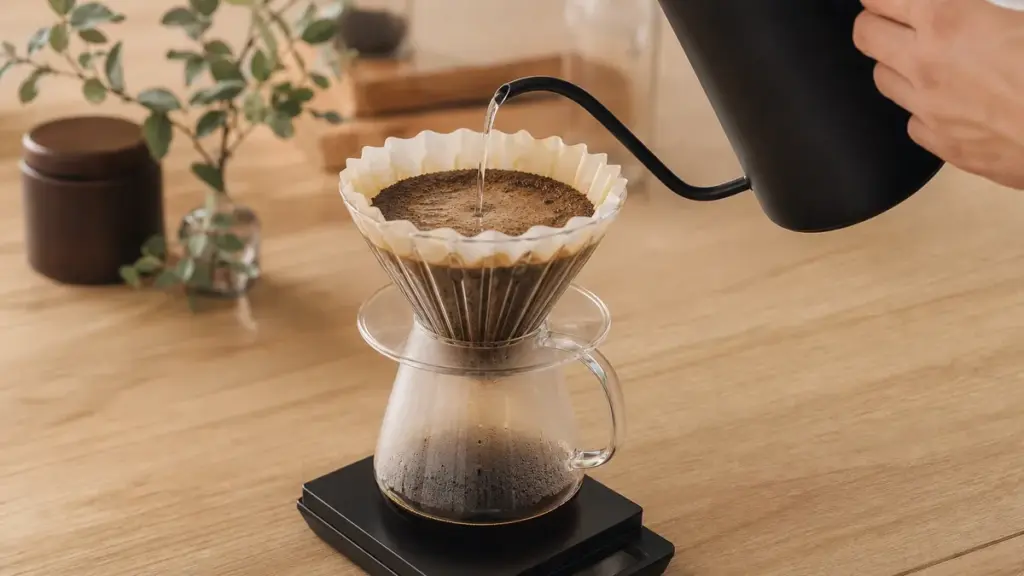
Why coffee tastes sour, and what to change
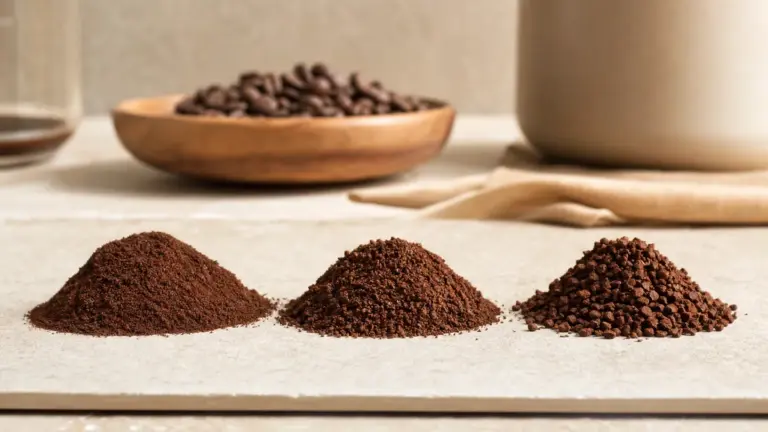
A sour, thin brew is a reasonable prompt to test more extraction, meaning more material dissolved from the grounds. For filter coffee, try a slightly finer grind; for an immersion brewer, where the grounds steep in water, try a longer steep instead. Keep the dose and water quantity unchanged for that comparison.
In a pour-over, check whether you wetted the whole coffee bed. Water finding an easy route through or around the grounds can leave extraction uneven, so a flat bed and controlled pouring matter alongside grind size. Do not keep grinding finer if the brew is already struggling to drain.
Temperature is another possible adjustment, especially if your brewing water has been cooling while you prepare everything. However, hotter is not an independent guarantee of better flavour: a controlled drip-coffee study found little sensory difference between its tested temperatures when strength and extraction were held constant. Temperature changes how extraction proceeds, so treat it as one tool rather than the entire explanation.
Finally, consider the beans. Naturally high-acidity coffee can taste sharp without a brewing fault. If careful adjustments leave a flavour you consistently dislike, compare a different roast or coffee rather than trying to remove every trace of acidity.
Why coffee tastes bitter or drying
Start by separating excessive concentration, extraction-related harshness and roast character.
If the coffee seems overwhelmingly intense, dilute a small sample with hot drinking water and compare it with the original. This is a useful diagnostic because controlled sensory research shows that concentration affects bitterness and several other flavour attributes. If dilution makes the drink pleasant, address strength before making a large grind adjustment.
If the brew is harsh, drying and unusually slow, test a slightly coarser grind. For immersion brewing, shortening the steep is another test. These are practical troubleshooting directions, not proof that every bitter drink is over-extracted.
A dark roast can also contribute bitterness that brewing adjustments will not remove completely. For espresso, an excessive beverage yield can be another contributor, so shortening the drink is worth testing before changing several machine settings.
Begin your comparison with clean equipment. The SCAA’s pour-over guidance explicitly starts there; there is little value in adjusting a recipe while leaving the brewer’s condition uncontrolled.
Weak, strong and flat are different problems
Strength is concentration; extraction is how much of the coffee has dissolved. They are related, but not interchangeable. A thin drink does not automatically need a finer grind, and an intense drink does not automatically need a shorter brew.
If filter coffee tastes balanced but watery, test more coffee for the same water quantity. If it tastes balanced but overpowering, try dilution or a lower dose on the next brew. If it is watery and sour, investigate extraction first. Our brewing ratio and temperature guide explains how to keep these adjustments separate.
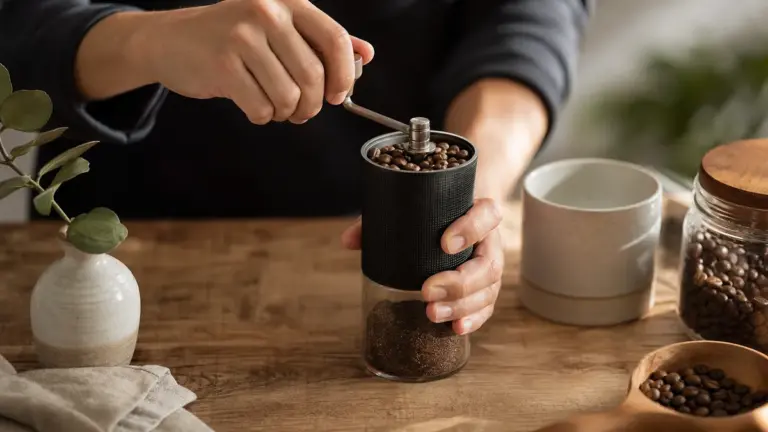
For flat coffee with little aroma, compare your beans with a recently opened batch. Coffee loses aroma as it ages, while oxidation can introduce unwanted flavours; grinding accelerates changes associated with freshness. No grind adjustment can restore aroma that has already been lost.
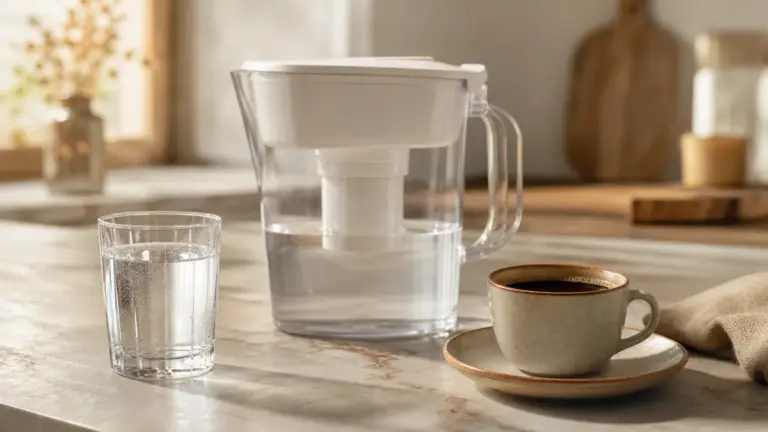
Water deserves a separate comparison. Alkalinity, the water’s capacity to neutralise acid, can mute coffee’s acidity when excessive; very low alkalinity can leave the drink sharply acidic. It is not the same measurement as hardness. Check your local supplier’s report rather than assuming all UK tap water behaves alike, and use water hardness, alkalinity and TDS to interpret the results.
A repeatable brewing test
Use this pour-over test to establish a baseline, not as a compulsory recipe for every brewer. It adapts Hario’s published single-cup guidance; the purpose is to make repeatable comparisons.
- Prepare clean equipment. Use a cone dripper, matching paper, scales, timer, kettle and server. Rinse the paper with hot water, then discard that water.
- Weigh 15 g of coffee and 250 g of brewing water. That is approximately 250 ml measured before heating, and a coffee-to-water ratio of about 1:16.7 by weight.
- Start with a medium-fine grind and water at 94 degrees Celsius. This temperature sits within Hario’s published 92 to 96 degrees Celsius guidance.
- Start the timer and wet all the grounds. Pause for about 30 seconds.
- Pour slowly and evenly to 250 g total water. Avoid directing the stream onto the paper around the edges.
- Record the finish time. Hario suggests about 2 minutes 30 seconds for this recipe. Treat that as a reference, not a pass-or-fail deadline.
- Taste, record and repeat. For thin sourness, test slightly finer; for harshness with slow drainage, test slightly coarser. Change nothing else during that comparison.
Keep a short record of coffee, dose, water weight, grind setting, temperature, finish time and taste. The broader grind size and extraction guide explains the mechanisms; here, the useful result is knowing whether your single change helped.
Symptom, likely cause and first fix
These are hypotheses to test, not diagnoses from taste alone. The table combines published brewing guidance with sensory research on strength, roast, freshness and water.
| Symptom | Likely cause to investigate | First fix to test |
|---|---|---|
| Sour, thin filter coffee | Insufficient extraction | Grind slightly finer |
| Sour despite consistent brewing | Coffee character or low-alkalinity water | Compare another coffee, then another water |
| Bitter and overwhelmingly intense | Excessive concentration | Dilute a small sample |
| Harsh, drying, slow-draining filter coffee | Grind or extraction problem | Grind slightly coarser |
| Smoky bitterness across recipes | Roast character | Compare a less darkly roasted coffee |
| Balanced but watery | Low concentration | Increase dose at the same water weight |
| Flat with little aroma | Staling | Compare a recently opened batch |
| Flat despite fresh beans | Excessive water alkalinity | Compare suitable brewing water |
Make the correction fit your brewing method
Pour-over and batch filter
For pour-over, check bed preparation and pouring before chasing a grind setting. Hario recommends finer grinding for weak coffee and coarser grinding when drainage is too slow. With an automatic brewer, keep within its instructions and use the same measured batch for comparisons.
Cafetière and other immersion brewers
Use steep time as a controlled adjustment: longer is a test for insufficient extraction, shorter for excessive extraction-related harshness. Pour the finished cafetière into another vessel rather than leaving the unused drink with the grounds. La Colombe’s published method uses a four-minute steep as its starting point, not a universal optimum.
Espresso and bean-to-cup machines
For sour espresso, check temperature and preparation, then test a slightly finer grind where appropriate. For bitter espresso, investigate roast character and excessive beverage yield. On bean-to-cup equipment, change only controls the manufacturer permits and follow its grinder-adjustment instructions.
Do not pursue finer grinding indefinitely. Barista Hustle notes that espresso extraction can eventually decline as channelling develops, so “finer” is not an unlimited route to improvement.
Moka pot
For burnt-tasting moka coffee, check heat and handling rather than applying a filter recipe. Bialetti instructs users to keep water below the safety valve, leave the coffee untamped, use low to medium heat and remove the pot promptly when full. Follow your own model’s instructions.
Train your palate with a three-cup brew
Collecting successive portions of one brew helps you compare sensations without changing the beans. Researchers call this fractionation. The following three-cup exercise is a simplified learning activity inspired by published drip-brew experiments, not their laboratory protocol.
- Prepare three stable, heatproof cups and the baseline pour-over above.
- Collect the beginning in the first cup, the middle in the second and the final drainage in the third. Move the dripper safely between cups without interrupting your usual pouring.
- Let the samples become comfortable to taste. Compare sourness, bitterness, drying mouthfeel and intensity separately.
- Combine portions afterwards and notice how their balance differs from each portion alone.
Do not expect an automatic progression from sour to sweet to bitter. Controlled drip-brew research found earlier fractions more sour and more bitter, while later fractions were weaker, sweeter and more floral. The researchers’ accompanying account also describes earlier liquid as darker, not paler. This contradicts the common teaching shortcut that bitterness only appears late.
Use the exercise to learn your own descriptions, not to predict flavour from cup position or colour.
FAQ
Can one coffee taste both sour and bitter?
Yes, sourness and bitterness can occur together. Controlled fractionation research found both were stronger in early drip-coffee fractions, so their coexistence does not prove uneven extraction. Record each sensation separately and test concentration, brewing consistency and coffee choice rather than automatically treating the drink as two opposite faults.
Can I improve the cup I have already brewed?
You can test dilution if excessive concentration is the main problem. Add hot drinking water gradually to a small sample and compare it before changing the whole drink. Dilution changes strength, however, not the extraction that already happened, and it cannot replace aroma lost through staling.
Does getting the brewing time right guarantee good flavour?
No, a reference brewing time cannot guarantee the flavour you prefer. Sensory research shows that strength, extraction and roast all matter, while manufacturer timings belong to particular recipes. Use the clock to recognise changes between otherwise similar brews, then let the taste comparison decide whether an adjustment helped.
Where to go next
Read Grind Size and Extraction for the principles behind these taste-led adjustments, then Brewing Ratios and Temperature to separate concentration changes from extraction changes. If your coffee still tastes bitter or sour after repeatable brewing comparisons, Water for Coffee: Hardness, Alkalinity and TDS is the next useful investigation.
Sources
-
Barista Hustle, The Coffee Compass, 2021. Practitioner guidance on filter-coffee extraction, strength and troubleshooting.
https://www.baristahustle.com/coffee-compass/ -
Hario UK, Expert V60 Brew Guide, undated, retrieved November 2026. Manufacturer’s published recipe and grind-adjustment guidance.
https://www.hario.co.uk/pages/brew-guides-v60-expert -
Hario UK, How to Brew Coffee with Hario V60 Coffee Dripper, 2026. Manufacturer’s guidance on preparation, pouring and channelling.
https://www.hario.co.uk/blogs/news/how-to-brew-coffee-with-hario-v60-coffee-dripper -
Frost, Ristenpart and Guinard, Effects of brew strength, brew yield, and roast on the sensory quality of drip brewed coffee, Journal of Food Science, 2020. Controlled sensory research.
https://ift.onlinelibrary.wiley.com/doi/10.1111/1750-3841.15326 -
Batali, Ristenpart and Guinard, Brew temperature, at fixed brew strength and extraction, has little impact on the sensory profile of drip brew coffee, Scientific Reports, 2020. Controlled sensory research, university repository record.
https://escholarship.org/uc/item/7200z8cg -
O’Mahony, Goldenberg, Stedmon and Alford, Confusion in the use of the taste adjectives ‘sour’ and ‘bitter’, Chemical Senses and Flavour, 1979. Controlled taste-identification experiments.
https://pages.uoregon.edu/chendon/coffee_literature/old_literature/1979%20Chem.%20Sens.%20Flavour%2C%20The%20misuse%20of%20%22sour%22%20and%20%22bitter%22.pdf -
Batali and colleagues, Sensory and monosaccharide analysis of drip brew coffee fractions versus brewing time, Journal of the Science of Food and Agriculture, 2020. Controlled fractionation and trained-panel research.
https://scijournals.onlinelibrary.wiley.com/doi/abs/10.1002/jsfa.10323 -
Specialty Coffee Association, Batali and colleagues, Less Strong, More Sweet, 25 Magazine, issue 11, undated webpage, retrieved November 2026. Researchers’ account of fractionation findings and brew appearance.
https://sca.coffee/sca-news/25-magazine/issue-11/less-strong-more-sweet-byd7r -
Speciality Coffee Association of Europe, Wellinger, Smrke and Yeretzian, The SCAE Water Chart: Measure, Aim, Treat, 2016. Technical guidance on hardness, alkalinity and flavour.
-
Specialty Coffee Association, Coffee Decoded: What is “freshly roasted” coffee?, undated, retrieved November 2026. Science communication on aroma loss, oxidation and grinding.
https://sca.coffee/sca-news/coffee-decoded-9-fresh-coffee -
Wacaco, Why Espresso Tastes Sour, Bitter or Weak, undated, retrieved November 2026. Manufacturer’s espresso troubleshooting guidance.
https://www.wacaco.com/es/blogs/guides/why-espresso-tastes-sour-bitter-or-weak -
Bialetti, How to use the Moka Express?, updated 2023. Manufacturer’s operating instructions.
https://bialetti-cookware.zendesk.com/hc/en-us/articles/5416235346322-How-to-use-the-Moka-Express -
La Colombe, French Press Brew Guide, undated, retrieved November 2026. Roaster’s published steeping and decanting method.
https://www.lacolombe.com/pages/french-press-brew-guide -
Specialty Coffee Association of America, Guidelines for Brewing with a Two Cup Pour-Over Brewer, revision 2 April 2016. Published best-practice guidance, including clean equipment.
https://scagermany.coffee/wp-content/uploads/2021/02/best-practices-two-cup-pour-over-brewer.pdf
Research combined retrieved primary sensory studies, coffee-association guidance and manufacturers’ brewing instructions; suggested comparisons are practical troubleshooting tests, not claims of first-hand testing.
Last checked: November 2026