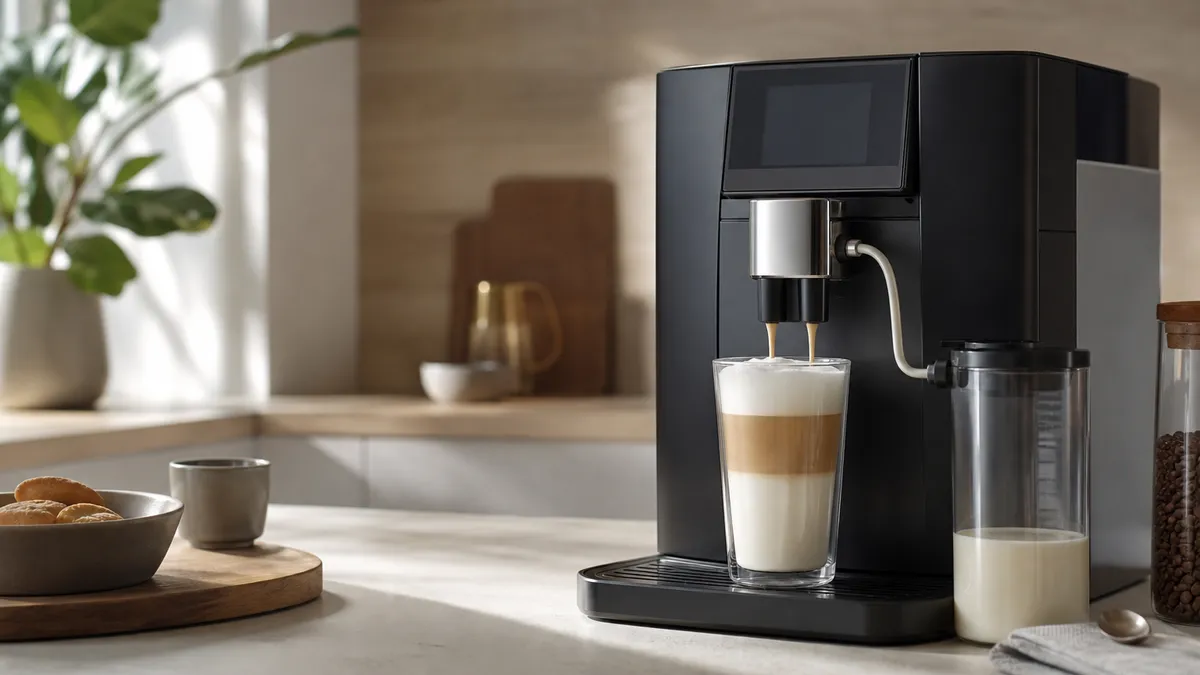
Bean-to-cup coffee machines grind whole beans and brew coffee automatically, making them a good choice for home drinkers who want freshly ground coffee without preparing each shot by hand. Choose one for convenience and repeatable drinks, but expect regular cleaning and less direct control than a traditional espresso machine.
In short
- Choose the milk system before comparing drink menus: automatic milk and a steam wand involve different daily routines.
- A removable brew unit needs manual rinsing; a fixed unit relies on its prescribed cleaning programme.
- A pre-ground coffee chute, sometimes called a bypass doser, is useful for occasional decaf.
- Oily beans can obstruct feeding into the grinder; sugar-coated or flavoured beans may breach the manufacturer’s instructions.
- Before buying, check access for filling, emptying and cleaning, not just the machine’s external dimensions.
How bean-to-cup coffee machines work
A bean-to-cup machine combines a grinder, water-heating system and motorised brewing mechanism. After you select a drink, it grinds a dose of coffee, compresses it inside the brew unit, pushes hot water through it and ejects the used grounds into an internal container.
The brew unit, also called an infuser or brewing group, is the mechanism that holds the ground coffee during brewing. Unlike a traditional machine’s portafilter, the removable handle containing the coffee basket, it normally works out of sight.
You still fill the water tank and bean hopper, empty the grounds container and drip tray, and maintain the milk system. Automatic brewing removes much of the preparation, not the housekeeping.
Here, “bean-to-cup” means a fully automatic machine. Some machines with integrated grinders still require you to move a portafilter and prepare the shot yourself. Our coffee machine types guide explains that distinction; the broader coffee machines hub covers other brewing approaches.
Drink quality versus manual espresso
The most useful comparison is control, not a blanket claim that one machine type always tastes better.
A traditional espresso setup lets you adjust the ground-coffee dose, grind, distribution, tamping and amount of espresso collected. A bean-to-cup machine takes over several of those decisions, although many models let you change strength, drink volume, temperature and grind setting.
Our judgement: choose automatic brewing when repeatable preparation matters more than experimenting with every extraction variable. Choose a traditional setup when adjusting espresso is part of the pleasure, provided you are willing to practise. Greater control creates opportunities, not a guarantee of a better drink.
Do not assume every named recipe represents a different brewing method. Ask what changes between “coffee”, “americano” and “long coffee” on the particular model: the amount of water, a separate hot-water addition or the brewing sequence may differ.
For a useful demonstration, taste your usual black coffee before adding milk. Then try the milk drink you actually make at home. The detailed choices involved in manual brewing belong in our espresso machine guide.
Adjust the drink, not everything at once
Start with the manufacturer’s recommended settings. If the coffee lacks body, check the strength setting and drink volume before making large grinder changes. If it barely trickles through, an excessively fine grind or unsuitable dose setting may be involved.
Change one setting at a time and follow the manual’s instructions for adjusting the grinder. There is no single grind number that transfers between brands, machines or coffees.
Automatic Milk Systems vs Steam Wands
Compare milk systems by hands-on effort, texture control and cleaning access. The longest drinks menu is not necessarily the most useful one.
| Milk arrangement | What you do | Main compromise | Best suited to |
|---|---|---|---|
| Automatic carafe or milk tube | Connect the milk supply and select a recipe | Milk-contact parts still need cleaning | Households wanting repeatable milk drinks |
| Manual steam wand | Steam milk in a separate jug, then pour | Requires practice and attention | Drinkers who enjoy controlling texture |
| Coffee-only machine | Prepare milk separately, if wanted | No integrated milk preparation | Mainly black-coffee households |
Automatic systems draw milk from a container and combine it with steam and air. They remove much of the handling involved in making a cappuccino or latte macchiato, but you must still rinse, dismantle or wash the relevant components as directed.
With a manual wand, you control how much air enters the milk and how it circulates in the jug. A traditional wand and a sleeve-style frother are not interchangeable designs, so ask for a demonstration rather than relying on the words “steam wand”.
Sage’s manual for a traditional espresso machine recommends finishing milk at 60 to 65 degrees Celsius. That is useful context for manual steaming, not a universal setting for automatic milk systems. More heat is not automatically the answer to a disappointing milk drink.
Check the manufacturer’s guidance for your preferred dairy or plant-based drink. Ask to see the frother taken apart: the cleaning demonstration can be more revealing than the brewing demonstration.
Brands
UK ranges checked in November 2026 include the following. These are manufacturer-described features, not independent findings about taste, reliability or service quality.
- De’Longhi: offers manual-frother machines such as the Magnifica Start ECAM220.22.GB and automatic LatteCrema models. Compare the complete model code, since milk equipment varies within a family.
- Philips: offers fully automatic machines with either a classic milk frother or LatteGo, depending on the model. Its published documentation also identifies removable brew groups on relevant machines.
- JURA: offers automatic household machines with integrated brew-unit cleaning programmes. Routine owner maintenance does not involve removing the brewing group.
- Siemens: offers EQ fully automatic machines. Check the individual model’s milk arrangement and maintenance instructions rather than assuming every EQ works identically.
- Miele: offers CM countertop machines, with owner cleaning instructions covering the removable brew unit and internal coffee residues.
This is a starting shortlist, not a ranking. Before favouring a brand, check the exact machine’s cleaning procedure, repair arrangements, replacement parts and suitability for your usual drinks.
Advantages/Benefits & Disadvantages
Advantages
The central benefit is fewer manual steps. You do not need to handle a portafilter for each coffee, and compatible machines can prepare milk drinks through a programmed sequence.
Adjustable drink settings can also make a shared machine easier to use. Once you have found a combination you like, you can return to it without repeating the whole preparation process.
Disadvantages
Automation limits access to parts of the brewing process. You cannot prepare and inspect the coffee bed as you would with a traditional portafilter.
Maintenance also remains unavoidable. Grounds, rinse water and milk residues need attention even when a machine describes itself as self-cleaning. A large menu cannot compensate for a cleaning routine nobody wants to follow.
Compare features and ownership requirements
Rather than comparing price bands, divide your shortlist into coffee-focused machines, automatic-milk machines and feature-rich machines with additional personalisation. These are practical comparison groups, not fixed market categories.
Assess the whole ownership requirement: beans, milk, compatible filters, cleaning products, descaler where required, electricity and repairs. To compare ongoing expenditure, list each consumable, its replacement interval and your expected use, then apply current itemised quotations. Ask sellers to confirm what is included and put repair or servicing terms in writing.
Cleaning routine: fixed and removable brew units
A removable brew unit gives you access for rinsing and cleaning the surrounding compartment. A fixed brew unit stays inside during routine owner maintenance and is cleaned using the manufacturer’s programme and specified products.
Neither arrangement means maintenance-free ownership. Removable units require handling; fixed units make following the prescribed programme especially important. Neither design alone proves superior hygiene or reliability.
Use this checklist alongside the exact model’s manual:
- After preparing milk: complete the required rinse and clean the milk-contact parts. With a manual wand, wipe and purge it promptly, following its instructions.
- At the end of the day: empty and clean the drip tray and grounds container. Wash other daily-cleaning components identified in the manual.
- At the specified interval: remove and rinse a removable brew unit, following the correct shutdown procedure. De’Longhi’s general guidance describes a roughly five-minute soak in water and cleaning at least monthly; Miele guidance specifies weekly cleaning on relevant machines.
- When prompted: run the prescribed coffee-system cleaning, descaling or filter-replacement procedure. These are different tasks, not substitutes for one another.
- Before reassembly: check that components are correctly positioned. Do not force a brew unit that will not seat.
Follow component-specific dishwasher instructions. A dishwasher-safe tray does not mean the brew unit is dishwasher-safe, and detergents can damage some removable brewing mechanisms.
| Symptom | Likely cause | First action |
|---|---|---|
| Full hopper, but little coffee reaches the grinder | Oily beans are sticking or feeding poorly | Follow hopper-cleaning instructions and try less oily beans |
| Coffee flows very slowly | Grind too fine or brew unit needs attention | Check settings and perform prescribed cleaning |
| Milk does not froth properly | Soiled milk system or incorrectly assembled parts | Clean and reassemble as instructed |
| Unpleasant smell inside the machine | Accumulated damp grounds or other residues | Clean the accessible interior and relevant components |
Beans, decaf and water
Why oily or flavoured beans cause trouble
Coffee naturally contains oils. The practical concern is excess surface oil: Miele explains that it can cling to the hopper and hinder beans from reaching the grinder. That is more precise than saying every dark roast will inevitably clog a machine.
Coated beans present a separate issue. Miele warns against beans treated with sugar, caramel or other substances because these can damage the machine. Choose untreated beans permitted by your manual; add flavouring to the finished drink instead.
A bypass doser for occasional decaf
A bypass doser is a separate chute for pre-ground coffee, allowing a different coffee to bypass the integrated grinder. It is useful when the hopper contains regular beans but somebody wants decaf.
Check that the model has one and follow its loading limit and preparation sequence. It is not a second bean hopper: do not put whole beans or instant coffee into it.
Set the correct water hardness
Use your water supplier’s address-level information and the machine’s supplied test procedure where applicable. Thames Water, for example, provides a postcode-based water-quality lookup.
Hardness reflects dissolved calcium and magnesium and may be reported in milligrams per litre as calcium carbonate. Other reports use Clark or German degrees, so match the units to the manual rather than copying a number directly. Set filtration and descaling arrangements according to the manufacturer, not a supposed UK-wide hardness figure.
Who should choose one?
Choose a bean-to-cup machine if you want freshly ground coffee with minimal shot preparation, particularly when several people want straightforward access to their usual drinks. Choose automatic milk only if its cleaning routine feels acceptable.
Look elsewhere if you want to experiment closely with espresso preparation or actively enjoy steaming and pouring milk. Our traditional coffee machine guide covers that more hands-on approach.
Before ordering, measure access for the water tank, hopper lid and service door, then rehearse removing the grounds container. For home bean-to-cup coffee machines, the decisive question is not how many drinks appear on the screen, but whether you like the coffee and will maintain the machine.
FAQ
Can I use ground coffee instead of beans?
Yes, if the machine has a designated pre-ground coffee function. Use its separate chute and follow the manual’s loading limit and operating sequence. Do not put ground coffee into the bean hopper. A bypass is particularly useful for an occasional different coffee, but not every machine includes one.
Does a manufacturer’s guarantee replace my consumer rights?
No, a manufacturer’s guarantee does not replace your statutory rights. For UK consumer purchases, goods must be of satisfactory quality, fit for purpose and as described. Contact the retailer about a fault rather than assuming the manufacturer is your only route. Keep your receipt, correspondence and maintenance records.
Does the machine refrigerate milk in its carafe?
Do not assume it does. Miele’s instructions explicitly explain that its milk flask does not cool the milk and should be refrigerated between uses as directed. Check the exact system’s instructions, including milk storage and cleaning requirements. An attached container is not necessarily a refrigerated container.
Where to go next
Read Coffee Machines: The Complete Buying Guide to organise your shortlist, then Types of Coffee Machine Explained if you are still comparing brewing approaches. Traditional Coffee Machines is the useful next read if greater hands-on control appeals.
Sources
Manufacturer pages below support descriptions of design and maintenance, not independent performance rankings. Undated pages were checked in November 2026.
- De’Longhi, Magnifica Start ECAM220.22.GB, undated manufacturer specification. Product page.
- De’Longhi, Magnifica family, undated UK range description. Range page.
- De’Longhi, Brewing Unit: Cleaning, Maintenance and Troubleshooting, undated support guidance. Support page.
- Philips, Fully Automatic Espresso Machines, current UK range, undated; and EP3246/70 product leaflet, 2023. UK range, product leaflet.
- JURA, Automatic Coffee Machines, undated UK range; and 3-phase-cleaning tablets, undated maintenance description. UK range, maintenance description.
- Siemens, EQ500 fully automatic coffee machine, undated UK range page; and EQ.500 classic user manual, document 8001186499_B, revision B, undated. Range page, manual.
- Miele, CM countertop coffee machines, undated UK range. Range page.
- Miele, Fill bean container and Coffee/coffee machine smells strange, undated support guidance. Bean-feeding guidance, brew-unit cleaning guidance.
- Miele, Operating and installation instructions: built-in coffee machine, document M.-Nr. 10 213 550, undated. Manual.
- Sage, The Barista Express BES875/SES875: EN Quick Guide, revision C21, undated. Manual.
- Thames Water, Water quality, undated; Drinking Water Inspectorate, Water Hardness / Hard Water, undated. Supplier lookup, hardness guidance.
- UK Parliament, Consumer Rights Act 2015, sections 9 to 11 and 30; GOV.UK, Accepting returns and giving refunds: the law, undated current guidance. Act, GOV.UK guidance.
Research combined retrieved manufacturer specifications, operating manuals, water-authority information and official consumer-rights guidance; no first-hand machine testing is claimed.
Last checked: November 2026