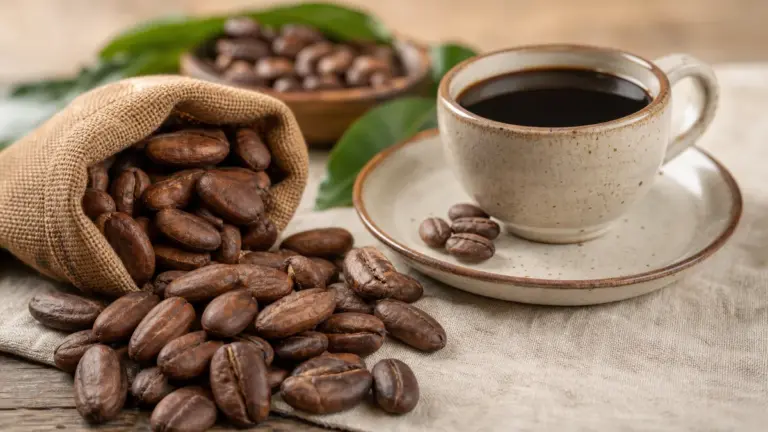
Vietnamese coffee is best known for full-bodied robusta, often with chocolatey, nutty flavours and a firm bitter finish, especially when dark roasted and brewed through a phin filter. Vietnam is the world’s largest robusta producer and second-largest coffee producer overall, but its higher-grade robustas and highland arabicas offer considerably more variety than that familiar strong, sweet iced drink suggests.
In short
- Start with the species: choose robusta for a substantial, chocolate-led cup; investigate Vietnamese arabica if you prefer a brighter style.
- Look beyond the country name: growing area, processing method and roast are more useful buying clues than “Vietnamese coffee” alone.
- Harvest is generally towards the year’s end: Sucafina lists November to January for the Central Highlands and October to January for northern Vietnam.
- Fine robusta is about assessed quality: it is not a separate species, a roast level or simply another name for large beans.
- Separate origin from preparation: Vietnamese-grown coffee need not be served with condensed milk, and a Vietnamese-style drink does not establish where its beans grew.
What does Vietnamese coffee taste like?
The familiar Vietnamese robusta style is substantial rather than delicate: chocolate, roasted nuts and a pronounced bitter edge, particularly in darker roasts. In a traditional iced milk coffee, those flavours meet the thick sweetness of condensed milk. The finished drink tells you about the recipe and roasting as well as the beans.
Better-selected robusta can be more nuanced. For example, importer Sucafina describes its Vietnamese Gánh offering with chocolate, honey and caramelised-nut notes. That is the supplier’s description of a particular coffee, not a promise that every Vietnamese robusta will taste the same.
Arabica provides another route into the origin. Vietnamese exporter Glogimex describes selected coffees from Cau Dat and Son La with jasmine, stone-fruit and cocoa notes, alongside a bright, clean character. Again, these are commercial descriptions of selected offerings, not independent tasting results or a national flavour specification.
For a useful first comparison, ask a roaster for a clearly identified Vietnamese robusta and arabica. Taste them without additions before deciding how you prefer to drink them. Treat “strong” as an incomplete description: ask whether the seller means bitterness, roast intensity or a concentrated brew.
Vietnam belongs within the wider variety covered by East and Southeast Asian coffee, rather than representing a single regional taste.
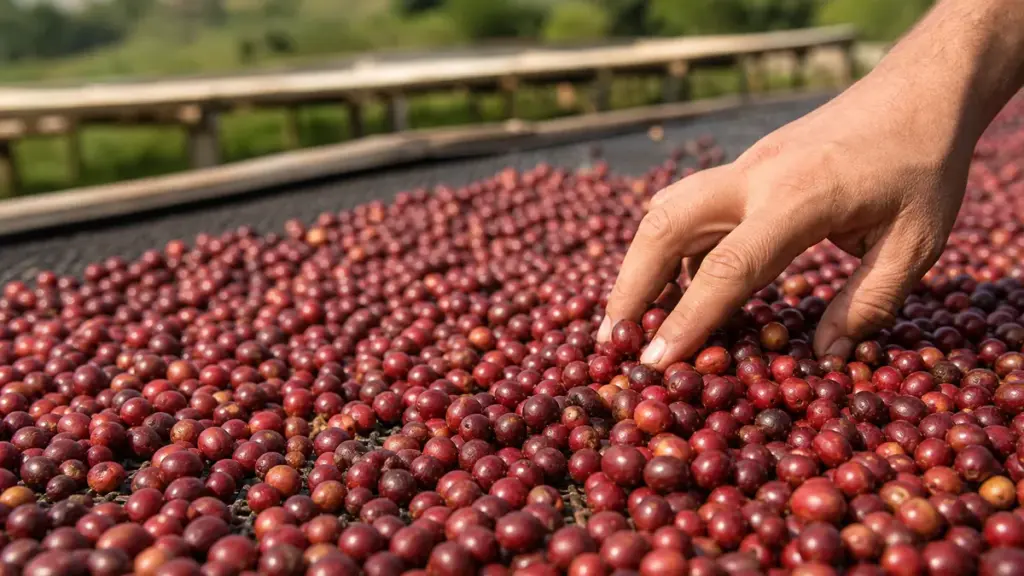
Vietnam coffee fact panel
These are orientation points, not specifications for every farm. Altitudes and harvest windows vary by location; flavour descriptions refer to the cited offerings.
| Feature | What to know | Source |
|---|---|---|
| Growing altitude | Sucafina gives an indicative Vietnamese coffee-growing range of 500 to 1,500 metres above sea level. This is not a nationwide minimum and maximum. | S7 |
| Main species and varieties | Robusta, Coffea canephora, dominates; Vietnamese selections include TR4. Arabica, Coffea arabica, includes Catimor, with Typica and Bourbon also listed in trade references. | S4, S5, S6, S7 |
| Main processing methods | Natural processing predominates in robusta. Washed and natural arabicas are established; honey-processed arabica is also offered. | S3, S7, S9 |
| Harvest months | Central Highlands: generally November to January. Northern Vietnam: generally October to January. These are indicative windows, not fixed dates. | S7, S8 |
| Typical cup orientation | Selected robusta: chocolate, honey, caramelised nuts and substantial body. Selected arabica: brighter cups with cocoa, stone-fruit or floral notes. | S8, S9 |
The world’s robusta powerhouse
USDA’s production dashboard lists Vietnam second behind Brazil for 2025/26, at 31.7 million 60 kg bags. Keep the year attached to the figure: a coffee marketing year is not the same as a calendar year.
The USDA Foreign Agricultural Service’s May 2026 Coffee Annual forecast 32.5 million bags for Vietnam in 2026/27, comprising 31.4 million robusta and 1.1 million arabica. These are forecast quantities expressed as green bean equivalent, not a final count of a completed harvest.
The distinction matters when comparing reports. Production estimates can be revised, and exports are not interchangeable with production. World Coffee Research separately identifies Vietnam as the largest robusta producer.
For the drinker, national scale is background, not a quality grade. A production total cannot tell you whether an individual bag contains carefully selected ripe cherries, well-managed processing or the roast style you enjoy. Judge the coffee using its own traceability and preparation information.
The Central Highlands and Vietnam’s arabica areas
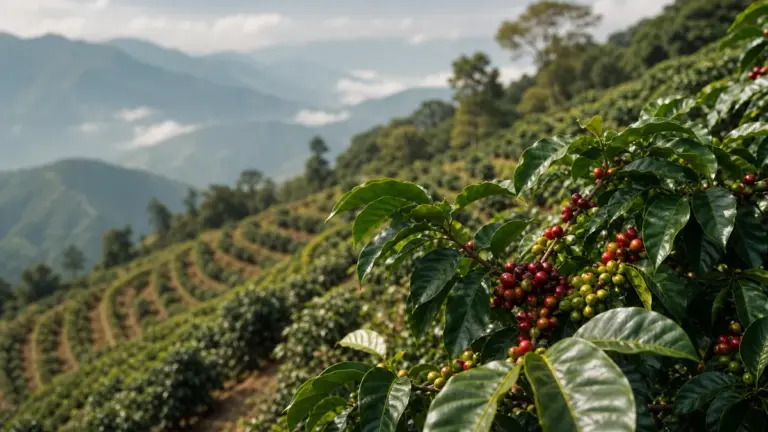
The Central Highlands, also called Tay Nguyen, are the centre of Vietnam’s coffee industry. The ICO’s country profile describes extensive basalt-soil plateaus here, with established coffee-growing areas including Dak Lak, Lam Dong and Gia Lai.
Buon Ma Thuot, in Dak Lak, is particularly associated with robusta. It is a useful name to recognise on a bag, but still ask for the producer or supplying group, process and roast. A broad geographical description leaves plenty unanswered.
Arabica has an established place in Lam Dong and in the northern growing areas of Son La and Dien Bien. It is therefore misleading to describe Vietnamese arabica as a completely new arrival. The newer development is greater attention to selected lots, processing and specialty preparation.
Nor should “growing interest in arabica” be confused with continuously expanding arabica acreage. World Coffee Research reports investment in specialty arabica, while USDA’s May 2026 assessment describes arabica area as stable.
For a neighbouring-country comparison, read coffee from Laos. Keep each country’s growing areas and coffees distinct rather than assuming that proximity makes them interchangeable.
Species, varieties and processing
Robusta is not one uniform planting
Robusta is the trade name associated with Coffea canephora, a different species from Coffea arabica. Within robusta there are selected cultivars, not just an undifferentiated category of “strong coffee”.
World Coffee Research records TR4 as a Vietnamese clonal selection developed through the Western Highlands Agroforestry Science Institute, usually abbreviated to WASI. A clone is propagated vegetatively from a selected plant, preserving its genetic identity. This is different from a region name or a processing description.
If a seller supplies a cultivar name, treat it as useful information rather than a flavour guarantee. Ask what the actual lot tastes like and how it was assessed. Do not rank two bags solely because one has a more detailed botanical label.
Processing changes what reaches the roaster
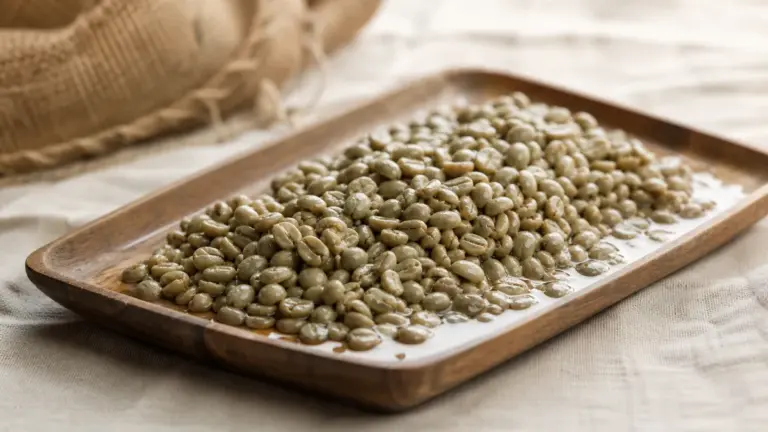
Natural processing means drying the harvested coffee fruit before removing its dried outer layers. The ICO identifies dry processing as Vietnam’s predominant approach, while Sucafina also lists washed and natural arabica.
Washed processing removes the fruit covering before the coffee finishes drying. Honey processing retains some of the sticky fruit material, called mucilage, during drying; the name does not mean honey has been added. Glogimex’s Vietnamese arabica offering includes both washed and honey processes.
Selective harvesting and post-harvest control are receiving more attention among producers supplying differentiated coffees, according to Sucafina. Some also experiment with yeast, enzyme or anaerobic fermentation, meaning fermentation under restricted oxygen conditions.
An experimental process name is a reason to ask questions, not automatic evidence of excellence. Request an intelligible flavour description and, where possible, taste the coffee before committing to a larger order.
Vietnam’s processing story should not be substituted for that of Indonesian coffee. Read the process description on the particular bag rather than applying a general “Asian coffee” label.
What fine robusta actually means
Fine robusta describes quality assessed through robusta-specific grading and tasting protocols. It is neither a separate botanical category nor a claim that robusta must imitate arabica.
The Coffee Quality Institute’s 2019 Fine Robusta Standards and Protocols specify, among other requirements:
- Zero primary defects and no more than five secondary defects in a 350 g green coffee sample.
- A final cupping score of 80.00 or above.
These are selected requirements, not the complete standard. A score alone does not establish compliance with every green, roasted and sensory criterion.
For buyers, the useful questions are practical: who evaluated this lot, under which protocol, and can the supplier provide the assessment? A large bean size or an attractive “premium” description is not a substitute.
Use the claim as a starting point for investigation. If the coffee appeals to you, look for traceability and a description of its sweetness, aftertaste and mouthfeel, not simply a prominent score.
Phin and iced coffee culture
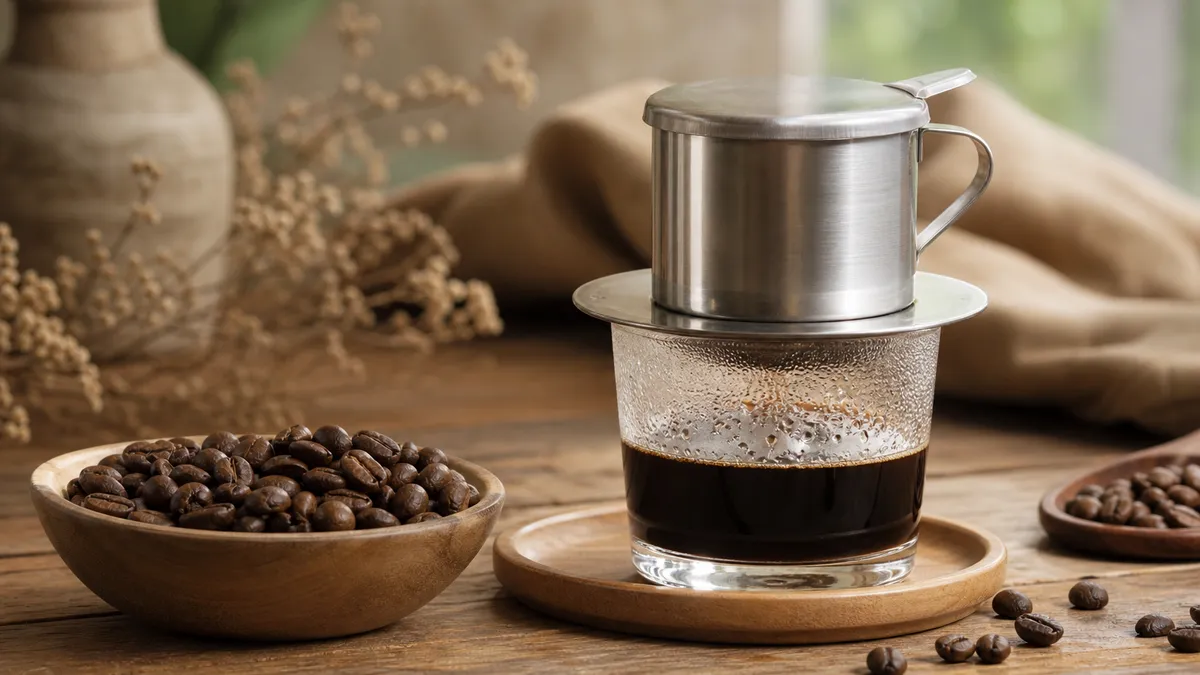
The phin is a small metal filter that sits above a cup or glass, allowing coffee to drip through under gravity. It connects the beans to one of Vietnam’s most recognisable drinking traditions without requiring an espresso machine.
Cà phê sữa đá combines coffee, sweetened condensed milk and ice. Its appeal lies in contrast: concentrated, bitter-edged coffee against creamy sweetness and cold dilution. Vietnam’s coffee culture also includes egg coffee associated with Hanoi and salted-cream coffee associated with Hue.
These preparations are part of the origin’s story, not its boundaries. Vietnam’s national tourism authority also describes contemporary cafés working with high-grade robusta, highland arabica and modern brewing methods alongside the phin.
Start with the drink you want to make, then choose an appropriate coffee. For a condensed-milk iced drink, ask the roaster for a coffee intended for that preparation. For tasting the origin itself, request a traceable coffee suitable for drinking black.
Choosing Vietnamese coffee in the UK
Use the following checklist before ordering:
- Confirm what “Vietnamese” means. Ask whether it identifies the beans’ growing country or the intended drink style.
- Check the species. Look for robusta, arabica or a clearly explained blend.
- Ask for location and process. A named growing area and processing description are more useful than an unexplained national label.
- Match the roast and grind to your equipment. Tell the roaster whether you use a phin, filter brewer or espresso machine.
- Read ingredients separately from tasting notes. Chocolate as a flavour description is not the same as cocoa added during preparation or roasting.
For broader exploration, coffee from the Philippines is another useful next origin. Keep your tasting notes specific to each coffee rather than trying to decide which country produces the single “best” cup.
FAQ
Is Vietnamese coffee always served with condensed milk?
No. Condensed-milk iced coffee is a famous Vietnamese preparation, not a requirement for drinking Vietnamese-grown beans. The country also has a specialty café scene using robusta and arabica with different brewing methods. When buying coffee, separate the origin, roast and suggested recipe so you know which part of the experience you are choosing.
Do I need a phin to try Vietnamese coffee?
No. A phin lets you explore a distinctive Vietnamese preparation, but the beans are not restricted to that brewer. Tell your roaster which equipment you have and ask for a suitable roast and grind. Buying a phin makes sense if you specifically want to investigate the slow-dripping preparation, rather than simply taste coffee grown in Vietnam.
Does “chocolatey” mean the coffee contains chocolate?
Not necessarily. Suppliers use chocolate and cocoa as sensory descriptions of coffee, including Vietnamese robusta. However, Vietnam’s tourism authority also describes preparations involving butter or cocoa during roasting. If ingredients matter to you, check the ingredient declaration or ask the producer directly rather than relying on the tasting notes.
Where to go next
Read East and Southeast Asia to place Vietnam within the wider region, then Indonesia to investigate another major coffee origin without confusing their processing traditions. Continue with Laos or Philippines to broaden your comparisons beyond Vietnam’s robusta-led industry.
Sources
Supplier descriptions below are used as attributed examples, not independent tasting evidence.
-
S1. USDA Foreign Agricultural Service, Production: Coffee, live dashboard, 2025/26 production series, retrieved November 2026.
https://fas.usda.gov/data/production/commodity/0711100 -
S2. USDA Foreign Agricultural Service, Coffee Annual: Vietnam, report VM2026-0016, 20 May 2026.
https://apps.fas.usda.gov/newgainapi/api/Report/DownloadReportByFileName?fileName=Coffee%20Annual_Ho%20Chi%20Minh%20City_Vietnam_VM2026-0016.pdf -
S3. International Coffee Organization and Vietnam Coffee-Cocoa Association, Country Coffee Profile: Vietnam, ICC-124-9, 4 March 2019.
https://www.ico.org/documents/cy2018-19/icc-124-9e-profile-vietnam.pdf -
S4. World Coffee Research, Vietnam, undated country profile, retrieved November 2026.
https://worldcoffeeresearch.org/countries/vietnam -
S5. World Coffee Research, History of Robusta, undated online varieties catalogue reference, retrieved November 2026.
https://varieties.worldcoffeeresearch.org/robusta-2/history-of-robusta -
S6. World Coffee Research, TR4, undated online varieties catalogue entry, retrieved November 2026.
https://varieties.worldcoffeeresearch.org/varieties/tr4 -
S7. Sucafina, Handbook 2024/2025, Asia-Pacific overview and Vietnam entries, 2024/2025 edition.
https://sucafina.com/na/lp/sucafina-origin-handbook -
S8. Sucafina, Gánh: Sucafina Originals, undated offering and origin information, retrieved November 2026.
https://sucafina.com/emea/offerings/ganh-sucafina-originals -
S9. Glogimex, Vietnamese Arabica, undated supplier offering, retrieved November 2026.
https://glogimex.vn/en/arabica/ -
S10. Coffee Quality Institute, Fine Robusta Standards and Protocols, 2019 edition, retrieved from SCITH’s hosted copy.
https://www.scith.coffee/wp-content/uploads/2021/03/Fine-Robusta-Standards-Protocols.pdf -
S11. Coffee Quality Institute, FAQs, processing-course and quality-system information, undated, retrieved November 2026.
https://www.coffeeinstitute.org/about/faqs -
S12. Viet Nam National Authority of Tourism, A taste of Vietnam: The story behind its beloved coffee culture, undated, retrieved November 2026.
https://vietnam.travel/things-to-do/taste-vietnam-story-behind-its-beloved-coffee-culture/
This article was researched from production reports, origin references, botanical catalogues, published grading protocols and attributed supplier descriptions, without first-hand tasting or testing.
Last checked: November 2026