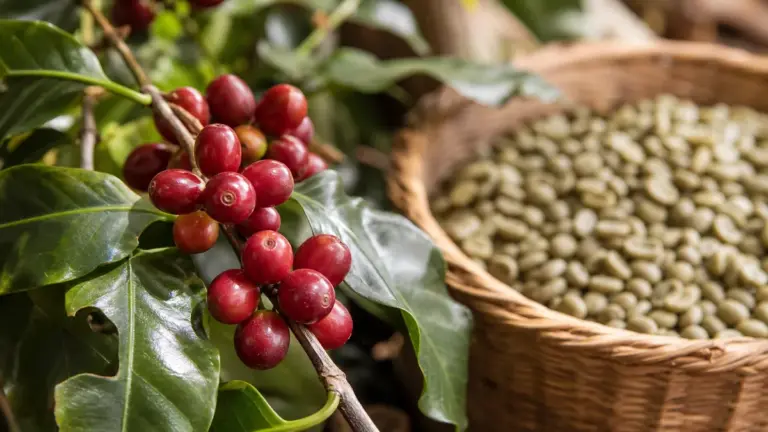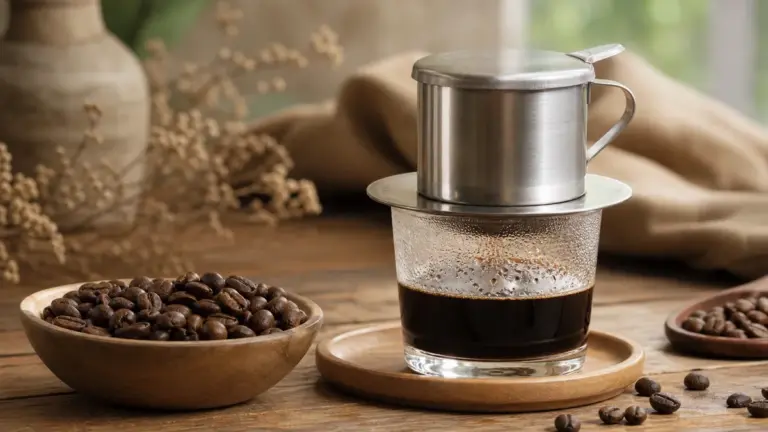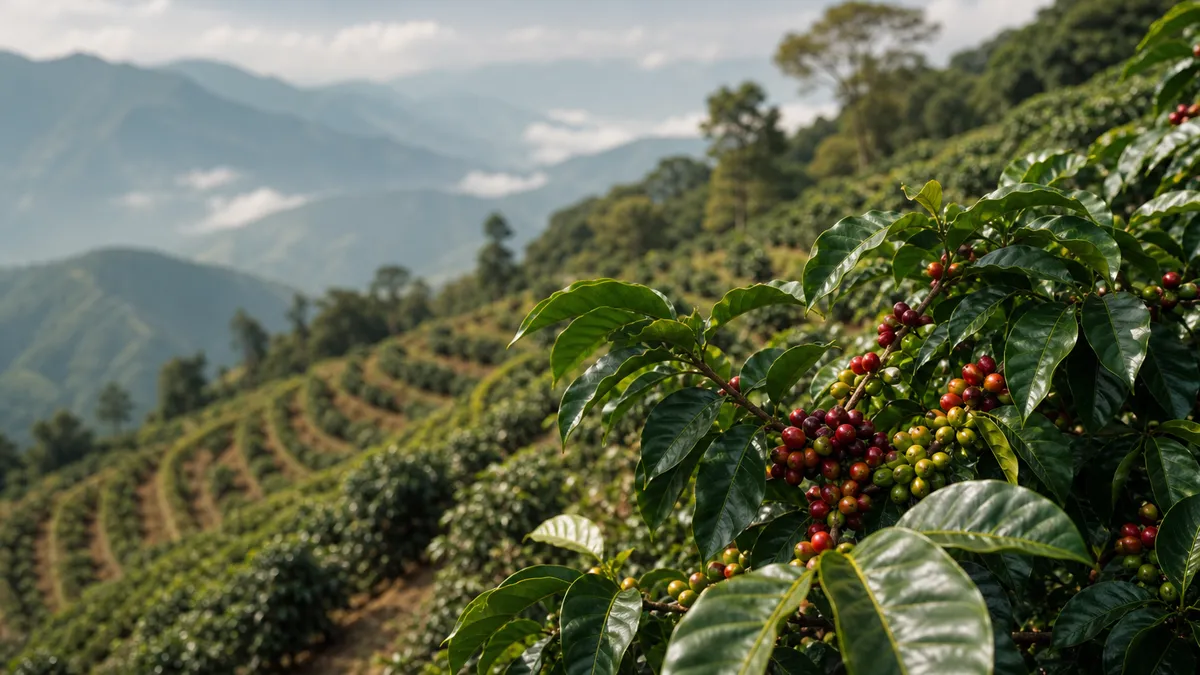
Chinese coffee from Yunnan can offer chocolate, nuts and caramel alongside citrus, tea-like or fruit notes, depending on the lot and roast. Catimor dominates production, but this is no longer simply an origin for anonymous blending coffee: named farms are developing distinctive lots through careful processing and a wider choice of varieties.
In short
- Pu’er, Baoshan, Dehong and Lincang are the principal producing areas. Dali belongs in the story, particularly for its historic coffee plantings, but should not be presented as an equally large production centre.
- A 2022 research paper reported Catimor 7963 at about 90% of cultivation. That is a dated cultivation estimate, not a verified current share of production.
- A useful broad altitude guide is 1,000 to 2,000 metres, although documented growing sites fall outside it.
- The main harvest is commonly given as November to March, with variation between farms.
- Look for the producer, variety and processing method, rather than treating “Yunnan” as a single flavour.
Yunnan coffee at a glance
Yunnan is China’s main coffee-growing province. Its coffee sector is predominantly arabica, with Catimor forming the foundation and smaller plantings of other varieties supplying an increasingly varied specialty offering.
| Feature | Origin fact panel |
|---|---|
| Growing altitude | Broad guide: 1,000 to 2,000 metres, according to USDA. This is not a province-wide minimum and maximum. |
| Main varieties | Catimor, particularly the 7963 line; smaller plantings include Typica and Bourbon. Geisha appears prominently among recent competition lots. |
| Processing | Washed, natural and honey, alongside anaerobic and yeast-inoculated experiments. |
| Main harvest | November to March in Starbucks Coffee Academy’s origin guide; Sucafina lists October to March for its Tianjiao lot. |
| Cup profile | Chocolate, nuts and caramelised notes are useful starting points. Selected lots also show citrus, floral, tea-like, stone-fruit or fermented-fruit characteristics. |
The regional context is covered in east and southeast asian coffee. Here, the most useful distinction is between Yunnan’s broad commercial production and the individual farm lots now sold with much more detailed information.
For a first purchase, start with a named producer and a processing description you understand. A washed Catimor is a sensible introduction before exploring heavily fermented naturals or unusual varieties.
Where coffee grows in Yunnan
Pu’er
Pu’er is one of Yunnan’s principal coffee-producing areas and an important centre for buying, processing and technical support. Nestlé’s published account describes a demonstration farm, agronomy assistance and a buying station established there during the early 1990s.
Look beneath the prefecture name on a bag. Menglian and Lancang, for example, appear as more specific origins within Pu’er in recent competition records. That extra detail helps distinguish a traceable lot from a broad regional designation.
Baoshan
Baoshan’s Lujiang valley is an established coffee-growing area. FAO’s account of Xinzhai village describes a dry-hot valley setting between the Gaoligong mountains and the Nujiang river, with a substantial change in elevation across the village.
It is also a useful warning against buying on altitude alone. Local conditions matter: FAO describes research used to establish an altitude band for Baoshan’s geographical indication, rather than assuming that the highest available ground must produce the best coffee.
Dehong and Lincang
Dehong and Lincang are also principal producing areas. Dehong has a longstanding agricultural research role: its tropical crops research institute is the selection institution named in the official record for Catimor CIFC7963 (F6).
Lincang’s specialty potential is visible in competition results. The winning coffee in the 2026 Gems of Yunnan selection came from Lincang, as did another of the highest-scoring entries. These are achievements by particular producers, not evidence that every Lincang coffee shares their quality.
Dali and the wider province
Dali deserves inclusion, but with the right emphasis. Its Zhukula village, in Binchuan county, is associated with historic coffee plantings. An official forestry-government report distinguishes this heritage destination from the main producing areas of Pu’er, Baoshan, Lincang and Dehong.
Yunnan’s coffee geography extends beyond those names. Xishuangbanna appears in Starbucks’ origin guide and among the leading entries in the 2026 competition. A short list of prefectures is therefore a starting map, not an exhaustive boundary.
Why Catimor dominates
Catimor is a family of cultivated arabica varieties, not one genetically uniform variety. World Coffee Research explains that different lines of the rust-resistant Timor Hybrid were crossed with Caturra to produce compact plants with resistance to coffee leaf rust, a fungal disease.
In Yunnan, the 7963 line became especially important. A 2022 sensory study described Catimor 7963 as representing about 90% of cultivation. The official Chinese germplasm record names Catimor CIFC7963 (F6) and identifies its Portuguese source and Dehong selection institution.
The distinction between cultivation and production matters. That research figure should not be rewritten as “more than 90% of today’s harvest”, nor does it establish an exact current share for every Catimor line.
Its dominance makes agricultural sense. Disease resistance, productive capacity and manageable plant size matter to growers as much as tasting potential matters to buyers. USDA identifies resistance to diseases such as leaf rust as a reason Catimor remains common.
However, “Catimor” is not a verdict on the cup. The 2026 Gems of Yunnan results include a slow-dried natural Catimor scoring 88.53. A variety name tells you something about the plant, but it does not replace an assessment of the finished lot.
From production growth to a specialty shift
Yunnan’s modern coffee expansion developed through agricultural research, technical assistance and commercial buying. A contemporary FAO report, published in 1992, records a UNDP-assisted programme and Catimor introductions available for evaluation. Nestlé’s own account describes its early-1990s investment in farm demonstrations, agronomy and procurement.
These sources establish the development period more securely than a simplified story in which one organisation introduced one variety on one decisive date.
The specialty shift now has measurable evidence. Yunnan’s Department of Agriculture and Rural Affairs reported that the province’s “specialty rate” increased from 8% in 2021 to 41.7% in 2025. Treat those as regional reporting figures: the retrieved account does not provide enough methodological detail to equate them with an independently audited international grading exercise.
Competition results provide a different, narrower measure. Alliance for Coffee Excellence’s 2026 Gems of Yunnan selection awarded the winning washed Geisha from Lincang 91.78 points. The results also document washed, natural, honey and experimental lots from several producing areas.
Neither dataset means that all Yunnan coffee is specialty coffee. Together, however, they support a clear change: the province now supplies identifiable, quality-focused lots alongside its established commercial production.
Variety diversification is part of that change. USDA reported growers planting Bourbon and Typica in response to demand for higher-quality coffee, while recent competition records confirm Geisha plantings. These are additions to Yunnan’s production base, not evidence that Catimor has already been displaced.
Processing experiments and what they change
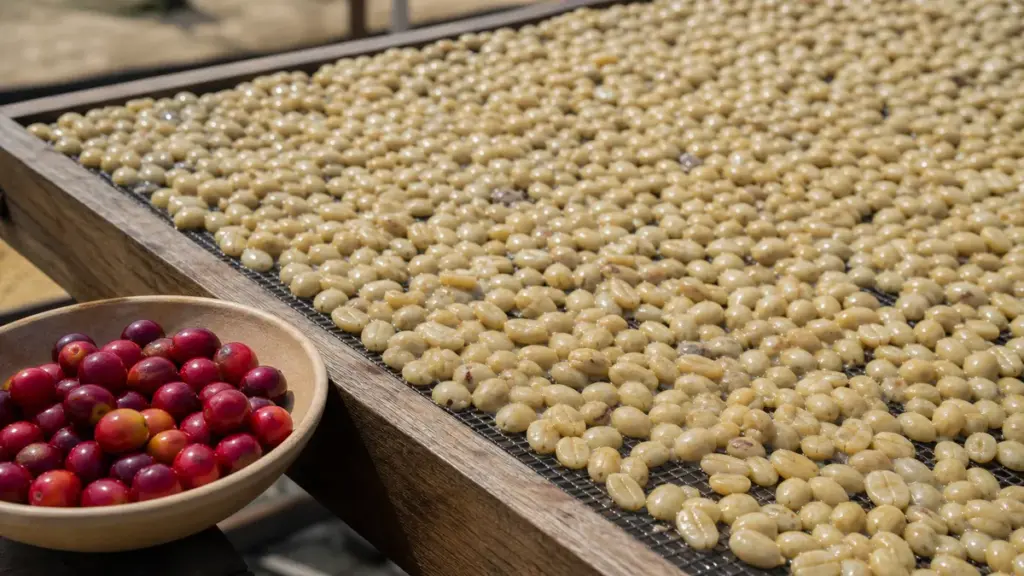
Processing is the work between picking the coffee fruit and preparing the dried seed for milling. Yunnan offers the familiar main approaches:
- Washed: the fruit and sticky mucilage surrounding the seed are removed before drying.
- Natural: the coffee dries inside the whole fruit.
- Honey: the skin is removed, but some mucilage remains during drying. The name describes the sticky fruit layer, not an addition of honey.
Experimental fermentation can sit within these categories rather than replace them. An “anaerobic natural”, for example, may undergo fermentation in a sealed container before the whole fruit is dried.
Sucafina documents this approach at Tianjiao and NanBanghe farms in Pu’er. Its lot description records sealed-container fermentation followed by drying on raised beds. This is a specific producer’s method, not a standard recipe followed throughout Yunnan.
Yeast inoculation means deliberately adding a selected yeast culture. Controlled research using Yunnan Catimor has compared yeast and bacterial starter treatments, examining changes in processing and flavour chemistry. Such experiments support the possibility of modifying flavour, but do not establish that every inoculated commercial lot will taste better.
Wine-yeast processing also appears in merchant descriptions. Tasse Coffee Roastery, for example, lists a Baoshan Catimor from Cong Gang farm as a natural processed with wine yeast. That is a supplier’s account of the lot, not independent verification of its fermentation.
For buyers, the useful questions are straightforward: what was fermented, which culture was added, how was oxygen managed, and how was the coffee dried? A dramatic process name is less informative than a clear answer.
What does Yunnan coffee taste like?
Chocolate, hazelnut and caramelised notes are reasonable starting expectations, but not a complete description. A 2022 descriptive sensory study examined coffees from different Yunnan growing areas and roast levels, identifying substantial variation rather than one fixed provincial flavour.
For a more fruit-led example, Sucafina describes its Tianjiao anaerobic natural with blackcurrant, tropical fruit, plum and molasses notes. Those are the importer’s descriptors for that lot, not promises attached to every Yunnan natural.
Our buying view: choose the flavour description first and the novelty second. If you want a rounded everyday coffee, look for chocolate, nuts and caramel on the roaster’s tasting notes. If you enjoy conspicuous fermentation, seek a clearly documented experimental lot rather than assuming that all Chinese coffee will provide it.
For a neighbouring-origin comparison, read thailand and myanmar, but compare named lots rather than assigning each country a single taste.
Choosing Yunnan coffee in the UK
Use this checklist when reading a roaster’s listing:
- Find the producer or processing station. Prefer information that goes beyond “China” or “Yunnan”.
- Check the variety. Distinguish a Catimor lot from Typica, Bourbon or Geisha.
- Read the full process description. “Natural” and “wine-yeast natural” are not interchangeable descriptions.
- Match the roast and tasting notes to your intended drink. Ask the roaster whether the coffee is intended for filter, espresso or both.
- Ask for the crop or harvest information. Use the published harvest season as context, not as a guaranteed UK arrival date.
For a workplace, request a sample before committing to a regular supply. Judge the actual coffee in the drinks your colleagues use, rather than selecting it solely because the origin is unfamiliar.
The strongest reason to try Yunnan coffee is its increasing range. Choose a traceable lot that suits your palate, then use a different process or variety for your next comparison.
FAQ
Is Yunnan coffee robusta because Catimor has hybrid ancestry?
No. World Coffee Research places Catimor cultivars within its arabica catalogue and explains their Caturra and Timor Hybrid parentage. That breeding history does not make a bag of Yunnan Catimor equivalent to a bag of robusta. For buying purposes, look for the named cultivar and the lot’s sensory description rather than reducing its identity to one ancestor.
Does wine-yeast processing mean wine has been added?
Not necessarily: a wine yeast is a fermentation culture, not wine itself. However, the label alone does not establish the full processing method or rule out other additions. Ask the roaster for the producer’s description. A precise account of ingredients and fermentation is more useful than drawing conclusions from “winey” tasting notes.
Should I avoid a Yunnan coffee if no cupping score is shown?
No. A missing score is not a reason by itself to reject a coffee. Use traceability, a clear processing description and the roaster’s explanation of flavour as your first filters. Published competition results demonstrate what selected lots achieved, but should not become a requirement for an enjoyable everyday purchase.
Where to go next
Read East and Southeast Asia for the wider regional context, then Thailand and Myanmar to explore neighbouring origins. Timor-Leste is another useful next read for building an Asian coffee comparison without treating the region as one flavour category.
Sources
-
USDA Foreign Agricultural Service, Coffee: World Markets and Trade, December 2024. Growing areas, broad altitude range, Catimor dominance and diversification into Bourbon and Typica.
https://fas.usda.gov/sites/default/files/2024-12/coffee.pdf -
Starbucks Coffee Academy, China origin sheet, undated, retrieved November 2026. Main growing areas, varieties, processing and harvest season.
-
Ma et al., Characterization of sensory properties of Yunnan coffee, Current Research in Food Science, 2022. Cultivation estimate for Catimor 7963 and descriptive sensory research.
https://pmc.ncbi.nlm.nih.gov/articles/PMC9386398/ -
World Coffee Research, Arabica Coffee Varieties: Caturra, undated live catalogue entry. Catimor family and parentage.
https://varieties.worldcoffeeresearch.org/varieties/caturra -
China Tropical Crops Germplasm Resources Information Network, Catimor CIFC7963 (F6), 2019. Official cultivar name, source, selection institution and agronomic characteristics.
https://www.ctcgris.cn/en/node/245 -
FAO, D. J. Walyaro, Coffee Production and Processing in Yunnan, P.R. China, technical report UNDP/CPR/86/016, February 1992. Contemporary evidence of the development programme and variety introductions.
https://www.fao.org/4/ar794e/ar794e.pdf -
Nestlé, Nestlé in China: Creating Shared Value 2013, 2013. Company account of early-1990s farm demonstrations, technical assistance and procurement.
https://www.nestle.com/sites/default/files/asset-library/documents/library/documents/corporate_social_responsibility/nestle-china-csv-report-2013.pdf -
Yunnan Department of Agriculture and Rural Affairs, Yunnan coffee follows a specialty-led path to greater value [translated title], 30 June 2026. Reported specialty-rate figures for 2021 and 2025.
-
Alliance for Coffee Excellence, Gems of Yunnan 2026, 2026. Competition scores, producers, locations, varieties and processes.
https://allianceforcoffeeexcellence.org/gems-of-yunnan-2026/ -
National Forestry and Grassland Administration, Yunnan’s Zhukula village: a century of coffee fragrance [translated title], 19 June 2025. Dali’s coffee heritage and distinction from the main producing areas.
https://www.forestry.gov.cn/c/www/dfdt/630434.jhtml -
FAO, Development of GI-protected Baoshan Arabica coffee in Xinzhai village, Baoshan city, Yunnan province of China, 2022. Geography, elevation variation and altitude-related research.
https://www.fao.org/one-country-one-priority-product/asia-pacific/good-practices/detail/coffee-xinzhai-baoshan-yunnan-china/en -
Yunnan Agricultural University and collaborators, Flavor modulation of fermented degummed coffee beans by ultrasound and ultra-high pressure: metabolomic and volatile profiles, Ultrasonics Sonochemistry, 2026. Controlled fermentation research using Yunnan Catimor.
https://pmc.ncbi.nlm.nih.gov/articles/PMC13330653/ -
Sucafina, Tianjiao Pu’er Anaerobic Natural, undated live lot description. Producer-specific fermentation, drying, harvest and claimed tasting notes.
https://sucafina.com/na/offerings/tianjiao-pu-er-anaerobic-natural -
Tasse Coffee Roastery, Yunnan Wine Yeast Fermentation, merchant listing on Shop, undated. Supplier-described wine-yeast natural from Cong Gang farm, Baoshan.
https://shop.app/products/8847392047387/yunnan-wine-yeast-fermentation -
Sucafina, Coffee Processing Primer, 2019. Definitions of washed, natural and honey processing.
https://www.sucafina.com/NA/news/coffee-processing-primer
This article was researched using government and agricultural records, contemporary development reports, peer-reviewed studies, competition results and clearly attributed supplier descriptions; no first-hand tasting is claimed.
Last checked: November 2026