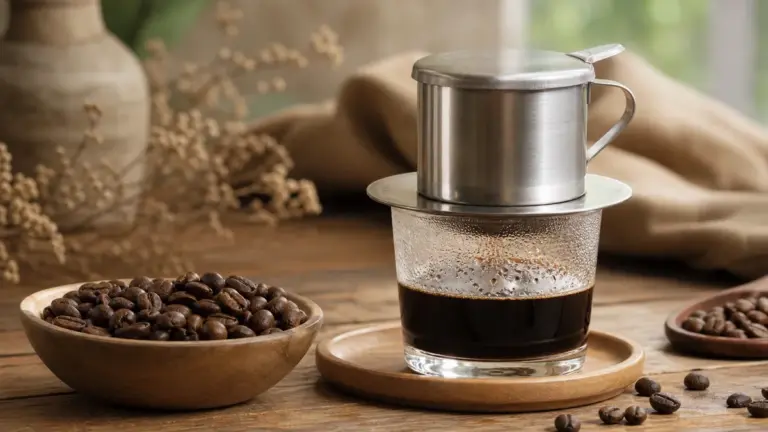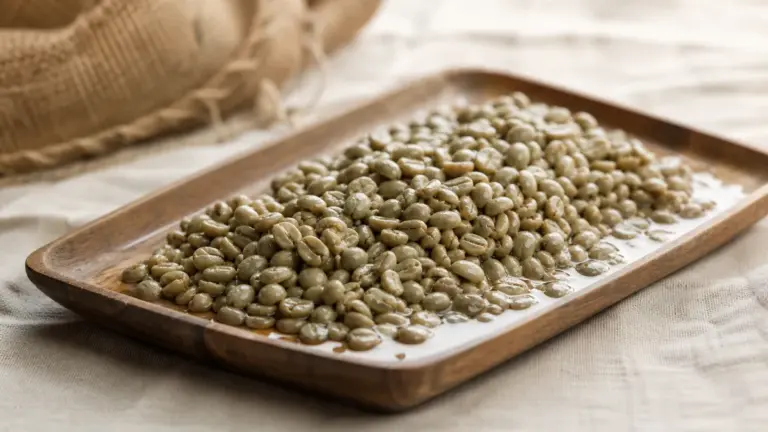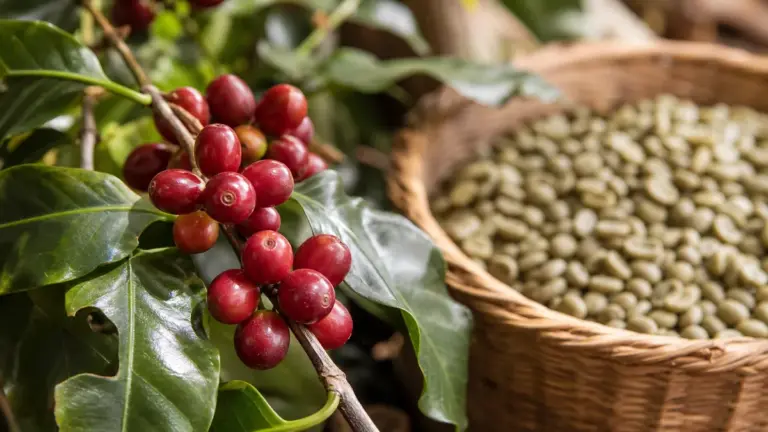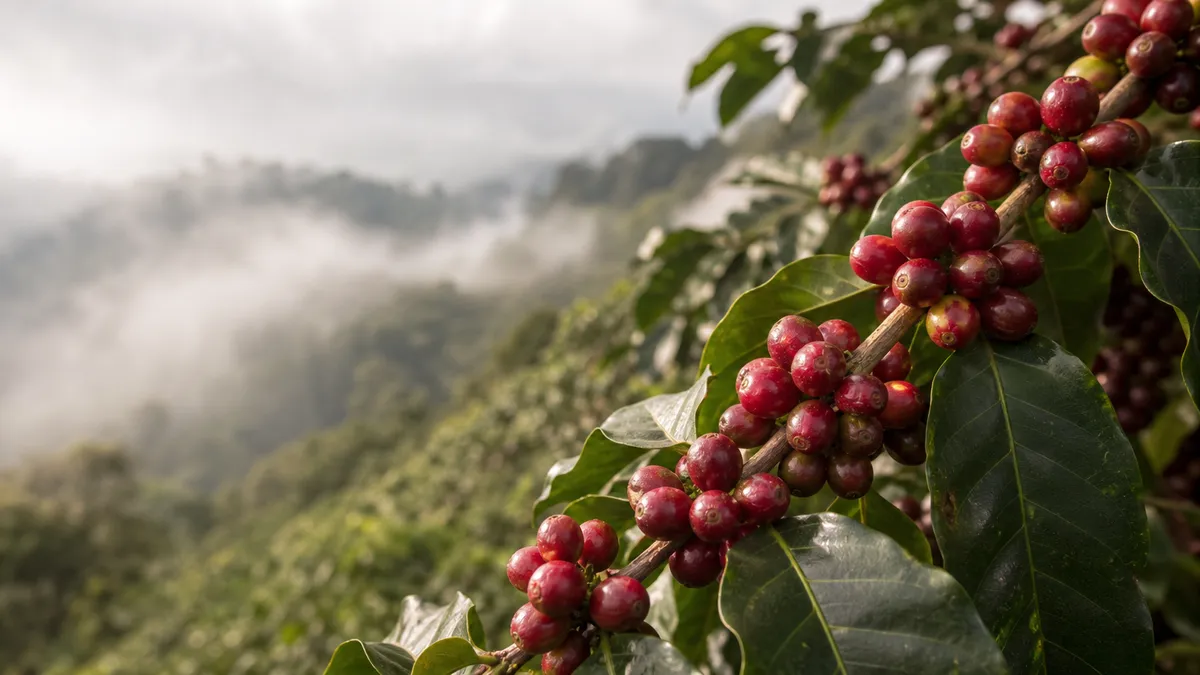
Coffee from Thailand and Myanmar can be sweet, chocolatey and gently citrus-led, or distinctly fruity and floral, depending on the region and processing. Start by separating northern Thailand’s highland arabica from southern Thailand’s fuller-bodied robusta, then explore Myanmar’s specialty arabicas from Shan State and the hills around Pyin Oo Lwin.
In short
- Look for a named producer, growing area and processing method, not just a country name.
- Northern Thai arabica is generally harvested from November to March, with local differences; Myanmar’s main specialty harvest commonly runs from December to March.
- Washed lots are a useful starting point for comparing origins; natural lots offer another route into fruit-led profiles.
- Coffee has supported alternatives to opium cultivation in both countries, but these projects involve livelihoods and market access, not simply replacing one plant with another.
- Myanmar’s specialty progress needs to be understood alongside the conflict and human rights crisis following the military coup of 1 February 2021.
Thailand and Myanmar coffee at a glance
Neither country has a single reliable flavour signature. Species, variety, processing and roast all matter, so treat the profiles below as buying directions rather than promises about every bag.
Arabica is the species Coffea arabica. Robusta is the usual trade name for coffee from Coffea canephora, a different species, not a darker roast of arabica.
Origin fact panel
The altitude figures describe documented growing areas or research sites, not the complete limits of cultivation. Harvest months are indicative: the producer’s own crop information takes precedence.
| Detail | Northern Thailand | Southern Thailand | Myanmar specialty arabica |
|---|---|---|---|
| Growing areas | Chiang Rai and Chiang Mai are key reference points | Chumphon, Ranong, Surat Thani and Krabi | Ywangan in southern Shan State; Pyin Oo Lwin in Mandalay Region |
| Documented altitude | About 1,100 to 1,600 metres across the Chiang Mai and Chiang Rai areas described by exporter Movaci | 82 to 483 metres across four sites in a published southern Thai study | 1,200 to 1,550 metres for DRWakefield’s documented Ywangan sourcing area |
| Varieties and selections | Catimor-family material; Typica and Gesha also appear in specialty production | Robusta selections, including the officially approved Chumphon 2 cultivar | Catuai, S795, Catimor, Caturra and San Ramon in Ywangan; SL34 and other varieties around Pyin Oo Lwin |
| Processing encountered | Washed, natural, honey and experimental fermentation | Natural, washed and, among some quality-focused producers, honey and anaerobic natural | Washed, natural and honey |
| Indicative harvest | November to February in Movaci’s Chiang Rai areas; December to March in its Chiang Mai areas | December to January in James Hoffmann’s published country profile | December to March for Ywangan and Mandalay Coffee Group’s sourcing |
| Cup directions | Chocolate, citrus, stone fruit and floral notes | Fuller body, chocolate and spice; some carefully processed lots show tropical fruit | Washed chocolate, tea and citrus profiles; natural lots can show berries and stone fruit |
Sources for this panel include published research, Thailand’s Highland Research and Development Institute, producer specifications and importer lot records, detailed below. Supplier tasting notes describe their coffees, not independently established national averages.
For the wider regional picture, use east and southeast asian origins. These two countries are best understood as distinct origins within that region, not interchangeable examples of “Asian coffee”.
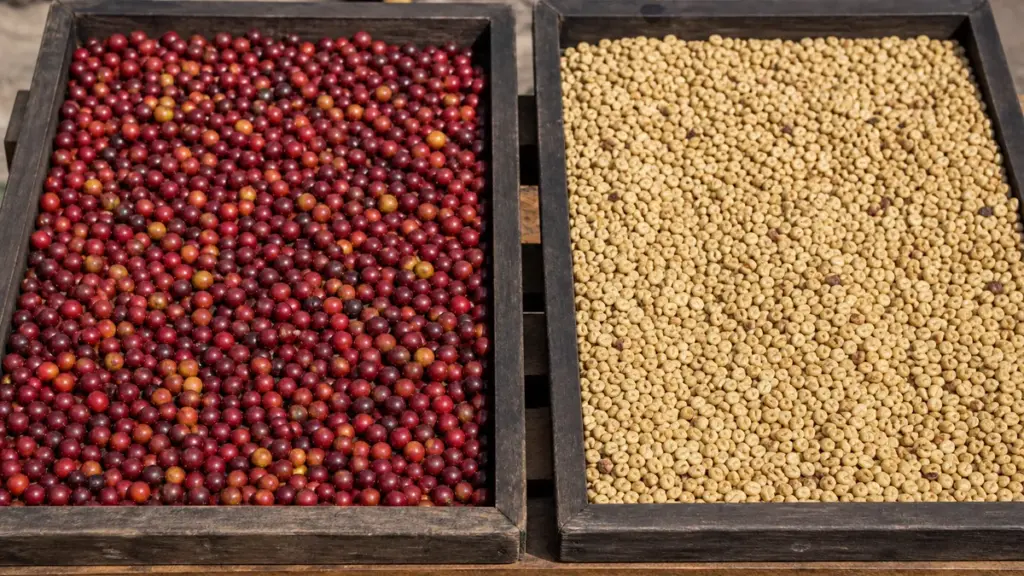
Northern Thailand: highland arabica with several expressions
Chiang Rai and Chiang Mai provide useful starting points for understanding Thai specialty arabica. Doi Chang and Doi Tung are growing-area names associated with Chiang Rai, while the hills around Doi Inthanon are part of Chiang Mai’s coffee geography. These names identify places, not botanical varieties.
The accessible end of northern Thai coffee is often sweet and rounded. Chocolate, nuts and citrus are useful descriptors to look for, but they do not capture everything: exporter Movaci also describes stone fruit and jasmine in its Chiang Rai sourcing.
Thailand’s Highland Research and Development Institute provides a more specific example. Its account of the Royal Project selections RPF-C3 and RPF-C4 reports citrus and lemon-tea notes for the former, and pineapple, almond and butter for the latter. Those are descriptions of particular selections under the reported evaluation conditions, not flavours guaranteed by the names.
For a first purchase, I would choose a washed lot with clear chocolate and citrus notes. That is an editorial preference rather than a quality ranking: it gives a straightforward reference before moving to fruitier naturals or more intervention-led fermentations.
To broaden the comparison beyond these mainland origins, read about philippine coffee. Keep the individual producer and process in view rather than assuming a broad regional label means identical flavour.
Southern Thailand: robusta deserves its own introduction
Southern Thailand’s coffee story is different. Research documents robusta cultivation in Chumphon, Ranong, Surat Thani and Krabi, including warm, low-altitude sites. It should not be described using a northern arabica fact sheet.
A fuller-bodied cup is one buying direction. Coffee Culture describes its washed, dark-roasted Chumphon robusta in terms of weight, earthy richness and crema, the foam on espresso. Producer Nine North Lake describes chocolate, spice and tropical fruit in its own Chumphon coffees, alongside natural, honey and anaerobic processing options.
These are commercial descriptions, so read them critically. A producer’s carefully sorted natural robusta and a dark-roasted blend component may share a country and species while offering very different drinking experiences.
The useful question is therefore not “Is Thai coffee arabica or robusta?” but “Which Thai coffee is this?” For espresso or milk drinks, ask for the actual lot’s roast guidance and tasting notes rather than buying on species alone.
Crop substitution: more than replacing opium with coffee
Coffee’s role in alternative development is central to northern Thailand’s modern coffee story. The Royal Project Foundation has promoted highland arabica for decades, while the separate Doi Tung Development Project began in 1988 and developed coffee and macadamia as alternatives within a wider livelihood programme.
Calling this simply “opium replaced by coffee” misses the mechanism. Farmers need knowledge, planting material, processing facilities and dependable buyers. The Mae Fah Luang Foundation’s account also emphasises health, education and livelihood development: coffee was part of a broader response to poverty and limited opportunity.
Myanmar has its own documented alternative-development work. The United Nations Office on Drugs and Crime describes support for former poppy-growing communities in Shan State, including coffee production and processing through the Green Gold Cooperative and access to international buyers.
These histories need careful language. A coffee-growing community is not necessarily a former opium-growing community, and a country-level development story does not establish the history of an individual farm.
When a bag makes a crop-substitution claim, look for a named cooperative, programme or producer. That is more meaningful than a general account of coffee “transforming lives”, especially if the seller cannot explain how the coffee was purchased.
For a separate neighbouring origin story, see lao coffee, rather than extending either country’s experience across the border.
Myanmar: specialty growth, with essential context
Myanmar’s specialty development was not the discovery of a previously coffee-free country. It was a change in how existing coffee could be harvested, processed, assessed and connected with buyers.
The Coffee Quality Institute records work with the USAID-funded Value Chains for Rural Development project from 2015. Activities included agricultural and processing training, tasting education, competitions, organisational development and market access. Winrock’s account also describes earlier Farmer-to-Farmer work beginning in 2013.
Shan State and Pyin Oo Lwin
Ywangan is a useful name to recognise on specialty bags. Mandalay Coffee Group lists Catuai alongside S795, Catimor, Caturra and San Ramon among the varieties cultivated by its Ywangan suppliers.
Do not expect every Myanmar coffee to be a fruit-heavy natural. DRWakefield describes one natural Ywangan Catuai with berry, peach, pear and orange notes, but its washed Pyin Oo Lwin coffee follows a different direction: chocolate, black tea and toffee.
That contrast is more useful than assigning Myanmar one national taste. It also explains why a newcomer can try the origin without committing to pronounced fermented-fruit flavours.
Why “rising origin” needs qualification
The military coup of 1 February 2021 and the subsequent crisis cannot be treated as background decoration. UN human rights reporting documents continuing violence and severe harm to civilians; coffee importer DRWakefield identifies disrupted trade routes and political uncertainty among the sector’s difficulties.
Earlier specialty successes therefore do not prove uninterrupted growth or dependable supply today. Nor does purchasing a bag, by itself, establish a particular social benefit.
For UK readers, a sensible approach is to ask who grew, processed and exported the coffee, and what the importer can substantiate about the trading relationship. Do not infer either ethical assurance or wrongdoing from nationality alone.
What processing changes in the cup
Processing is the work between harvesting coffee cherries and producing dried green beans ready for roasting. It helps explain why coffees from the same growing area can taste markedly different.
- Washed: the fruit pulp and mucilage, the sticky layer around the seeds, are removed before final drying.
- Natural: the coffee dries inside the whole cherry before the dried fruit layers are removed.
- Honey: the outer pulp is removed, but some mucilage remains during drying. The name does not mean honey has been added.
The explanation is more complex than fruit simply soaking into a bean. Research discussed by the Specialty Coffee Association identifies both microbial fermentation and changes in the living seed’s metabolism during processing. Those changes can alter compounds involved in flavour formation during roasting.
This supports a practical comparison: if possible, try washed and natural coffees from the same producer. Keep the roast and preparation reasonably comparable, and notice fruit character, sweetness, acidity and finish.
“Anaerobic”, meaning processing with limited or absent oxygen, is not a complete flavour description. Ask what was fermented, how the process was managed and whether anything was added. The process name alone cannot tell you whether you will enjoy the result.
How to choose a bag in the UK
Use traceability first, then sensory preference. A useful product description should identify the growing area, producer or producer group, species, processing method and roast date. Variety and harvest information add detail, but an honest mixed-variety description is preferable to unsupported precision.
For a first comparison, my suggested sequence is:
- Choose a washed northern Thai arabica with chocolate and citrus notes as your reference.
- Try a washed Myanmar arabica if you want to compare chocolate, tea or toffee-led descriptions.
- Move to a natural lot from either origin if berries, stone fruit or more pronounced fermentation character appeal.
- Explore southern Thai robusta separately, using the producer’s own profile rather than expecting it to resemble the arabicas.
This is a tasting route, not a ranking of countries or processes.
For deeper comparison, record the producer, variety, process and roast alongside your impressions. World Coffee Research’s Sensory Lexicon separates description from preference: recognising an aroma is not the same as deciding that it makes a coffee better.
Be particularly careful with Catimor. World Coffee Research explains that it is a family of related varieties, not one uniform variety. Its shared breeding background does not justify predicting a single flavour, and Thailand’s reported selection-specific profiles demonstrate why that shortcut is unhelpful.
The most revealing way to explore Thailand and Myanmar coffee is to compare identifiable lots, not national reputations. Buy the coffee whose documented character interests you, then let the next bag test your assumptions.
FAQ
Do fruit tasting notes mean fruit has been added?
No, fruit tasting notes do not by themselves indicate added ingredients. They usually describe aromas or flavours perceived in the coffee, using familiar foods as references. However, tasting notes are not an ingredient declaration. If avoiding additions matters to you, ask the roaster whether the lot was infused or co-fermented with other ingredients.
Is Doi Tung a coffee variety?
No, Doi Tung is a place name and the name associated with a development project and coffee business, not a botanical variety. Coffee from that area can have a separate variety description, such as Typica or Gesha. Read the origin and variety fields separately rather than treating every prominent name on a bag as a cultivar.
Must higher-grown coffee taste better?
No, altitude alone cannot establish that one coffee will taste better than another. Genetics, growing conditions, processing, storage, roasting and brewing all contribute to the sensory result. Altitude is useful context when comparing documented lots, but it is not a substitute for tasting information or a reason to dismiss southern Thailand’s lower-grown robusta.
Where to go next
Read East and Southeast Asia to place these origins within the wider region, then Laos for another mainland comparison. Philippines and Timor-Leste are useful next reads for expanding your understanding beyond mainland Southeast Asia.
Sources
-
Movaci Coffee, Specialty Thai Coffee & Tea, Sourced and Exported from Chiang Mai, undated live exporter profile, retrieved November 2026. Regional altitudes, harvest windows, processing and supplier-described profiles.
https://www.movaci.coffee/ -
Highland Research and Development Institute, New Arabica Coffee Varieties [Thai-language title: กาแฟอะราบิกาสายพันธุ์ใหม่], 22 September 2022. Royal Project research, RPF-C3 and RPF-C4 selections and reported sensory characteristics.
https://www.hrdi.or.th/articles/Detail/1544 -
Maneerat, E., et al., Impact of Seasonal Weather Variations on Physical Attributes of Robusta Coffee Beans, Indian Journal of Agricultural Research, volume 58, issue 6, 2024. Southern Thai research sites, altitudes and natural processing.
https://arccarticles.s3.amazonaws.com/PublishedArticle/Final-attachment-published-AF-865-6089603e9087340b9bdcbbb1.pdf -
Hoffmann, James, Thailand’s Coffee Crop, authorised excerpt from The World Atlas of Coffee, 2018, published by Mother Earth Gardener. Indicative southern harvest calendar and country context.
https://www.motherearthgardener.com/plant-profiles/thailands-coffee-crop-ze0z1811zgsch/ -
Peer-reviewed research published by MDPI, Morpho-Physiological Traits, Phytochemical Composition, and Antioxidant Activity of Canephora Coffee Leaves at Various Stages, 2022. Identification of the Thai-approved Chumphon 2 cultivar.
https://www.mdpi.com/2037-0164/13/2/11 -
Mae Fah Luang Foundation, It Takes a Village: Sustainable Livelihoods through a Change of People’s Mindset in Doi Tung, first edition, November 2015. Project history and alternative-development approach.
https://www.maefahluang.org/wp-content/uploads/2021/04/Mae-Fah-Luang-Book-ICAD2-it-takes-a-village.pdf -
United Nations Office on Drugs and Crime, Providing Alternative Development Opportunities for a Peaceful Sustainable World, undated programme brochure. Myanmar alternative development and Green Gold Cooperative.
https://www.unodc.org/coafg/uploads/res/alternative-development_html/UNODC_AD_Global_Brochure.pdf -
Coffee Quality Institute, Myanmar, undated project record covering activities from 2015. Training, quality assessment, organisation and market access.
https://coffeeinstitute.org/engagement/global-impact/myanmar -
Winrock International, Launching a Specialty Coffee Movement in Myanmar, 16 October 2020. Earlier development work and specialty-sector mechanisms.
https://winrock.org/launching-a-specialty-coffee-movement-in-myanmar/ -
Mandalay Coffee Group, Green Coffees, undated live producer-exporter profile. Regional varieties, harvest and processing.
https://mcg.coffee/green-coffees/ -
DRWakefield, Myanmar Ywangan, sourcing sheet, undated, hosted in December 2022; Myanmar Ywangan Natural Catuai, Myanmar Pyin Oo Lwin and Myanmar, undated live records. Lot specifications, supplier tasting notes and trade context.
https://drwakefield.com/wp-content/uploads/2022/12/Myanmar-Ywangan.pdf
https://drwakefield.com/coffees/myanmar-ywangan-natural-catuai/
https://drwakefield.com/coffees/myanmar-pyin-oo-lwin/
https://drwakefield.com/origins/myanmar/ -
Office of the United Nations High Commissioner for Human Rights, Annual Update on the Human Rights Situation in Myanmar: Overview of Developments in 2025, 2026. Political and human rights context.
https://bangkok.ohchr.org/sites/default/files/documents/2026-02/ohchr_myanmar_annual_update_2025.pdf -
Coffee Culture Thailand, Thai Robusta Coffee: Chumphon, undated live product record; Nine North Lake, Lamae Hills Farm-Direct Robusta, live record identifying the 2025/2026 crop. Producer-described robusta profiles and processing, not independent performance assessments.
https://coffeeculture.asia/product/pure-thai-robusta-coffee-culture/
https://www.ninenorthlake.com/products/lamae-hills-farm-direct-robusta-whole-bean -
World Coffee Research, Arabica Coffee Varieties: T8667, undated live catalogue entry; Sensory Lexicon, version 2.0, second edition, 2017. Catimor terminology and the distinction between sensory description and quality judgement.
https://varieties.worldcoffeeresearch.org/varieties/t8667
https://worldcoffeeresearch.org/download/bf904452-fc8c-488f-b591-c0b20d9bcab2 -
Specialty Coffee Association, Zhang, S. J., and De Bruyn, F., The Fermentation Effect, 25 Magazine, issue 10, live republication retrieved November 2026. Research-based explanation of processing, microbial activity and seed metabolism.
https://sca.coffee/sca-news/25-magazine/issue-10/english/the-fermentation-effect-25-magazine-issue-10-bw558
Research combined institutional publications, peer-reviewed research and named producer and importer records; commercial sensory descriptions are attributed and have not been presented as first-hand tasting.
Last checked: November 2026