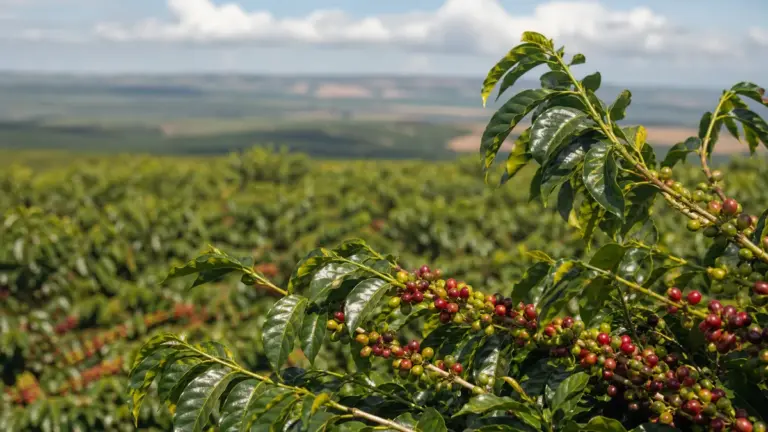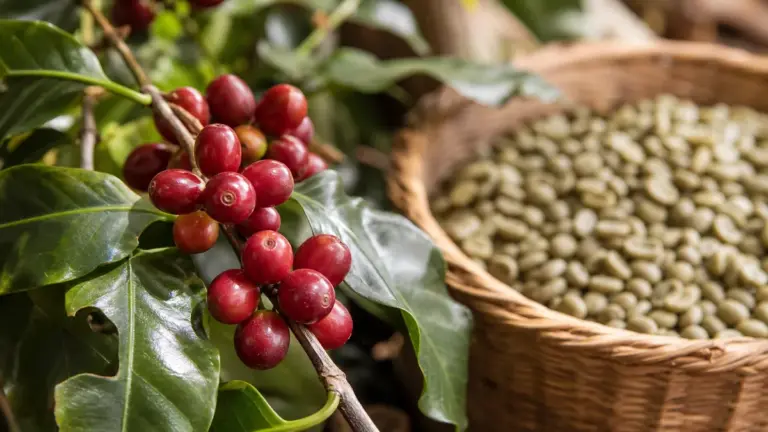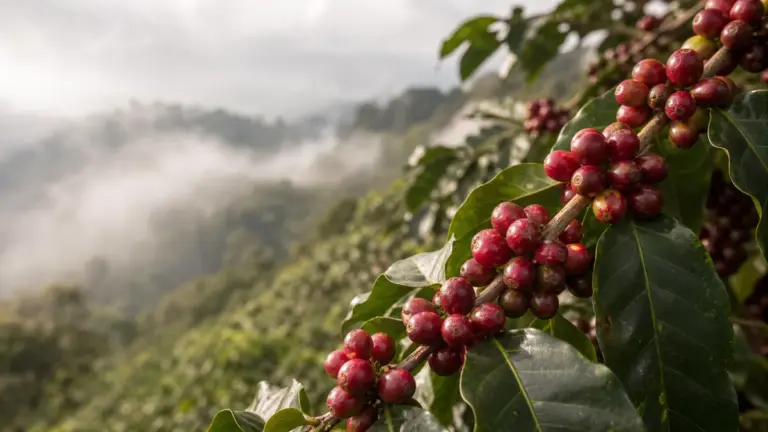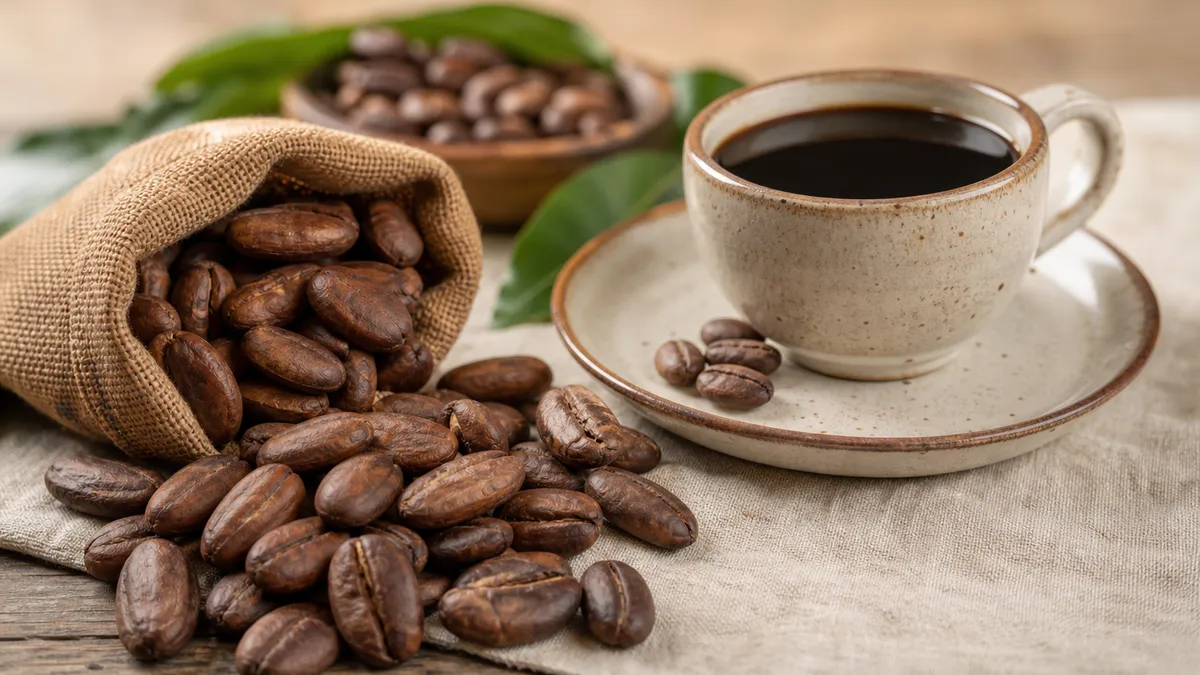
Filipino coffee ranges from the bold tropical-fruit character of liberica, closely associated with the barako tradition, to dried-fruit and chocolate notes in excelsa and citrus, caramel and tea-like flavours in highland arabica. There is no single Philippine cup profile: start with the species, then look for the growing region and processing method.
In short
- Barako is a cultural and trading name, strongly associated with Philippine liberica, not a universally precise botanical label.
- Excelsa is treated here as Coffea dewevrei, a separate species following the 2025 genomic study and Kew’s current classification. Older references call it Coffea liberica var. dewevrei.
- Arabica is the highland starting point, including coffees from Benguet and Mountain Province in northern Luzon and growing areas in Mindanao.
- October to March is a broad harvest guide, not a calendar that fits every farm or species. Ask for the particular lot’s harvest information.
- For your first purchase, prioritise a named producer or cooperative, declared species and processing method over an unspecified “strong Filipino coffee”.
Philippine coffee at a glance
The Philippines grows arabica, robusta, liberica and excelsa commercially. These are distinct coffee types, not four interchangeable varieties of the same plant; robusta is the trading name associated with Coffea canephora. The national industry roadmap identifies robusta as the largest production category, so barako’s cultural prominence should not be mistaken for production dominance.
| Origin fact | Practical guide |
|---|---|
| Altitude | The Philippine Coffee Board gives 300 to 500 metres for its southern Luzon growing-region profile and 1,000 to 1,800 metres for the Cordillera. These are regional guides, not national limits or guarantees for an individual farm. |
| Species and varieties | Arabica, robusta, liberica and excelsa. Documented Philippine arabica collections include Typica, Bourbon, Caturra and Mundo Novo. |
| Processing | Natural or dry processing is widespread; washed and semi-washed methods are also documented. |
| Harvest months | Broadly October to March, with substantial regional variation. |
| Cup profiles | Liberica: tropical fruit; excelsa: dried fruit, chocolate and spice; highland arabica: examples include citrus, caramel, chocolate and tea-like notes. These are possibilities, not a national tasting specification. |
Sources for the panel: Philippine Coffee Board regional and harvest information; Philippine arabica genetic research; the national industry roadmap; published species flavour descriptions; and Department of Agriculture lot records.
For the broader geographical context, use our guide to east and southeast asian coffee. Within the Philippines, however, the species name is often the more useful first clue when choosing a bag.
History: a trading past, with some persistent myths
Lipa, in Batangas, became an important coffee centre during the nineteenth century. Its story is often compressed into a neat sequence: friars introduced coffee in 1740, Lipa briefly supplied the world, then coffee leaf rust destroyed everything. Historical research does not support that tidy account.
Maria Rita Isabel Santos Castro’s archival study challenges both the documentary basis of the friar story and the supposed world monopoly. It also argues that the industry’s decline involved land use, investment and competing crops, rather than disease alone. This is historical interpretation based on contemporary records, not a reason to dismiss Batangas’s genuine coffee heritage.
A short, qualified timeline:
- 1740: the frequently repeated introduction date, not a securely documented starting point.
- Late nineteenth century: Lipa’s coffee boom.
- 1889 to 1892: the coffee crisis examined in Castro’s research.
- May 2023: completion of a documented Batangas State University project supporting barako propagation and farming.
The distinction matters when buying heritage coffee: an evocative story can explain a community’s attachment to a crop without proving the species, provenance or quality of today’s beans.
Liberica and barako: related, but not identical labels
Barako usually refers to a Philippine coffee tradition closely associated with liberica, especially in Batangas and Cavite. In botanical terms, liberica is Coffea liberica. In everyday trade, barako can carry broader associations with regional identity and forceful coffee, so the word alone is not a complete ingredient declaration.
Research on Philippine liberica explicitly discusses this naming problem: local branding and historical growing areas can blur distinctions between coffees. It also documents substantial variation in liberica bean shape, including oblong and teardrop forms. The strikingly large beans are useful visual context, but appearance should not replace traceability.
For someone buying in the UK, the useful questions are straightforward:
- Is this declared as pure liberica or as a blend?
- Where were the beans grown?
- Who produced or consolidated the lot?
- How were the cherries processed?
- What does this particular roast taste like?
Liberica need not be described only as fierce or bitter. Published species-level observations include jackfruit, mango and other tropical-fruit notes, sometimes with tea-like character. These descriptions are not a controlled survey of Philippine lots, so treat them as an invitation to explore, not a promise printed by botany.
Excelsa: a distinct species, not simply smaller barako
Excelsa deserves its own place in the story. This article follows the 2025 study by Davis and colleagues, which combined genomic evidence, plant characteristics and geographical distribution to support recognising Coffea dewevrei separately from Coffea liberica. Kew’s Plants of the World Online now accepts C. dewevrei.
Older Philippine publications commonly use C. liberica var. dewevrei. That reflects the classification those authors followed, rather than necessarily indicating a different crop. Readers may therefore encounter the same familiar trading name, excelsa, under different scientific names. The present article uses the newer species treatment.
Published flavour observations describe excelsa in terms of dried plum, currant or fig, chocolate and spice, with low to medium acidity. The researchers also stress the need for more rigorous sensory evaluation across growing environments and processing methods. That qualification is especially useful here: a species description cannot stand in for tasting a named Philippine harvest.
For a first comparison, ask a roaster to suggest clearly identified liberica and excelsa lots. Avoid choosing solely by how “strong” each is advertised to be.
Highland arabica: a different side of Filipino coffee
Arabica offers another route into the Philippines. Documented growing areas include Benguet and Mountain Province in northern Luzon, alongside highland locations in Mindanao such as Davao del Sur and South Cotabato. Philippine arabica research records a diverse collection rather than one uniform national planting.
Names worth recognising include Typica, Bourbon, Caturra and Mundo Novo. These are arabica variety names, not alternative names for regions or processing methods. Philippine research documents their presence, while World Coffee Research provides the reference framework for their names and relationships.
For example, World Coffee Research identifies Caturra as a natural mutation of Bourbon and Mundo Novo as originating from a natural cross between Typica and Bourbon. Such names describe plant ancestry; they do not, by themselves, tell you whether a finished coffee will taste floral, chocolatey or sharply fruity.
Actual lot records are more informative. Department of Agriculture listings for washed coffees from Benguet and Mountain Province include combinations of brown sugar, caramel, citrus, chocolate, berries and black tea. These are assessments of individual coffees, not flavours that every farm in the region must produce.
If those descriptions appeal, begin with a traceable highland arabica. Keep our timor-leste guide as a separate origin comparison, rather than assuming neighbouring countries share a cup profile.
Processing and revival: quality beyond the species name
Processing means removing and drying the coffee fruit to obtain the beans. In natural processing, the fruit is dried before hulling; in washed processing, the pulp is removed and the coffee undergoes further wet processing before drying. Philippine extension guidance describes both methods, while the national roadmap identifies natural processing as the most widespread practice.
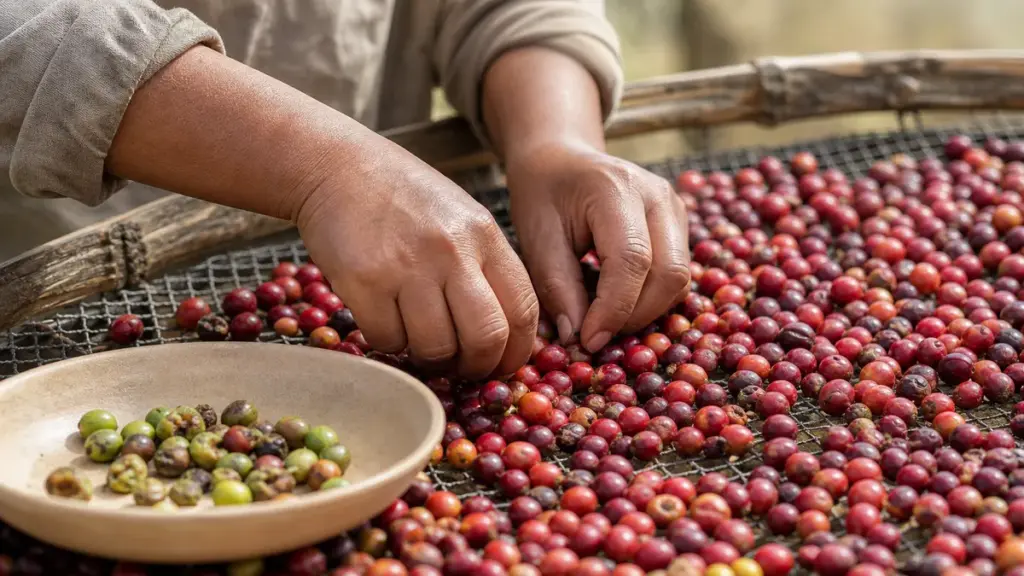
That distinction does not establish a simple quality ranking. Selective picking, separation of damaged fruit and careful post-harvest handling also matter. Philippine extension guidance recommends picking ripe cherries and keeping harvested fruit and containers clean.
PHilMech’s field research explains why this is more than tidiness. In the production systems it examined, inadequate drying facilities and prolonged drying contributed to over-fermentation and mould, while contact with soil could introduce earthy flavour. Those findings concern particular surveyed systems, not every Philippine producer.
The revival is also more tangible than a new label on a bag. The Bureau of Agricultural Research’s report on the Batangas State University BARAKO project records seedling propagation work, farmer training and a demonstration farm. Completed in May 2023, the project distributed more than 20,000 seedlings across six coffee-producing municipalities. These are documented activities, not proof that every participating farm subsequently achieved the same results.
For buyers, the sensible response is to seek evidence at lot level. Ask what changed in harvesting or processing, who handled the coffee and whether the roaster can describe the result.
Choosing Philippine coffee in the UK
My suggested starting order is a named highland arabica, then clearly identified liberica, then excelsa. This is an editorial tasting route, not a quality hierarchy: it makes the comparison about identifiable coffees rather than an undefined national style.
Use this buying checklist:
- Confirm the growing origin. Look for a farm, cooperative, municipality or province, not just a roasting address.
- Check the species. If the bag says barako, ask what that means for its contents.
- Separate variety from process. “Bourbon” and “washed” answer different questions.
- Ask for harvest information. Request the crop year or picking period for that lot.
- Choose by the stated cup profile. Tell the roaster whether you want chocolate and caramel, bright fruit, or something more unfamiliar.
- Keep your first comparison simple. Buy a manageable quantity and make notes before changing several brewing variables.
For tasting, write down aroma, sweetness, acidity, bitterness and texture separately. Then ask a more useful question than “Is this strong?”: would you recognise and enjoy this particular coffee again?
For another regional reading route, compare the origin information in our vietnam guide. Keep the same buying discipline: Philippine coffee is most revealing when the bag tells you which coffee, from whom, and how it was handled.
FAQ
Do jackfruit or chocolate tasting notes mean ingredients have been added?
No, those words can describe perceived flavours rather than added ingredients. Published observations use tropical-fruit descriptors for liberica and dried-fruit or chocolate descriptors for excelsa. Check the product’s ingredients and description separately if you want an unflavoured coffee, because a tasting note is not an ingredient declaration.
Does “roasted in the Philippines” prove the beans were grown there?
No, a roasting location does not establish the agricultural origin. The Philippine industry roadmap documents imported coffee as part of the domestic market. If your aim is to explore Philippine-grown beans, ask for the growing country and a more specific origin, rather than relying on the address of the roasting business.
How should I compare different Philippine coffees at home?
Start by keeping your brewing method, coffee-to-water ratio and water consistent. Treat that first round as a comparison exercise, then adjust each coffee separately if you wish. Record your own impressions before consulting the tasting notes, and include a simple preference: which cup would you most like to drink again?
Where to go next
Read East and Southeast Asia for the regional overview, then Vietnam to continue exploring another origin without treating national labels as tasting guarantees. Laos and Thailand and Myanmar are useful next reads if you want to build a wider regional tasting list.
Sources
-
Philippine Coffee Board, Philippine Coffee, undated, accessed November 2026. Regional profiles, broad harvest calendar and commercial coffee types.
https://philcoffeeboard.com/philippine-coffee/ -
Department of Agriculture, Bureau of Agricultural Research and Philippine Council for Agriculture and Fisheries, Philippine Coffee Industry Roadmap 2021 to 2025, 2022. Production context, processing and imports.
https://pcaf.da.gov.ph/wp-content/uploads/2022/06/Philippine-Coffee-Industry-Roadmap-2021-2025.pdf -
University of Adelaide, Maria Rita Isabel Santos Castro, Demythologising the History of Coffee in Lipa, Batangas in the XIXth Century, MA dissertation, December 2003.
https://digital.library.adelaide.edu.au/dspace/bitstream/2440/56622/8/02whole.pdf -
Ma. Carmen Ablan Lagman, Variability in Philippine Coffea liberica Provides Insights into Development Amidst a Changing Climate, Proceedings, 89(1), 27, 2023. Barako terminology and Philippine liberica variation.
https://www.mdpi.com/2504-3900/89/1/27 -
Davis and colleagues, Royal Botanic Gardens, Kew and partner institutions, Genomic Data Define Species Delimitation in Liberica Coffee with Implications for Crop Development and Conservation, Nature Plants, 2025.
https://www.nature.com/articles/s41477-025-02073-y.pdf -
Royal Botanic Gardens, Kew, Plants of the World Online: Coffea dewevrei, current taxonomic record, accessed November 2026.
https://powo.science.kew.org/taxon/urn%3Alsid%3Aipni.org%3Anames%3A747092-1 -
Davis and colleagues, Genomic Elucidation of Hybridization between Liberica and Excelsa Coffee and Its Implications for Coffee Crop Development, Scientific Reports, 2026. Species flavour observations and their limitations.
https://pmc.ncbi.nlm.nih.gov/articles/PMC13369886/ -
Miriam D. Baltazar and Jermaine Marie Ann O. Fabella, Cavite State University, Assessment of the Genetic Diversity of Philippine Arabica Coffee (Coffea arabica L.) Using SSR Markers, Philippine Journal of Science, 149(3-a), 2020.
-
World Coffee Research, Arabica Varieties Catalogue, including Caturra and Mundo Novo entries, undated online edition, accessed November 2026.
https://varieties.worldcoffeeresearch.org/arabica/varieties
https://varieties.worldcoffeeresearch.org/varieties/caturra
https://varieties.worldcoffeeresearch.org/varieties/mundo-novo -
Department of Agriculture, Philippine Rural Development Project, NL Coffee Auction, undated lot records, accessed November 2026. Used for provenance, process and sensory descriptions only.
https://prdp-hub.da.gov.ph/nl-coffee-auction/ -
Department of Agriculture, Agricultural Training Institute, Techno Guide: Coffee, undated edition retrieved November 2026. Harvesting and processing guidance.
https://ati2.da.gov.ph/ati-4b/content/sites/default/files/2022-11/Coffee%20Technoguide%20w%20page%20numbers.pdf -
Rodelio G. Idago and Renita SM. Dela Cruz, PHilMech, Value Chain Improvement of Robusta and Liberica Coffee, Technical Bulletin No. 9, volume 5, number 1, 2015 cover edition.
https://www.philmech.gov.ph/resources/technical-bulletin/Technical%20Bulletin%20No.%209.pdf -
Department of Agriculture, Bureau of Agricultural Research, Bringing Back the Glory Days of Kapeng Barako in Batangas, BAR R4D Digest, July to September 2023.
This article was researched through Philippine agricultural publications, primary botanical and genetic studies, historical research and published lot records; no first-hand tasting or farm visits are claimed.
Last checked: November 2026