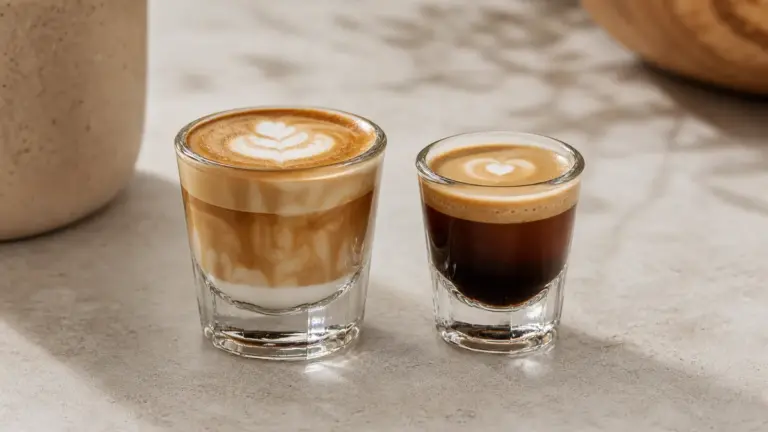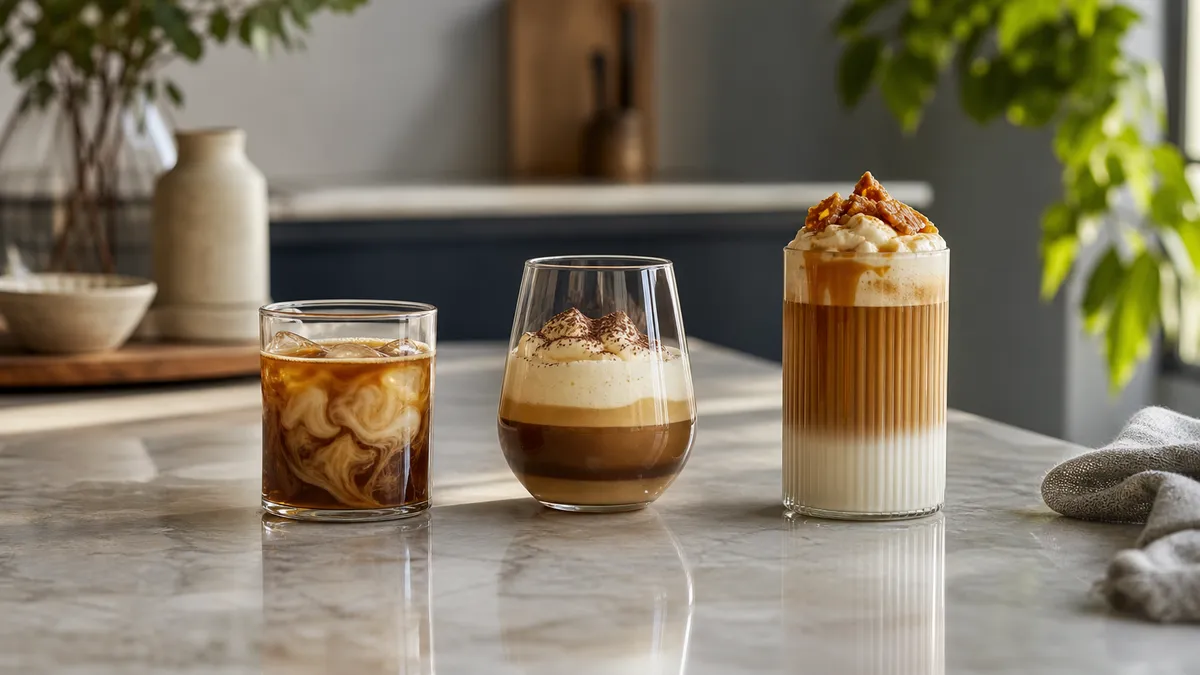
You can make specialty coffee recipes at home by combining a well-brewed coffee with a few carefully measured ingredients: condensed milk, whipped cream, honey, spices or citrus peel. These five drinks move beyond the everyday milk-coffee menu, with clear recipes and practical ways to keep the coffee recognisable rather than buried under sweetness.
In short
- Try café bombón, Einspänner, honey ginger coffee, maple cinnamon coffee or cardamom lemon espresso.
- Each recipe makes one serving and uses 36 g of espresso.
- For the shared espresso base, start with 18 g of ground coffee and collect 36 g of drink: a 1:2 dose-to-yield ratio.
- Heat dairy milk to 60 to 65°C for the two warm milk recipes.
- Caffeine estimates assume an arabica double espresso, not a standardised or laboratory-tested serving. See the safety note before making several drinks.
Before you start
Here, “signature drink” means a coffee recipe with a deliberate flavour combination and presentation, rather than another name for a standard espresso drink. The collection includes established drinks and adaptations of published manufacturer recipes. The quantities below are proposed home versions, not claims of first-hand testing or definitive traditional proportions.
For more everyday drinks and other recipe styles, start with coffee recipes.
Make a consistent espresso base
You will need an espresso machine, a suitable grinder, digital scales and heatproof cups or glasses. The milk recipes also need a small saucepan and whisk, or a steam wand and milk jug.
- Prepare your machine according to its instructions.
- Grind 18 g coffee, using a basket designed for that dose.
- Distribute the grounds evenly and tamp level.
- Brew into a cup on scales, stopping at 36 g espresso.
- Use 28 to 32 seconds as an initial reference, not a pass-or-fail rule. Taste the coffee before adding other ingredients.
This starting recipe follows Heyday Coffee Co.’s published espresso guide. If your coffee already has a successful roaster-supplied recipe, use that instead and record the yield so you can repeat the drink.
Keep syrups, spices and dairy out of the machine’s water tank and brewing components. Add them to the serving cup or prepare them separately.
Five specialty coffee recipes to make at home
1. Café bombón
Best for: a small, sweet after-dinner drink.
Café bombón combines espresso with sweetened condensed milk. Nestlé Professional publishes a layered version; this adaptation uses weighed ingredients rather than treating a glass’s proportions as a universal recipe.
Recipe card
- Serves: 1
- Time: approximately 3 minutes, with the machine ready
- Equipment: espresso equipment, scales, small heatproof glass, spoon
- Ingredients:
- 36 g espresso
- 20 g sweetened condensed milk
- Approximate caffeine: 160 mg under the shared arabica-double assumption. See the caffeine and sensitivity note below.
- Contains: milk
Method
- Put the condensed milk into the glass.
- Brew the espresso separately.
- Pour it gently over the back of a spoon onto the condensed milk.
- Present the layers, then stir thoroughly before drinking.
Balance: start without additional sugar or syrup. On your next attempt, reduce the condensed milk if the finish seems cloying.
Choose this when you want a dessert-like coffee, rather than the less sweet milk-and-espresso balance explained in cortado and piccolo.
2. Einspänner
Best for: the contrast between hot coffee and cool cream.
The Vienna Tourist Board describes an Einspänner as a double espresso covered with whipped cream, served in a handled glass. This home version keeps that simple structure without chocolate or flavoured syrup.
Recipe card
- Serves: 1
- Time: approximately 5 minutes
- Equipment: espresso equipment, small bowl, whisk, spoon, heatproof handled glass
- Ingredients:
- 36 g espresso
- 40 ml cold pasteurised double cream
- 3 g icing sugar, optional
- Approximate caffeine: 160 mg under the shared arabica-double assumption. See the caffeine and sensitivity note below.
- Contains: milk
Method
- Whisk the cream, adding the icing sugar if wanted, until softly mounded rather than stiff.
- Brew the espresso into the glass.
- Spoon the cream gently over the surface.
- Serve immediately, letting each sip pass through the cream.
Balance: try unsweetened cream first. Aim for a soft topping that yields as you drink, not a firm cap that must be eaten separately.
3. Honey ginger coffee
Best for: a gently spiced, rounded milk drink.
Nespresso’s published Honey Ginger Coffee combines honey, ground ginger, coffee and frothed milk. This adaptation mixes the flavourings into the espresso instead of reproducing its layered presentation.
Recipe card
- Serves: 1
- Time: approximately 5 minutes
- Equipment: espresso equipment, saucepan and whisk or steam wand and jug, thermometer, mug
- Ingredients:
- 36 g espresso
- 140 ml pasteurised whole milk
- 10 g honey
- 0.1 g ground ginger
- Approximate caffeine: 160 mg under the shared arabica-double assumption. See the caffeine and sensitivity note below.
- Contains: milk
Method
- Put the honey and ginger in the mug.
- Add the espresso and stir thoroughly.
- Warm the milk to 60 to 65°C, whisking lightly, or steam it to the same range.
- Pour into the coffee mixture and stir once more.
Balance: the proposed honey dose is lower than in Nespresso’s published recipe. Taste before increasing it; aim for gentle ginger warmth, not a dominant spicy finish. Ground ginger remains a suspension, so stir again if it settles.
4. Maple cinnamon coffee
Best for: a warm, aromatic drink without a separate flavoured syrup.
Nespresso Professional includes a Maple Cinnamon Latte in its recipe book. This version keeps the maple-and-cinnamon pairing but gives it a smaller, explicitly measured home formulation.
Recipe card
- Serves: 1
- Time: approximately 5 minutes
- Equipment: espresso equipment, saucepan and whisk or steam wand and jug, thermometer, mug
- Ingredients:
- 36 g espresso
- 120 ml pasteurised whole milk
- 10 g pure maple syrup
- 0.1 g ground cinnamon
- Approximate caffeine: 160 mg under the shared arabica-double assumption. See the caffeine and sensitivity note below.
- Contains: milk
Method
- Stir the maple syrup and cinnamon together in the mug.
- Add the espresso and mix well.
- Heat and lightly froth the milk to 60 to 65°C.
- Pour it into the coffee and serve.
Balance: treat the cinnamon as an accent. If the drink tastes dusty, reduce it rather than adding more syrup to compensate.
For a first attempt, choose a coffee whose tasting notes suggest nuts, caramel or chocolate. That is a flavour-pairing suggestion, not a requirement.
5. Cardamom lemon espresso
Best for: a short, aromatic drink without milk.
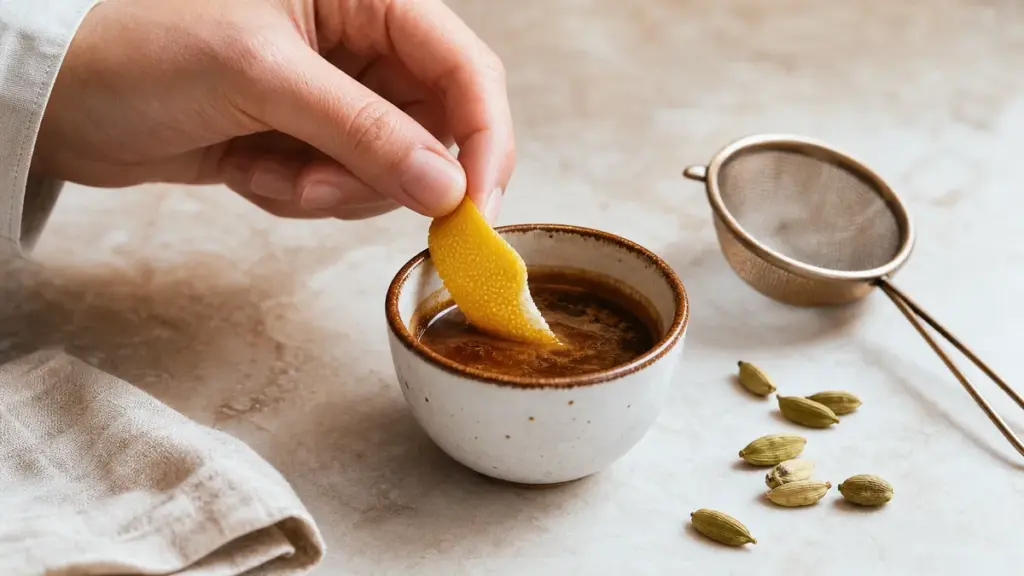
This is adapted from Nespresso’s Cardamom Espresso, which combines cardamom seeds, cane sugar syrup, espresso and a brief lemon-peel infusion. It uses peel rather than lemon juice.
Recipe card
- Serves: 1
- Time: approximately 3 minutes
- Equipment: espresso equipment, small cup, spoon, peeler, fine strainer
- Ingredients:
- 36 g espresso
- 5 ml plain cane sugar syrup
- 0.1 g lightly crushed green cardamom seeds
- 1 g washed lemon peel, with minimal white pith
- Approximate caffeine: 160 mg under the shared arabica-double assumption. See the caffeine and sensitivity note below.
Method
- Put the syrup and cardamom in the cup.
- Add the espresso and stir.
- Dip the lemon peel into the drink for 10 seconds, then remove it.
- Strain into a warmed serving cup to remove the seeds.
Balance: taste before adding more syrup. If the citrus dominates, shorten the peel contact next time.
Prefer an unflavoured, longer black drink? Follow americano and long black instead of extending this infusion indefinitely.
How to balance coffee, sweetness and texture
Start with coffee you enjoy on its own. Taste the espresso first, then decide what the added ingredient should contribute: sweetness, aroma, texture or a deliberate contrast.
For your first experiments, give each ingredient one job. In the bombón, condensed milk provides sweetness and body. In the Einspänner, cream provides the topping. In the cardamom drink, the spice and peel supply the aromatic accents. Adding all three approaches to one glass makes troubleshooting unnecessarily difficult.
When to use syrups
Use a syrup when you want an easily measured sweetener, a particular flavour or a repeatable recipe. It is optional, not a requirement for specialty coffee.
The maple recipe already contains syrup, while the bombón already contains sweetened condensed milk. Start without another sweetener in either. For the cardamom recipe, plain syrup lets you adjust sweetness without also changing the spice dose.
If developing your own version, alter the sweetener by 2 g at a time, keeping the coffee and milk unchanged. This is a suggested tasting increment, not a brewing standard.
Keep the ratios separate
The espresso’s 1:2 ratio means dry coffee dose to finished espresso by weight. It does not describe the amount of milk or syrup.
The bombón’s proposed 36 g espresso to 20 g condensed milk is a separate ingredient relationship. Recording both makes it clear whether you changed the extraction or merely changed the finished drink.
| Symptom | Likely cause to investigate | Fix to try |
|---|---|---|
| Coffee disappears behind sweetness | Too much sweetener for your taste | Reduce it while keeping the espresso unchanged |
| Drink feels dusty or gritty | Too much ground spice or retained seeds | Reduce powder; strain whole-spice infusions |
| Milk has large, loose bubbles | Too much air introduced during frothing | Aim for a finer texture; tap and swirl the jug |
| Cream topping is difficult to drink through | Cream whipped too firmly | Stop at a softer, spoonable consistency |
Caffeine, ingredients and safe preparation
The recipe cards use an illustrative estimate of about 160 mg caffeine per serving, assuming an arabica double espresso. The basis is laboratory research by Ludwig and colleagues: regular espresso extractions using 18.1 to 20.4 g of arabica coffee contained 152 to 174 mg caffeine.
Those experimental drinks were not brewed to this article’s exact recipe, so the estimate is not a measurement or an upper limit. The same paper reported much wider variation among purchased espresso servings. Use product-specific information where available rather than assuming every double contains the same amount.
EFSA’s 2015 evidence assessment found that habitual intakes up to 400 mg daily, spread across the day, raise no safety concerns for healthy non-pregnant adults. NHS pregnancy guidance advises no more than 200 mg daily from all sources. These are population benchmarks, not targets; sensitivity, medicines and medical conditions vary. Ask a GP, pharmacist or midwife about personal circumstances.
Use pasteurised dairy, follow use-by dates and refrigerate milk, cream and opened ingredients according to their labels. FSA household guidance recommends a fridge temperature of 0 to 5°C. Make the finished drinks to order, and wipe and purge the steam wand after use.
FAQ
Can I make these without an espresso machine?
Yes, but treat the result as an adaptation rather than an equivalent espresso recipe. Use a short, concentrated coffee from equipment you already know, keeping its preparation consistent between attempts. Begin with the listed flavouring quantities and adjust to taste. The espresso-based caffeine estimate no longer applies to that substitution.
Can I replace the dairy ingredients?
Yes, although you should expect a different flavour and texture. For the warm milk drinks, choose a plant drink intended for hot coffee and follow its heating instructions. The bombón needs a sweetened condensed alternative, not ordinary plant milk. The Einspänner needs a product specifically suitable for whipping.
How can I serve several different recipes to guests?
Prepare the ingredients first, then brew and assemble each drink close to serving. Measure sweeteners into separate cups, keep dairy refrigerated until needed, and ask about allergies before starting. For a tasting, divide finished drinks into smaller portions rather than giving every guest several full espresso-based servings.
Where to go next
Use Coffee Recipes to choose your next specialty coffee recipes by drink style. Read mocha for a dedicated coffee-and-chocolate recipe, or affogato when you want coffee served as a simple dessert.
Sources
-
Heyday Coffee Co., “Espresso Brew Guide”, undated, retrieved November 2026. Shared espresso dose, yield, timing and grind-adjustment guidance.
https://www.heydaycoffee.com/pages/brew-guides/espresso -
Nestlé Professional, “Receta café bombón o biberón”, undated, retrieved November 2026. Espresso-and-condensed-milk structure and layered preparation.
https://www.nestleprofessional.es/recetas-para-hosteleria/bombon-o-biberon -
Vienna Tourist Board, “Quirks of Viennese Cuisine”, undated, retrieved November 2026. Einspänner description and presentation.
https://www.wien.info/en/dine-drink/viennese-cuisine/quirks-of-viennese-cuisine-356154 -
Nespresso, “Honey Ginger Coffee”, undated, retrieved November 2026. Published honey, ginger, coffee and milk combination.
https://www.nespresso.com/ncp/res/generated/recipes/229THE_en_INT.pdf -
Nespresso Professional, “Recipe Book”, fifth edition, undated, retrieved November 2026, “Maple Cinnamon Latte”, printed page 16.
https://www.nespresso.com/static/us/solutions/b2b/documents/NESP_POD_RecipeBookPDF_Digital_031524_v2.pdf -
Nespresso, “Cardamom Espresso”, undated, retrieved November 2026. Cardamom, syrup, espresso and brief lemon-peel infusion.
https://www.nespresso.com/recipes/uk/en/27635CAR-cardamom-espresso.html -
Breville, “the Duo-Temp Pro Instruction Book”, BES810, 2014, hosted by Sage Appliances. Milk temperature, texture and steam-wand cleaning guidance.
https://assets.sageappliances.com/BES810/SES810-instruction-manual.pdf -
Ludwig and colleagues, “Variations in caffeine and chlorogenic acid contents of coffees: what are we drinking?”, Food & Function, 2014, volume 5, pages 1718 to 1726. Laboratory caffeine measurements and retail-serving variation.
https://pubs.rsc.org/en/content/articlepdf/2014/fo/c4fo00290c -
European Food Safety Authority, “Caffeine”, current topic page summarising the 2015 safety assessment, retrieved November 2026.
https://www.efsa.europa.eu/en/topics/topic/caffeine -
NHS, “Foods to avoid in pregnancy”, reviewed 15 June 2026. Pregnancy caffeine guidance, pasteurised dairy and washing fruit.
https://www.nhs.uk/pregnancy/keeping-well/foods-to-avoid/ -
Food Standards Agency, “How to chill, freeze and defrost food safely”, 2017, current GOV.UK version retrieved November 2026. Household refrigeration and storage guidance.
https://www.gov.uk/government/publications/how-to-chill-freeze-and-defrost-food-safely/how-to-chill-freeze-and-defrost-food-safely
The piece was researched using published recipes, a roaster’s brewing guide, manufacturer instructions, laboratory research and official safety guidance; the home formulations are editorial adaptations, not first-hand test results.
Last checked: November 2026