Organic coffee certification means that coffee has been produced and handled under legally defined organic standards, with independent checks and supporting records. It covers farming and the supply chain, not simply the absence of sprays, and does not guarantee a particular flavour, a living income or a lower carbon footprint.
In short
- Organic farming prioritises soil fertility and preventive pest management, with restricted lists of permitted inputs.
- Organic does not mean “chemical-free”, and certification is not a promise of zero pesticide residues.
- Great Britain and Northern Ireland follow different organic regulatory frameworks.
- On a UK coffee packet, check the organic claim, control-body code and agricultural-origin statement, not just a green-looking symbol.
- Environmental benefits are supported by research, but outcomes depend on farm management, location and the measure being compared.
Organic Coffee Certification
Organic certification is a checked production system. Farmers must follow rules governing soil, fertilisers, planting material and crop protection; businesses handling the coffee must protect its organic identity through processing, storage and sale.
A control body is an organisation authorised to assess compliance and issue certification. Its work includes inspections and examination of records, with sampling or testing where appropriate. UK government guidance describes annual inspections alongside additional checks.
For coffee, paperwork matters as much as the field visit. A roaster needs evidence that incoming beans are organic, procedures preventing mixing with conventional coffee, and records connecting purchases with production and sales.
Inspectors can use a mass balance, an accounting check comparing material received with material dispatched. Organic purchases must support recorded organic sales, allowing for processing losses and stock changes.
Certification therefore means more than a farmer saying no pesticides were needed that season. Our coffee certification hub puts organic within the wider family of coffee assurance schemes.
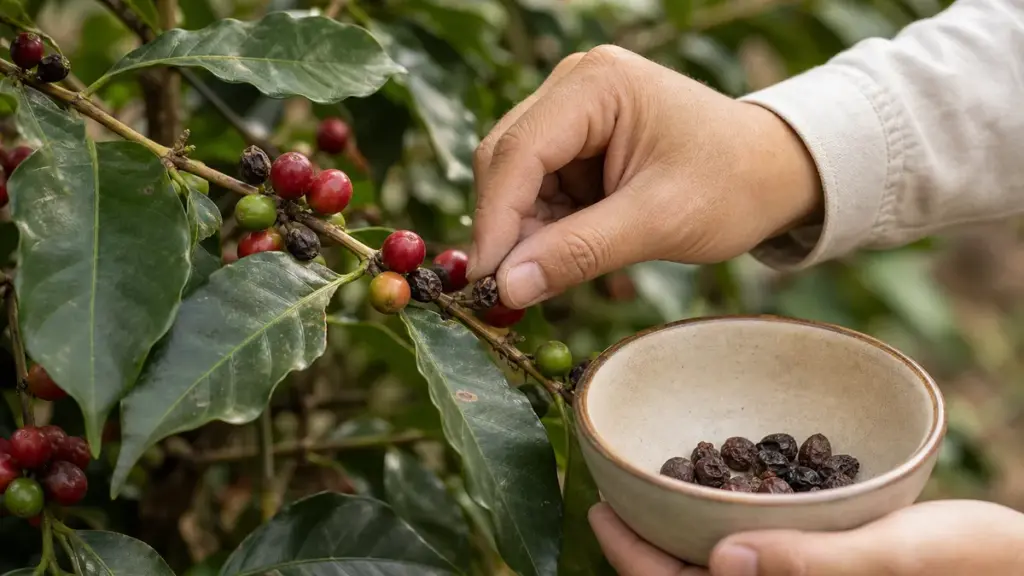
Organic Certification Standards
Great Britain and Northern Ireland
The following distinction was checked in November 2026.
Great Britain, meaning England, Scotland and Wales: the framework remains based on assimilated Regulations (EC) 834/2007 and 889/2008, as amended for domestic application. The Organic Products Regulations 2009 provide domestic control and enforcement provisions. Businesses producing or preparing coffee for sale as organic need certification from an approved UK organic control body.
Northern Ireland: organic production follows Regulation (EU) 2018/848 and associated legislation under the arrangements applying there. This is also the principal EU organic framework.
Both systems restrict agricultural inputs and control organic production and handling, but their detailed requirements are not interchangeable. Businesses should have their control body approve arrangements for their activities and destination markets.
Conversion and continuing compliance
A farm cannot normally stop using prohibited inputs and immediately market its next harvest as organic. Conversion is the period during which organic management must be followed before the crop qualifies.
For perennial crops other than forage, including coffee, the normal requirement is at least three years before the first organic harvest. Recognition of earlier management or adjustments to conversion require assessment and approval, not simply the farmer’s decision.
Records, inspections and compliance remain necessary after conversion while the business sells coffee as organic.
Imports and the post-Brexit position
Import documentation depends on the route:
- Into Great Britain from outside the EU, EEA and Switzerland: a Great Britain certificate of inspection, or COI, is required for each consignment, alongside recognised exporter and control-body arrangements.
- Into Great Britain from the EU, EEA and Switzerland: the COI waiver remained in place when checked. Defra updated its guidance on 4 September 2026, removing the previously announced 1 February 2027 start date and confirming an extension.
- Into Northern Ireland from outside the EU, EEA and Switzerland: the importer needs the relevant approval and an EU COI through TRACES NT, the electronic trade-control system.
EU full-compliance controls for many third-country operators took effect from 1 January 2025. This did not require every exporter worldwide to join a cooperative: recognised equivalence and trade-agreement routes also exist. Group certification is available to eligible producers with documented internal controls, not compulsory for everyone.
On 20 October 2026, the Council and European Parliament reached a provisional agreement on changes to EU organic rules. Formal endorsement and adoption were still pending at checking; proposed changes should not be treated as rules already in force.
Soil Standards
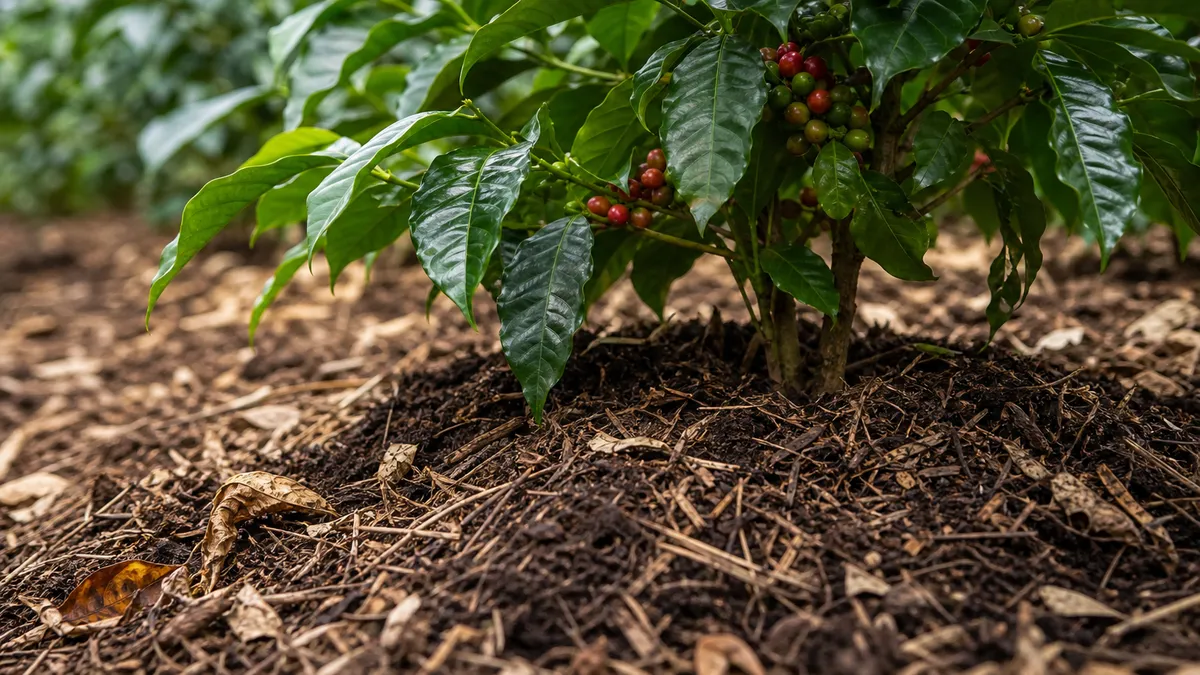
Organic soil standards aim to maintain fertility and biological activity, protect soil structure and limit erosion and compaction. Plants should be nourished primarily through the soil ecosystem.
Management can involve composted organic material, suitable green manures and legumes, alongside cultivation practices that protect the ground. Mineral nitrogen fertilisers are prohibited under the relevant organic plant-production rules. Other fertilisers and soil conditioners are restricted to authorised materials and conditions.
Coffee needs an explanation that annual-crop examples sometimes miss. A perennial plantation cannot be rotated around a farm like a field of vegetables. Standards therefore require appropriate alternative ways of maintaining fertility where rotation is impractical.
Nor does “organic material” automatically mean “permitted organic fertiliser”. Its source, composition and restrictions still matter. Farmers should check inputs with their certifier rather than assume that anything described as natural or biological is acceptable.
The requirement is to manage a functioning soil system, not merely substitute one fertiliser for another.
Pest Control Methods
Organic pest control starts with prevention. Standards prioritise suitable species and varieties, cultivation methods and protection of natural enemies before permitted plant-protection products are considered.
For coffee, monitoring and harvest hygiene can help remove infestation sources. Research by Cenicafé, Colombia’s coffee research centre, shows that infested fruit left on trees or the ground can sustain coffee berry borer populations.
Cenicafé has also studied the fungus Beauveria bassiana alongside fruit collection for berry borer control. This demonstrates a management approach, not automatic organic approval for every formulation containing the fungus.
The practical hierarchy is:
- Prevent: choose appropriate planting material and support crop health.
- Monitor: identify the pest and assess the problem.
- Use cultural or biological measures: remove infestation sources and support suitable natural controls.
- Check treatments: use only products authorised under applicable organic rules and local law, following their restrictions.
- Record actions: retain the evidence required by certification.
“Organic means no chemicals” is therefore misleading. Some crop-protection substances are permitted under defined conditions. Certification also does not guarantee zero residues: suspected contamination must be investigated rather than organic status being assumed.
Organic Labels in the UK
Separate three questions: who certified the business, where the agricultural ingredients were grown, and which logo is used.
| Label element | What it tells you | What it does not tell you |
|---|---|---|
| Control-body code | Identifies the relevant certification body | The coffee’s farm or growing country |
| Agricultural-origin statement | Where agricultural ingredients were grown | Where the beans were roasted |
| Certifier’s symbol | Certification under that organisation’s scheme | That all schemes have identical additional requirements |
| EU organic leaf | Use of the EU organic logo under its rules | That the coffee was grown in the EU |
Approved codes include GB-ORG-05 for Soil Association Certification and GB-ORG-02 for Organic Farmers and Growers in Great Britain. Their Northern Ireland codes are XI-ORG-05 and XI-ORG-02. Imports can carry other recognised codes.
For prepacked organic food produced in Great Britain, origin statements distinguish “UK Agriculture”, “Non-UK Agriculture” and mixed origin. Roasting imported beans in Britain does not make their agricultural origin British.
Northern Ireland has distinct origin-wording requirements, including EU and non-EU descriptions where applicable. The EU organic logo is compulsory on prepacked organic food produced there; its use is optional in Great Britain, subject to the relevant requirements.
Processed food described as organic must contain at least 95% organic agricultural ingredients, with restrictions on the remainder. This does not permit diluting organic coffee with conventional beans: rules also restrict combining the same ingredient in organic and non-organic form.
A quick packet check
Find the control-body code, agricultural-origin wording and certifier rather than relying on the front design. If anything seems inconsistent, request the current certificate and confirmation that the particular product is covered.
Benefits of Organic Coffee
Organic coffee supports a defined, independently checked approach to farming and handling. Environmental claims need a second step: examining what research actually measured.
A 2025 systematic review by Jones and colleagues examined 43 peer-reviewed articles on organic management in coffee. It identified potential environmental benefits associated with soil and nutrient management, alongside economic risks and practical barriers for farmers.
However, organic-management research does not always compare certified and uncertified coffee. Studies may examine compost, shade trees or green manures without testing certification itself. Findings supporting those practices cannot automatically support every claim about an organic packet.
Organic management and agroforestry, growing coffee with trees, can overlap. Nevertheless, organic certification alone does not specify a particular shade canopy or bird habitat.
Carbon claims need similar care. Inputs, productivity and the assessment boundary affect results. The reviewed evidence does not justify treating every organic coffee as automatically lower-carbon per kilogram.
Costs and farmer trade-offs
Organic production involves certification administration, inspections, records, permitted inputs and labour. Conversion can expose farmers to production risks before they can market a fully organic harvest.
Office buyers and roasters should assess supply, certification coverage, delivery, minimum orders and continuity. Obtain itemised written quotations rather than assuming the label explains the commercial offer.
The review did not establish a dependable route for every converting farmer to maintain yields and improve financial outcomes. Organic certification is not proof of a living income.
Keep separate questions separate: fair trade coffee addresses another certification approach, while Rainforest Alliance certification has its own requirements. Choose organic coffee for its verified production standards, then seek separate evidence about livelihoods, biodiversity and climate claims.
FAQ
Can a farmer use organic methods without being certified?
Yes, a farmer can use practices such as composting and preventive pest management without holding organic certification. That does not establish a certified organic product. For coffee marketed as organic through the regulated supply chain, the required certification and supporting evidence must be in place; a supplier’s informal assurance is not an equivalent substitute.
Does organic coffee automatically qualify as speciality coffee?
No, organic certification does not award a sensory grade or establish speciality status. It assesses production and handling requirements rather than guaranteeing sweetness, aroma or freedom from cup defects. Treat organic status and cup quality as separate purchasing questions, and ask the supplier for information supporting each claim.
Can a certified roaster also handle conventional coffee?
Yes, certification does not necessarily require an exclusively organic roastery. The business must have effective procedures for separation, cleaning, identification and record keeping so conventional material does not compromise organic production. Shared equipment needs an assessed cleaning approach, not simply an assumption that the next batch will remain organic.
Where to go next
Read Coffee Certification: The Complete Guide to understand how assurance schemes fit together. Fair Trade Coffee explains a different approach to trading requirements, while Rainforest Alliance covers another scheme that should not be mistaken for organic certification.
Sources
-
Defra, “Organic products: approved UK control bodies”, current guidance, 2026. Inspection responsibilities and Great Britain and Northern Ireland codes.
https://www.gov.uk/guidance/organic-food-uk-approved-control-bodies -
UK legislation, Council Regulation (EC) No 834/2007, amended domestic text. Organic principles and plant-production requirements, particularly Article 12.
https://www.legislation.gov.uk/eur/2007/834 -
UK legislation, “The Organic Products Regulations 2009”, revised text. Domestic control and enforcement framework.
https://www.legislation.gov.uk/uksi/2009/842/contents -
Soil Association, “Organic standards for Northern Ireland”, current standards page, 2026. Applicable EU framework and distinction between baseline and additional standards.
https://www.soilassociation.org/what-we-do/our-standards/soil-association-organic-standards/organic-standards-for-northern-ireland/ -
Soil Association, “Baseline organic standards for farming and growing in Great Britain”, updated 18 May 2026. Conversion, perennial systems and soil management.
https://www.soilassociation.org/media/ercj114m/farming-growing-organic-standards-gb.pdf -
Soil Association, “Baseline organic standards for food and drink in Great Britain”, updated 18 May 2026. Records, mass balance, separation, cleaning and suspected non-compliance.
https://www.soilassociation.org/media/4yzde4xa/food-drink-organic-standards-gb.pdf -
Defra, “Organic food: labelling and advertising rules”, current guidance, 2026. Ingredient thresholds, codes, agricultural origin and logo requirements.
https://www.gov.uk/guidance/organic-food-labelling-rules -
Defra, “Importing organic food, feed and seed to the UK”, updated 4 September 2026. Importer certification, COIs, TRACES NT and the extended waiver.
https://www.gov.uk/guidance/importing-organic-food-to-the-uk -
European Commission, “Organic production and products”, current guidance, 2026. Soil-based production, preventive crop protection and permitted inputs.
https://agriculture.ec.europa.eu/farming/organic-farming/organic-production-and-products_en -
European Commission, “The organic logo” and “Trade in organics”, current guidance, 2026. Ingredient rules, logo use, import recognition and electronic COIs.
https://agriculture.ec.europa.eu/farming/organic-farming/organic-logo_en
https://agriculture.ec.europa.eu/farming/organic-farming/trade_en -
European Commission, Delegated Regulation (EU) 2021/715, 2021. Requirements for groups of operators and their internal control systems.
https://eur-lex.europa.eu/legal-content/EN/ALL/?uri=CELEX%3A32021R0715 -
FiBL and IFOAM Organics International, “The World of Organic Agriculture: Statistics and Emerging Trends 2026”, 2026 edition. Implementation of third-country compliance controls from January 2025.
https://www.fibl.org/fileadmin/documents/shop/1861-organic-world-2026.pdf -
Council of the European Union, “Organic farming”, current policy account, 2026. Status of the provisional agreement reached on 20 October 2026.
https://www.consilium.europa.eu/en/policies/organic-farming-1/ -
Cenicafé, “Comportamiento poblacional y estrategias de control de la broca durante la retención de pases de cosecha”, Revista Cenicafé 75(1), 2024. Experimental research on harvest hygiene and biological control.
https://publicaciones.cenicafe.org/index.php/cenicafe/article/view/1547 -
Jones, K., Njeru, E. M., Garnett, K. and Girkin, N. T., “Organic management in coffee: a systematic review of the environmental, economic and social benefits and trade-offs for farmers”, Agroecology and Sustainable Food Systems 49(8), 2025. Evidence synthesis and limitations.
https://www.tandfonline.com/doi/full/10.1080/21683565.2025.2510361
This article was researched using current government guidance, legislation, certification standards, coffee research and a peer-reviewed systematic review, distinguishing legal requirements from measured outcomes.
Last checked: November 2026